
Mallorca Tourism Tax (Ecotasa) 2026: Rates, Exemptions & Obligations
The Mallorca tourism tax Ecotasa is a concern for holidaymakers and holiday landlords alike: how much does it actually cost, who has to pay it, and what obligations does it create for property owners who rent out their property? Since 1 July 2016, the levy — officially known as the Impuesto sobre Estancias Turísticas (ITS) — has been charged on all the Balearic Islands. It applies to overnight stays in hotels, holiday apartments, agrotourism establishments and even campsites. In this guide you will find all the current rates for 2026 by accommodation type and season, which guests are exempt, from when a long-stay discount applies, how billing works as a landlord, and which reform plans the island government has announced.

Are you planning to rent out your property on Mallorca and wondering what tax obligations this entails?
- 📩 Submit a personal enquiry — We will connect you with experienced tax and legal experts on Mallorca
- Everything about holiday rentals on Mallorca
What is the Ecotasa — and what is it for?
The colloquial name Ecotasa is actually a nickname; the official legal name is Impuesto sobre Estancias Turísticas (ITS). The tax is a Balearic autonomous-community tax, not a national instrument. It was introduced in 2016 to curb mass tourism on the islands whilst simultaneously funding investment in the environment, infrastructure, and the quality of life of the local population.
Important to understand: It is not the landlord who owes the tax — the guest pays it. However, the landlord or hotel operator is responsible for collecting it, accounting for it correctly, and remitting it to the tax authority. This distinction has practical consequences, which we address further below.
The tax applies on all four inhabited Balearic Islands: Mallorca, Ibiza, Menorca, and Formentera. The rates are uniformly regulated across the Balearics; there are no municipal surcharges.
Note: The revenue from the ITS is ring-fenced into a sustainable tourism fund (Fondo de Turismo Sostenible). According to the principles of the legislation, this is intended to fund nature conservation, beach restoration, and improvements to tourist infrastructure.
Who has to pay the Ecotasa?
The payment obligation applies to all persons aged 16 and over who spend the night in a tourist accommodation on the Balearics. Children and young people under 16 are fully exempt — an age threshold that applies regardless of the accommodation category.
Overnight stays covered include those in:
- Hotels of all categories (1 to 5 stars)
- Aparthotels and tourist apartments
- Holiday apartments and fincas with an ETV licence
- Agrotourism establishments and rural hotels
- Hostels and guesthouses
- Campsites
- Cruise ships (with restrictions, see below)
Please note: Cruise passengers are also generally subject to the Ecotasa. An exception applies, according to available information, for cruise passengers whose home port is in the Balearic Islands.
Not covered by the ITS are long-term rental arrangements: Anyone occupying a property for longer than two months does not fall under the tourism tax law. In such cases, the regular long-term rental on Mallorca is the legally correct model.
Current Ecotasa rates 2026: all rates at a glance
The rates are calculated per person per night. The following table shows the net rates plus 10 % VAT, as well as the actual gross amount payable.
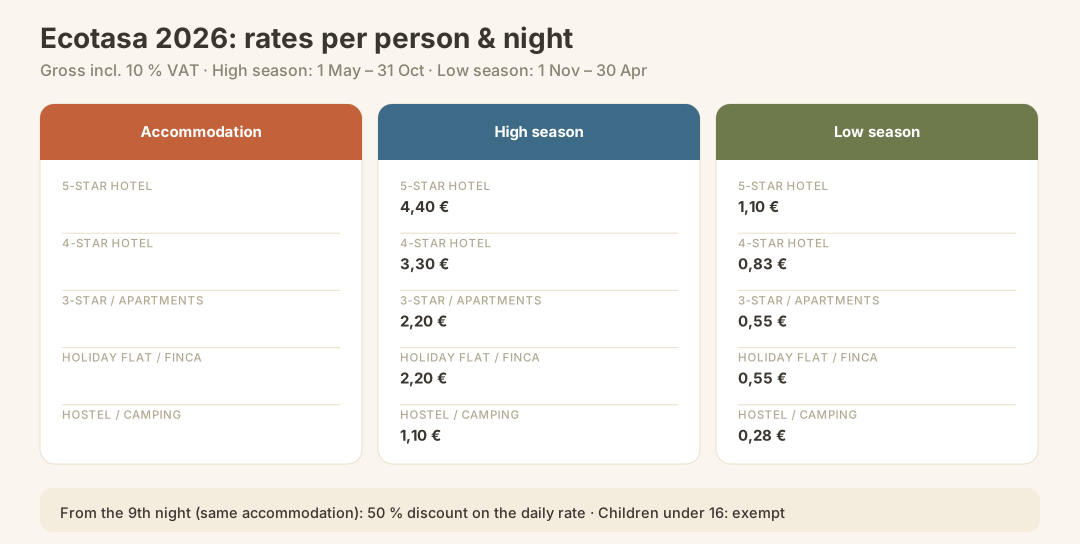
Hotels and classic accommodation establishments
| Accommodation category | Peak season net | Peak season gross (incl. 10 % VAT) | Off-season net | Off-season gross |
|---|---|---|---|---|
| 5-star hotels | 4,00 € | 4,40 € | 1,00 € | 1,10 € |
| 4-star Superior / 4★ | 3,00 € | 3,30 € | 0,75 € | 0,83 € |
| 3-star hotels / apartments | 2,00 € | 2,20 € | 0,50 € | 0,55 € |
| Budget accommodation / hostels / camping | 1,00 € | 1,10 € | 0,25 € | 0,28 € |
Peak season: 1 May to 31 October
Off-season: 1 November to 30 April
Holiday apartments, fincas and agrotourism
| Accommodation type | Peak season gross (incl. 10% VAT) | Low season gross (incl. 10% VAT) |
|---|---|---|
| Holiday home / finca with ETV licence | 2,20 € | 0,55 € |
| Agroturismo / rural hotel | 2,20 € | 0,55 € |
Please note: The gross amounts shown in the table are the amounts the guest actually pays on-site. The net amount is the tax itself; the 10% VAT is added on top.
The long-stay discount: from the 9th night onwards
One of the most important calculations that many holidaymakers are unaware of: From the ninth day of stay in the same accommodation, the daily rate is halved. This discount applies only to an uninterrupted stay at the same establishment.
Worked example: 14 nights in a 4-star hotel, peak season
| Period | Nights | Gross rate | Amount |
|---|---|---|---|
| Nights 1–8 | 8 | 3,30 € | 26,40 € |
| Nights 9–14 | 6 | 1,65 € | 9,90 € |
| Total per person | 14 | — | 36,30 € |
For a family of two adults and two children under 16, only the two adults pay, making a total of 72,60 € for the entire stay. Children pay nothing.
Exemptions and special provisions in detail
The following groups of people or situations are exempt from the Ecotasa or benefit from reductions:
| Regulation | Details |
|---|---|
| Children under 16 years of age | Full exemption, no exceptions |
| From the 9th night onwards (same accommodation) | 50% reduction of the daily rate |
| Cruise passengers whose home port is the Balearic Islands | According to available information, exempt |
| Long-term rental exceeding 2 months | No tourist rental relationship, ITS does not apply |
Note: The research contains no information on further specific exemption provisions (e.g. for people requiring care or certain professional groups). If you are in a special case, you should enquire directly with the relevant tax authority of the Balearic Islands.
Obligations for landlords: collection, accounting and remittance
As the owner of a holiday property with a valid ETV licence, you are the Substituto del Contribuyente – that is, the taxpayer who collects the tax on behalf of the guest and remits it to the authority. In practical terms, this means:
Step-by-step obligations of the landlord:
- Calculate the tax correctly – based on the number of guests (aged 16 and over), season and accommodation category
- Collect the amount from the guest – ideally upon arrival, in cash or via the agreed payment method
- Issue a receipt – the guest is entitled to a proof of payment
- Keep records – all amounts collected must be documented in a traceable manner
- Submit periodic declarations – to the Agència Tributaria de les Illes Balears (ATIB)
- Remit the tax – within the deadlines set by the ATIB
Please note: If you fail to collect or remit the tax, you as the landlord are liable to the tax authority – even if your guest has refused to pay. The risk lies with the landlord, not the guest.
The responsible authority is the Agència Tributaria de les Illes Balears (ATIB), reachable at atib.es. There you will also find the official declaration forms and current deadlines.
Those who have their property managed by a professional property management company can delegate the collection and remittance of the Ecotasa. Find out more in the guide on Property Management for Holiday Homes on Mallorca.
Reform Plans: What Is Being Proposed for 2026 and Beyond?
The Balearic Government has publicly discussed plans to significantly increase and structurally reform the Ecotasa. The available information mentions the following changes under discussion:
| Point under discussion | Current rate | Proposed rate (under discussion) |
|---|---|---|
| 5-star hotel high season (Jun–Aug) | €4.00 net | €6.00 net |
| Cruise passengers | 2,00 € | 6,00 € |
| January / February | full low-season fee | planned abolition |
| Hire cars (< 6 months on the islands) | no charge | 30–80 € depending on emissions rating |
| Private vehicles belonging to holidaymakers (< 6 months) | no charge | 35–150 € |
Please note: These changes are, based on current research, still at the discussion stage. Several media observers have suggested that implementation remains politically uncertain. The rates set out in the previous section apply for the current 2026 season. Please check the latest information on illessostenibles.travel or with the ATIB before travelling or ahead of the booking season.
Ecotasa and Holiday Letting: The Connection to the ETV Licence
Collecting the Ecotasa presupposes that you are legally permitted to let your property for tourist purposes in the first place. On Mallorca, this requires an ETV licence (licence for tourist holiday accommodation). Without a valid ETV licence, you are not permitted to charge tourist rental fees — and therefore cannot collect the Ecotasa either. Anyone letting without a licence risks substantial fines which, while unrelated to the Ecotasa itself, do not remove the tax obligation.
Find out more in the guide to the ETV licence Mallorca and to the transfer of an ETV licence.
Most Common Ecotasa Mistakes
In practice, we encounter the same stumbling blocks time and again:
- Forgetting VAT: Many landlords pass on only the net rate and forget that an additional 10 % VAT is due on top. The guest pays the gross amount.
- Not applying the long-stay discount: The 50 % discount from the 9th night onwards is a legal requirement, not optional.
- Incorrectly classifying children: The age limit is 16 years. Under-16s pay nothing at all – even if they are 15 years and 11 months old.
- No receipt issued: Guests are entitled to a receipt. Missing receipts can cause problems during inspections by the ATIB.
- No periodic return submitted: The tax must not only be collected, but also declared and remitted to the ATIB.
- Confusion with long-term rental: Anyone who enters into an 11-month tenancy agreement or a regular long-term rental is not subject to the ITS – but is subject to other tax obligations.
- Season incorrectly classified: High season begins on 1 May, not 1 April. Anyone letting in April applies off-season rates.
What comes next? Tax obligations relating to property rental
The Ecotasa is just one element within the overall tax framework surrounding a holiday property on Mallorca. Anyone renting out their property has further obligations:
- Income tax on rental income: Non-residents generally pay 19 % (EU citizens) or 24 % on gross rental income
- IBI (property tax): Annual municipal tax on property ownership → IBI tax Spain
- Wealth tax: Dependent on property value and residence status → Wealth tax Spain
- Taxes on sale: Plusvalía and capital gains → Taxes on property sales
A comprehensive overview is available in our Taxes & Legal Guide.
Checklist: Handling the Ecotasa correctly as a landlord
- ETV licence present and currently valid
- Accommodation category correctly classified (for the correct rate)
- Season correctly determined for the check-in date
- Age of all guests recorded (children under 16 exempt)
- Length of stay established (note discount from the 9th night onwards)
- Gross amount (incl. 10 % VAT) correctly calculated
- Amount collected on arrival or at the latest during the stay
- Receipt / proof of payment issued to the guest
- Bookkeeping kept up to date
- Periodic tax return submitted to the ATIB and amount remitted
Conclusion: Ecotasa – manageable, but with clear obligations
For the individual holidaymaker, the Mallorca tourism tax Ecotasa is a modest levy: between 0,28 € and 4,40 € per night per person depending on category and season, with a noticeable discount from the 9th night onwards. For families with children under 16, the total amount is reduced considerably.
For landlords, however, the Ecotasa is no walk in the park: correct calculation, receipt obligations, periodic declarations with the ATIB, and liability for amounts not remitted all make a clean process structure essential. Those who have their holiday property managed by a professional property management company can delegate this workload – and sleep more soundly.
The announced reform plans (higher rates in peak season, possible new levies on hire cars and private vehicles) are worth monitoring – they have not yet been formally adopted politically, but could affect the calculations for future booking seasons.
Official sources
- Agència Tributaria de les Illes Balears (ATIB) – Responsible tax authority for the ITS: atib.es
- Govern de les Illes Balears – Turisme – Official information page on sustainable tourism tax: illessostenibles.travel/de
- BOIB (Butlletí Oficial de les Illes Balears) – Official Gazette of the Balearic Islands, source of the legal basis: boib.caib.es