
Property Sale Taxes in Spain: Plusvalía, Capital Gains Tax & Withholding Tax in Mallorca
Anyone selling a property in Mallorca encounters two entirely different types of tax simultaneously: the municipal land value increment tax Plusvalía Municipal and the national capital gains tax on the sale proceeds. Together, these can account for a significant portion of your net proceeds – and both operate according to their own rules, deadlines, and calculation formulas. Whether you sell as a tax resident or a non-resident makes a fundamental difference: whilst non-residents pay a flat tax rate of 19 %, residents are subject to a progressive scale. On top of this, there is an automatic withholding tax that the buyer retains directly at the notary. In this guide, you will learn how both taxes are calculated, which costs you can deduct, what deadlines apply – and which mistakes experienced sellers regularly end up paying dearly for.

Do you already know how much of the sale proceeds will reach you after tax?
- 📩 Submit a personal enquiry — tax check for your specific sale
- All taxes & legal questions at a glance
The two types of tax at a glance
When selling a property in Mallorca, two independent taxes must generally be distinguished:
| Tax | Full name | Who levies it? | Basis |
|---|---|---|---|
| Plusvalía Municipal | Impuesto sobre el Incremento de Valor de los Terrenos de Naturaleza Urbana (IIVTNU) | Municipality (Ayuntamiento) | Cadastral value of the land + length of ownership |
| Capital gains tax | Impuesto sobre la Renta (IRPF) or IRNR for non-residents | Spanish state (AEAT) | Actual sale profit |
Both taxes fall exclusively on the seller – not the buyer. The buyer, by contrast, pays stamp duty (ITP) or VAT; for more on this, see the guide on purchase ancillary costs in Mallorca.
Please note: The Plusvalía and the capital gains tax cannot be offset against each other. Both arise independently, though the Plusvalía paid can be claimed as a deductible cost when calculating capital gains tax.
Plusvalía Municipal: calculation, rates, and due date
The Plusvalía Municipal taxes the notional increase in value of the urban plot (not the building) during your period of ownership. The basis is not the actual market price, but the official cadastral value (valor catastral) of the land portion.
Two calculation methods
Since a ruling by the Spanish Constitutional Court (2021), you may choose between two methods – and apply whichever is more favourable to you:
Method 1 – Objective method (valor catastral × municipal coefficient × tax rate)
| Length of ownership | Maximum national coefficient |
|---|---|
| Up to 1 year | 0,14 |
| 1–2 years | 0,13 |
| 2–3 years | 0,15 |
| 3–4 years | 0,17 |
| 4–5 years | 0,17 |
| 5–6 years | 0,17 |
| 6–7 years | 0,12 |
| 7–8 years | 0,10 |
| 8–9 years | 0,09 |
| 9–10 years | 0,08 |
| 10–11 years | 0,08 |
| 11–12 years | 0,08 |
| 12–13 years | 0,08 |
| 13–14 years | 0,08 |
| 14–15 years | 0,08 |
| 15–20 years | 0,06 |
| Over 20 years | 0,045 |
Method 2 – Actual Value Method
If the actual capital gain (sale price minus purchase price, in each case only the land portion) is lower than the amount calculated under Method 1, you may use this real gain as the basis for calculation.
Please note: If the property is sold at a loss (actual sale price below the original purchase price), no Plusvalía is due. However, you must actively demonstrate and apply for this exemption.
Tax rate and municipality
Each municipality sets its own applicable tax rate; the statutory maximum rate is 30 % of the assessed increase in value. Cities such as Palma de Mallorca have their own bylaws. You can find out the exact rate from the relevant Ayuntamiento.
Deadline
| Situation | Deadline |
|---|---|
| Sale between living parties | 30 days from notarisation |
| Inheritance | 6 months from the date of death (extendable to 12 months) |
Capital gains tax for non-residents: 19 % flat rate
If your primary tax residence is not in Spain — meaning you are not a Spanish tax resident — a flat tax rate of 19 % applies to the gain from the property sale. This rate applies regardless of whether you are an EU or non-EU citizen.
Calculation formula
Taxable gain = sale price – purchase price – deductible costs
Tax = taxable gain × 19 %
Deductible costs on sale
The following costs may be offset against the gain:
| Type of cost | Deductible? | Note |
|---|---|---|
| Notary and legal fees on the original purchase | ✅ Yes | Keep receipts |
| Transfer tax (ITP) or VAT (IVA) on purchase | ✅ Yes | From the purchase transaction |
| Estate agent's commission on sale | ✅ Yes | Supported by invoice |
| Legal costs on sale | ✅ Yes | Solicitor, gestión |
| Structural improvements | ✅ Yes | Structural works only |
| Cosmetic renovations (kitchen, paint, flooring) | ❌ No | Not considered a value-enhancing measure |
| Ongoing maintenance costs | ❌ No | Not capital works |
| Plusvalía paid | ✅ Yes | Reduces the taxable gain |
Worked example – non-resident
| Item | Amount |
|---|---|
| Sale price | 250.000 € |
| Original purchase price | 180.000 € |
| Deductible costs (notary, ITP, agent's fees on purchase, agent's fees on sale) | 15.000 € |
| Taxable gain | 55.000 € |
| Capital gains tax (19 %) | 10.450 € |
| Withholding tax already retained (3 % × 250.000 €) | 7.500 € |
| Additional payment / refund | 2.950 € additional payment |
The 3 % withholding tax: how it works
When a property is sold by a non-resident, the buyer is legally obliged to retain 3 % of the sale price and remit it directly to the Spanish tax authority AEAT. This is not a final tax, but an advance payment towards capital gains tax.
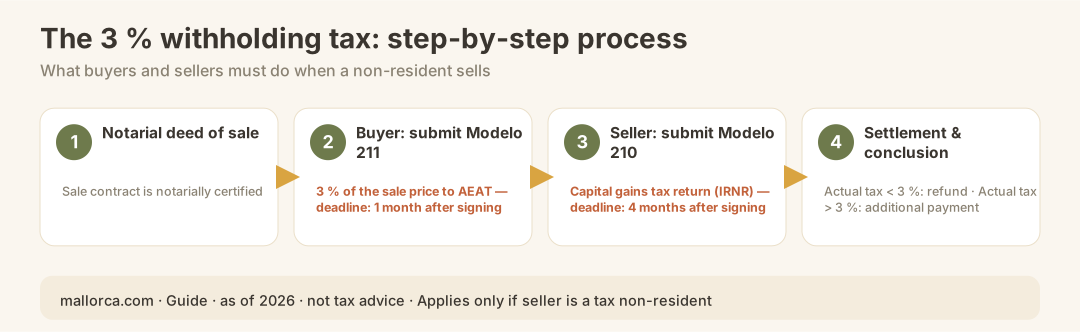
Process:
- The notary certifies the purchase contract
- The buyer pays 3 % of the sale price not to the seller, but forwards this amount via Modelo 211 to the AEAT – within one month of certification
- The seller submits the tax declaration via 4 months of certification via Modelo 210
- If the actual tax is less than the 3 % withheld: refund
If the actual tax is more: additional payment
Please note: If the buyer fails to remit the withholding tax, the property itself serves as security. Buyers purchasing from a non-resident should never forget this – and indeed they should not.
Capital gains tax for residents: progressive bands
Anyone who is tax-resident in Spain (more than 183 days per calendar year in the country, or whose centre of economic interests is in Spain – governed by Article 9 of Law 35/2006) pays capital gains tax on property within the IRPF at a progressive banded rate:
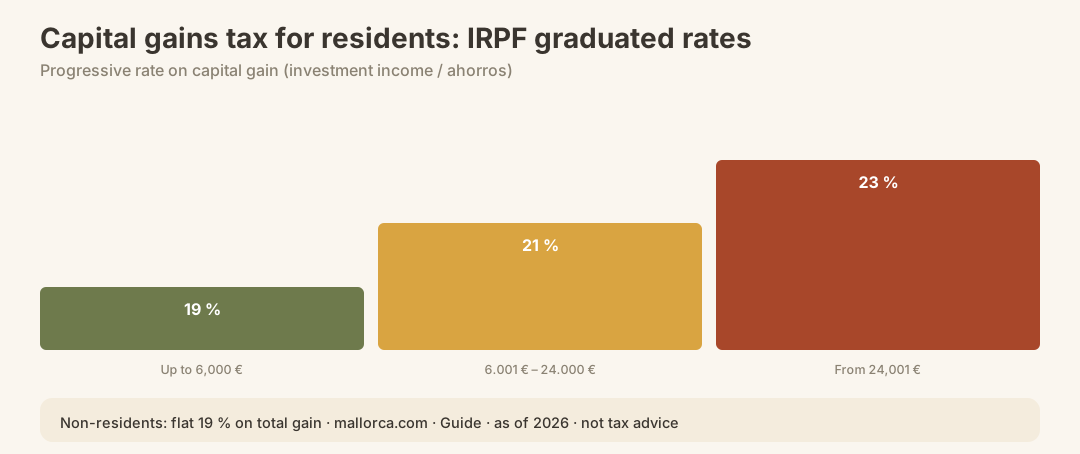
| Amount of gain | Tax rate |
|---|---|
| Up to 6.000 € | 19 % |
| 6.001 € to 24.000 € | 21 % |
| From 24.001 € | 23 % |
Please note: The bands shown above reflect the rates for capital income (ahorros) cited in several sources for 2025/2026. Different bands may apply to higher gains; please have this checked by a tax adviser in your specific case.
Capital gains tax is declared in the annual Spanish income tax return (IRPF, Modelo 100), which must generally be submitted by the end of June of the following year.
Please note: Residents are not subject to automatic withholding tax upon sale. The 3 % withholding applies only when the seller is a non-resident.
Tax Exemptions and Special Provisions
Exemption Upon Reinvestment in Primary Residence (Residents)
Under certain conditions, residents may be exempt from capital gains tax if the full sale proceeds are reinvested in the purchase of a new primary residence in Spain. The reinvestment must take place within 2 years before or after the sale.
Exemption for Persons Aged 65 and Over (Residents)
Residents who have reached the age of 65 and have used the property as their primary residence for at least 3 years are exempt from capital gains tax on that primary residence — regardless of any reinvestment.
No Plusvalía in the Event of an Actual Loss in Value
As mentioned above: if you can demonstrate that the actual sale price is lower than the original purchase price, the Plusvalía does not apply. Proof is provided by means of the purchase deed and the sale deed.
Please note: These exemptions apply exclusively to tax residents. Non-residents cannot claim the reinvestment exemption.
Residents vs. Non-Residents: A Direct Comparison
| Criterion | Non-Resident | Resident (IRPF) |
|---|---|---|
| Tax Rate | 19 % (flat) | 19 % / 21 % / 23 % (progressive) |
| Form | Modelo 210 | Modelo 100 (IRPF annual return) |
| Filing Deadline | 4 months after the sale | Generally by 30 June of the following year |
| 3 % Withholding Tax | Yes, retained by the buyer | No |
| Reinvestment Exemption | No | Yes (subject to conditions) |
| Age Exemption 65+ | No | Yes (primary residence, min. 3 years) |
| Plusvalía | Yes, for both | Yes, for both |
Deductible Costs: The Frequently Overlooked Items
Many sellers underestimate how much they can deduct from their taxable gain. These costs are regularly overlooked:
At the time of the original purchase:
- Notary fees and land registry fees
- Stamp duty (ITP) or VAT (IVA) paid
- Legal fees for a solicitor or gestor at the time of purchase
At the time of sale:
- Estate agent's commission (including Spanish VAT applicable thereon)
- Legal and notary fees for the sale
- Costs for the energy certificate (required by law)
- Costs for any legalisation proceedings (e.g. Schwarzbauten)
- Plusvalía Municipal paid
Tip: Keep all invoices and receipts from the purchase process permanently — even if the purchase took place many years ago. Without documentary evidence, the costs cannot be claimed for tax purposes.
Deadlines at a Glance
| Tax / Form | Who submits? | Deadline |
|---|---|---|
| Modelo 211 (withholding tax remittance) | Buyer | 1 month after notarisation |
| Modelo 210 (capital gains tax for non-residents) | Seller | 4 months after notarisation |
| Plusvalía Municipal | Seller | 30 days after notarisation |
| IRPF / Modelo 100 (resident) | Seller | Generally by 30 June of the following year |
Please note: Missed deadlines for the Plusvalía and the Modelo 210 can result in surcharges and interest. The deadlines run from the date of notarial completion, not from the date of receipt of payment.
Most Common Mistakes When Selling Property in Mallorca
Experienced tax advisers and solicitors encounter these mistakes time and again:
Purchase documents not retained: Anyone who no longer has the purchase deed, ITP assessments, and notary invoices from the original purchase cannot deduct these costs — which significantly increases the taxable gain.
Withholding tax refund not claimed: Many non-residents are unaware that, after submitting the Modelo 210, they can receive a refund if the actual tax owed is less than the 3 % withheld. This claim must be made proactively.
Plusvalía submitted too late: The 30-day deadline at the Ayuntamiento passes quickly, especially when the sale is being coordinated from abroad.
Renovations incorrectly claimed: Kitchen and bathroom refurbishments, painting works, or new floor coverings are not tax-deductible. Only structural building measures that add value to the property count.
Tax residency status misjudged: Anyone who spends more than 183 days a year in Spain is a tax resident — even if they are not aware of it. This has implications for the applicable tax rate and available exemptions.
No withholding tax retention agreed for non-residents: Buyers who forget to apply the retention are personally liable to the AEAT.
No Plusvalía check carried out on a loss-making sale: Anyone who sells at a loss and still pays Plusvalía is giving away money unnecessarily.
What comes next? Reporting obligations and subsequent taxes
After the sale, there are still a few matters to attend to:
- Land Registry (Registro de la Propiedad): The transfer of ownership is registered by the buyer. As the seller, you no longer need to take any action, but you should ensure that any existing mortgage is formally discharged.
- Cadastre Office (Catastro): The buyer is responsible for updating the records, but as the seller it is worth confirming that the transfer has been completed, in order to avoid future IBI bills (property tax).
- Income tax return in Germany: Anyone liable to tax in Germany must also declare the sale profit there. The double taxation agreement (DTA) between Germany and Spain provides that gains from immovable property are generally taxed in the country where the property is located (Spain) — in Germany they are subject to the progression clause. A German tax adviser should be engaged in parallel.
- Wealth tax return: This no longer applies after the sale in respect of the sold property, but make sure the position as at the reference date is correctly reflected (the reference date is 31 December of the year of sale). More on this in our guide to wealth tax in Spain.
Checklist: selling on Mallorca with a clean tax record
Use this list as a basis for preparing your sale:
- Purchase deed (Escritura de Compraventa) from the original acquisition available
- ITP assessment or IVA invoice from the purchase available
- All notary, legal, and gestoría invoices from the purchase gathered together
- Invoices for structural improvements (with planning permissions) available
- Energy performance certificate commissioned (mandatory before the sale)
- Cadastral value of the property known (for Plusvalía estimate)
- Tax residency status checked (resident or non-resident?)
- Estate agent's commission and contractual terms confirmed in writing
- Tax adviser with Spanish expertise engaged
- Deadline for Plusvalía (30 days) entered in the calendar
- Deadline for Modelo 210 (4 months) noted
- Withholding tax refund (if applicable) planned for
Conclusion: good preparation saves real money
The tax burden when selling a property on Mallorca is manageable — provided you know what to expect. The 19 % capital gains tax for non-residents is clearly regulated, and the 3 % withholding tax is a well-functioning advance payment system. Problems arise almost invariably when documents are missing, deadlines are missed, or one's own tax residency status is misjudged. The Plusvalía Municipal is a municipal tax with its own rules — for long periods of ownership and rising cadastral values it can add up to a significant amount, whereas in the case of a loss-making sale it may not apply at all. Plan your sale from a tax perspective at least six months in advance, engage a specialist tax adviser on the ground at an early stage, and keep all documentation from the original purchase — that is the best investment you can make in your net proceeds.
Official Sources
- Agencia Tributaria (AEAT) – Modelo 210 (IRNR), Modelo 211, Modelo 100: https://www.agenciatributaria.es
- Agencia Tributaria Illes Balears (ATIB) – Balearic taxes and regional regulations: https://www.atib.es
- Ley 35/2006, de 28 de noviembre – Impuesto sobre la Renta de las Personas Físicas (IRPF Act, Article 9 tax residency): https://www.boe.es/buscar/act.php?id=BOE-A-2006-20764
- Real Decreto Legislativo 2/2004 – Texto Refundido de la Ley Reguladora de las Haciendas Locales (Plusvalía Municipal / IIVTNU): https://www.boe.es/buscar/act.php?id=BOE-A-2004-4214
- Real Decreto-ley 26/2021 – Reform of the Plusvalía following the Constitutional Court ruling: https://www.boe.es/diario_boe/txt.php?id=BOE-A-2021-17910
- Ajuntament de Palma – Plusvalía Municipal Palma: https://www.palma.cat
- Consell de Mallorca – Tax administration Balearic Islands: https://www.conselldemallorca.net