
Taxing Rental Income as a Non-Resident in Spain: Modelo 210 & IRNR
You rent out your Mallorca property and are not tax-resident in Spain? Then you are obliged to declare your rental income as a non-resident in Spain – via the Modelo 210 form and the underlying non-resident tax, IRNR. This applies to long-term lettings just as much as holiday rentals, to EU citizens just as much as Swiss or British nationals, and it applies even if you do not rent the property out at all. What differs is the tax rate, the deductions available, and the filing deadline. This guide explains step by step how the tax is calculated, which costs you can offset, exactly when the return must be submitted, and which mistakes prove the most costly. Concrete numerical examples and tables replace the usual bureaucratic jargon.

Would you like to know exactly how much tax you will owe – and what you can legally deduct?
- 📩 Submit a personal enquiry — we will connect you with specialist tax advisers for non-residents on Mallorca
- Everything about letting on Mallorca
What is the IRNR – and who does it affect on Mallorca?
The IRNR (Impuesto sobre la Renta de No Residentes) is the Spanish income tax for persons who are not tax-resident in Spain but who earn income there or hold property assets there. It is a national tax and is administered through the Agencia Tributaria (AEAT) – entirely separate from the IBI, the municipal property tax, which you also pay to the town hall.
You are a non-resident if you spend fewer than 183 days in the calendar year in Spain and your principal economic centre of life is not in Spain. The days do not need to be consecutive – every individual day counts.
The IRNR affects you on Mallorca in three scenarios:
| Scenario | Taxable event | Form |
|---|---|---|
| Property is rented out | Actual rental income | Modelo 210 |
| Property is vacant / owner-occupied | Deemed income (Renta Imputada) | Modelo 210 |
| Property is sold | Capital gain | Modelo 210 |
This guide focuses on the most common situation: Taxation of Rental Income. At the end you will find an overview on the topics of deemed income during vacancy periods and on sale.
Note: IRNR does not replace IBI. Both taxes apply in parallel. More on IBI tax in Spain.
Tax Rates 2026: EU/EEA vs. Non-EU
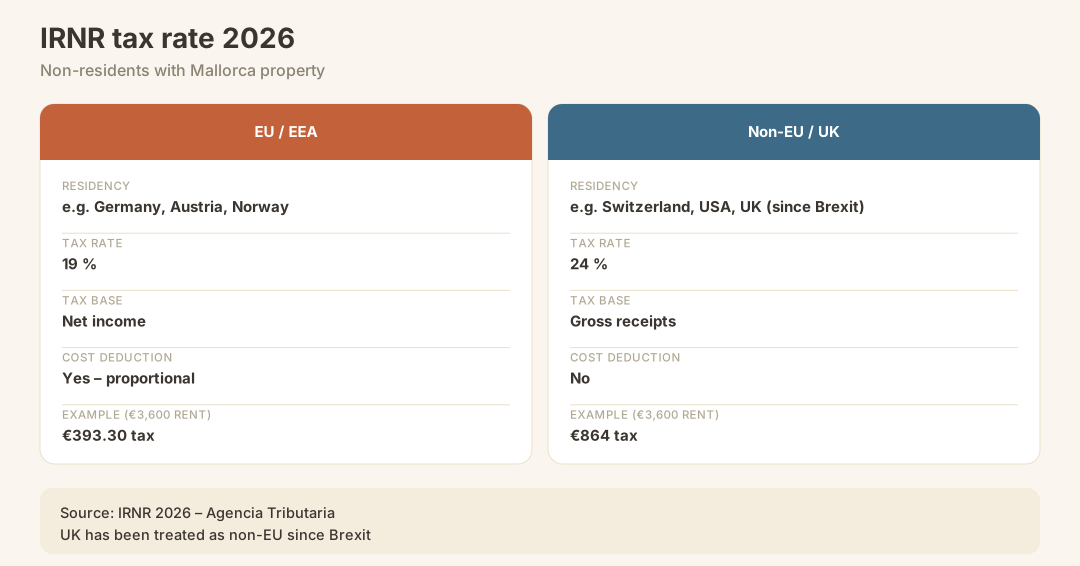
The tax rate depends solely on the country in which you are tax resident — not on your nationality.
| Residency | Tax Rate | Tax Base |
|---|---|---|
| EU or EEA country (e.g. Germany, Austria, Netherlands, Norway) | 19 % | Net income (after deductions) |
| Non-EU country (e.g. Switzerland, USA, Australia) | 24 % | Gross income (no deductions) |
| United Kingdom (since Brexit) | 24 % | Gross income (no deductions) |
Caution: Since Brexit, British nationals are treated as non-EU residents for tax purposes. Anyone who previously calculated at 19 % with cost deductions now pays 24 % on gross rental income — with no deductibility whatsoever.
Deductible Costs: What EU/EEA Landlords Can Claim
Only those who are tax resident in an EU or EEA country may deduct costs. These are calculated on a pro-rata basis for the days actually rented out.
| Type of Cost | Deductible? (EU/EEA) | Deductible? (Non-EU/UK) |
|---|---|---|
| Repairs & maintenance | ✅ pro rata | ❌ |
| Property management fees | ✅ pro rata | ❌ |
| Ancillary costs (borne by the landlord) | ✅ pro rata | ❌ |
| IBI (property tax) | ✅ pro rata | ❌ |
| Insurance premiums | ✅ pro rata | ❌ |
| Mortgage interest | ✅ pro rata | ❌ |
| Depreciation (wear and tear) | ✅ pro rata | ❌ |
If the property is rented out for, say, only 90 out of 365 days, then only 90/365 of the annual costs may be claimed. For the days used personally or left vacant, the Renta Imputada may apply.
Note: You should retain receipts for at least four years, as the Agencia Tributaria can carry out retrospective audits.
Worked example: how the tax works in practice
Example 1 – German owner (EU, 19 %)
Sophie from Munich rents out her flat in Port de Pollença for 90 days at 1.200 € per month (= 3.600 € income). Her pro-rata costs for those 90 days amount to approximately 1.530 €.
| Item | Amount |
|---|---|
| Rental income | 3.600 € |
| Deductible costs (pro rata) | − 1.530 € |
| Net income | 2.070 € |
| Tax (19 %) | 393,30 € |
Example 2 – Swiss owner (non-EU, 24 %)
Markus from Zurich lets the same flat under identical conditions.
| Item | Amount |
|---|---|
| Rental income (gross) | 3.600 € |
| Deductible expenses | none |
| Tax base | 3.600 € |
| Tax (24 %) | 864 € |
The difference purely through residency status: around €470 more in tax liability — without a single euro of additional income.
The Modelo 210: Step by Step
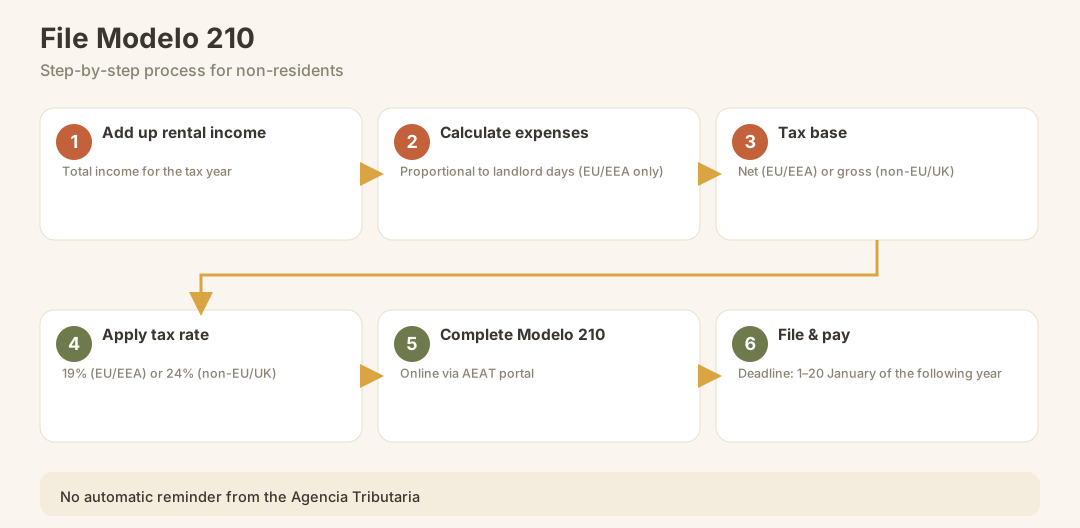
The Modelo 210 is the only official form for the IRNR. You can complete and submit it directly via the online portal of the Agencia Tributaria — a Spanish digital certificate makes the process easier, but is not mandatory (you can also file through an authorised tax adviser).
What you will need:
- NIE (Número de Identificación de Extranjero)
- Cadastral value of the property (shown on the IBI notice)
- Evidence of rental income (bank statements, tenancy agreements)
- Receipts for deductible expenses (EU/EEA only)
- IBAN for any potential tax refund
Process:
- Add up rental income for the tax year
- Calculate deductible expenses on a pro-rata basis (EU/EEA only)
- Determine the net or gross tax base
- Apply the tax rate (19 % or 24 %)
- Complete the Modelo 210 online (AEAT portal: sede.agenciatributaria.gob.es)
- Submit the form and transfer the tax payment
Please note: You will not receive an automatic reminder from the Agencia Tributariano automatic reminder. The filing obligation rests entirely with you.
Deadlines 2026: What needs to be submitted and when?
| Taxable event | Tax year | Deadline |
|---|---|---|
| Rental income (annual return) | 2025 | 1–20 January 2026 |
| Owner-occupation / vacancy (Renta Imputada) | 2025 | by 31 December 2026 |
| Property sale (capital gain) | upon sale | within 4 months of the sale |
Since 2024, rental income has been subject to an annual return rather than the previous quarterly submissions. This means you file a single declaration once a year covering the entire previous year — the deadline is 20 January.
Please note: The switch to annual filing applies to rental income. The Renta Imputada (deemed income for owner-occupied properties) continues to carry a deadline of 31 December of the following year.
Short-term rentals (Airbnb, Booking & Co.)
From a tax perspective, it makes no difference whether you let your property on a long-term basis or through platforms such as Airbnb or Booking.com: the IRNR obligation applies in both cases, the Modelo 210 is the correct form in both cases, and the tax rates are identical.
What additionally changes for tourist short-term rentals on Mallorca:
- Licence requirement: In the Balearic Islands, holiday rentals (ETV – Estancias Turísticas en Viviendas) are subject to a licensing requirement. Anyone wishing to apply for a new licence should check the current status of licence allocations.
- Fines: Letting without a valid ETV licence can attract substantial penalties.
- Increased scrutiny: The Agencia Tributaria cross-references platform data with tax returns.
More on the topic of licences: ETV licence Mallorca
Deemed income for owner-occupied properties: taxable even without rental income
A common misconception: anyone who does not rent out their Mallorca property still has to file an IRNR return — on a deemed income (Renta Imputada) calculated on the basis of the cadastral value.
The logic behind this: Spain taxes the economic benefit of owning a second property, even if you generate no income from it.
| Parameter | Value |
|---|---|
| Taxable base | 2% of the cadastral value (or 1.1% if the cadastral value has been recently updated) |
| Tax rate EU/EEA | 19 % |
| Tax rate non-EU | 24 % |
| Filing deadline | 31 December of the following year |
Since this guide focuses on rental income: anyone who partly rents out and partly uses the property themselves within the same year must declare both elements on a pro-rata basis — reporting actual income for the days rented and the Renta Imputada for the days of personal use.
Most common mistakes and how to avoid them
1. Forgetting to file
The Agencia Tributaria sends no reminders. Missing the deadline (20 January) automatically triggers surcharges.
2. Trying to deduct expenses as a non-EU resident
Swiss, British, and non-EU nationals may not claim any expenses whatsoever. Incorrect deductions lead to additional tax demands and fines.
3. Not declaring short-term rental income
Airbnb and Booking.com pass data to the Spanish tax authorities. Anyone who fails to declare is highly likely to be found out.
4. Not knowing the cadastral value
For the Renta Imputada you need the cadastral value. It appears on your annual IBI notice. Without it, you cannot complete the return correctly.
5. Confusing IBI and IRNR
IBI (paid to the local authority) and IRNR (paid to the Agencia Tributaria) are two separate taxes. Both must be paid.
6. Missing NIE
Without a NIE, no Modelo 210 can be submitted. The NIE is the tax identification number for foreign nationals in Spain.
7. Ignoring post-Brexit status
Many British owners still calculate on the basis of 19% and allowable deductions. Since Brexit, the rate of 24% on gross rental income applies.
What comes next? Keeping track of further tax obligations
The Modelo 210 for rental income is often just one of several tax obligations:
| Tax / Obligation | Who is affected? | Guide |
|---|---|---|
| Wealth tax (Patrimonio) | Non-residents with property value above the tax-free allowance | Wealth tax Spain |
| IBI (property tax) | All property owners | IBI tax Spain |
| Capital gains tax on sale | All non-residents upon sale | Taxes on property sales |
| ETV licence (holiday rental) | All short-term landlords on Mallorca | ETV licence Mallorca |
| Exit tax | When relocating tax residence out of Spain | Exit tax Spain |
Anyone considering renting through a Spanish limited company (SL) rather than as a private individual should work through the tax implications thoroughly beforehand: Buying property via an SL.
Checklist: Modelo 210 for landlords
Before submitting, you should tick off the following points:
- NIE is available and currently valid
- Rental income for the tax year fully documented (bank statements, contracts)
- Residency status checked (EU/EEA or non-EU/UK?)
- Deductible expenses evidenced and calculated on a pro-rata basis (EU/EEA only)
- Cadastral value taken from the current IBI notice
- Rental days vs. personal-use days apportioned
- Correct tax rate applied (19 % or 24 %)
- Modelo 210 submitted on time (by 20 January for the previous year's rental income)
- Tax transferred or direct debit mandate set up
- ETV licence in place (for short-term tourist lets)
- IBI paid separately
Conclusion
Declaring rental income as a non-resident in Spain is no dark art – but it demands care when it comes to deadlines, tax rates, and record-keeping obligations. The most important principle: You will not be reminded. The responsibility lies with you, and the Agencia Tributaria is increasingly proactive in its checks. EU/EEA residents benefit from proportional cost deductions and the lower rate of 19 %; non-EU citizens (incl. UK since Brexit) pay 24 % on gross rental income. Anyone who fails to declare Airbnb income on the assumption that the platform "surely handles it" is mistaken: the tax obligation rests with the property owner. A tax adviser on Mallorca who specialises in non-residents will typically pay for themselves within the first year – through correct cost deductions alone.
📩 Request tax adviser contact now
Official sources
- Agencia Tributaria (AEAT) – Online portal for Modelo 210: sede.agenciatributaria.gob.es
- Agencia Tributaria – Information page IRNR / Modelo 210: agenciatributaria.es
- Real Decreto Legislativo 5/2004 – Texto refundido Ley IRNR (BOE): boe.es
- ATIB (Agència Tributària de les Illes Balears) – responsible for Balearic taxes (IBI, ITP etc.): atib.es
- Consell de Mallorca – Information on the ETV licence (holiday lettings): conselldemallorca.net