
Autónomo in Spain: Registration, Social Security Contributions & Taxes 2026
As a self-employed person on Mallorca, you operate legally and for tax purposes under the status ofAutónomo Spanien – the Spanish equivalent of the German sole trader. The system was fundamentally reformed in 2023: instead of a fixed flat-rate amount, you now pay social security contributions based on your actual net income. This is fairer for lower earners – but those who earn well pay noticeably more than before. In this guide, you will find out which administrative steps must be completed before your first invoice is sent, how the new contribution system works in practice, which deadlines recur regularly, and where Germans on Mallorca typically come unstuck. The figures apply to 2026 and are backed by current legislation (RDL 3/2026).

Would you like to register as an Autónomo on Mallorca and get started on solid footing?
- 📩 Submit a personal enquiry — we recommend vetted Gestorías and guide you through the first steps
- All official procedures at a glance — Residencia, NIE, Empadronamiento
What is an Autónomo – and does that apply to me?
An Autónomo (trabajador por cuenta propia) is a natural person who carries out an economic activity on their own account – that is, at their own risk and without dependency on an employer. You issue invoices under your own tax identification number (NIF or NIE), charge IVA (VAT) where required, and make monthly social security contributions.
The crucial difference from Germany: there isno legal separation between you and your business. Business debts are your personal debts. Anyone on Mallorca who provides freelance consultancy, carries out trades, sells photographs, works remotely for clients abroad, or runs an online business while being tax-resident in Spain will generally fall into this category.
Important: Registration must take placebefore your first invoice. Anyone who is already trading without being registered risks significant fines from the Agencia Tributaria.
When the threshold for mandatory registration is crossed depends on the regularity and extent of the activity. An occasional one-off service may be assessed differently from ongoing contract work – if in doubt, a gestoría or law firm can advise.
Requirements: what you need before registering
Before you submit even the first form, a number of basic requirements must be met:
| Requirement | Details |
|---|---|
| Minimum age | 18 years |
| NIE number | Mandatory for all non-Spanish nationals; EU citizens apply at the foreigners' registration office (Extranjería) or a Spanish consulate in their home country |
| Right of residence | EU citizens require a valid Residencia (Certificado de Registro de Ciudadano de la UE); non-EU nationals require a residence and work permit |
| Spanish bank account | Practically indispensable for the SEPA direct debit collection of social security contributions |
| Empadronamiento | Municipal registration certificate; technically not a mandatory prerequisite for registration, but in practice frequently required by the authorities |
If you do not yet have your NIE number, read our guide to theNIE-Nummer auf Mallorcafirst. We explain the Residencia in detail underResidencia Spanien.
Step-by-step registration
Registering as an autónomo involves two independent but closely linked steps: registering with the tax authority and registering with social security.
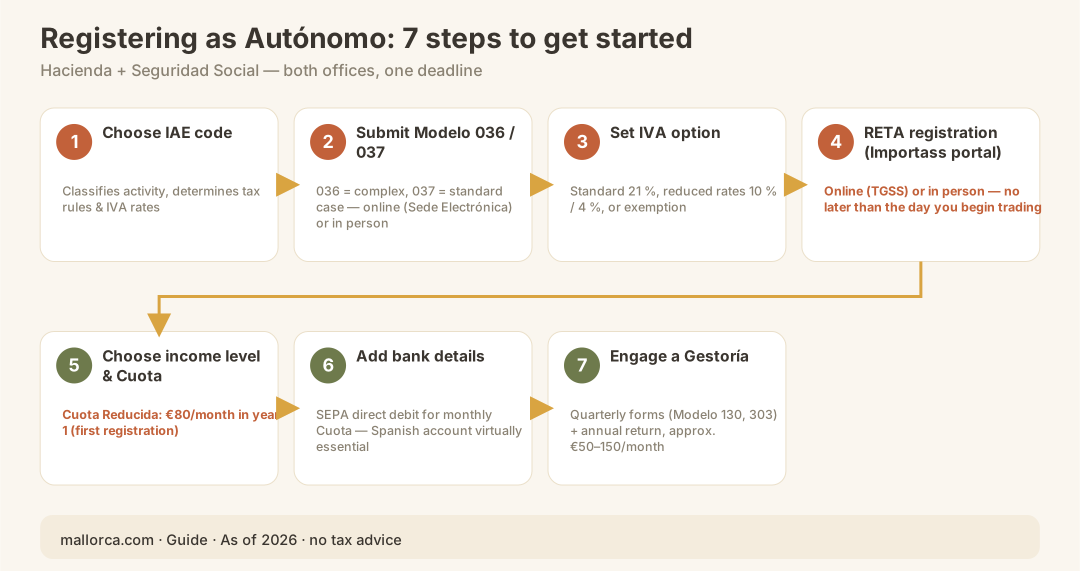
Step 1 – Registration with the tax authority (Agencia Tributaria / Hacienda)
- Choose your IAE code – The Impuesto sobre Actividades Económicas classifies your activity. Choosing the correct code is important because it determines which tax rules and IVA rates apply.
- Complete Modelo 036 or 037 – The 036 is the more detailed form (for complex situations, multiple activities, or VAT options); the 037 is the simplified version for standard cases. You will enter personal details, the type of activity (IAE code), the start date of the activity, and the chosen method of tax assessment.
- Choose your IVA option – Most activities are subject to standard IVA (21%; reduced rates apply to certain services). Some areas (e.g. certain educational services, healthcare professions) are exempt.
- Submit – Online via the Sede Electrónica of the AEAT using a digital certificate or Cl@ve, or in person at a tax office (Delegación de la AEAT).
Step 2 – Registration with social security (RETA)
The Régimen Especial de Trabajadores Autónomos (RETA) is the social security system for the self-employed. Registration can be completed online via the Importass portal of the Tesorería General de la Seguridad Social (TGSS) or in person at a social security office.
- Provide an income forecast – Since 2023, when registering with RETA you select a contribution base that corresponds to your expected net income bracket. This can be adjusted up to six times per year.
- Provide bank details for direct debit – The monthly cuota is collected automatically.
- DUE procedure (optional) – The Documento Único Electrónico allows you to combine the tax authority and social security registrations into a single electronic process.
Deadline: The RETA registration must be in place no later than the day on which the activity begins — not after. The tax authority should ideally be notified at the same time or slightly beforehand.
The income-based contribution system 2026
Since 2023, Spain has operated the Cotización por ingresos reales system — contributions based on actual net income. The old flat-rate choice of contribution base no longer exists. The system is fully in force in 2026.
How is the calculation made?
Your monthly net income (revenue minus deductible business expenses, before IRPF but after IVA) places you in one of 15 income brackets. Each bracket has a minimum and maximum contribution base. Your contribution (cuota) is calculated at approximately 31.5% of this base — including the MEI supplement (Mecanismo de Equidad Intergeneracional), which has risen to 0.9% in 2026 (up from 0.8% previously), meaning approximately €1–5 more per month depending on the bracket.
2026 contribution table (extract, frozen at 2025 levels)
The increases originally planned for 2026 (up to €206 more per month for top earners) were halted following political opposition by an emergency decree (Real Decreto-ley 16/2025). After a parliamentary interlude — during which Congress overturned the decree in January 2026 — the government passed a successor regulation in February 2026 (RDL 3/2026), which was confirmed by Congress on 26 February 2026. The result: rates remain at 2025 levels.
| Monthly net income (€) | Approximate cuota/month (€) |
|---|---|
| Under 670 | approx. 206 |
| 670 – 900 | approx. 230 |
| 900 – 1.166 | approx. 260 |
| 1.166 – 1.300 | approx. 290 |
| 1.300 – 1.700 | approx. 320 |
| 1.700 – 2.030 | approx. 350 |
| 2.030 – 2.330 | approx. 390 |
| 2.330 – 2.760 | approx. 430 |
| 2.760 – 3.190 | approx. 475 |
| 3.190 – 3.620 | approx. 515 |
| Over 6.000 | approx. 623 |
Source: Research [3], RDL 3/2026. Exact figures depend on the contribution base selected within the applicable range.
Annual Reconciliation (Regularización)
At the end of the year, the social security authority reconciles your actual income (as reported in your income tax return) with the estimate you provided during the year. If you underestimated, you will owe an additional payment; if you overpaid, you will receive a refund. This makes a realistic income estimate at the outset — and regular adjustments to it — essential.
Cuota Reducida: 80 € in the first year
Those registering as self-employed in Spain for the first time benefit from the Cuota Reducida (formerly: Tarifa Plana). The legal basis is Real Decreto-ley 13/2022 and the Estatuto del Trabajo Autónomo.
| Period | Monthly contribution |
|---|---|
| First 12 months | 80 € (fixed, regardless of income) |
| Extension to 24 months | possible if net income remains below the minimum wage |
| From month 13 (or 25) | regular income-based contribution |
Please note: The Cuota Reducida applies only if you have never previously been registered as an autónomo — or if your last deregistration was at least two years ago (more favourable conditions apply to certain groups, e.g. women returning after parental leave). Re-registering and quickly deregistering again in order to claim the discount more than once is not permitted.
Tax obligations: quarterly filings & annual return
As an autónomo, you are locked into a fixed cycle of quarterly advance payments and annual final declarations. Deadlines are non-negotiable — late submissions automatically incur a surcharge.
Overview of mandatory forms
| Form | Purpose | Due date |
|---|---|---|
| Modelo 130 | Quarterly IRPF advance payment (income tax) | 20 January, 20 April, 20 July, 20 October |
| Modelo 303 | Quarterly IVA return (VAT) | 20 January, 20 April, 20 July, 20 October |
| Modelo 100 | Annual income tax return (IRPF) | Usually April–June of the following year |
| Modelo 390 | Annual IVA summary | 30 January of the following year |
| Modelo 347 | Annual declaration of transactions exceeding 3.005 € | February of the following year |
IRPF: How much income tax do you pay?
Spanish income tax (Impuesto sobre la Renta de las Personas Físicas) is progressive. As an autónomo, you choose between the simplified direct method (bookkeeping based on actual income and expenses, for turnover below 600.000 €/year) and the standard direct method. The flat-rate scheme (estimación objetiva) still exists for certain activities, but is becoming less common.
The Modelo 130 is an advance payment of 20 % of the quarterly profit (income minus business expenses) minus advance payments already made during the current year. The final tax liability is calculated in the annual return (Modelo 100); any overpayment is refunded.
You can find more detail on specific IRPF rates and allowances in our guide Taxes as a resident (IRPF).
IVA: The standard rate is 21 %
You charge your clients IVA (VAT), remit it via the Modelo 303, and can offset IVA paid on business expenses against it. The standard rate is 21 %; certain services are subject to 10 % or 4 %. Some activities (certain educational or healthcare services) are exempt — in which case the 303 does not apply.
What social security covers
The monthly RETA contribution is not a pure tax but an insurance benefit. As a registered autónomo you are entitled to:
- Access to public healthcare in Spain (Sistema Nacional de Salud)
- Sick pay for extended incapacity to work (after a waiting period)
- Maternity/paternity payments
- Cessation-of-activity benefit (prestación por cese de actividad) — under certain conditions
- State pension (calculated on a pro-rata basis according to years contributed and contribution base)
The Spanish healthcare system is explained in our article Health insurance in Spain. Especially in the early stages, when you don't yet have a public health card, a private supplementary insurance policy can be a sensible option – more on this under Health & Insurance.
Autónomo vs. Sociedad Limitada (SL): Which Is Worth It and When?
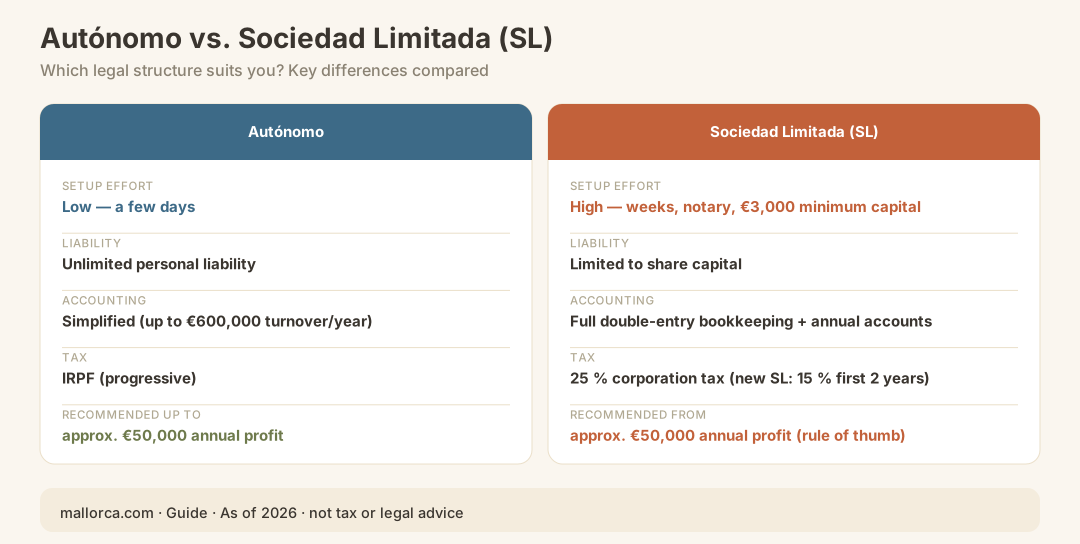
| Criterion | Autónomo | Sociedad Limitada (SL) |
|---|---|---|
| Set-up effort | Low (days) | High (weeks, notary, minimum capital 3.000 €) |
| Liability | Unlimited personal liability | Limited to share capital |
| Ongoing bookkeeping obligation | Simplified (below 600.000 € turnover) | Full double-entry bookkeeping, annual accounts |
| Corporation tax | Not applicable (IRPF) | 25 % (for new SL: 15 % for the first 2 years) |
| Worth considering from an annual profit of | Up to approx. 50.000 € | From approx. 50.000 €, as a rule of thumb |
| Social security | RETA (self-employed) | Director may also be required to pay RETA |
For most freelancers, remote workers and small service providers on Mallorca, autónomo status is the simpler and more cost-effective way to get started. A limited company (SL) is generally only worthwhile from higher profit levels onwards, or where limiting liability is strategically important.
The gestoría: Why You Need One
A gestoría is a practice specialising in administrative and tax services – a hybrid of tax adviser, payroll accountant and bureaucratic service provider that has no direct equivalent in the UK or Germany. For autónomos on Mallorca, it is almost indispensable.
What a gestoría handles:
- Submission of all quarterly forms (Modelo 130, 303, etc.)
- Annual tax return (Modelo 100)
- Communication with Hacienda and Seguridad Social
- Bookkeeping and invoice checking
- Advice on changing activity, taking a break or deregistering
Costs: Depending on the scope of services and the practice, typically 50–150 € per month. Given the complexity and the automatic penalties for missed deadlines, this is money well spent.
Tip: Look for a gestoría that has experience with German-speaking clients or employs staff who speak German. There are suitable practices on Mallorca – ask via your personal enquiry on a recommendation.
Most Common Mistakes When Starting as an Autónomo
From real-world experience on Mallorca, these mistakes come up time and again:
- Issuing invoices before registering. This is illegal. Registration must take place before the first economic activity.
- Choosing the wrong IAE code. An incorrect activity code can lead to the wrong tax rules applying and cause problems during audits.
- Setting the income forecast for RETA too low. To keep the monthly Cuota down, some people deliberately underestimate their income. The annual reconciliation claws that back — with interest.
- Missing quarterly deadlines. The 20th of the month following the end of the quarter is not a suggestion — it is a hard deadline with an automatic penalty charge.
- No Empadronamiento. Technically not a mandatory requirement, but without a certificate of registration you will run into difficulties in several places. More under Empadronamiento Mallorca.
- Using your NIE instead of your NIF. As a resident you receive a Spanish NIF — check which number you are putting on invoices.
- Forgetting to deregister. Anyone who ceases trading but has not officially deregistered will continue to pay Cuotas. Deregistration must be actively completed with Hacienda (Modelo 036/037) and the Seguridad Social.
Deductions and Tax Optimisation as an Autónomo
As an Autónomo you can deduct legitimate business expenses from your taxable profit. Exactly what is deductible depends on the activity and the tax regime. Typical deductible items:
- Work-related rent or a proportional home-office share (with supporting evidence)
- Vehicle costs for professional use (proof required)
- Hardware and software, work equipment
- Gestoría fees
- Professional development and training
- Professional association membership fees
- Part of the social security contributions (RETA Cuota)
Please note: Spanish tax inspectors scrutinise deductions very carefully. Without proper supporting documents (invoices bearing your NIF), expenses will generally not be recognised. Retention period for records: usually 4 years.
Checklist: Registering as an Autónomo on Mallorca
Use this list as a rough guide — in individual cases the order may vary slightly:
- NIE number applied for and received
- Residencia (Certificado de Registro) applied for
- Empadronamiento (registration with the local authority) completed
- Spanish bank account opened
- IAE code for the planned activity identified (if necessary with a Gestoría)
- Modelo 036 or 037 submitted to the Agencia Tributaria
- RETA registration with the Seguridad Social (Importass portal or in person)
- Income level selected for the RETA contribution base (check Cuota Reducida)
- Gestoría engaged (bookkeeping, quarterly forms)
- First quarter marked in the calendar (deadline: 20th of the following month)
- Note annual deadlines for Modelo 347, 390, 100
What comes next?
Registering as an autónomo is the starting point, not the destination. Once you are registered, the following topics run in parallel:
- Taxes & Finances: Annual IRPF return, and where applicable Modelo 720 (foreign assets exceeding 50.000 €) – more under Taxes & Finances and Modelo 720.
- Health Insurance: With active RETA membership you are entitled to the public health card (Tarjeta Sanitaria) – read more under Healthcare Mallorca.
- Residency: Your tax domicile determines many downstream consequences – including for your tax return in Germany. Details on relocating to Mallorca can be found in our Relocation Guide.
- Electronic Invoicing Obligation: The Crea y Crece project (B2B e-invoicing) and the VeriFactu system for invoice tracking are in the roll-out phase. VeriFactu has, as things currently stand, been postponed to 2027; you should clarify your specific obligations with your gestoría.
Conclusion
The autónomo system on Mallorca is manageable once you know what needs to be done and when. The two central registration steps (Hacienda + Seguridad Social), a realistic view of the monthly contributions, and a reliable gestoría by your side form the foundation. Anyone making use of the Cuota Reducida of 80 € in the first year has time to build up their income before the regular contributions kick in. The quarterly cycles are tight but predictable – with the right setup, things run like clockwork before long.
Official Sources
- Agencia Tributaria (AEAT) – Modelo 036/037, Modelo 130, 303, 100, 390, 347: https://www.agenciatributaria.es
- Tesorería General de la Seguridad Social (TGSS) – RETA registration, contribution bases, Importass portal: https://sede.seg-social.gob.es
- Real Decreto-ley 13/2022 – Introduction of the income-based contribution system for autónomos (BOE): https://www.boe.es
- Real Decreto-ley 3/2026 – Confirmation of the frozen contribution rates for 2026 (BOE): https://www.boe.es
- Estatuto del Trabajo Autónomo – Ley 20/2007, including Cuota Reducida regulations: https://www.boe.es/buscar/act.php?id=BOE-A-2007-13409
- Govern de les Illes Balears / ATIB – Balearic Tax Authority (for regional taxes): https://www.atib.es