
Getting Married in Mallorca: The Complete Guide to a Civil Wedding in Spain
Anyone wishing to get married in Mallorca faces a fascinating combination of dream-worthy scenery and Spanish bureaucracy. The good news upfront: a civil marriage solemnised in Spain is recognised as a valid civil union in Germany and in all other EU countries – so the effort is doubly worthwhile. This guide explains step by step which documents you will need as a German couple, how the Spanish civil registry procedure (Registro Civil) works, what the difference is between a legally binding ceremony and a purely symbolic free ceremony, and how to subsequently register your marriage in the German civil register. This will save you time, stress, and unnecessary translation costs.

Would you like to know which steps will lead most quickly to saying 'I do' for your specific situation – two German nationals, a mixed-nationality couple, or already resident in Mallorca?
- 📩 Submit a personal enquiry — we connect you with vetted local legal and planning experts
- Authorities & Registration in Mallorca — everything you need to know about Registro Civil, Empadronamiento & more
Civil ceremony vs. free ceremony: what is legally binding?
Before you start gathering documents, you need to make a fundamental decision: should your wedding in Mallorca be legally binding, or are you planning a symbolic celebration and intend to marry in a civil registry office in Germany?
A legally binding marriage in Spain means: the ceremony takes place before a Spanish civil registrar (Registro Civil), a justice of the peace (Juzgado de Paz), or – in certain cases – a notary. Only then is a marriage valid under Spanish law and automatically recognised throughout the EU.
Free ceremony (ceremonia civil libre or simbólica): a celebrant shapes the occasion individually and emotionally. However, it has no legal effect whatsoever. Many couples combine both: a civil ceremony beforehand (sometimes in Germany, sometimes in Mallorca) and a free ceremony on their chosen day at a finca or on the beach.
Please note: If you live in Germany and simply want to get married without registering permanently in Spain, a civil ceremony in Germany followed by a celebration in Mallorca is often the more straightforward route. However, anyone who specifically wishes to move the legal act to the island will find all the necessary information here.
Who may marry in a civil ceremony in Mallorca?
In principle, any couple may marry in Spain, provided the personal requirements under Spanish law (or the relevant law of their home country) are met. The following applies to German nationals:
| Requirement | Details |
|---|---|
| Minimum age | 16 years with judicial authorisation, 18 years without restriction |
| No existing marriage | Single, divorced (divorce decree required) or widowed (death certificate required) |
| Residence in Spain | Not mandatory – non-residents may also marry in Spain |
| No blood relationship | Prohibited degrees of kinship under Spanish law |
Same-sex marriages have been legal in Spain since 2005 and are recognised on exactly the same basis as opposite-sex marriages. In Germany, a more nuanced assessment applies to same-sex marriages contracted abroad within the EU – legal advice beforehand is recommended in this case.
The required documents: what you need to bring from Germany
In practice, this step tends to be the most time-consuming. Allow at least three months' lead time, and ideally six, as some German authorities take several weeks even for straightforward certificates.
Documents for both partners (German nationals)
| Document | Source | Special note |
|---|---|---|
| Valid passport or national identity card | Personal possession | Must be valid at the time of application |
| Birth certificate (certified extract from the birth register) | Registry office of the place of birth | As recent a version as possible |
| Certificate of residence / registration certificate | Residents' registration office | Current, including marital status |
| Certificate of no impediment to marriage / marriage eligibility certificate | Registry office in Germany | Confirms that no impediments to marriage exist |
| In the case of divorce: legally binding divorce decree | Family court | With confirmation of legal finality |
| In the case of widowhood: death certificate of the former partner | Registry office | – |
Apostille and certified translation
All German documents submitted in Spain must be provided with an Apostille. In Germany, the Apostille is issued by the competent authority (which varies by federal state – often the Regierungspräsidium or the Oberlandesgericht). In addition, the documents must be translated into Spanish by a sworn translator.
Please note: An ordinary (non-sworn) translation will not be accepted by the Spanish Registro Civil. Make sure the translator is authorised as a „traductor jurado".
Certificate of no impediment to marriage – the critical bottleneck
The certificate of no impediment to marriage (referred to in Spain as „certificado de capacidad matrimonial") is the central document. It confirms to the Spanish registry office that no impediments to marriage exist under German law. The registry office at your place of residence in Germany is responsible for issuing it. This certificate has a limited period of validity – make sure you schedule your appointment in Spain accordingly.
The process at the Spanish Registro Civil (registry office)
The Registro Civil responsible for Mallorca is located in Palma de Mallorca. The process takes place in several stages:
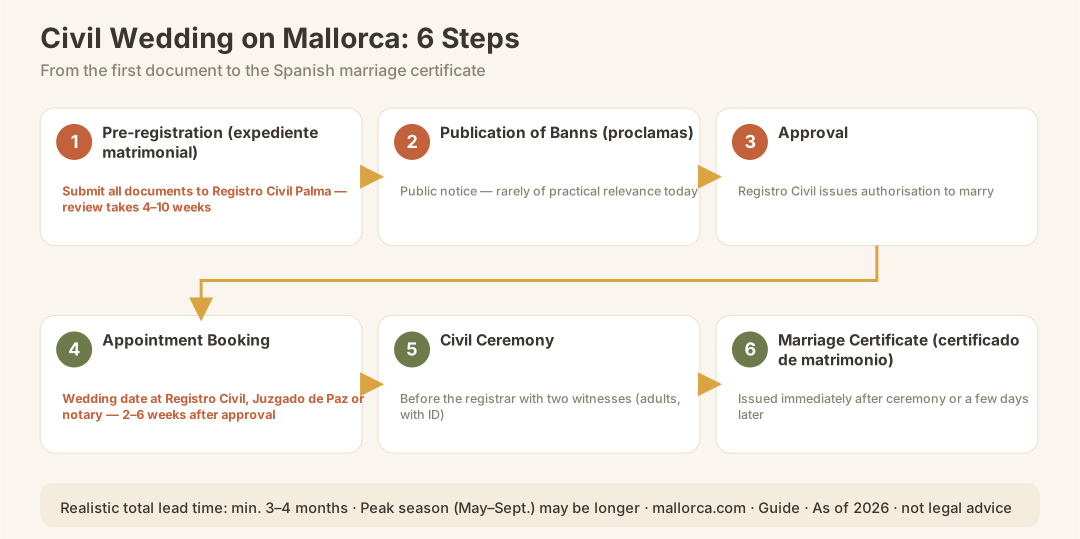
Step-by-step overview
- Preliminary registration (expediente matrimonial): You submit all documents to the Registro Civil. The officials check whether all requirements have been met. This process can take several weeks.
- Publication of banns (proclamas): In some cases a public announcement is arranged – a remnant of old canon law that is rarely of practical relevance in civil proceedings today.
- Approval: The Registro Civil grants approval for the marriage.
- Booking an appointment: You arrange the actual wedding date – either at the Registro Civil, at the competent Juzgado de Paz (Justice of the Peace) or, if you are residents, possibly at the notary's office.
- Civil ceremony: Before the registrar with two witnesses (of legal age, with ID).
- Marriage certificate (certificado de matrimonio): You receive the Spanish marriage certificate either immediately after the ceremony or a few days later.
| Phase | Typical duration |
|---|---|
| Obtaining documents in Germany | 4–8 weeks |
| Review by Registro Civil Palma | 4–10 weeks |
| Waiting time until the wedding date | 2–6 weeks after approval |
| Issuance of the marriage certificate | As a rule, a few days after the ceremony |
Please note: Allow realistic lead times overall: at least 3–4 months between the first document application and the wedding date, and rather more during the high season (May–September).
Registro Civil Palma: address and contact
The Registro Civil Palma is the central point of contact for marriages on Mallorca.
| Information | Details |
|---|---|
| Name | Registro Civil de Palma de Mallorca |
| Address | Carrer de l'Estudi General, 7, 07001 Palma (in the Palace of Justice) |
| Jurisdiction | All municipalities on the island of Mallorca |
| Language | Spanish (Catalan also possible) |
| Tip | Book an appointment in advance by phone or online |
Those who do not live in Palma but are registered (Empadronamiento) in a smaller municipality on Mallorca may alternatively apply to the Juzgado de Paz of the respective municipality.
A symbolic ceremony on Mallorca: what an officiant costs
Many couples opt for a combination: a civil ceremony with a small group beforehand (e.g. in Germany or at the Registro Civil Palma) and an elaborately arranged celebration with a symbolic ceremony at a finca or on the beach. The officiant (oficiante de ceremonia) takes care of the design and presentation of the symbolic wedding.
According to the 2026 wedding cost guide by SR Events Mallorca, prices for an officiant on Mallorca start from from €1,200. The actual total costs of a Mallorca wedding depend heavily on the number of guests, the venue, and the service providers.
| Cost block | Approximate guide figure |
|---|---|
| Master of ceremonies | from €1,200 |
| Venue hire (e.g. finca for up to 125 guests) | from approx. €6,050 incl. VAT |
| Surcharge per person from 126 guests onwards | from approx. €10 + VAT per person |
| Wedding-night suite (often included) | depending on venue |
| Party extension until 6 a.m. | from approx. €726 per hour (example) |
Please note: These figures are taken from publicly available offers from Mallorcan service providers and are intended as a guide only. Always obtain individual quotes.
How your Spanish marriage is recognised in Germany
Here is the good news: a civil marriage concluded in Spain is automatically recognised as a valid civil marriage in Germany, as all EU countries mutually recognise civil marriages. You do not need to apply for a separate recognition decision.
However, there is one important step you should not forget:
Subsequent registration in the German marriage register
If a German national has contracted a legally valid marriage abroad, it may be subsequently registered in the German marriage register upon application. A German marriage certificate will then be issued by the competent registry office in Germany. This step is formally voluntary, but in practice it is often essential — for example for:
- Name changes in passports and identity cards
- Family law proceedings in Germany
- Pension entitlements and inheritance law
Important: The surname does not change automatically upon marriage. If you wish to use a shared married name in Germany, you must submit a name declaration to the German registry office as part of the subsequent registration process. Only after this can a new passport be issued.
The subsequent registration process
- You obtain the Spanish marriage certificate (certificado literal de matrimonio) — available from the Registro Civil Palma or via the Spanish Ministry of Justice.
- The certificate is apostilled (in Spain: the competent authority is the respective Registro Civil).
- A sworn translation into German is prepared.
- You submit the application for subsequent registration at the German registry office (place of residence or birthplace of one of the partners). The application form is available from the Federal Foreign Office.
- The registry office reviews the application and enters the marriage into the marriage register.
| Step | Responsible authority |
|---|---|
| Certificado literal de matrimonio | Registro Civil Palma |
| Apostille (Spain) | Registro Civil / Ministerio de Justicia |
| Certified translation | Traductor jurado (DE↔ES) |
| Application for subsequent registration | Responsible registry office in Germany |
| Declaration of name | Registry office Germany |
Special considerations for residents on Mallorca
If you are already legally registered on Mallorca – that is, you have an Empadronamiento and, as an EU citizen, have registered your Residencia – certain simplifications apply:
- You can use your place of residence in Mallorca as the basis for the Registro Civil, without necessarily having to submit documents from Germany via the consulate.
- The Empadronamiento (municipal residents' register) serves as proof of residence for the Registro Civil.
- Anyone living permanently in Spain should also check whether the marriage has any effect on their taxes as a resident (IRPF) – for example, through the option of filing a joint tax return (declaración conjunta).
For questions regarding family reunification in Spain – for instance where one partner is a non-EU citizen – separate regulations apply.
Most common mistakes when getting married on Mallorca
These are the pitfalls we encounter time and again:
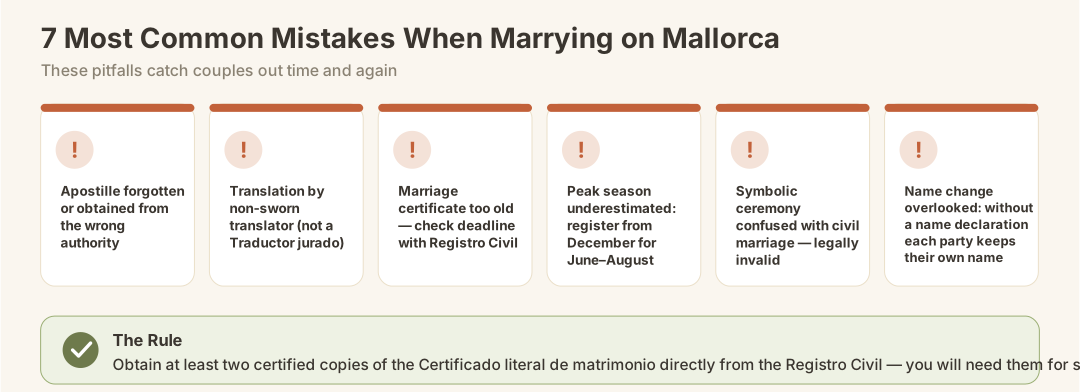
- Forgetting the Apostille or obtaining the wrong one: The Apostille must come from the authority responsible in Germany (which varies by federal state). Notarisation by a notary is not a substitute.
- Translation by a non-sworn translator: Only a 'traductor jurado' is accepted.
- Marriage certificate too old: Many registry offices do not accept certificates that are more than a few months old – you should enquire about the exact time limit with the relevant Registro Civil.
- Lack of time during the high season: Registro Civil Palma has long waiting times in summer. Anyone wishing to marry in June, July or August should begin the process by December at the latest.
- Confusing a civil ceremony with a symbolic one: A symbolic ceremony has no legal effect. Anyone who discovers after the celebration that they are not actually married has a serious problem.
- Forgetting to change your name: In Germany, a name change does not happen automatically – without a formal declaration of name (Namenserklärung) at the registry office, everyone retains their existing name.
- Obtaining only one copy of the Spanish marriage certificate: Collect at least two certified copies directly from the Registro Civil – you will need them for the subsequent registration in Germany and potentially for other authorities.
What comes next? First steps after the wedding
After the ceremony, there are a number of practical matters to attend to:
- Declaration of name at the German registry office, if you wish to change your name
- New identity documents (passport, national ID card, and where applicable your Spanish NIE/TIE) – apply for updated versions
- Update your health insurance: spouses may be able to be covered as co-insured dependants – find out more in the guide on health insurance in Spain
- Review your tax situation: as a married couple resident on Mallorca, check whether a joint IRPF assessment would be advantageous
- Will and matrimonial property regime: in international marriages it is advisable to clarify the matrimonial property regime legally – Spanish and German law differ considerably in this regard
Checklist: civil marriage on Mallorca
Use this overview as your personal to-do list:
- Decision: civil ceremony in Spain or in Germany?
- Request certified copies of birth certificates from the registry office
- Apply for a certificate of no impediment (Ehefähigkeitszeugnis) from the German registry office
- Obtain apostilles for all German documents
- Engage a sworn translator (Traductor jurado)
- Submit documents to the Registro Civil Palma
- Arrange a wedding date (allow at least 3–6 months' lead time)
- Organise two adult witnesses with valid ID
- After the ceremony: collect two copies of the Certificado literal de matrimonio
- Obtain an apostille for the Spanish marriage certificate
- Have a sworn translation into German produced
- Submit an application for subsequent registration (Nachbeurkundung) at the German registry office
- Submit a declaration of name if applicable
- Update identity documents
- Review health insurance and tax situation
Conclusion
Getting married on Mallorca is entirely feasible from a legal standpoint – and the result is a fully valid EU civil marriage that is recognised in Germany without any further formalities. The key lies in careful and timely preparation of the documents. Anyone who underestimates the apostilles, sworn translations, and certificate of no impediment, or leaves them too late, risks missing their preferred date. With a lead time of at least four to six months, a good local network, and this guide as your reference, there is nothing standing between you and saying "I do" beneath the Mallorcan sun.
Official sources
- German Federal Foreign Office – Getting married abroad (FAQ): https://www.auswaertiges-amt.de/de/service/fragenkatalog-node/606794-606794
- German Federal Foreign Office – Subsequent registration in the marriage register: https://www.germany.info/us-de/service/familienangelegenheiten/eheregister-1216890
- Your Europe (EU Commission) – Civil marriages in the EU: https://europa.eu/youreurope/citizens/family/couple/marriage/index_de.htm
- Ministerio de Justicia España – Registro Civil: https://www.mjusticia.gob.es/es/ciudadanos/tramites/registro-civil
- Registro Civil de Palma de Mallorca:Carrer de l'Estudi General, 7, 07001 Palma
- BOE – Spanish Civil Code (Title IV: Marriage): https://www.boe.es/buscar/act.php?id=BOE-A-1889-4763