
Parental Leave in Spain: Baja Maternidad & Paternidad 2026 – the Complete Expat Guide
If you're an expat or new resident in Spain expecting a child, you'll encounter a system that has fundamentally changed in recent years. The parental leave in Spain – officially known as the permiso por nacimiento y cuidado de menor – has, since 2021, granted both parents equally long, fully paid periods of leave that cannot be transferred to the other parent. Under Royal Decree-Law 9/2025 of 29 July 2025, the duration was increased to 17 weeks per parent, supplemented by two flexible weeks that can be taken up until the child's eighth birthday. This guide explains step by step who is eligible, how much the maternity benefit amounts to, what deadlines apply, what is different for the self-employed (autónomos) – and what particularities you need to be aware of in Mallorca.
Are you expecting a child in Spain and don't know where to start?
- 📩 Submit a personal enquiry — We connect you with German-speaking gestorias and lawyers in Mallorca
- Everything about family & life in Mallorca
What exactly is the "baja por Maternidad/Paternidad" – and why does it go by a different name today?
Spain has officially abolished the traditional distinction between maternity and paternity leave. Since Royal Decree-Law 6/2019, which is aimed at the principle of equal treatment and equal opportunities, the benefit is uniformly referred to as the permiso por nacimiento y cuidado de menor – that is, leave for birth and childcare. In everyday speech and in many official texts, however, the terms baja por maternidad and baja por paternidad.
The key innovation: entitlement is individual and non-transferable. If one parent does not use their weeks, they are forfeited – unlike the German parental allowance system, where partner months can be transferred. The explicit aim is to involve fathers in childcare.
The benefit applies to:
- Birth of a child
- Adoption
- Taking in a foster child (acogimiento)
Duration and allocation of parental leave 2026
Under Decree 9/2025 (published on 29 July 2025), the following system applies:
| Constellation | Compulsory Paid Weeks | Flexible Remaining Weeks | Additional Flex Weeks | Total |
|---|---|---|---|---|
| Each Parent (birth from 31.07.2025) | 6 weeks immediately after birth | 11 weeks up to the 1st birthday | 2 weeks up to the 8th birthday | 17 + 2 weeks |
| Single Parents (birth from 31.07.2025) | 6 weeks immediately | 26 weeks | 4 weeks up to the 8th birthday | 32 + 4 weeks |
| Birth Mother (special provision) | May begin up to 4 weeks BEFORE the due date | — | — | — |
Important: The two (or four) additional flex weeks under Decreto 9/2025 may only be applied for from 1 January 2026 onwards. Eligible parents are those whose child was born, adopted, or taken into foster care on or after 2 August 2024. A fresh recognition of the basic entitlement is not required for this purpose.
The first 6 weeks: compulsory, uninterrupted, full-time Both the mother and the father are required to take six full consecutive weeks immediately after the birth. This compulsory phase protects the mother's health and ensures the basic care of the newborn.
The remaining 11 weeks: flexible After the compulsory phase, the remaining weeks may be taken consecutively or spread out week by week until the child's first birthday — subject to agreement with the employer. A part-time arrangement is also possible under certain conditions.
Benefit amount: what does the Seguridad Social pay?
The benefit amounts to 100 % of the regulatory base (base reguladora). This is the average of your social security contributions over the last few months before the benefit begins – not your gross salary, but generally close to it.
| Benefit type | Amount | Paying authority |
|---|---|---|
| Baja por nacimiento (both parents) | 100% of the base reguladora | Seguridad Social (INSS) |
| Employer's contribution during Baja | €0 (the employer pays nothing on top) | — |
| Tax treatment | Depends on individual circumstances – consult a gestoría | — |
Please note: Payment is made directly through the Instituto Nacional de la Seguridad Social (INSS), not through your employer. Your contract with the employer is suspended for the duration of the Baja (suspensión de contrato), but your position remains protected.
Eligibility: who is entitled?
Not everyone automatically qualifies for the paid version. The following basic requirements apply:
For employees (trabajadores por cuenta ajena)
- Active social security obligation at the time of birth – you must be registered with the Seguridad Social
- Minimum contribution period (período mínimo de cotización):
- Under 21 years of age: no minimum contribution period required
- 21 to 26 years of age: at least 90 contribution days within the last 7 years or 180 days in total
- From age 26: at least 180 contribution days within the last 7 years or 360 days in total
| Age at birth | Minimum contribution period |
|---|---|
| Under 21 years | None |
| 21–26 years | 90 days in the last 7 years or 180 days in total |
| From age 26 | 180 days in the last 7 years or 360 days in total |
For the self-employed (autónomos)
autónomos are also entitled to claim if they:
- are registered with the Seguridad Social as self-employed (Régimen Especial de Trabajadores Autónomos, RETA)
- meet the same minimum contribution periods as employees
- are up to date with their contributions (estar al corriente de pago)
Please note: As an autónomo, you will generally need to appoint a substitute (sustituto) for the duration of the baja or provide evidence that you have ceased trading — otherwise the benefit may be reduced or refused. Discuss this with your gestoría in good time.
Step by step: how to apply for baja with the INSS
GP appointment and documentation: Obtain a medical certificate immediately after the birth (or, in the case of pregnancy, in good time beforehand). The hospital doctor or your midwife will issue the relevant birth documents.
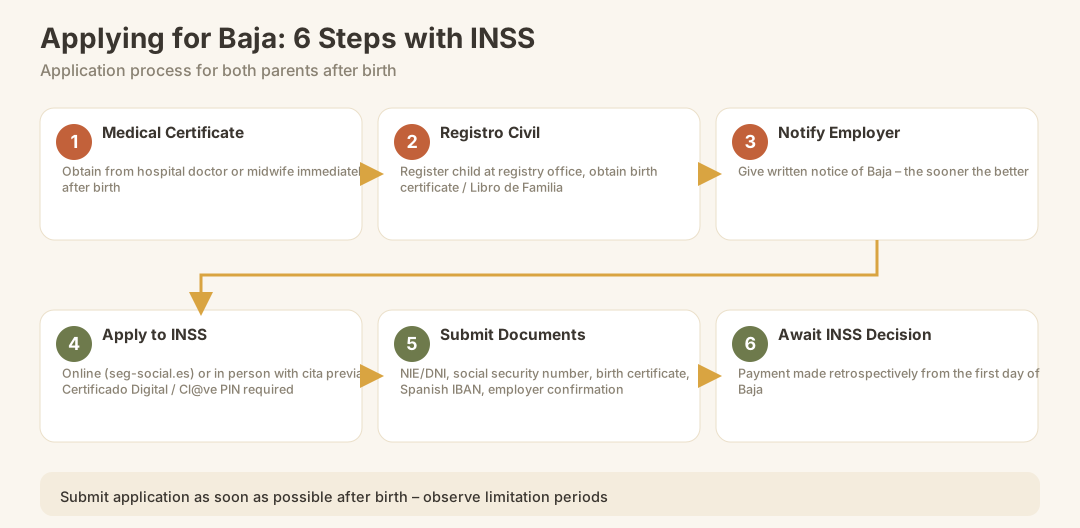
Register office (Registro Civil):) Register the child at the register office. You will need the Libro de Familia or an equivalent birth certificate.
Notify your employer: Give written notice of your baja. There is no statutory deadline for advance notification, but the earlier the better — so that your employer can plan for your absence.
Submitting an application to the INSS: Submit the application (solicitud de prestación por nacimiento y cuidado de menor) via:
- The Seguridad Social online portal: www.seg-social.es
- In person at the relevant INSS office with an appointment (cita previa)
- Using your Certificado Digital or Cl@ve PIN (electronic signature)
Submitting your documents: You will generally need:
- DNI, NIE or passport
- Social security number (número de afiliación)
- Birth certificate or adoption document
- Bank account details (Spanish account for transfer)
- For employees: confirmation from the employer (comunicación empresarial)
Awaiting the INSS decision: The INSS reviews the application and transfers the benefit retrospectively from the first day of the baja.
Important: Submit the application as promptly as possible after the birth. Although backdating is possible, there are limitation periods. Do not wait for months.
Special considerations for expats and EU citizens on Mallorca
As an EU citizen (Germans, Austrians, Swiss nationals) you have the same entitlement as Spanish nationals – provided you are properly registered as a resident, hold a valid Residencia and contribute to the Spanish Seguridad Social.
Important preliminary questions for expats
| Question | Answer |
|---|---|
| I work for a German company – which system applies? | The decisive factor is where you are subject to social security contributions. For posted workers: check the EU posting certificate A1 |
| I have private health insurance and do not pay into the Seguridad Social | No entitlement to Baja benefits – health cover only through private health insurance |
| I hold a Non-Lucrative Visa | As a rule, no gainful employment is permitted, therefore no contributions → no entitlement |
| I have narrowly missed the parent threshold for contribution years | Check with the INSS whether exceptional circumstances apply |
If you work as an expat in Mallorca and have correctly registered your Residencia and your Empadronamiento the application process is identical to that for Spanish employees.
Baja and taxes: what do you need to report to the tax authorities?
The Baja benefit from the Seguridad Social must be declared as social security income in your income tax return (IRPF). The tax treatment depends on the specific individual case and has evolved through case law. Have the precise classification checked by a gestoría or a tax adviser. You can find more on IRPF deductions in the Balearic Islands in our dedicated guide.
Special situations: multiple pregnancies, premature birth, disability
The standard duration of 17 weeks is extended in certain situations:
- Multiples: For each additional child beyond the first, the Baja is generally extended by further weeks per parent – the precise arrangements should be clarified with the INSS on a case-by-case basis
- Premature birth or hospitalisation of the newborn: If the baby remains in hospital after birth, the start of the Baja (apart from the compulsory 6 weeks) can be deferred until the child is discharged home
- Child with a disability: The Baja is extended by further weeks – the exact duration should be clarified with the INSS
Breastfeeding provision (permiso de lactancia)
In addition to parental leave itself, there is the permiso de lactancia: a daily absence of one hour (or an equivalent reduction in the working day) for mothers and fathers, until the child is nine months old. This entitlement may be taken as a single block of consecutive time off – the precise arrangements are to be negotiated with the employer.
Most common mistakes with parental leave in Spain
Applying too late: Anyone who submits the application months after the birth risks complications with retrospective deadlines. Submit the application no later than within the first few weeks after the birth.
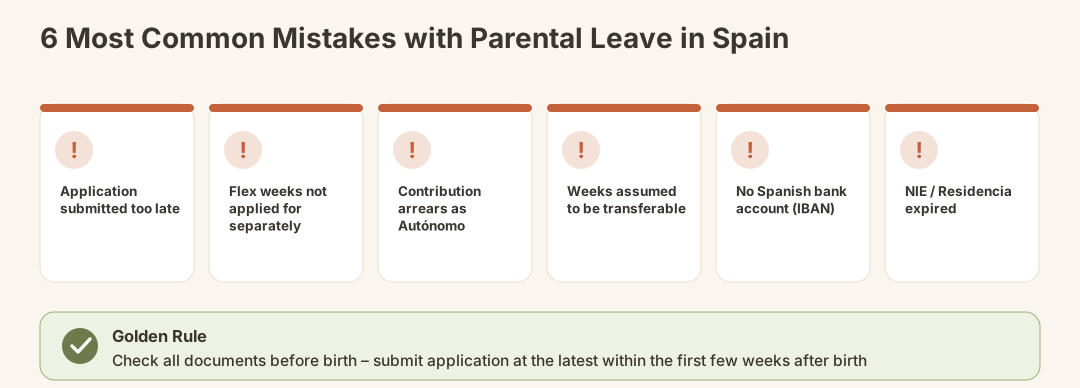
Forgetting that the flex weeks must be applied for separately: The two additional weeks under Decreto 9/2025 are not granted automatically – they must be actively applied for at the INSS from 1 January 2026.
Outstanding contributions as an autónomo: Anyone with debts to the Seguridad Social loses their entitlement to the benefit. Clarify your contribution status before the child is born.
Assuming the weeks are transferable: They are not. If the father does not take his 17 weeks, they are forfeited.
No Spanish bank account: The INSS pays exclusively into an account with a Spanish IBAN. Open an account in good time.
NIE/Residencia not up to date: Expired or incorrect documents considerably delay the INSS decision. Check all documents before the birth.
Parental leave and child benefit: what happens after the 17 weeks?
The baja ends after 17 weeks (plus any flex weeks). After that, you have the following options in Spain:
- Unpaid parental leave (excedencia por cuidado de hijos): Up to 3 years' leave with the right to return to your position, but without social security benefits
- Reduction of working hours (reducción de jornada): Entitlement to a reduction in working hours until the child is 12 years old – the precise scope is to be clarified on a case-by-case basis with the employer
For information on state family benefits after the baja – in particular the prestación por hijo a cargo and its interaction with German child benefit – read our guide on child benefit when emigrating to Spain.
Checklist: parental leave in Spain – what to sort out before and after the birth
Before the birth:
- Check that your Residencia and empadronamiento are up to date
- NIE and social security number in place
- Spanish bank account set up
- Clarify contribution periods with the Seguridad Social (request an Informe de Vida Laboral if necessary)
- As an autónomo: rule out any outstanding contribution arrears and appoint a representative for the period of baja
- Notify your employer in writing in good time
After the birth:
- Register the child at the Registro Civil and obtain the birth certificate
- Submit the application to the INSS (online or by appointment)
- Have your Certificado Digital / Cl@ve PIN ready for the online application
- Hand your employer a copy of the INSS decision letter
- From 1 January 2026: apply separately for flex weeks (for births from 2 August 2024)
What comes next? The next steps after the baja
Once you return to work, it is well worth putting your family life in Spain on a solid footing. This includes:
- School enrolment: Schools on Mallorca for German-speaking children
- Registering household help correctly: Registering household help in Spain
- Tax optimisation as a family: Taxes as a resident (IRPF)
- Planning for retirement in the long term: Claiming your pension in Spain
Conclusion
Parental leave in Spain is, in 2026, one of the most progressive systems in Europe: 17 weeks of fully paid leave per parent, non-transferable, supplemented by flexible weeks available until the child's eighth birthday. For expats on Mallorca, the key point is this: anyone correctly registered with the Seguridad Social who meets the minimum contribution periods is entitled to exactly the same benefits as Spanish employees. The biggest pitfalls are contribution arrears, out-of-date identity documents, and submitting applications too late. Plan everything well before the birth – the Spanish system is then remarkably family-friendly.
Official sources
- Real Decreto-ley 9/2025, of 29 July 2025 – extension of parental leave regulations: BOE
- Real Decreto-ley 6/2019, of 1 March 2019 – equalisation of parental leave entitlements: https://www.boe.es/eli/es/rdl/2019/03/01/6
- Estatuto de los Trabajadores (Real Decreto Legislativo 2/2015) Art. 48 – Suspension of the employment contract: BOE
- INSS – Instituto Nacional de la Seguridad Social: Application forms and online portal: https://www.seg-social.es
- Ley General de la Seguridad Social (Real Decreto Legislativo 8/2015) – Eligibility conditions: BOE