
Retiring to Mallorca: Pension, Taxes & Health Insurance
Mallorca is no longer just a holiday dream that only a lucky few can afford – for thousands of German retirees, it has long since become an everyday reality. The island combines a Mediterranean climate, a well-developed German-speaking infrastructure, and the legal certainty of EU membership in a way that few other destinations can match. At the same time, there are very real pitfalls when it comes toretiring and relocating to Mallorca— where is your pension taxed? How does health insurance work? What happens to your care allowance? This guide answers precisely these questions – with concrete figures, official registration processes, and a realistic assessment of the cost of living. So you can make an informed decision about whether making the move to the island is the right step for you.

Would you like to plan your retirement on Mallorca in concrete terms – without bureaucratic chaos?
- 📩 Submit a personal enquiry — We'll work out your individual step-by-step plan
- Authorities & Registration at a Glance
Why Mallorca? An Overview of Advantages and Challenges
Mallorca doesn't attract retirees by chance. The island is only around two hours by air from all major German airports, with year-round connections at attractive prices. Add to that the mild climate, an established German-speaking community, and – as an EU member state – reliable legal frameworks for pensions, care allowances, and health insurance.
Yet retirement on Mallorca has its downsides too, which you should factor in with clear eyes.
| Advantages | Challenges |
|---|---|
| Mild climate with plenty of sunshine | Winter can be cool and damp – often without central heating |
| Cost of living up to 20–30 % lower than in major German cities | Summer heat and high UV exposure |
| EU freedom of movement – no residence permit required | Bureaucratic effort: NIE, Residencia, Empadronamiento |
| German pension and care allowance are transferred abroad | Risk of social isolation despite the existence of German-speaking enclaves |
| Well-developed German-speaking infrastructure (doctors, lawyers, banks) | Seasonal limitations during the winter months |
| Short flight connections to Germany (approx. 2 hrs) | In-kind care benefits do not apply within the EU abroad |
Cost of Living: What Does Day-to-Day Life Really Cost?
The financial advantage over major German cities is real – but it depends heavily on your lifestyle and the location you choose on the island.
While in Munich or Hamburg you would typically budget between 1.200 and 1.500 Euro per month in rent for a 50 m² flat, on Mallorca you pay between 700 and 1.200 Euro depending on location for comparable accommodation. Restaurant visits, services, and public transport are on average cheaper on the island. Those who live modestly can get by on around 1.500 Euro per month, including rent, groceries, and utility bills.
| Expenditure item | Mallorca (approx.) | Comparison major German city (approx.) |
|---|---|---|
| Rent 50 m² (mid-range location) | 700–1.200 €/month | 1.200–1.500 €/month |
| Total cost of living (1 person) | approx. 1.500 €/month | approx. 1.800–2.200 €/month |
| Overall cost saving | 20–30 % | – |
Please note: In popular locations such as Palma, Port Andratx, or the south-west, rental prices are significantly above the island average. Those living inland or in less touristy municipalities can save considerably more.
Legal Basics: NIE, Residencia, and Empadronamiento
As an EU citizen, you do not need a separate residence permit to move to Mallorca – freedom of movement within Europe applies. Nevertheless, three administrative steps are mandatory:
- Apply for a NIE number – The Número de Identidad de Extranjero is essential for all dealings with the authorities, banking transactions, and purchasing property. The Policía Nacional is the responsible body.
- Residencia (Certificado de Registro) – After no more than three months of residence, you must register with the Policía Nacional and apply for the Residencia certificate.
- Empadronamiento – Registration with the Ayuntamiento (local council) of your place of residence. Without Empadronamiento, access to many public services and the healthcare system is restricted.
Anyone living on Mallorca for more than six months must also deregister in Germany and register their new place of residence in Spain.
Please note: Anyone who spends 183 days or more per year on Mallorca becomes tax-resident in Spain. This has direct consequences for the taxation of pension income – more on this in the next section.
You can find further information in our guides on the NIE number, on the Residencia, and on Empadronamiento.
Pension income on Mallorca: transfers and taxation
Transfers are straightforward
The Deutsche Rentenversicherung (DRV) will transfer your state pension to any account on request – whether in Germany or Spain. According to the DRV, German pensions are paid out to more than 150 countries. The payment itself is therefore no obstacle to relocating to the island.
Where is the pension taxed? The double taxation agreement
This is where things get complex. Taxation is governed by the double taxation agreement (DTA) between Germany and Spain, which was revised in 2011. The old agreement of 1968 provided for taxation exclusively in the country of residence. The new agreement divides taxing rights:
| Situation | Taxing rights |
|---|---|
| Fewer than 183 days/year in Spain, centre of life in Germany | Germany taxes the pension; often tax-free up to the basic personal allowance |
| Spanish Residencia, no longer resident in Germany | Limited tax liability in Germany (withholding tax); loss of the German basic personal allowance |
| Civil service pensions (formerly public sector) | Special provision – taxing rights remain in principle with the state paying the pension |
| Pensioners with Residencia in Spain (statutory pension) | Spain holds the taxing rights; Germany generally retains a withholding tax right |
Please note: A new DTA has applied since 2011; at the same time, the statutory pension in Germany has been subject to progressively full taxation since 2005. Anyone who moves their place of residence to Spain and no longer has a German address loses the German basic personal allowance and becomes only limitedly tax-liable in Germany. You should have this situation reviewed by a tax adviser with DTA expertise before you relocate.
You can find detailed information on your ongoing tax obligations as a resident in our guide to taxes as a resident (IRPF).
Health insurance: making sure you are fully covered
Health insurance is the cornerstone of your planning – and at the same time the area in which most retirees feel uncertain. The good news is that as a pension recipient from Germany, you have a legally secured route into the Spanish healthcare system.
The route via the S1 form (formerly E-121)
Retirees who receive their pension exclusively from Germany and wish to live in Spain can access the Spanish state health system via the S1 form (the former E-121 certificate). Here are the steps:
- Apply for the S1 form from your German statutory health insurer – The form confirms that you are covered by health insurance in Germany and are entitled to benefits in kind in Spain.
- Register with the INSS – The S1 form is submitted to the Spanish Instituto Nacional de la Seguridad Social (INSS).
- Apply for the Tarjeta Sanitaria – Upon registering with the INSS, you will receive the Spanish health card (Tarjeta Sanitaria), which allows you to visit GP surgeries and hospitals within the state SNS (Sistema Nacional de Salud).
| Step | Responsible authority | Document |
|---|---|---|
| Request S1 | Your German statutory health insurer | S1 form |
| Submit S1 | INSS (Spain) | Registration |
| Apply for Tarjeta Sanitaria | Centro de Salud / INSS | Spanish health card |
Please note: For a temporary stay in Spain (a short holiday or transitional period), the European Health Insurance Card (EHIC) applies — found on the back of your German health insurance card. The EHIC covers only medically necessary treatment; it is not a substitute for permanent health insurance when taking up residence.
If you also receive a Spanish pension
Anyone who has been employed in Spain for more than one year and therefore also receives a Spanish pension must arrange cover through the Spanish health insurance system — no longer via the S1 form.
Supplementary private health insurance
Even with a Tarjeta Sanitaria, many retirees are advised to take out supplementary private health insurance, particularly for dental treatment, access to specialists without long waiting times, or use of private clinics. Find out more in our guide to health insurance in Spain.
Care allowance and care benefits: what applies on Mallorca?
Care allowance is transferred — benefits in kind are not
The German care allowance continues to be paid even when you are resident on Mallorca. As an EU member state, Spain is subject to the EU regulation on the coordination of social security systems, which guarantees payment to other EU countries.
However, one important distinction applies:
| Type of benefit | Applicable on Mallorca? |
|---|---|
| Care allowance (cash benefit) | Yes – transferred |
| Benefits in kind (outpatient care services from Germany) | No – cease upon taking up residence abroad |
| Care aids and equipment | Generally restricted – consultation with your care insurance fund required |
In practice, this means you must organise care on the ground yourself and finance it from the care allowance and your own funds. Outpatient care services from Germany do not provide services on Mallorca.
Housing and care options on the island
In practice, three models are predominantly used:
- Shared senior living – communal living, sometimes with outpatient care support
- Retirement residence – residential care facilities on the island
- 24-hour home care – carers within your own household
Please note: The care situation should be planned not only for today, but with a view to potentially increasing care needs in the future. Someone who is fit today may find themselves in a difficult position later if no residential care infrastructure was organised in good time.
Taxes as a resident: IRPF, Modelo 720 and more
Anyone who relocates their primary residence to Mallorca and spends more than 183 days per year there becomes fully liable to income tax in Spain (IRPF – Impuesto sobre la Renta de las Personas Físicas). This means that all worldwide income – including the German pension – must in principle be declared in Spain.
Modelo 720 – reporting obligation for assets held abroad
As a tax resident in Spain, you are required to report assets held abroad that exceed certain thresholds to the Spanish tax authorities. This applies to bank accounts, property, and securities held outside Spain.
| Asset category | Reporting threshold (approx.) | Form |
|---|---|---|
| Bank accounts abroad | 50.000 € per category | Modelo 720 |
| Property abroad | 50.000 € per category | Modelo 720 |
| Securities/insurance policies abroad | 50.000 € per category | Modelo 720 |
You can find detailed information on this in our guide to the Modelo 720 as well as in our overview of Taxes & Finances.
Important: Tax law is individual. Have your specific situation reviewed by a tax adviser (Asesor Fiscal) authorised in Spain before you officially transfer your residence.
Living on Mallorca: renting or buying?
The decision between renting and buying depends on your budget, your planning horizon, and your flexibility. Both options have their merits.
Renting
Renting is the more flexible solution – particularly during the first few months, when you can get to know the island, different regions, and how you feel in your everyday surroundings. Rental prices vary considerably depending on location: Palma, the south-west, and popular coastal towns are significantly above the island average.
Buying
Those who wish to stay permanently often consider buying a property. In addition to the purchase price, there are considerable additional costs: property transfer tax (ITP), notary fees, land registry fees, and possibly estate agent commission. The Balearic ITP rates are tiered – seek advice from a local lawyer or asesor before purchasing.
Please note: You will need your NIE number in order to purchase a property. For information on relocating and finding accommodation, see the guide Moving to Mallorca.
Social Integration: Between the German Enclave and Everyday Mallorcan Life
Mallorca offers one of the most extensive German-speaking infrastructures of any European expat destination: German-speaking doctors, lawyers, tax advisers, church congregations, and an active expat community. This makes settling in considerably easier.
At the same time, this very infrastructure carries a risk: those who live exclusively within the German enclave remain permanently cut off from Mallorcan society. A knowledge of Spanish – even a basic one – makes everyday dealings with authorities, doctors, and neighbours significantly easier, and opens the door to a far richer life on the island.
Please note: Especially in winter, when many seasonal businesses close and tourists stay away, social life in tourist-oriented towns can become noticeably quieter. Anyone spending their first winter on Mallorca should be prepared for the unfamiliar stillness.
The Most Common Mistakes When Emigrating as a Retiree
The same pitfalls come up time and again in practice. Here is an overview of the most important ones:
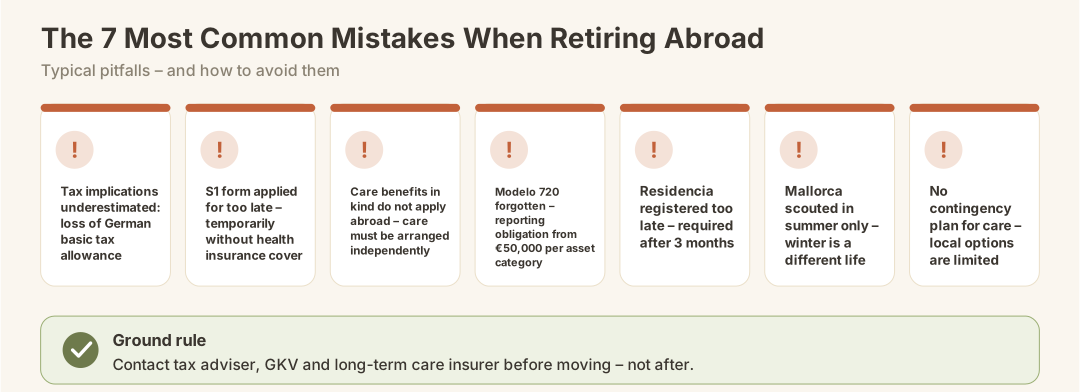
- Underestimating the tax consequences – Many retirees relocate without checking what tax obligations arise from giving up their German residence. Losing the basic personal tax allowance in Germany can prove costly.
- Applying for the S1 form too late – Anyone who applies for the S1 form only after moving will temporarily find themselves without adequate health insurance cover.
- Overlooking the implications for care allowances – Care benefits in kind do not apply abroad. Anyone who already has a recognised care level must arrange their own care provision on Mallorca.
- Forgetting the Modelo 720 – The obligation to declare assets held abroad affects many people who, after a long working life, hold savings, property, or securities in Germany.
- Registering residencia too late – After three months, registration is compulsory. Failing to do so can cause problems when accessing public services.
- Only scouting during the high season – Those who only know Mallorca in summer are in for a surprise: winter on the island is a very different experience.
- No contingency plan for care needs – People who are in good health today rarely plan for the possibility of increasing care needs. The options available locally are limited and should be explored well in advance.
What Comes Next? Next Steps Once You Have Made the Decision
Once the decision has been made, the following order of steps is recommended:
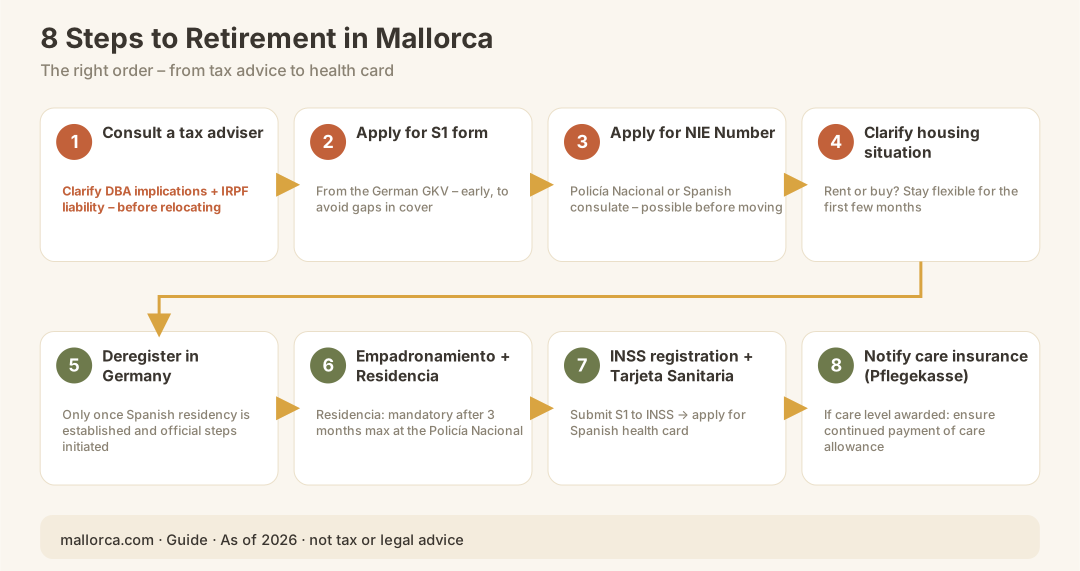
- Consult a tax adviser – Clarify the implications of the DBA and your IRPF obligations before changing your place of residence.
- Apply for the S1 form from your statutory health insurer (GKV) – Do this early, so that no gap in cover arises.
- Apply for your NIE number – This can be done before moving from Germany (e.g. through the Spanish consulate).
- Sort out your housing situation – Rent or buy? Stay flexible for the first few months.
- Deregister in Germany – Only once your Spanish residence is established and all the necessary steps with the authorities on Mallorca have been initiated.
- Empadronamiento + Residencia – As soon as possible after arrival and once your housing situation is secured.
- INSS registration and Tarjeta Sanitaria – Register with the INSS using the S1 form and apply for a health card.
- Inform your long-term care insurance provider – If you have a care needs assessment (Pflegegrad): inform your long-term care insurance provider of the change of residence and ensure continued payment of care allowance.
Checklist: Retiring to Mallorca
- Clarify your tax situation with a double taxation agreement specialist (before the move)
- Apply for the S1 form from your German statutory health insurer
- Apply for your NIE number
- Secure a property or flat on Mallorca
- Deregister in Germany (only after your Spanish residence has been secured)
- Empadronamiento at the relevant Ayuntamiento
- Apply for residencia at the Policía Nacional
- Submit the S1 to the INSS and apply for the Tarjeta Sanitaria
- Check Modelo 720 requirements (declare overseas assets if thresholds are exceeded)
- Inform your long-term care insurance provider of the change of residence (if you have a Pflegegrad)
- Consider supplementary private insurance (particularly for dental and specialist care)
- Have your German driving licence exchanged if necessary → Exchanging your driving licence
Conclusion
Retiring to Mallorca is the right move for many people – provided it is well planned. The island offers genuine financial advantages, legal security through EU membership, and an infrastructure that makes the transition considerably easier for German retirees. The pitfalls lie not in the fundamentals but in the details: the tax law surrounding the new double taxation agreement, access to health insurance via the S1 form, the realities of care allowance abroad, and the reporting obligations for assets.
Anyone who clarifies these points before the move – with a specialist tax adviser, their health insurer, and the relevant authorities – can enjoy retirement on Mallorca to the full.
Official sources
- Deutsche Rentenversicherung (DRV) – Pension payments abroad: www.deutsche-rentenversicherung.de
- German Consulate Palma / Federal Foreign Office – FAQ on health and long-term care insurance in Spain: spanien.diplo.de
- INSS – Instituto Nacional de la Seguridad Social (Spain): www.seg-social.es
- ATIB – Agència Tributària de les Illes Balears (Balearic tax authority): www.atib.es
- AEAT – Agencia Estatal de Administración Tributaria (Spanish tax authority, IRPF, Modelo 720): www.agenciatributaria.es
- BOE – Boletín Oficial del Estado (Spanish Official Gazette, double taxation agreement Germany–Spain): www.boe.es