
Private Health Insurance Spain Comparison: Sanitas, DKV, Adeslas & ASSSA
Anyone emigrating to Spain – whether to Mallorca, the mainland, or the Canary Islands – will sooner or later face a very practical question: how do I protect my health without having to rely on the often lengthy waiting times in the public system? Comparing private health insurance in Spain is not a luxury concern but simply a necessity for many residents – particularly those with no entitlement to the Spanish Seguridad Social, such as retirees without an S1 form or self-employed individuals in the early stages of their business. In this guide you will learn how the four most frequently mentioned providers – Sanitas, DKV, Adeslas, and ASSSA – are positioned, what they cost, what they cover, and which one suits which life situation best.

Which plan suits your situation in Mallorca – residencia, retirement, or self-employment?
- 📩 Submit a personal enquiry — We'll help you find the right provider and plan
- Overview: health insurance in Spain
The Spanish private insurance system – a brief explanation
Spain has two systems: the state Seguridad Social (comparable to the German public health insurance scheme) and the private sector, which is used by Spaniards and expats alike. The latter owes its growing popularity in no small part to the often lengthy waiting times in the public sector.
Private insurers conclude fee agreements with doctors and clinics, thereby building up a network of contracted providers. Within this network you can consult specialists directly – without having to go through a GP first. Billing is handled either by direct settlement on presentation of your insurance card or, for certain services, subject to prior approval from the insurer.
Please note: Traditional Spanish plans have historically excluded certain services that are taken for granted in the German system – these commonly include medication, vaccinations, medical aids, dental prosthetics, and high-cost therapies such as dialysis. However, this varies considerably depending on the provider and plan, which is precisely why a direct comparison is so important.
| Feature | Seguridad Social (public) | Private health insurance |
|---|---|---|
| Waiting times | Sometimes several weeks | Generally very short |
| Choice of doctor | Assigned doctor | Free choice of doctor within the network |
| Language | Spanish | Multilingual doctors often available |
| Monthly premium | Subject to social security contributions | From approx. 34–40 € (depending on age and plan) |
| Dental cover | Rarely included | Available as an add-on or included, depending on plan |
| Acceptance up to | — | Generally up to 75 years of age |
Who benefits from private health insurance in Spain?
Not every resident necessarily needs a private policy – but for certain groups it is practically indispensable:
- Retirees without an S1 form: Anyone who is not integrated into the Spanish healthcare system via the S1 form has no entitlement to the Seguridad Social and must make private provisions.
- Self-employed individuals (Autónomo) in the early stages: Those who have only recently registered as an Autónomo do pay Cuotas, but may not yet have built up full cover.
- Expats and digital nomads: For the Digital Nomad Visa or the Non-Lucrative Visa, proof of private health insurance without co-payments and waiting periods is mandatory.
- Families with children: Anyone living on Mallorca with children who needs quick access to paediatricians and specialists benefits considerably from the private system – more on this in the guide Schools & Life on Mallorca.
- Long-term residents and seasonal residents: Anyone staying longer than 90 days (see the 90/180-day rule) needs robust cover.
Sanitas – Widest reach, visa-compliant, transparent pricing
Sanitas is one of Spain's best-known private health insurers and belongs to the Bupa Group. For expats on Mallorca and the mainland, the Sanitas Más Salud tariff is particularly relevant, as it is recognised for applications for the Residencia (residence permit).
Tariff overview
| Tariff | Special feature | Price from (per person/month) |
|---|---|---|
| Sanitas Más Salud | Comprehensive cover, no excess, visa-eligible | approx. 55.26 € |
| Sanitas Más Salud Plus | Comprehensive cover with excess | approx. 40.31 € |
Please note: These prices are based on research and are subject to change. The actual premium depends on age, place of residence, and tariff details – an individual quote is recommended.
Sanitas strengths:
- Very wide network of contracted providers across mainland Spain and the Balearen
- Multilingual customer service (including German, English, Spanish, Swedish, French, Italian, and Dutch)
- Accepted for Residencia applications with no excess
- Direct billing throughout the entire Sanitas network
What you should bear in mind:
- The scope of cover outside the network depends on the tariff
- Lower-cost tariffs with an excess (Más Salud Plus) may not be fully suitable for visa applications – what matters here is the specific application form required by the consular authority
DKV – German expertise, strong international focus
The DKV (Deutsche Krankenversicherung) is present in Spain with, among others, the product lines DKV Salud Internacional and DKV Mundisalud, and is aimed particularly at German-speaking expats who expect a level of cover similar to German standards.
What DKV offers in Spain
| Area of cover | DKV speciality |
|---|---|
| Choice of doctor and hospital | Free choice also available outside the network |
| Dental care | Dental treatment and dentures are reimbursable to an above-average degree |
| Medication | Reimbursement of high-quality medication depending on the tariff |
| International cover | Worldwide validity under international tariffs |
| Preventive care | Preventive examinations and health check-ups |
| Psychotherapy | Included in certain tariffs |
| Physiotherapy | Included in certain tariffs |
DKV is considered particularly well-suited to people who value a German standard of service and a clear tariff structure. According to research, the provider offers flexible tariffs for employees, self-employed individuals, and expats.
Please note: DKV tariffs may also be suitable — depending on the specific tariff variant — as proof of residency (Residencia) or for visa applications. Which tariff is actually recognised should be clarified with the relevant immigration authority or consulate before taking out a policy.
ASSSA – Specialist for retirees and long-term residents
ASSSA Salud is a provider well established in the expat community, which according to research specialises particularly in retirees and older residents.
Strengths and limitations of ASSSA
| Criterion | ASSSA |
|---|---|
| Target group | Retirees, older residents, long-term residents |
| Maximum entry age | Generally up to 75 years |
| Premium increase with age | ASSSA advertises that premiums do not rise solely on the basis of age |
| Network | Independent contracted network, focus on specific regions |
| Psychotherapy | Not included in the standard offering according to user reports |
| Web portal | Dedicated client portal available |
| Dental cover | Limited in the standard tariff |
Expat reviews indicate that ASSSA performs well for classic core benefits – however, those who require psychotherapy or extensive dental cover will find other providers more suitable. The advertised premium stability is an important factor for retirees coming from the US or German insurance markets.
Adeslas – market leader by volume, extensive network
Adeslas (SegurCaixa Adeslas) is one of Spain's largest private health insurers and is known as a provider with a very broad doctor network. Within the expat community, Adeslas is not generally perceived as a premium provider, but its value for money and network density make it a serious option worth considering.
| Feature | Adeslas |
|---|---|
| Market position | One of Spain's largest providers |
| Network breadth | Very extensive doctor network, particularly on the mainland |
| Price range | Comparatively affordable |
| Multilingual support | Less strong than DKV or Sanitas |
| Visa suitability | Possible depending on tariff – check specific tariff details |
| Dental cover | Available as an add-on module |
Please note: Adeslas is mentioned in our research as a provider, but without the level of detail documented for Sanitas, DKV, or ASSSA. The information above is based on general market data – individual advice is essential before making any specific tariff decision.
The big comparison: providers at a glance
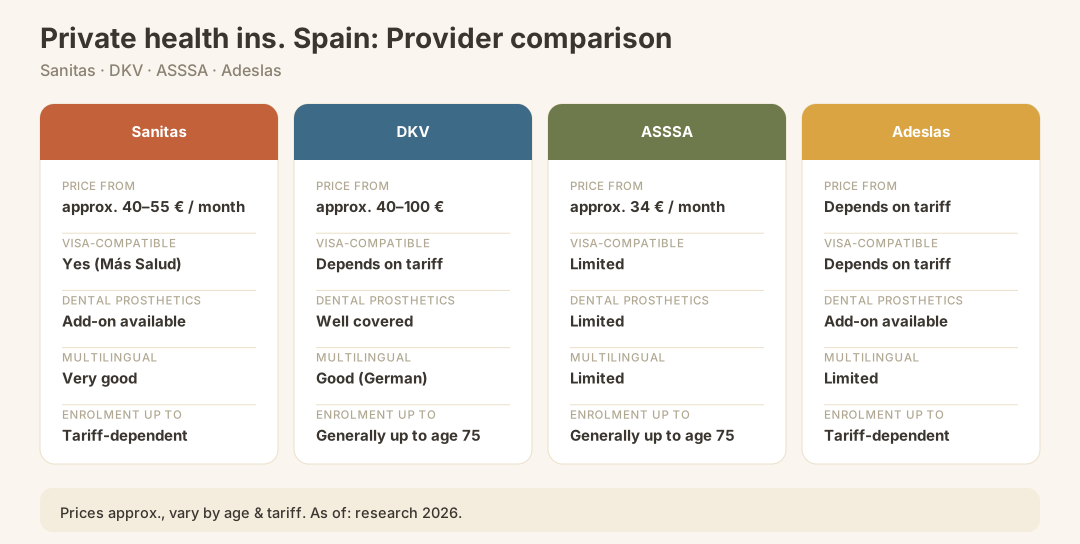
This table gives you a structured overview of all four providers – based on the available research sources:
| Criterion | Sanitas | DKV | ASSSA | Adeslas |
|---|---|---|---|---|
| Price from (approx.) | approx. 40–55 € / month | approx. 40–100 € (age-dependent) | approx. 34 € / month | depending on tariff |
| Visa-eligible (Residencia) | Yes (Más Salud) | Depending on tariff | Check – limited | Depending on tariff |
| Psychotherapy | Depending on tariff | Depending on tariff | Not included in standard | Depending on tariff |
| Dental prosthetics | Available as add-on | Well covered | Limited | Available as add-on |
| International coverage | Tariff-dependent | Internationally strong | Emergency care EU | Tariff-dependent |
| Multilingual service | Very good | Good (German) | Limited | Limited |
| Maximum age for enrolment | Depends on tariff | Typically up to age 75 | Typically up to age 75 | Depends on tariff |
| Premium stability with age | Standard | Standard | Explicitly advertised | Standard |
| Direct billing | Within network | Within network | Within network | Within network |
What Spanish insurance policies typically exclude
A key difference between German and Spanish tariffs: many local providers exclude certain services from their standard offering — either because the costs would otherwise be too high, or because these services are traditionally covered by the public sector.
Typical exclusions in standard Spanish tariffs (varies by provider and tariff):
- Medications (often must be paid for out of pocket)
- Vaccinations
- Aids and appliances (wheelchair, hearing aids, etc.)
- Dental treatment and dentures in the basic tariff
- Dialysis and other cost-intensive long-term treatments
- Psychotherapy (not always included)
- Glasses and optical aids
Please note: Anyone who requires these services — for example due to chronic conditions — needs to actively seek out providers and tariffs that explicitly include them. An experienced local broker is far more valuable than an online comparison tool.
You can find more detailed information about dental services in Mallorca here: Dentist Mallorca.
Private health insurance and the Residencia: what you need to know
To apply for the Residencia in Spain – that is, the residence permit for EU citizens – proof of adequate health insurance is required in many cases. Specific requirements apply:
- No Co-Payments (Co-Pagos): Policies with an excess are rejected by some consulates and immigration authorities.
- No Waiting Periods (Periodos de Carencia): Cover must take effect immediately.
- Comprehensive Cover with No Gaps in Benefits: Gaps in mental health, dental, or emergency cover can lead to rejection.
- Annual Policy Required: Monthly cancellable policies are often not sufficient.
The policy Sanitas Más Salud is explicitly identified in research as visa-compliant with no excess. With DKV, it depends on the specific policy – it is worth checking with the provider or broker before submitting your application.
Please note: The exact requirements vary depending on the consulate (for initial applications from Germany) and the municipality or Oficina de Extranjería on Mallorca. Always obtain up-to-date confirmation before taking out a policy.
Step by Step: How to Choose the Right Policy
- Clarify your situation: Are you a retiree, self-employed, an employee, or a digital nomad? This determines the basic requirements.
- Check visa requirements: Do you need the policy for a Residencia, Non-Lucrative Visa, or Digital Nomad Visa? If so, it must be free of co-payments and waiting periods.
- Declare pre-existing conditions: Pre-existing conditions must be declared in the application. Incorrect declarations can lead to cancellation of the policy.
- Prioritise benefits: What do you actually need? Dental, mental health, physiotherapy, international cover? Make a list before requesting quotes.
- Compare quotes: Obtain at least three quotes – ideally through an independent broker who is not tied to a single provider.
- Read the small print: Which benefits are genuinely included, and which are only available as add-on modules? What waiting periods apply for childbirth, dental prosthetics, or mental health conditions?
- Activate the policy:Once cover is arranged, apply for your insurance card, check the policy for completeness, and have it translated for official purposes if required.
The most common mistakes when taking out private health insurance in Spain
Mistake 1: Choosing the cheapest tariff without checking the benefits Entry-level tariffs may sound tempting, but they frequently fail to cover essential areas. Anyone who needs psychotherapy, physiotherapy, or dental prosthetics will end up paying more in the long run.
Mistake 2: Failing to declare pre-existing conditions Anyone who conceals asthma, diabetes, or chronic conditions in their application risks having the policy cancelled or a claim refused when the time comes to use it.
Mistake 3: Using tariffs with an excess for visa applications Tariffs with co-payments are not accepted by many consulates and immigration authorities for Residencia applications.
Mistake 4: Not checking the network A large network on the mainland does not automatically mean good cover on Mallorca. Check in advance whether your preferred clinics and doctors are part of the contracted network.
Mistake 5: Taking international cover for granted Many tariffs only cover emergencies outside Spain. Anyone who travels regularly within the EU needs an explicit international module.
What comes next? Keeping related cover in mind
Health insurance is just one component of your overall protection as a resident on Mallorca. You should address the following in parallel:
- The Mallorca healthcare system:Understand how the public system is structured and when you may still be able to make use of it.
- Taxes as a resident (IRPF):Premiums for private health insurance can be tax-relevant under certain conditions.
- Relocation Service Mallorca:Anyone who wants professional support throughout the entire relocation process will find guidance here.
- Empadronamiento Mallorca:Registering with the local residents' register is often a prerequisite for the Residencia and, by extension, for accessing public health services.
Checklist: Taking out private health insurance in Spain
- Residency status and visa requirements clarified
- Pre-existing conditions documented and prepared for the application
- Benefit priorities defined (dental, mental health, abroad, etc.)
- At least three quotes obtained from different providers
- Network on Mallorca / place of residence specifically checked
- Co-payment clauses and waiting periods in the policy reviewed
- Visa compatibility confirmed with the consulate or immigration authority
- Annual policy taken out with immediate cover start
- Insurance card received and saved (photo on mobile)
- Policy translated if required for official documents
Conclusion: Which provider is right for you?
There is no single answer to the question of the best private health insurance in Spain – it depends too much on your individual situation. What emerges clearly from the research:
- Sanitas Más Salud is the first choice if you need the policy primarily for residency or a visa application – clearly structured, no excess, visa-compliant.
- DKV is the strongest option for German-speaking expats who expect a level of cover close to German standards and place value on dental benefits and international coverage.
- ASSSA is particularly appealing to retirees and older residents who value premium stability and do not require psychotherapy.
- Adeslas can be an interesting choice for cost-conscious residents who prioritise a large network of doctors on the mainland – the multilingual aspect is less pronounced here.
The price range of approx. 34 to 100 € per month can only be meaningfully assessed once you know which benefits you actually need. Get independent advice – ideally from someone who knows the Mallorca market.
Official sources
- Seguridad Social Spain (healthcare system): www.seg-social.es
- Ministerio de Sanidad – health information: www.sanidad.gob.es
- Conselleria de Salut Balearic Islands (Ib-Salut): www.ibsalut.es
- AEAT – tax treatment of insurance premiums: www.agenciatributaria.es
- Dirección General de Seguros y Fondos de Pensiones (DGSFP): www.dgsfp.mineco.es