
Crypto Tax Spain: Correctly Declaring Bitcoin and Altcoins to the Hacienda
Anyone who is tax-resident in Spain and buys Bitcoin, trades altcoins, or receives staking rewards faces a regulatory framework that has changed fundamentally in recent years. Crypto tax in Spain is far from a niche topic today: the Agencia Tributaria has massively tightened its controls, created a dedicated reporting form for crypto assets held abroad with the Modelo 721, and is preparing to receive transaction data from exchanges automatically from 2026. This guide explains step by step which taxes apply to which crypto activities, which forms you need to submit and when, what the most common mistakes are — and how thorough documentation can give you peace of mind. All information relates to tax residents (residentes) in Spain.
Do you hold crypto assets worth more than €50,000 on foreign platforms — and do you know whether you have filed the Modelo 721 correctly?
- 📩 Submit a personal enquiry — We connect you with vetted tax advisers with crypto expertise on Mallorca
- All tax guides at a glance
How Spain defines cryptocurrencies
Spain treats cryptocurrencies for tax purposes as financial assets, not as legal tender. Under Ley 46/1998 of 17 December 1998, the euro remains the only legal currency in Spain. Bitcoin, Ethereum, Solana, and all other tokens are therefore neither money nor currency in the legal sense, but digital assets (activos virtuales).
What this means in practice: every transaction — a sale, a swap, a payment made in crypto, a staking payout — can trigger a taxable event. The Agencia Tributaria (AEAT) has consistently maintained this position in its guidance and has most recently reinforced it through several new legal instruments.
The key legal bases at a glance
| Legal basis | Content | Relevant since |
|---|---|---|
| Ley 35/2006 (IRPF Act) | Income tax for residents; crypto gains as capital income | Ongoing |
| Ley 11/2021 (Anti-Fraud Act) | Extended reporting obligations for exchanges; legal basis for Modelo 721 | 10.07.2021 |
| Orden HFP/887/2023 | Introduction of the Modelo 721 (crypto assets held abroad) | From tax year 2022 |
| EU DAC8 Directive | Automatic exchange of information on crypto assets within the EU | From 01.01.2026 |
| CARF (OECD) | Transaction reporting obligation for crypto service providers, including non-EU | From 01.01.2026 |
Note: Spain is no special case – the DAC8 directive, taking effect in 2026, obliges all EU member states to automatically exchange data on crypto transactions with one another. As a resident in Spain, you will therefore be captured even if you trade on a platform based in another EU country.
Who is liable to tax in Spain?
Tax residency in Spain arises when you spend more than 183 days in the calendar year in Spain, or when your primary centre of economic interest (family or professional base) is located in Spain. In this case, you are subject to unlimited tax liability on your worldwide income – this includes, without exception, crypto gains realised on a German, US, or any other foreign platform.
Anyone who does not exceed the 183-day threshold is considered a non-resident and falls under the non-resident income tax (IRNR) – a separate regime that is not the focus of this guide.
→ Everything on the topic of residency: Residencia Spanien
Taxable events: what triggers a tax liability, and when?
This is the question most crypto investors underestimate. In Spain, the rule is: Not only selling for euros is taxable. Every exchange of one cryptocurrency for another is also a taxable event, as the Agencia Tributaria treats this as a disposal of the first asset and an acquisition of the second.
| Transaction | Taxable? | Type of tax |
|---|---|---|
| Sale of Bitcoin for euros | Yes | Capital gain (IRPF) |
| Exchange of BTC for ETH | Yes | Capital gain (IRPF) |
| Purchase of goods/services with crypto | Yes | Capital gain (IRPF) |
| Staking rewards | Yes | Investment income (rendimientos del capital mobiliario) |
| Lending interest | Yes | Capital income (rendimientos del capital mobiliario) |
| Gift / inheritance of crypto | Yes | Inheritance / gift tax |
| Purchase of crypto for euros (not a sale) | No | No taxable event |
| Transfer between own wallets | No | No taxable event (document it!) |
Note: Many investors overlook coin-to-coin swaps. Anyone who exchanged Ethereum for Solana in 2024 must declare the gain (or loss) realised in doing so in their Renta 2024 — regardless of the fact that they never received a single euro in cash.
Capital gains tax (IRPF): rates and calculation
Gains from the sale or exchange of cryptocurrencies flow into the so-called base imponible del ahorro — the savings and capital gains component of the Spanish income tax. Graduated tax rates apply there, regardless of the holding period. A tax-free holding period such as exists in Germany (one year there) does not.
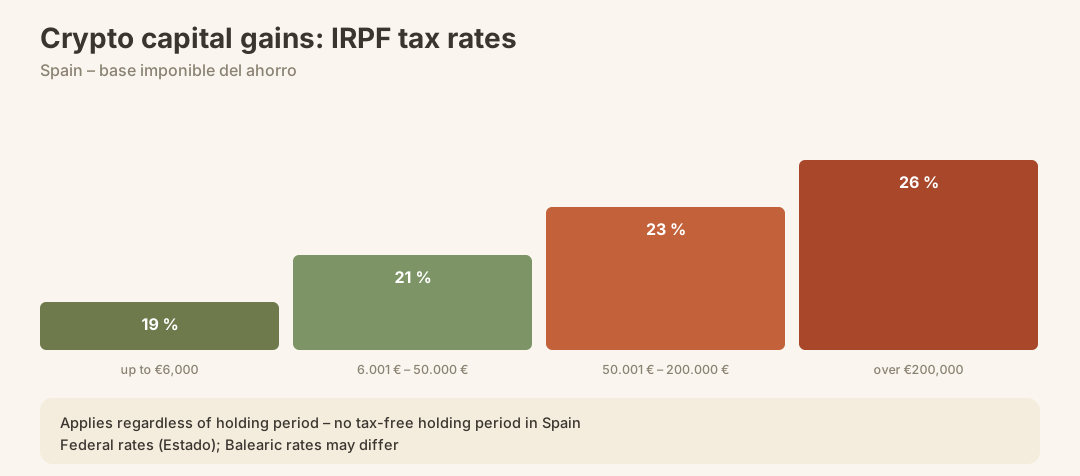
IRPF tax rates on crypto capital gains (Renta)
| Taxable gain (bracket) | Tax rate |
|---|---|
| Up to 6.000 € | 19 % |
| 6.001 € – 50.000 € | 21 % |
| 50.001 € – 200.000 € | 23 % |
| Over 200.000 € | 26 % |
These rates are federal rates (Estado). The Balearic Islands, as an autonomous community, may make their own adjustments — check the current Balearic rates with your tax adviser each year.
How to calculate your gain
The taxable gain is derived from the sale price minus the acquisition price (plus all costs directly associated with the purchase, such as transaction fees). As a valuation method, Spain applies — in line with other securities — the principle of FIFO (First In, First Out): The units purchased first are deemed to be sold first.
Worked example:
- Purchase: 1 BTC in March 2023 for €25,000
- Purchase: 1 BTC in November 2023 for €35,000
- Sale: 1 BTC in June 2024 for €55,000
Under FIFO, the Bitcoin purchased in March 2023 is treated as sold → Gain: €55,000 – €25,000 = 30.000 € Tax: €6,000 × 19 % + €24,000 × 21 % = €1,140 + €5,040 = €6,180
Staking, lending and mining: classifying special cases correctly
Passive crypto income such as staking rewards or interest from crypto lending is not treated as a capital gain in Spain but rather as investment income (rendimientos del capital mobiliario). It also flows into the base imponible del ahorro and is taxed at the same progressive rates of 19 % to 26 %. The difference lies in the timing: this income is taxable in the year it is received — not when the tokens received are subsequently sold.
Mining has a further peculiarity: commercial mining may be classified as an economic activity and is then subject to the standard income tax rate (base imponible general) as well as, where applicable, VAT and social security contributions as an autónomo.
Note: Whether your mining activity is regarded as commercial depends on its scale, regularity and the infrastructure deployed. If in doubt, a tax adviser specialising in crypto should be consulted.
The Modelo 721: declaring crypto assets held abroad
Since the 2022 tax year, the Modelo 721 has been introduced as a dedicated declaration form for cryptocurrencies held on foreign platforms. It is the counterpart to the Modelo 720 for bank accounts and securities held abroad.
Modelo 721 – who must file?
You are required to submit if all three of the following conditions are met:
- You have tax residency in Spain (more than 183 days or your main centre of economic activity is there).
- You hold cryptocurrencies on a foreign exchange or platform (e.g. Binance, Kraken, Coinbase – provided they are based outside Spain).
- The total value of all crypto assets held there amounts to €50,000 or more on 31 December of the tax year.
What do you need to declare in the Modelo 721?
| Required detail | Details |
|---|---|
| Name of the crypto platform | e.g. Binance, Kraken, Coinbase |
| Total value on 31 December | Valuation in euros at the reference date exchange rate |
| Type of assets | Bitcoin, Ethereum, altcoins, etc. |
| Country where the platform is based | Country of registration of the exchange |
Filing deadline: The Modelo 721 must generally be submitted between 1 January and 31 March of the following year. Please check the current deadline on the Agencia Tributaria website.
Please note: Private wallets and crypto assets held on Spanish platforms are not subject to reporting via the Modelo 721. Nevertheless, gains from these holdings may of course be taxable under IRPF.
The Renta (Modelo 100): How to include crypto in your income tax return
The Modelo 721 is a purely declaratory obligation – it does not replace your income tax return (Declaración de la Renta, Modelo 100). Gains, losses, and capital income from crypto must also be declared in your annual Renta.
Step by step: crypto in the Renta
- Export all transactions for the tax year – most exchanges offer a CSV export or a tax summary.
- Calculate profit/loss per transaction – sale price minus FIFO cost basis, including fees.
- Record staking/lending income separately – these fall under a different section of the Renta than capital gains.
- Check loss offsetting – capital losses from crypto can be offset against capital gains in the same year; any remaining excess losses can be carried forward for up to four years.
- Enter the figures in the relevant field of the Renta – capital gains under ganancias y pérdidas patrimoniales, staking income under rendimientos del capital mobiliario.
- Meet the filing deadline – the Renta campaign generally runs from April to the end of June of the following year.
Please note: Losses from crypto investments cannot be offset against regular employment income or rental income – only against other investment income and capital gains.
From 2026: New reporting obligations for crypto exchanges (CARF & DAC8)
From January 2026, one of the most significant changes for crypto investors comes into effect: all crypto service providers operating in Spain (Crypto-Asset Service Providers, CASPs) – including international platforms serving Spanish residents – are required to report detailed transaction data for their users to the Agencia Tributaria. This includes:
- User identities (including non-residents)
- Annual buy, sell, and exchange transactions
- Wallet balances and crypto assets
This regulation is based on the OECD framework CARF (Crypto-Asset Reporting Framework) and the EU directive DAC8, which has been in force since 1 January 2026. In concrete terms, this means:The Agencia Tributaria will in future have access to balances, purchases, sales and exchange transactions on reportable platforms. Anyone who has previously submitted incomplete information should use the time until then to regularise their tax situation.
Please note: Under the new rules, the reporting obligation expressly also applies to decentralised platforms and cross-border transactions — not just to traditional, centralised exchanges.
Wealth tax and inheritance tax on crypto
Wealth tax (Impuesto sobre el Patrimonio)
As a tax resident in Spain, you must declare your worldwide net assets in your wealth tax return. Cryptocurrencies are included — valued at the market value on 31 December of the tax year. Whether wealth tax is actually payable depends on your total assets and the applicable allowance.
→ More on this: Wealth tax Spain
Inheritance and gifts
If cryptocurrencies are gifted or inherited, inheritance and gift tax (Impuesto sobre Sucesiones y Donaciones) applies in Spain. The amount is determined by the market value at the time of transfer and the rates and allowances applicable in the Balearic Islands.
The Beckham Law special regime and crypto
Anyone making use of the special regime for workers posted abroad (Régimen Especial para Trabajadores Desplazados, also known as the Beckham Law) is only taxed on Spanish income — foreign income is generally excluded. This sounds appealing, but has an important consequence for crypto investors: gains from crypto transactions processed via foreign platforms may, depending on their classification, benefit from the tax exemption. At the same time, the new CARF/DAC8 rules from 2026 onwards mean there is an increased need for scrutiny, as exchanges will also identify and report Beckham Law users.
Please note: The tax treatment of crypto gains under the Beckham regime is complex in detail. You should absolutely have this reviewed by an adviser specialising in international tax law.
Penalties and fines: what are the consequences of non-compliance?
The Agencia Tributaria has significantly increased the number of tax audits involving crypto in recent years. The consequences of infringements are considerable:
| Infringement | Possible consequence |
|---|---|
| Failure to submit the Modelo 721 | Fine per each undeclared asset |
| Incomplete or incorrect information | Back payment + surcharges (recargos) |
| Late submission of the Renta | Late payment surcharge, plus interest where applicable |
| Serious tax evasion | Criminal and tax fraud proceedings |
The Agencia Tributaria can, in cases of undeclared crypto gains, not only demand back payment of tax but also impose sanctions under the anti-fraud law Ley 11/2021. In extreme cases, criminal consequences may follow.
Most common mistakes with crypto tax in Spain
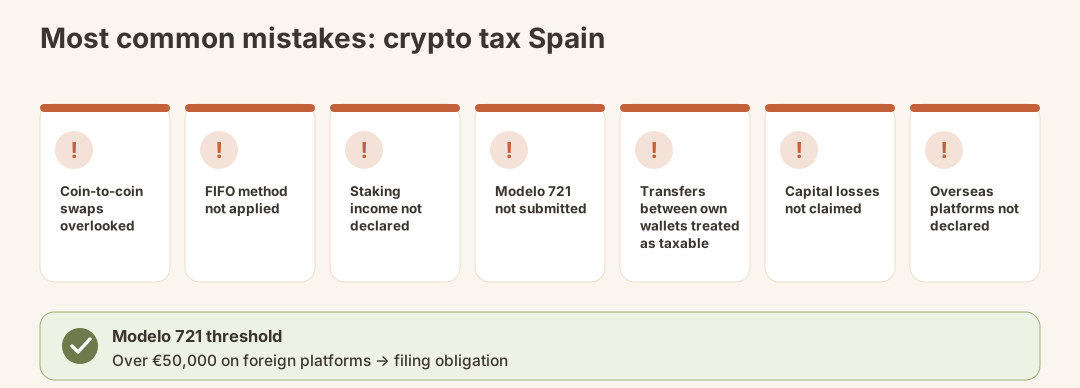
- Forgetting coin-to-coin swaps: Anyone swapping ETH for SOL realises a taxable gain or loss on the ETH position — this must appear in the Renta.
- Not applying the FIFO method: The arbitrary matching of buy-and-sell pairs is not permitted; FIFO applies.
- Staking income not declared: Staking rewards are frequently regarded as 'not yet realised' — however, they are taxable in the year they are received.
- Modelo 721 not submitted: Anyone holding more than 50.000 € on foreign platforms who fails to submit the form risks substantial fines.
- Transfers between one's own wallets treated as taxable: These do not constitute a taxable event, but must be carefully documented (timestamps, wallet addresses, amounts).
- Capital losses not claimed: Losses from crypto can be offset against other capital gains and carried forward for up to four years — many investors fail to take advantage of this.
- Foreign platforms not declared: With CARF/DAC8 from 2026 onwards, the data will be reported regardless; it is better to make a voluntary correction now.
What comes next? Crypto regulation in 2026 and beyond
Spain is moving, along with the rest of the EU, towards a significantly more transparent crypto tax regime. The key developments:
- CARF from January 2026: Crypto service providers will report user data to the Spanish tax authority.
- DAC8 from January 2026: Automatic exchange of data between EU tax authorities regarding crypto assets.
- MiCA Regulation: The European Markets in Crypto-Assets framework (MiCA) establishes a unified licensing framework for crypto service providers in the EU and further increases transparency.
- Digital Euro: The Bank of Spain has given the green light to MONEI's EURM stablecoin project; initial tests of the digital euro with the ECB took place in May 2025.
For investors, this means: anonymous crypto trading as a resident in Spain will become virtually impossible. A complete transaction history and a proactive tax strategy are not optional — they are mandatory.
Checklist: Crypto Tax Spain – Annual Checklist for Residents
- All transactions for the tax year exported (CSV from every exchange used)
- FIFO calculation carried out for all sales and swap transactions
- Staking/lending income recorded and valued separately
- Crypto assets on foreign platforms valued as at 31 December
- Check: Does the total value on foreign platforms exceed 50.000 €? → Submit Modelo 721 (deadline: generally 31 March of the following year)
- Losses identified and loss carryforwards from previous years taken into account
- Transfers between your own wallets documented
- Crypto holdings included in the wealth tax return
- Renta (Formular 100) submitted with all crypto details by the end of June
- Tax adviser with crypto experience consulted (especially for complex DeFi structures)
Conclusion
Crypto tax in Spain is complex, but manageable — provided you know which rules apply. Spain taxes crypto gains at 19 % to 26 % with no tax-free holding period, requires the Modelo 721 for holdings exceeding 50.000 € on foreign platforms, and from 2026 will achieve near-complete transparency over all transactions through CARF and DAC8. Anyone who organises their transaction history now, applies FIFO consistently, submits all forms on time, and actively claims losses is well positioned. Those who wait risk not only fines, but will face a system in 2026 that already has access to all their data.
→ Taxes as a Resident (IRPF) | ETF & Index Funds Spain Tax | Tax Adviser Spain Expat
Official Sources
- Agencia Tributaria (AEAT) – Modelo 721 (Declaración de monedas virtuales en el extranjero): https://sede.agenciatributaria.gob.es/Sede/en_gb/procedimientoini/GI55.shtml
- BOE – Law 11/2021, of 9 July, on measures for the prevention and combating of tax fraud: https://www.boe.es/eli/es/l/2021/07/09/11
- BOE – Order HFP/887/2023 (Modelo 721): https://www.boe.es
- Agencia Tributaria – IRPF, Income Tax Return (Modelo 100): https://www.agenciatributaria.es
- European Commission – DAC8 Directive (Directive 2023/2226/EU): https://eur-lex.europa.eu
- OECD – Crypto-Asset Reporting Framework (CARF): https://www.oecd.org/tax/exchange-of-tax-information/crypto-asset-reporting-framework-and-amendments-to-the-common-reporting-standard.htm