
German civil service pensions in Spain: where is tax due?
Retired civil servants from Deutsche Post or Deutsche Bahn who move the centre of their lives to Mallorca occupy a special position for tax purposes: the question of taxation of civil service pensions in Spain is, in principle, settled in their favour: under Article 18(1), the German–Spanish double taxation agreement (DTA) gives Germany the exclusive right to tax them. But in December 2025, according to press reports, an instruction from the tax authorities in North Rhine-Westphalia caused alarm: some of these pensioners were suddenly to become liable for tax in Spain, with significant financial consequences. The all-clear came at the end of March 2026. This guide explains what happened, why you should still take action, and how the DTA normally works for you.

- Taxes for residents of Mallorca — IRPF basics for all residents
Tax on a German statutory pension in Spain
Explanation
Rendimiento del trabajo means employment and pension income. Enter your current annual gross statutory pension; in the first year, enter the amount actually paid. The preset is an example, not a statistic: there is no official average pension for emigrants.
Explanation
Your first actual payment determines Germany’s taxing right and the treaty cap under Protocol VI, independently of the calculation year.
Explanation
Mínimo personal means Spain’s personal tax allowance. Your age at the end of the tax year determines the age additions; the state and Balearic allowances are calculated separately.
- Total tax · forecast
- €8,346.95
- German tax · forecast
- €1,080.00
- Spanish tax after credit · forecast
- €7,266.95
- Net of total gross income (pension plus other income)
- €31,253.05
Legal status: 1 January 2026
This calculation is provided for guidance only and is not a substitute for tax or legal advice in specific cases.
The double taxation agreement and the public-purse principle
The German–Spanish double taxation agreement (DTA) determines which country has the right to tax particular types of income. For pensioners, one distinction is crucial:
| Type of income | Right to tax under the DTA | Article |
|---|---|---|
| Statutory pension (Deutsche Rentenversicherung) | Spain (country of residence) | Art. 17 |
| Civil service pension paid from public funds | Germany (paying state) | Art. 18 Abs. 1 |
| Private pension / occupational pension | Spain (country of residence) | Art. 17 |
The so-called public-purse principle means that if a pension is paid from the public funds of a contracting state, that state — and that state alone — has the right to tax it. For conventional federal civil servants, that is clearly Germany.
In practice, a retired civil servant living on Mallorca who receives only a civil service pension does not have to file an income tax return (IRPF) in Spain and pays tax in Germany, with the allowances available there.
Note: This rule applies only to pensions paid from public funds. Anyone who also receives a statutory pension from Deutsche Rentenversicherung or has private income should have their tax position assessed separately.
What happened in December 2025: the OFD directive
According to reports in Mallorca Zeitung, a regional tax authority in North Rhine-Westphalia issued an instruction in December 2025 (the reports name Düsseldorf in one instance and Köln in another); it has not been published. Its central point was that the public-purse principle should no longer apply to retired civil servants from certain formerly state-owned enterprises, specifically Deutsche Post and Deutsche Bahn. The reasoning, in essence, was that after privatisation, the post office and railway no longer constituted a “public purse” within the meaning of the DTA.
The consequences would have been serious: this group would have had to pay tax on their pensions in Spain in future, at progressive Spanish IRPF rates that can reach 47 %, and without German reliefs such as the age-related tax allowance or the basic personal allowance.
What the OFD directive would have meant in practice
| Situation | Tax outcome under the OFD directive |
|---|---|
| Pension up to approx. 12,000 euros/year (single) | Taxable in Spain, but below the tax-free allowance threshold |
| Pension of 20,000 euros/year (single) | Spanish IRPF tax, no German basic tax-free allowance |
| Pension of 30,000 euros/year (married couple) | No longer eligible for the German tax benefit of joint assessment, resulting in higher overall tax |
| Those affected with an existing tax assessment | An objection must be lodged within the objection period |
Important: The directive came without warning and took many of those affected completely by surprise. Anyone who had already received an amended tax assessment had to respond by the deadline.
The all-clear: directive withdrawn (March 2026)
At the end of March 2026, the Mallorca Zeitung reported that the directive had been withdrawn with the support of the Federal Ministry of Finance. We have not seen a published directive or a BMF letter confirming this. Anyone who received a tax assessment based on the directive should therefore have it reviewed.
Retired Post and Railway civil servants whose centre of life and tax residence are in Spain remain subject exclusively to German tax law under Article 18 paragraph 1 DBA. They therefore benefit from:
- the German basic tax-free allowance (2026: 12,096 euros for single people, 24,192 euros for married couples filing jointly)
- the German age-related tax allowance
- the German joint taxation of married couples
Note: Anyone who received an amended tax assessment based on the interim OFD directive should, despite the general all-clear, check whether a formal objection is necessary. Tax assessments are not corrected automatically.
Who exactly is affected? Post, Railway and other civil servants
The debate about the OFD directive primarily concerned civil servants who worked for Deutsche Post or Deutsche Bahn – both formerly state-owned companies that were privatised. Their civil servants remain federal civil servants, however, and their pensions are paid through government bodies (in particular the Bundesanstalt für Post und Telekommunikation, BAnst PT).
| Type of pension | Paying body | Tax treaty classification |
|---|---|---|
| Federal civil servant's pension (general) | Bundeskasse / relevant authority | Public funds → Article 18(1) |
| Former postal civil servant's pension | Bundesanstalt für Post und Telekommunikation (BAnst PT) | Previously disputed, now once again Article 18(1) |
| Former railway civil servant's pension | Relevant pension authority | Previously disputed, now once again Article 18(1) |
| Statutory pension (DRV) | Deutsche Rentenversicherung | Article 17 → taxed in Spain |
| Private/occupational pension | Insurer / pension fund | Article 17 → taxed in Spain |
Note: If you receive both a civil service pension and a statutory pension, your tax liability is split: the civil service pension is taxed in Germany and the statutory pension in Spain. This generally means filing tax returns in both countries.
Tax residency in Spain: When does this affect you?
The tax treaty only becomes relevant if you are actually tax resident in Spain. Spanish tax law (Article 9 of the IRPF Act, Law 35/2006) sets out several criteria – meeting just one is enough:
- 183-day rule: You spend more than 183 days in Spain during the calendar year (1 January to 31 December). The days do not have to be consecutive.
- Centre of economic interests: The main focus of your economic interests is in Spain.
- Centre of family life: Your spouse (unless you are separated) or minor children are resident in Spain.
Important:Anyone who spends fewer than 183 days in Spain but has their permanent centre of life on Mallorca (family, home, bank account) can still be considered tax resident. The 183-day threshold is only one of several tests.
Anyone classed as a non-resident – meaning they spend fewer than 183 days in Spain and do not have their permanent centre of life there – is not subject to IRPF but to non-resident income tax (IRNR). As a rule, however, this does not apply to people who have moved to Mallorca full-time. Read more in the guide Non-resident income tax in Spain.
The practical tax position for retired German civil servants on Mallorca
Under current law, the position for retired German civil servants living on Mallorca is as follows:
Step by step: assessing your tax position
- Check your tax residence: Do you live on Mallorca for more than 183 days a year, or is it your centre of life? → Yes: You are tax resident in Spain.
- Identify the type of income: Do you receive only a German civil service pension? → If so, Article 18(1) of the double taxation agreement applies.
- Tax liability in Germany: Your pension is taxed in Germany by Finanzamt Neubrandenburg (the tax office responsible for pensioners living abroad).
- Tax liability in Spain: In principle, you do not need to file an IRPF return for the pension (provided you have no other income taxable in Spain).
- Check for mixed income: Do you also receive a statutory pension, rental income or other income? → A separate assessment is needed; consult a tax adviser.
- Check your tax assessments: Have you already received an amended assessment from the period when the OFD directive applied? → Check whether you can appeal.
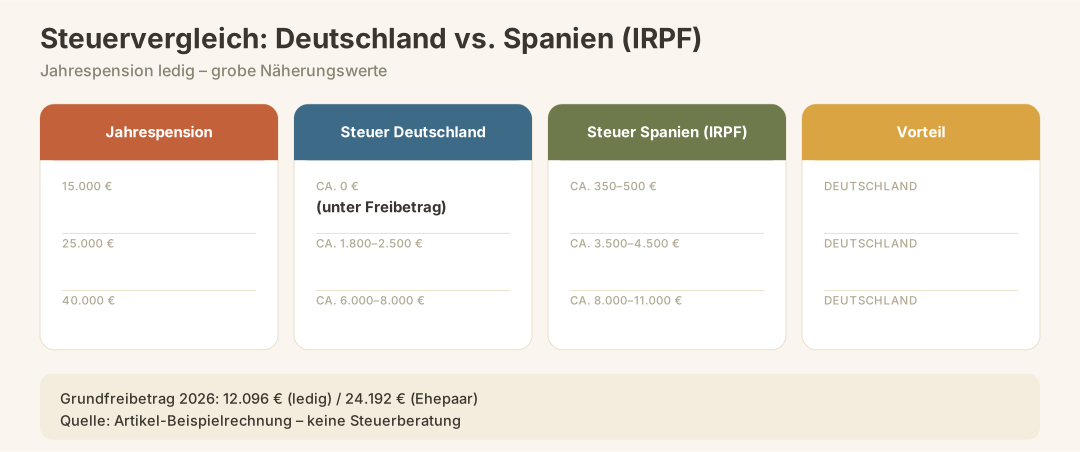
Comparison: pension tax in Germany vs IRPF in Spain (illustrative calculation)
| Annual pension (single person) | Tax in Germany (approx.) | IRPF in Spain (approx.) | Advantage |
|---|---|---|---|
| 15,000 euros | Approx. 0 euros (below the 12,096 tax-free allowance plus age-related tax relief) | Approx. 350–500 euros | Germany |
| 25,000 euros | Approx. 1,800–2,500 euros | Approx. €3,500–€4,500 | Germany |
| €40,000 | Approx. €6,000–€8,000 | Approx. €8,000–€11,000 | Germany |
Note: These figures are highly simplified estimates for illustration. Your actual tax liability depends on other income, deductions, marital status and the basis of calculation. Seek advice from a tax adviser with experience of double taxation agreements.
Registration requirements and official procedures: What you need to do in Germany and Spain
Even if you remain liable for tax in Germany, you have administrative obligations in both countries.
In Germany
- Finanzamt Neubrandenburg is responsible for retirees and pensioners living abroad who receive income from Germany.
- You must still file a German income tax return.
- You must inform the tax office that you have moved to Spain and be able to provide a certificate of tax residence (Certificado de Residencia Fiscal).
- Deregistering your German place of residence is formally necessary to cease being subject to unlimited tax liability in Germany – but it does not automatically resolve every tax issue.
In Spain
- Empadronamiento (registration with the local municipality) – the essential first step for everything else. More on this: Empadronamiento Mallorca
- Residencia (NIE + right of residence as an EU citizen): apply for these. More on this: Residencia Spain
- Certificado de Residencia Fiscal from the Spanish tax office – this certificate is important for the German tax office.
- IRPF return: If your only income is a civil service pension and it is taxed in Germany, you generally do not need to file a tax return in Spain. However, if you also have Spanish income (e.g. rental income), you may need to file one.
| Authority | Task | Jurisdiction |
|---|---|---|
| Finanzamt Neubrandenburg | German tax return for pensioners living abroad | Germany |
| Agencia Tributaria (AEAT) | Spanish tax authority | Spain |
| Ayuntamiento (municipal office) | Empadronamiento | Mallorca |
| Policía Nacional | Residencia / NIE | Mallorca |
Modelo 720 and other reporting obligations in Spain
If you are tax resident in Spain, you may have additional Spanish reporting obligations – even if your pension is taxed in Germany.
- Modelo 720: Assets held abroad (bank accounts, securities and property outside Spain) worth more than 50,000 euros per category must be reported. Find out more: Modelo 720 reporting obligation
- Wealth tax (Impuesto sobre el Patrimonio): If you are a tax resident with substantial total assets, Spanish wealth tax may apply.
- German tax obligations remain: If you were subject to unlimited tax liability in Germany and simply deregister your residence without meeting all the requirements, you may become subject to extended limited tax liability.
Important: In certain cases, the German Foreign Tax Act provides for retrospective taxation if you move to a low-tax country. Spain is not automatically considered a low-tax country under this rule. Even so, please get your individual circumstances checked before moving.
The most common mistakes about civil service pensions and Spain
This section is not just a theoretical exercise – it reflects questions that come up time and again in practice.
- “I no longer pay tax in Germany because I live in Spain.” Incorrect: Retired civil servants continue to pay tax on their pensions in Germany – to Finanzamt Neubrandenburg.
- “Postal and railway civil servants are different from other civil servants.” This was disputed briefly, but has now been clarified: they too fall under Article 18 paragraph 1 of the DBA.
- “I don’t need to file a tax return in Spain.” That’s true for the civil service pension itself – but not if you also have income taxable in Spain or a combination of different types of income.
- “The OFD decision didn’t affect me, so I don’t need to do anything.” Check anyway whether your tax assessment was changed during the transitional period from December 2025 to March 2026. Amended assessments are not automatically reversed.
- “Modelo 720 doesn’t apply to me because I pay tax in Germany.” Incorrect: Modelo 720 is a Spanish reporting requirement for tax residents, regardless of where you pay income tax.
- “The DBA protects me completely from double taxation.” The DBA determines which country has the right to tax your income, but it does not remove your reporting obligations in Spain or prevent cases involving different types of income from becoming complicated.
- “My wife receives a statutory pension – that doesn’t change anything.” It does: statutory pensions are taxed in Spain under Article 17 of the DBA. Couples with different types of income have to deal with two separate tax systems.
What comes next? Topics closely linked to your pension
Taxation of your civil service pension is just one part of your tax and legal situation in Mallorca. These topics are closely related:
- Taxation of German statutory pensions in Spain: If you receive a statutory pension as well as your civil service pension, different rules apply. Taxation of German statutory pensions in Spain
- IRPF deductions in the Balearic Islands: Even if your civil service pension is not subject to IRPF, other income may be. IRPF deductions in the Balearic Islands
- Health insurance in Spain: As a pensioner from Germany, you may be able to use the S1 form. S1 form for Spain
- Spanish will: Inheritance matters involving more than one country should be planned for. Spanish will
- Gestoría: A local Gestoría can handle many of these tasks. Gestoría in Spain
Checklist: A retired civil servant moves to Mallorca
Use this checklist as a starting point – it is no substitute for individual advice, but it provides a structured overview.
Before the move
- Clarify how your pension is treated under the DBA (paid from public funds: yes or no?)
- Identify cases involving multiple income sources (state pension, private pension, rental income)
- Deregister your residence in Germany and inform the tax office
- Apply to have Finanzamt Neubrandenburg designated as your responsible tax office
- Engage a tax adviser familiar with the DBA
After the move
- Apply for empadronamiento in your municipality on Mallorca
- Apply for residencia / NIE
- Apply to the AEAT for a Certificado de Residencia Fiscal
- Check whether Modelo 720 applies (foreign assets worth more than €50,000 per category)
- Review any tax assessments issued between Dec. 2025 and March 2026
- Ensure you have health insurance cover (S1 form or private health insurance)
- Have a Spanish will drawn up
Conclusion
The good news outweighs the bad: following the withdrawal of the OFD directive, the principle that public-service pensions are taxed by the paying state once again applies without restriction to former postal and railway civil servants. Retired civil servants living on Mallorca pay income tax on their pensions in Germany – with the basic tax-free allowance and age-related tax relief, which in 2026 amount to €12,096 (single) and €24,192 (married couple, joint assessment) respectively. For most pension levels, this is considerably more favourable than taxation under Spain’s IRPF system.
The episode involving the OFD directive does, however, show how quickly administrative guidance can change – and how important it is to keep a close eye on your own tax assessments. Anyone who received a revised assessment during the transitional period (December 2025 to March 2026) should not assume the matter will resolve itself automatically.
And as soon as other sources of income come into play alongside the pension – a state pension, rental income or investment income – the situation can quickly become complex.
Official sources
- German–Spanish double taxation agreement (DBA): Article 17 (pensions) and Article 18 (public-service pensions) — https://www.bundesfinanzministerium.de
- Spain’s IRPF law (Ley 35/2006), Artículo 9: Tax residence — https://www.boe.es
- Agencia Tributaria (AEAT): Spanish tax authority responsible for IRPF and Modelo 720 — https://www.agenciatributaria.es
- Finanzamt Neubrandenburg: Tax office responsible for German pensioners living abroad — https://www.finanzamt-neubrandenburg.de
- Federal Agency for Post and Telecommunications Deutsche Post (BAnst PT): Pension provider for postal civil servants — https://www.banst-pt.de
- Mallorca Zeitung – original article on the OFD directive (March 2026): https://www.mallorcazeitung.es/geld/2026/03/22/auswandern-nach-mallorca-steuerfalle-fur-128157214.html
- Mallorca Zeitung – all-clear (March 2026): https://www.mallorcazeitung.es/geld/2026/03/31/auswandern-nach-mallorca-entwarnung-fur-128620161.html
If your pension comes from Switzerland
Yes, Switzerland and Spain have their own double taxation agreement covering taxes on income and wealth. It was concluded in 1966 and subsequently amended. Anyone living in Mallorca who receives payments from Switzerland must therefore check the Swiss–Spanish agreement, not the provisions of the German–Spanish agreement explained on this page.
Which country may tax a pension depends, among other things, on tax residence and the type of payment. The existence of the agreement alone does not establish where a particular pension is taxable. Note: This is not legal or tax advice; the circumstances of each case should be assessed by a qualified professional.
This guide provides a general overview of the legal position and does not replace legal or tax advice on your individual circumstances. Laws and deadlines may change; the linked official sources are authoritative.