
Inheritance Tax Spain Resident: worldwide assets, allowances & Modelo 650
Anyone living in Spain as a resident will be taxed on an inheritance not only on assets located in Spain – but on everything held worldwide. This unlimited tax liability is the most important distinction from the situation of non-residents, and many newly relocated individuals only become aware of it once an inheritance has already occurred. This guide explains what erbschaftsteuer spanien resident means in practice: which allowances apply, how the tax rates are structured, what special rules the Balearics offer, why matters become complicated in the absence of a double taxation agreement between Germany and Spain – and how to submit the Modelo 650 on time. You will also learn which mistakes prove the most costly and when a Spanish will makes all the difference.

Does an inheritance with connections to Spain and Germany affect you?
- 📩 Submit a personal enquiry — We will connect you with a tax adviser or abogado specialising in German-Spanish inheritance law
- Understanding taxation as a resident in Spain — Income tax, deadlines and IRPF at a glance
What does unlimited tax liability mean as a resident?
The Spanish inheritance and gift tax – Impuesto sobre Sucesiones y Donaciones, ISD for short – does not only apply to assets physically located in Spain. What is decisive is the habitual residence (residencia habitual) of the heir at the time the inheritance arises.
If the heir has their habitual residence in Spain, unlimited tax liability (obligación personal de contribuir) applies. This means: everything they inherit – a flat in Munich, a portfolio held with a German bank, a forest in Brandenburg – is in principle subject to Spanish inheritance tax. Nationality is irrelevant in this context: a German permanently living in Mallorca pays Spanish inheritance tax even on an inheritance from Germany.
Please note: There is no double taxation agreement between Germany and Spain in the area of inheritance and gift tax law. Both countries may tax the same inheritance. Mutual credit mechanisms do exist under domestic law – however, an inheritance tax return must first be filed in both countries.
By contrast, limited tax liability (obligación real) applies as follows: anyone without a residence in Spain pays ISD only on assets located in Spain – for example, on a holiday apartment in Mallorca.
| Situation | Tax liability | Tax base |
|---|---|---|
| Heir is a resident in Spain | Unlimited | Worldwide assets |
| Heir is non-resident, assets in Spain | Limited | Only assets in Spain |
| Heir is non-resident, no assets in Spain | No Spanish ISD | – |
Who pays the tax – and when?
An important principle that differs from the German system: in Spain, it is the heir or beneficiary who pays the tax – not the estate itself. Each heir submits their own declaration and bears the tax attributable to their share of the inheritance.
The statutory deadline is 6 months from the date of death. If this deadline is missed, surcharges and default interest will apply. An extension is possible – however, the application must be submitted by the end of the 5th month following the death. For gifts, the deadline is only one month.
Please note: The deadline extension is not granted automatically. The application must be actively submitted, generally to the relevant Autonomous Community or – for non-residents – to the AEAT in Madrid.
Tax brackets: who falls into which group?
Spanish inheritance tax recognises four tax brackets (Grupos), which reflect the degree of kinship with the deceased. They determine the level of personal allowances and also influence the multiplier.
| Group | Relationship to the deceased | National allowance (basis) |
|---|---|---|
| I | Children and adopted children under 21 years of age | 15.956,87 € + 3.990,72 € per year under 21 (max. 47.858,59 €) |
| II | Children/adopted children aged 21 or over, spouses, parents, grandparents | 15.956,87 € |
| III | Siblings, aunts/uncles, nieces/nephews, parents-in-law | 7.993,46 € |
| IV | All other persons, not relatives | No allowance |
Please note: These are the national basic allowances (Ley 29/1987). The Autonomous Communities – and in particular the Balearic Islands – may deviate considerably from these in favour of the beneficiaries. The law of the relevant region is ultimately what applies.
The national tax rates: basic tariff and multiplier
Spanish national inheritance tax law operates with two tables.
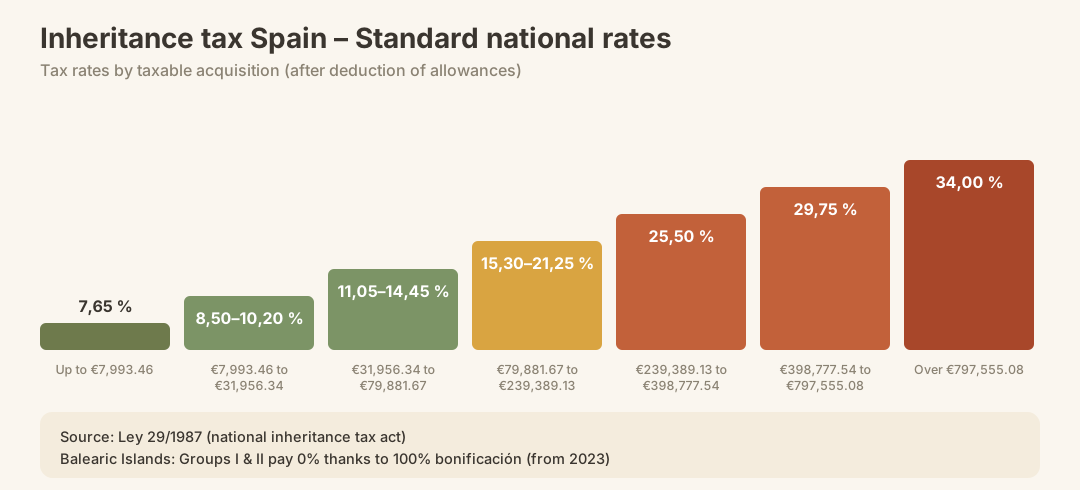
Table 1 – Basic tariff (based on the taxable acquisition after deduction of allowances):
| Taxable acquisition | Tax rate |
|---|---|
| Up to 7.993,46 € | 7,65 % |
| 7.993,46 € to 31.956,34 € | 8,50 % – 10,20 % |
| 31.956,34 € to 79.881,67 € | 11,05 % – 14,45 % |
| 79.881,67 € to 239.389,13 € | 15,30 % – 21,25 % |
| 239.389,13 € to 398.777,54 € | 25,50 % |
| 398.777,54 € to 797.555,08 € | 29,75 % |
| Over 797.555,08 € | 34,00 % |
Table 2 – Multiplier (based on tax group and the beneficiary's existing assets):
| Beneficiary's existing assets | Group I & II | Group III | Group IV |
|---|---|---|---|
| Up to 402.678,11 € | 1,0000 | 1,5882 | 2,0000 |
| 402.678,11 € to 2.007.380,43 € | 1,0500 | 1,6676 | 2,1000 |
| 2.007.380,43 € to 4.020.770,98 € | 1,1000 | 1,7471 | 2,2000 |
| Over 4.020.770,98 € | 1,2000 | 1,9059 | 2,4000 |
Note: The concept of a multiplier that takes into account the pre-existing wealth of the heir is unknown in German inheritance tax law. For wealthy heirs, it can significantly increase the effective tax burden. In extreme cases – Group IV, high pre-existing wealth – the absolute maximum tax rate can reach up to 81.6%.
The Balearic special rules: de facto exemption for close relatives
The Autonomous Community of the Balearic Islands introduced a far-reaching reform at the end of 2023 with Law 11/2023 (of 23 November 2023) and Legislative Decree 4/2023 (of 18 July 2023), as amended by Legal Regulation 1/2014 of 6 June 2024.
The key provision: For heirs in Groups I and II, the tax relief (bonificación) 100% of the estate value. In practice, this means that children, spouses, parents and grandparents generally pay no inheritance tax on estates in the Balearic Islands.
According to several law firms specialising in German-Spanish inheritance law, this rule also applies to testators and heirs with connections to Germany, provided the Balearic rules are applicable.
Important caveat regarding property: For the 100% relief to apply to an inherited property, the tax value declared upon acceptance of the inheritance must not exceed 120% of the so-called reference value (valor de referencia). If the declared value exceeds this threshold, the extensive tax exemption no longer applies. In such cases, the valuation should always be reviewed by a lawyer.
| Rule | Applies to | Condition |
|---|---|---|
| 100% Bonificación | Groups I and II (children, spouses, parents, grandparents) | Balearic Islands connection, property value ≤ 120% of reference value |
| State allowances | All groups | Applied subsidiarily where Balearic law does not apply |
| Deadline extension | All heirs | Application by the end of the 5th month following the date of death |
Note: Despite the de facto tax exemption, the inheritance tax return must still be submitted within the 6-month deadline. The obligation to file therefore exists regardless of whether any tax is actually due.
Which authority is responsible – ATIB or AEAT?
Jurisdiction depends on where the testator had their habitual residence:
- The deceased was a resident in the Balearic Islands: The competent authority is the Agència Tributària de les Illes Balears (ATIB). The declaration is submitted here; the Balearic special rules apply.
- The deceased was a resident in another Autonomous Community: The competent authority is the tax authority of the relevant region.
- The heir is a non-resident: The competent authority is the Agencia Estatal de Administración Tributaria (AEAT), Oficina Nacional de Gestión Tributaria, Calle Infanta Mercedes 49, 28020 Madrid. State inheritance tax law applies here – unless the heir actively opts to apply the law of the Autonomous Community, which has been possible under certain conditions since a ECJ ruling and the subsequent amendment to Spanish legislation.
| Situation | Competent Authority | Address / Contact |
|---|---|---|
| Deceased resident in the Balearic Islands | ATIB | atib.caib.es |
| Deceased resident in another region | Regional tax authority | Varies by region |
| Heir is a non-resident | AEAT, Oficina Nacional | C/ Infanta Mercedes 49, 28020 Madrid |
The Modelo 650: Self-Assessment Step by Step
The Modelo 650 is the main form for the Spanish inheritance tax return (autoliquidación). For more straightforward cases, there is also the Modelo 652, a simplified version. Both are available to download from the AEAT website.
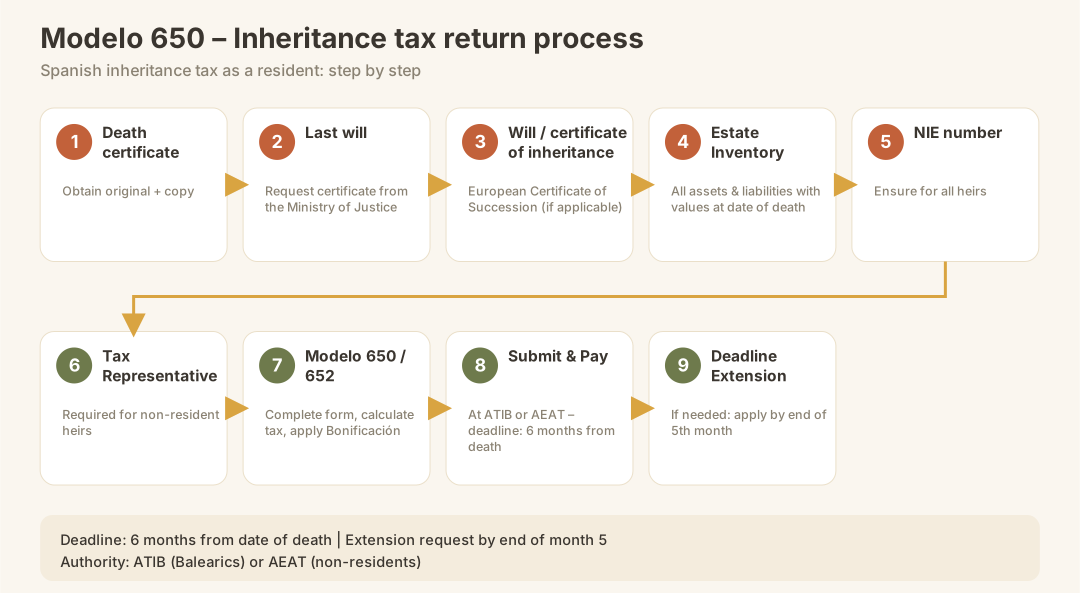
The procedure works as follows:
- Death certificate – obtain (original and copy)
- Certificate of Last Will – request from the Spanish Ministry of Justice; this confirms whether a will has been registered
- Will or certificate of inheritance – obtain; for German testators, a European Certificate of Succession is often also required
- Complete schedule of all estate assets and liabilities, including valuations as at the date of death
- NIE number – ensure all heirs have one; no declaration can be submitted without a NIE
- Tax representative – appoint one in Spain (mandatory for heirs not resident in Spain)
- Modelo 650 / 652 – complete the form, calculate the tax, and apply any bonificación where applicable
- Submit and pay – at the competent authority, within 6 months of the date of death
- Extension of deadline – if required: apply actively before the end of the 5th month
Please note: Those who do not wish to carry out a self-assessment may alternatively submit a schedule of estate assets and request an administrative assessment (liquidación administrativa) by the authority.
Double taxation with Germany: what can be done?
As no double taxation agreement exists, the same assets may be subject to inheritance tax in both Spain and Germany. The solution lies in mutual offsetting:
- In Germany: Inheritance tax paid in Spain can be credited against German tax under § 21 ErbStG, to the extent that the same assets are taxed in both countries.
- In Spain: By the same token, foreign tax may be credited under Spanish domestic law.
However, the credit is not automatic — it must be actively applied for, and the returns filed in both countries must be coordinated with one another. Anyone who fails to take a coordinated approach will end up paying more than necessary.
Please note: Due to the lack of harmonisation, a residual tax liability in both countries may remain even after the credit has been applied. Case-specific advice from an Abogado specialising in German-Spanish inheritance law is essential here.
Related to this: Modelo 720 – Reporting obligation for assets held abroad
Special consideration: gifts made during one's lifetime
The ISD covers not only inheritances but also inter vivos gifts. As a general rule, the same 100% reduction for Group I and II applies on the Balearic Islands for gifts — but with one key difference:
Under current rules, the reduction applies primarily to persons who are tax-resident in the Balearic Islands. Anyone whose tax residence is in Germany and who receives a property on Mallorca as a gift will generally not benefit from this exemption. Non-residents who receive a property as a gift may face a significant tax liability.
Furthermore, the deadline for declaring a gift is only one month — considerably shorter than for inheritances.
If you are considering transferring property during your lifetime, the topic of Spanish wills is closely connected to this.
The most common mistakes — and how to avoid them
- Missing the deadline: The 6 months run from the date of death, not from the date you become aware of the inheritance. Anyone who submits late will face surcharges.
- Failing to apply for an extension: The application must be submitted by the end of the 5th month — after that, it is too late.
- No NIE: Without an NIE number, heirs cannot file a return or have a property transferred into their name. If necessary, the NIE can be applied for posthumously via an authorised representative.
- Reference value exceeded: For properties, a declared value exceeding 120 % of the reference value results in the loss of the Balearic Bonificación – a costly mistake.
- No Spanish will in place: Without a will in Mallorca, a certificate of inheritance or European Certificate of Succession is often required – this costs time and money.
- Double taxation not coordinated: Anyone who submits their declarations in Germany and Spain independently of one another forfeits potential tax credits.
- Tax group incorrectly classified: Adopted children, stepchildren, and unregistered partners fall into different groups depending on the legal situation – this has considerable consequences.
What comes next? Further tax obligations in the event of inheritance
Submitting the Modelo 650 is not the end of the matter. Further steps often follow after inheritance tax:
- Plusvalía Municipal: The municipal land value increment tax (Impuesto sobre el Incremento de Valor de los Terrenos de Naturaleza Urbana) applies to the increase in value of urban land since the last change of ownership. It is levied by the respective municipality and must be declared separately.
- Registration in the land registry: Only after payment of inheritance tax (or submission of the declaration) can the property be transferred to the heir in the land registry.
- IRPF / Income tax: If the inherited property is later sold, income tax (IRPF) is payable on the increase in value since acceptance of the inheritance.
- IBI (property tax): As the new owner, you take on the ongoing property tax.
More on ongoing taxation as a resident: Taxes as a resident – IRPF
Checklist: inheritance tax in Spain as a resident
- Date of death noted – 6-month deadline starts immediately
- NIE numbers of all heirs available
- Tax representative in Spain appointed (mandatory for non-resident heirs)
- Certificate of Last Will requested from the Spanish Ministry of Justice
- Will or certificate of inheritance / European Certificate of Succession obtained
- Complete estate inventory with valuations prepared
- Reference value of the properties checked (120% threshold for Bonificación)
- Tax class (Grupo I–IV) correctly determined
- Modelo 650 (or 652) completed and submitted to ATIB or AEAT
- Extension requested if necessary (until end of 5th month)
- Plusvalía Municipal declared separately with the local authority
- Credit against German inheritance tax applied for
- Land registry transfer initiated
Conclusion
As a resident, inheritance tax in Spain is far from a niche issue — it applies to your entire worldwide assets and comes with strict deadlines that allow no leeway. The good news: the Balearic Islands offer close family members (Groups I and II) a de facto 100% tax exemption that goes well beyond what the national regulations provide. The condition, however, is that property values are correctly assessed and the return is submitted on time — even if no tax is ultimately due.
The absence of a double taxation agreement between Germany and Spain remains the greatest challenge: without coordinated advice in both countries, the same inheritance can be taxed twice. A will drawn up on Mallorca, combined with professional tax and legal guidance, is the best protection against unpleasant surprises.
📩 Submit an enquiry now — We will connect you with the right specialist for German-Spanish inheritance law.
Official Sources
- Ley 29/1987, de 18 de diciembre, del Impuesto sobre Sucesiones y Donaciones (Spanish Inheritance and Gift Tax Act, national legal basis): https://www.boe.es/buscar/act.php?id=BOE-A-1987-28141
- Law 11/2023 of the Balearic Islands (of 23 November 2023) – Reform of Balearic inheritance tax; Legislative Decree 4/2023 (of 18 July 2023) and Statutory Instrument 1/2014 (of 6 June 2024)
- ATIB – Agència Tributària de les Illes Balears (responsible for inheritance tax where the deceased was domiciled in the Balearic Islands): https://www.atib.es
- AEAT – Agencia Estatal de Administración Tributaria (responsible for non-residents; Modelo 650/652 download): https://www.agenciatributaria.es
- Spanish Embassy Berlin – Spanish Inheritance Tax Procedures (information sheet with procedural guidance): https://www.exteriores.gob.es/Embajadas/berlin/de/Embajada/Documents/Erbschaftsteuer.pdf