
Spanish Will: What Residents and Property Owners Need to Know in 2026
You own a property on Mallorca, have been living on the island for years, or are planning your permanent move there – and the topic of a Spanish will sits somewhere on your mental to-do list, but never quite makes it to the top. Yet it is one of the most consequential decisions you can make regarding your Spanish assets. Since the EU Succession Regulation (EuErbVO, Regulation 650/2012) came into force on 17 August 2015, cross-border estates are governed in principle by the law of the deceased's last habitual residence – meaning that anyone who dies as a resident on Mallorca without having made a choice of law will have their estate administered under Spanish inheritance law. In this guide, you will learn how Spanish inheritance law is structured, why having your own Spanish will almost always makes sense, which forced heirship rules constrain your planning, and how the probate process unfolds step by step.

The EU Succession Regulation: The new guiding principle
Until August 2015, German nationals in Spain were automatically subject to German law in the event of inheritance – regardless of how long they had already been living in Spain. This was fundamentally changed by the EU Succession Regulation 650/2012 (often referred to as "Brussels IV" or "EuErbVO").
For all estates where the deceased passed away after 17 August 2015, the following applies:
The inheritance law of the state in which the deceased had their last habitual residence governs the entire succession – including property located abroad.
This means: anyone who dies as a resident on Mallorca without having made a choice of law will generally have their worldwide estate administered under Spanish inheritance law – not under German, Austrian, or Swiss law.
Important exceptions: Denmark, Ireland, and the United Kingdom do not participate in the Regulation.
The choice of law (professio iuris)
Pursuant to Art. 22 EuErbVO, you may elect in your will the law of your home country (nationality). A German national residing on Mallorca may therefore stipulate that German inheritance law applies to their entire estate.
| Aspect | Without choice of law | With choice of law (German law) |
|---|---|---|
| Applicable inheritance law | Spanish inheritance law | German inheritance law |
| Forced share for children | 2/3 of the estate (legítima) | 1/2 of the estate |
| Spouse's position | Usufruct (usufructo) | Full heir possible |
| Testamentary freedom | Restricted | Broader scope |
| Procedural law | Spanish procedure | Spanish procedure |
Please note: The choice of law applies to the entire estate – a partial choice of law that applies only to the Spanish or only to the German assets is, under the prevailing interpretation, inadmissible. Anyone who draws up two separate wills (one in Germany, one in Spain) and includes a choice of law in only one of them risks making an inadmissible partial choice of law. The actual intention of the testator must then be interpreted – a classic source of dispute.
Intestate succession in Spain: who inherits without a will?
Without a will, the Spanish rules of intestate succession automatically apply (sucesión intestada) pursuant to the Spanish Código Civil (Art. 657 ff. CC). The order of priority differs considerably from the German rules – particularly with regard to the position of the spouse:
| Rank | Heirs | Special feature |
|---|---|---|
| 1. | Children and descendants | Inherit in equal shares; grandchildren take the place of predeceased children |
| 2. | Parents and grandparents | Only if there are no descendants |
| 3. | Spouse | Not a full heir, but holder of a usufruct right (usufructo) over a portion of the estate |
| 4. | Siblings, nieces, nephews | Lower priority |
| 5. | The Spanish state | As the heir of last resort |
A particularly critical point: under Spanish intestate succession, the surviving spouse does not receive ownership but merely a usufruct right (usufructo) over a portion of the estate. In practice this can mean that the spouse is entitled to remain living in the shared property but cannot sell or encumber it without the consent of the heirs.
The compulsory share (legítima): the limits of your freedom to make a will
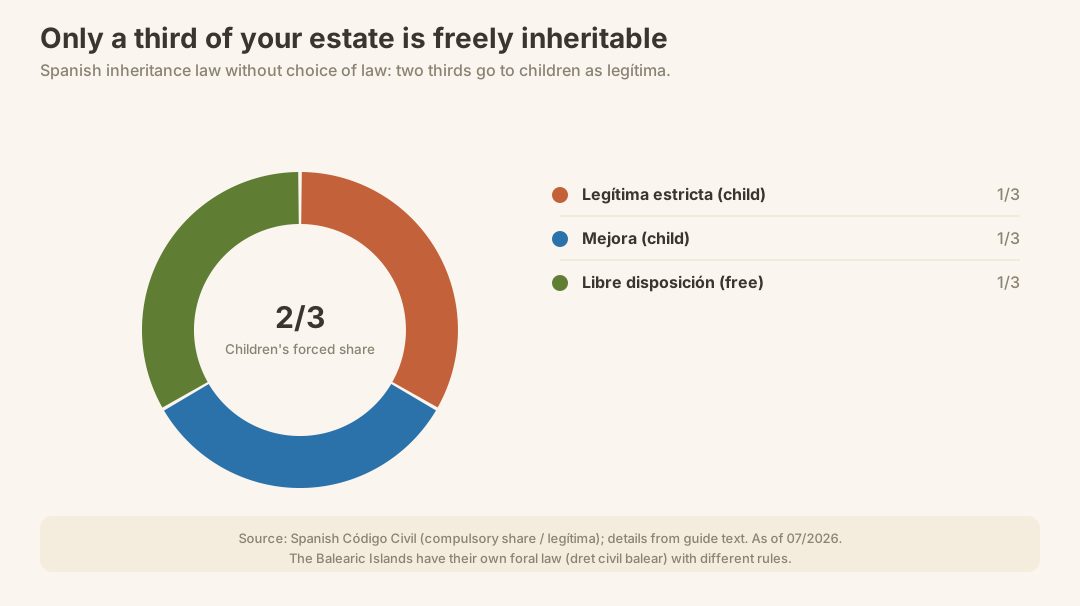
Spanish inheritance law contains strict compulsory share rules that reserve two thirds of the estate in favour of the children:
| Portion | Designation | Rule |
|---|---|---|
| 1st third | Legítima estricta | Must be divided equally among all children |
| 2nd third | Mejora | Can be allocated preferentially to one or more children |
| 3rd third | Libre disposición | Free third – can be inherited by any person of your choosing |
Note: The Balearic Islands have their own foral laws (dret civil balear), which may differ from the general provisions of the Código Civil. The Balearic forced heirship rules have their own specific characteristics. For concrete planning decisions, advice from an Abogado specialising in Balearic inheritance law is essential.
What does this mean in practice? If you have two children and an estate worth €600,000, your children are entitled to at least €400,000 (two thirds) as their forced share – regardless of what your will states. The free third (€200,000) can be distributed at your own discretion – e.g. to your spouse, to friends, or for charitable purposes.
Unmarried partners receive nothing under Spanish statutory succession. Without a will, an unmarried partner inherits nothing – a classic reason not to put this matter off.
Why having your own Spanish will is almost always a good idea
Even if you already have a German will or make a choice of law under Art. 22 EuErbVO: The process of administering an estate for Spanish assets takes place in Spain. Spanish notaries, land registries and banks require either a Spanish will (testamento) or must accept a foreign document through a complex recognition procedure – including an apostille, certified translation, and often months of processing time.
A Spanish will that covers exclusively the assets located in Spain is the clean and efficient solution. It enables:
- Faster processing with the Spanish notary and land registry
- A clear choice of law under Art. 22 EuErbVO within the same document
- Direct nomination of heirs for the Spanish property
- Avoidance of lengthy apostille–translation–recognition cycles
Note: The Spanish will should be coordinated in substance with the German (or Austrian/Swiss) will in order to avoid contradictions and an inadmissible partial choice of law. This is a typical task for an Abogado with experience in cross-border inheritance law.
Forms of will in Spain
Spanish law recognises several forms of will. For international property owners, the notarial will is the clear standard:
| Form | Spanish | Characteristic |
|---|---|---|
| Notarial Will (open) | Testamento abierto | Standard form; notary certifies and registers; recommended for foreigners |
| Holographic Will | Testamento ológrafo | Written entirely by hand, dated and signed; must be judicially recognised after death |
| Closed Will | Testamento cerrado | Rare; contents remain secret until death |
Under Spanish law, pursuant to Art. 670 para. 1 CC, a will is a strictly personal act (acto personalísimo) – it cannot be executed by a representative.
After notarial certification, the will is registered in the Central Register of Last Wills (Registro Central de Actos de Última Voluntad) in Madrid. Only in this way can it be located and acted upon after death.
Inheritance tax in the Balearic Islands: what heirs pay
Mallorca inheritance tax
Explanation
Balearic law applies when the deceased spent most days of the five years before the death in the Balearics. If they were not resident in Spain, the heirs may apply the law of the region holding the most valuable part of the Spanish estate.
Explanation
The share falling to this heir, at least the valor de referencia — the cadastral reference value, below which the tax may not be assessed.
Explanation
The group decides the allowance, the tariff, the multiplier and the relief. Within group III the law distinguishes further between blood relatives and relatives by marriage.
Explanation
The larger relief for blood collaterals applies only when no descendants of the deceased inherit alongside. Disinherited descendants do not count.
- Payable (cuota a ingresar)
- €27,129.85
- Value of the inherited property
- €300,000.00
- Kinship group
- Group III — siblings, uncles, aunts, nieces, nephews
Main-home reduction: €0.00 · Value stated in the deed within the limit: Yes, value within the limit
Legal status: 25 July 2025
This calculation is provided for guidance only and is not a substitute for tax or legal advice in specific cases.
Inheritance and gift tax (Impuesto de Sucesiones y Donaciones, ISyD) is a regional tax. In the Balearic Islands, increasingly favourable rules apply for direct family members. The actual tax burden depends on the heir's tax bracket, the value of the estate, and the applicable allowances.
Please note: Balearic inheritance tax rates and allowances are subject to change and should always be verified with a qualified tax adviser or the Balearic tax authority (ATIB) when planning in specific cases.
| Tax bracket | Relationship to the deceased | Tendency (Balearic Islands) |
|---|---|---|
| Group I | Children under 21 years of age | Enhanced allowances |
| Group II | Spouse, children aged 21 and over, parents | Favourable rules |
| Group III | Siblings, nieces, nephews, parents-in-law | Higher tax burden |
| Group IV | Other heirs, unrelated persons | Highest tax burden |
In Spain, the payment of inheritance tax is subject to a Six-month deadline from the date of death. This deadline can be extended by a further six months under certain conditions – however, the application must be submitted within the first five months.
Please note: If the six-month deadline is missed, interest and surcharges may apply. In practice, this is one of the most common and costly pitfalls for heirs living abroad.
The inheritance process in Mallorca: step by step
Estate costs calculator
Explanation
The value given to the property in the deed of acceptance and allocation of the estate (escritura de aceptación y adjudicación de herencia). Under the fee schedules (aranceles) the value assessed for tax purposes applies and, as long as none exists, the value stated in the deed — in the normal case the value you record there. The preset is an example, not a statement about the market. The calculation assumes one registered unit (finca registral) — if the parking space or storeroom is a unit of its own, the registry scale applies again to each.
Explanation
How many heirs take the property in equal shares. Both fees rise with every further heir: the notary charges each heir on their own share, and the registry spreads the value across the shares — and because both scales fall as values rise, the same property costs more with more heirs. Where shares are unequal, notary and registry charge on the actual value of each one.
- Subtotal of the costs entered
- €1,409.03
- Notary (deed of acceptance)
- €952.78
- Land registry (Registro de la Propiedad)
- €456.25
Without the freely agreed items — the full calculation is on the advice page.
Legal status: 1 September 2012
This calculation is provided for guidance only and is not a substitute for tax or legal advice in specific cases.
Following the death of a property owner in Mallorca, the inheritance process typically proceeds as follows:
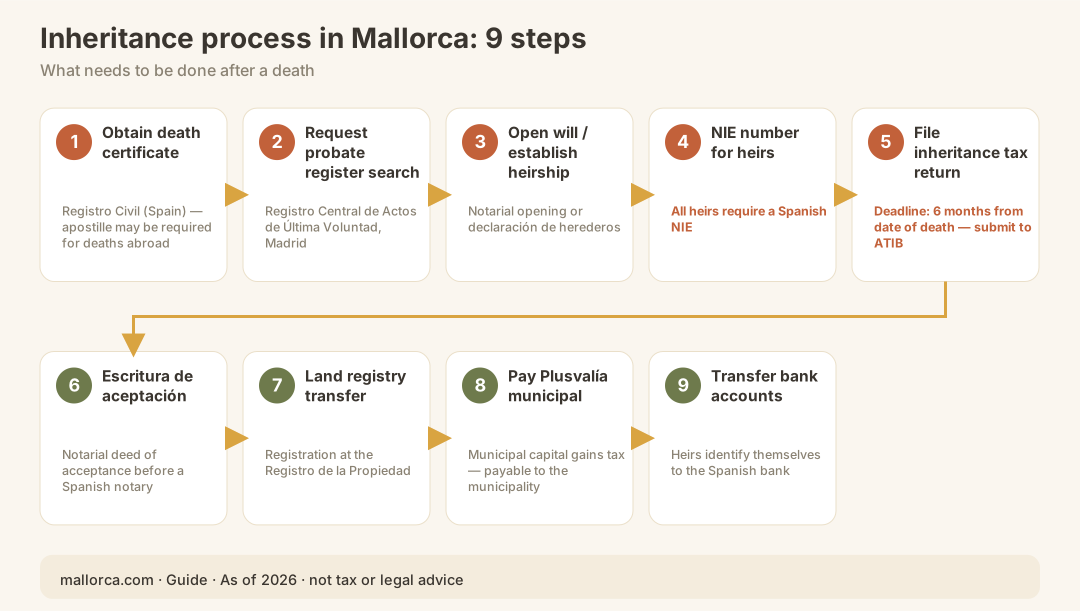
- Obtain the death certificate – Issued by the Spanish civil registry (Registro Civil), with an apostille if the death occurred abroad
- Search the central wills register – Submit an enquiry to the Registro Central de Actos de Última Voluntad in Madrid to check whether a Spanish will exists (subject to a fee, usually a few euros)
- Open the will / obtain proof of entitlement – Notarial opening of the will, or in the case of intestate succession: declaración de herederos by a notary or court
- NIE number for the heirs – All heirs require a Spanish identification number (NIE) for tax and land registry purposes
- Calculate and declare inheritance tax – Tax return submitted to ATIB (Balearic Islands) within 6 months
- Escritura de aceptación de herencia – Notarial deed of acceptance of inheritance before a Spanish notary
- Transfer of title in the land registry – Registration of the new owners at the Registro de la Propiedad
- Plusvalía municipal – Municipal capital gains tax on the property (payable to the relevant local authority)
- Transfer of bank accounts – Heirs identify themselves to the Spanish bank
Capital gains on sale by the heirs
If heirs subsequently sell the inherited property, Spanish capital gains tax (Impuesto sobre la Renta de no Residentes for non-residents, or IRPF for residents) will apply. The calculation is based on the difference between the value at the time of inheritance (the tax acquisition value) and the sale proceeds. How the acquisition value is determined has a significant impact on the subsequent tax liability – a further argument for careful estate planning and an accurate valuation of the property in the inheritance tax assessment.
Anyone who, as a non-resident, inherits and sells a Spanish property should also familiarise themselves with non-resident tax in Spain – as the rules differ considerably depending on tax status.
The most common mistakes in estate planning in Mallorca
| Mistake | Consequence |
|---|---|
| No Spanish will drawn up | Lengthy apostille/translation process; statutory succession may apply contrary to your wishes |
| No choice of law made | Spanish succession law applies automatically to the entire estate |
| Attempted partial choice of law (for Spanish assets only) | Choice of law invalid; dispute over interpretation |
| Six-month deadline for inheritance tax missed | Interest and surcharges |
| Heirs have no NIE number | Delays at the notary, land registry and bank |
| German will only, with no coordination | Contradictions between the German and Spanish documents |
| Unmarried partner not provided for in the will | Partner receives nothing under statutory succession |
| Land registry transfer forgotten or delayed | Unable to act on a subsequent sale |
What comes next? Tax follow-up steps for residents
A Spanish will is just one component of comprehensive estate planning. Anyone living in Mallorca and holding assets there should also keep the following topics in mind:
- Modelo 720: Residents must declare foreign assets above certain thresholds — this also applies to heirs who acquire assets abroad following a bequest → Modelo 720 reporting obligation
- IRPF: As a resident, heirs pay Spanish income tax on rental income from inherited property → Taxes as a resident
- Residencia: Anyone whose habitual residence is in Mallorca should also be officially registered as a resident — this has a direct bearing on the applicable succession law → Residencia Spain
- German pension: How a pension from Germany is taxed in Spain is a subject in its own right → Taxing a pension in Spain
Checklist: Spanish will and estate planning
- NIE number in place (your own and, where applicable, those of the intended heirs)
- German will brought up to date and coordinated with an abogado
- Spanish will drawn up with a notary (testamento abierto recommended)
- Choice of law under Art. 22 EuErbVO reviewed and, where appropriate, declared in the will
- Consistency between the German and Spanish will ensured (no impermissible partial choice of law)
- Will registered with the Central Wills Registry in Madrid
- Heirs informed of where the will and documents are kept
- Balearic inheritance tax allowances and tax brackets discussed with a tax adviser
- Lasting power of attorney (poder notarial) drawn up in case of loss of mental capacity
- Land registry extract for the Spanish property kept up to date
Conclusion: Acting now costs little; leaving it costs a great deal
A notarial will in Mallorca is no great hurdle – with a German-speaking abogado and a Spanish notary, it can generally be arranged within a few weeks. The alternative – no will, no choice of law, no preparation – can saddle heirs with months of proceedings, unplanned tax payments, and, in the worst case, a genuine dispute over the property. The six-month deadline for inheritance tax runs from the date of death, regardless of whether heirs abroad are aware of everything or not. Anyone who lives, loves, or invests in Mallorca would do well to tackle this topic properly – and then put it firmly behind them.
Official sources
- EU Succession Regulation 650/2012 (EuErbVO / "Brussels IV"), in force from 17. August 2015: https://eur-lex.europa.eu/legal-content/DE/TXT/?uri=CELEX%3A32012R0650
- Código Civil (CC) Spain, Art. 657–1087 (law of succession), Art. 662 ff. (wills): https://www.boe.es/buscar/act.php?id=BOE-A-1889-4763
- Registro Central de Actos de Última Voluntad (Central Wills Registry, Madrid): https://www.mjusticia.gob.es
- ATIB – Agència Tributària de les Illes Balears (Balearic tax authority, inheritance tax): https://www.atib.es
- Gobierno de las Illes Balears – Balearic foral law (dret civil balear): https://www.caib.es
- BOE – Boletín Oficial del Estado (Official State Gazette of Spain): https://www.boe.es