
ETFs and Index Funds in Spain: How to Make the Most of the Traspaso Tax Advantage
As a tax resident in Spain, you are investing in one of the few EU economies where the choice between ETF and index fund Spain tax makes a measurable difference — not through the magic of compound interest, but through a concrete statutory mechanism called Traspaso. Spain allows fund investors to move their capital between approved investment funds without triggering an immediate capital gains tax liability. ETFs are excluded from this benefit. This guide explains how the Traspaso mechanism works, which tax rates apply, when an ETF is nonetheless worthwhile, what the Modelo 720 has to do with your portfolio — and which mistakes you should avoid. All figures are drawn from verified sources; this article does not replace individual tax advice.

Would you like to know whether an index fund portfolio, an ETF broker, or a combination makes sense for your personal situation?
- 📩 Submit a personal enquiry — our network partners know the Spanish tax framework from practical experience
- Everything about taxes as a resident in Spain
Why Spain has its own investment logic
Spain is a special case in Europe. While ETF savings plans have long since become a mass-market product in Germany, with millions of private investors using them to build wealth, Spanish households still hold around 600 billion euros in conventional investment funds — compared with roughly 300 billion euros in exchange-traded securities including ETFs. The ratio is therefore markedly different from more ETF-oriented markets such as Germany.
The reason is not a lack of interest: according to 2025 data from N26, nearly two in three new customers in Spain (65 per cent) were investing for the very first time. Young people aged between 18 and 29 now account for 30 per cent of that neobank's Spanish customer base. The appetite is clearly there — but the tax structure channels it in a particular direction: towards investment funds that can take advantage of the Traspaso, and away from ETFs, which cannot.
For you as a resident, this means: before blindly continuing a German or Austrian ETF savings plan in Mallorca, it is worth familiarising yourself with the Spanish rules of the game.
The Traspaso: how tax deferral works
The basic principle
The Traspaso is enshrined in Spanish income tax law (IRPF). It allows investors to sell units in an approved investment fund and reinvest the proceeds directly into another approved fund — without a taxable event being triggered. The latent gains are not realised; the original acquisition cost is carried over to the new fund.
The tax authority only steps in when you ultimately make a withdrawal.
What this means in practice
Suppose you have invested 50,000 euros in a global index fund that has grown to 80,000 euros. You wish to switch to a more defensive fund.
- Without Traspaso (e.g. when selling an ETF): You realise a gain of 30,000 Euro. The first 6,000 Euro are taxed at 19 %, the next 24,000 Euro (up to a total gain of 30,000 Euro) at 21 % — you pay tax immediately.
- With Traspaso (index fund to index fund): No taxable event. The full 80,000 Euro continue to grow in the new fund, as though you had never touched them.
The difference over ten, twenty or thirty years of investment horizon is considerable, because every euro that does not go to the tax authorities keeps working for you.
Conditions for a valid Traspaso
Not every fund transfer qualifies automatically. The following conditions must be met:
| Condition | Detail |
|---|---|
| Investor type | Tax residents in Spain only |
| Source fund type | Approved investment fund (FI/UCITS structure) |
| Target fund type | Also an approved investment fund |
| ETFs | Excluded — treated as shares for tax purposes |
| Direct transfer | Money must not pass through the investor's account |
| Purchase price | Is transferred to the target fund |
Note: Direct settlement between the fund companies or custodian banks is mandatory. If you withdraw the money even briefly, the transaction is treated as a sale — and you immediately owe tax.
Spain's capital gains tax: the exact brackets
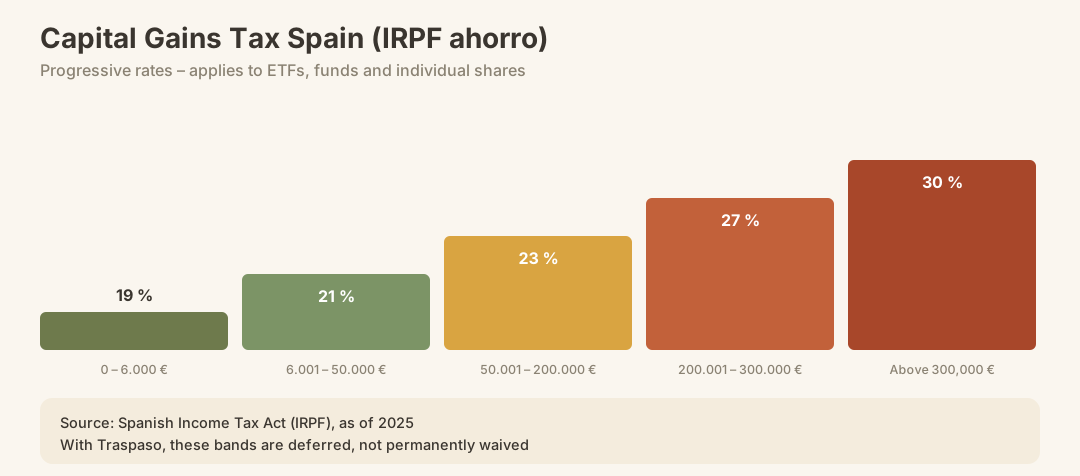
When you realise gains from an ETF or a fund (or cannot make use of a Traspaso), those gains fall under the so-called ahorro portion of IRPF. The tax rates are applied on a progressive basis:
| Amount of gain (€) | Tax rate |
|---|---|
| 0 – 6.000 | 19 % |
| 6.001 – 50.000 | 21 % |
| 50.001 – 200.000 | 23 % |
| 200.001 – 300.000 | 27 % |
| Over 300,000 | 30 % |
Source: Spanish Income Tax Act (IRPF), as at 2025
These rates apply regardless of whether you invest in ETFs, investment funds, or individual shares – as soon as you sell and realise gains. With a traspaso, these brackets are simply deferred, not permanently waived.
ETF vs. index fund: the tax comparison
Both product types can track exactly the same index, hold the same companies, and have similarly low costs. The only – but crucial – difference lies in the tax treatment when switching.
| Criterion | Index fund (FI) | ETF (UCITS) |
|---|---|---|
| Traspaso possible | ✅ Yes | ❌ No |
| Tax on switching | None (deferred) | Due immediately |
| Trading | Once daily (NAV) | Stock exchange, continuous |
| Typical TER | 0,10–0,30 % p. a. | 0,07–0,55 % p. a. |
| Savings plan eligible | Yes (many platforms) | Yes |
| Availability in Spain | Via fund platforms (e.g. MyInvestor) | Via broker |
| Tax reporting | Fund company reports | You/broker reports |
For long-term investors who rebalance frequently or make strategic switches (e.g. from aggressive to defensive at retirement), the tax advantage of index funds in Spain is considerable.
When an ETF still makes sense
The Traspaso advantage is real, but it is not the only criterion. ETFs can be the better choice in the following situations:
Long-term buy-and-hold without switching: If you buy an ETF and hold it for twenty years without ever rebalancing, the absence of Traspaso is irrelevant. You only realise gains on the final sale — exactly as with an index fund.
Specific markets: For certain niches (e.g. Spanish single indices such as the IBEX 35 or the Solactive Spain 40) there are ETFs with cost ratios of around 0.30 percent p.a., but often no comparable investment funds available via Spanish platforms.
International brokers: Anyone investing through a non-Spanish broker will often only have access to ETFs and must handle the tax reporting themselves.
Short-term need to act: ETFs can be traded intraday; fund purchases are settled at the end-of-day price.
Please note: Anyone holding ETFs through a foreign broker must declare the annual gain themselves in their IRPF return. Unlike with Spanish fund providers, there is no automatic tax deduction by the provider.
The Modelo 720: reporting obligation for overseas portfolios
Anyone resident in Spain who holds assets abroad — including ETFs or investment funds with non-Spanish brokers or banks — may be required to declare these via Modelo 720.
| Feature | Detail |
|---|---|
| Threshold | €50,000 per category |
| Deadline (initial declaration) | 1 January – 31 March of the following year |
| Subsequent years | Re-declare only if changes exceed €20,000 |
| Responsible authority | AEAT (Agencia Tributaria) |
| Portfolios/accounts with EU brokers | Count as overseas assets |
| Penalties for non-declaration | Can be substantial (the ECJ has partially challenged the regime; national implementation is ongoing) |
Note: The Modelo 720 has been partially reformed following a 2022 ECJ ruling. However, the reporting obligation itself remains in place. Make sure to seek up-to-date advice on this — the implementation details are subject to change.
You can find more on this in our guide: Modelo 720 reporting obligation.
Step by step: How to carry out a traspaso
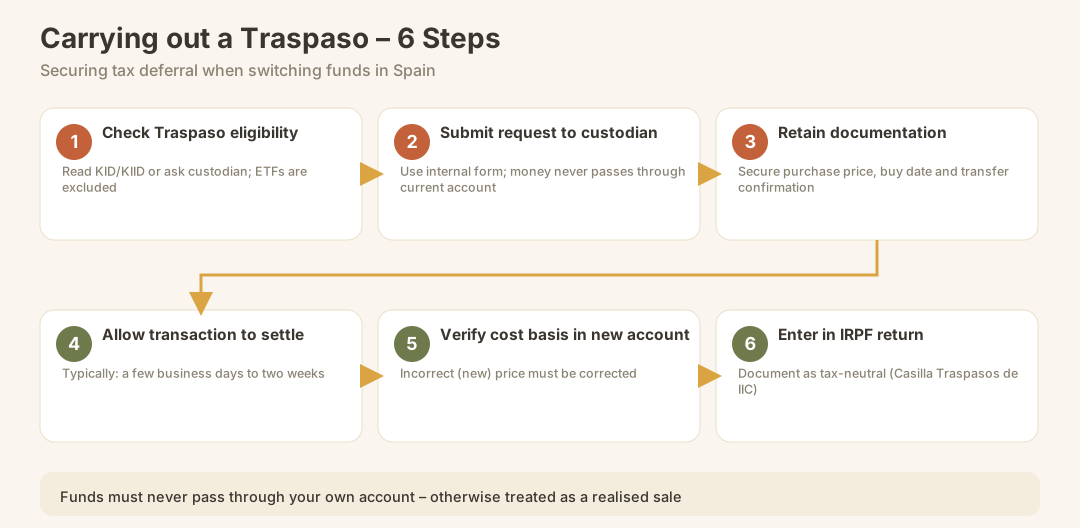
- Check whether both funds are traspaso-eligible. Read the key information documents (KID/KIID) or ask your custodian bank. ETFs are not eligible.
- Submit the traspaso request to your custodian bank or platform. Use the internal form; the money never passes through your current account.
- Keep all records. The original purchase price, the date of the original purchase, and the transfer confirmation are essential for your later tax return.
- Allow the transaction to be processed in full. Typical processing times range from a few business days to two weeks, depending on the fund provider.
- Check the transferred purchase price in your new account. If the custodian bank enters the wrong (new) price as the basis, you must correct this — otherwise you will later calculate either too little or too much tax.
- Report the traspaso in your IRPF return. It is documented as tax-neutral but must still be declared.
IRPF return: What to enter and where
Capital gains from funds and ETFs belong in the base del ahorro of your Renta return (Modelo Renta/IRPF, filed each year generally between April and the end of June for the previous year).
| Transaction | Form field (Renta) | Tax relevance |
|---|---|---|
| Gain from ETF sale | Casilla Ganancias patrimoniales (ahorro) | Immediately taxable |
| Loss from ETF sale | Casilla Pérdidas patrimoniales (ahorro) | Offsettable against gains (up to 4 years) |
| Traspaso index funds | Casilla Traspasos de IIC | Tax-neutral, but must be declared |
| Final sale after Traspaso | Casilla Ganancias patrimoniales (ahorro) | Total gain calculated from the original acquisition price |
| Foreign dividends (accumulating) | Depending on fund structure | May need to be declared as investment income |
For a complete overview of all deduction options available to residents in the Balearic Islands, read our guide to IRPF deductions Balearic Islands.
UCITS: What this means for your ETF
All ETFs and investment funds authorised in the EU must comply with the UCITS framework (Undertakings for Collective Investment in Transferable Securities). UCITS standardises diversification, custody, disclosure, and investor protection. By mid-2025, UCITS ETFs in Europe had assets under management exceeding 2.7 trillion euros (according to EFAMA Market Insights Q1/2025).
For you as an investor in Spain, this means above all:
- Only UCITS funds are eligible for the Traspaso.
- US-domiciled ETFs (e.g. Vanguard US-domiciled) are not UCITS-compliant and are therefore neither eligible for the Traspaso nor freely distributable to retail investors within the EU.
- The typical ongoing charge (TER) of European UCITS ETFs varies depending on the market and provider; compare the relevant key information documents.
Most common mistakes when investing as a resident in Spain
1. Simply continuing a German ETF portfolio without reviewing the tax implications Gains arising with a German broker must be declared by you in Spain. German Abgeltungssteuer does not exempt you from this obligation — as a resident, you are taxed on your worldwide income.
2. Attempting to process a Traspaso via your own current account The moment funds land in your account, the Traspaso is considered completed for tax purposes — and you owe tax. Direct settlement between the fund companies is not optional.
3. Failing to verify the acquisition price after the Traspaso Platforms occasionally book the current price as the new acquisition cost. This leads to errors in the subsequent tax return.
4. Forgetting Modelo 720 Anyone holding an ETF portfolio with a foreign broker who exceeds the threshold of 50,000 euros must report it — even if no gains have been realised.
5. Failing to offset losses against gains ETF losses can be carried forward for up to four years and offset against future capital gains. Forgetting this means paying more tax than necessary.
6. Treating accumulating ETFs with a foreign domicile as blanket tax-free In Spain, accumulating funds can also generate taxable returns, depending on the structure and domicile of the fund. Check this in the KID/KIID of the relevant product.
What comes next? An overview of ongoing obligations
After your first investment as a Spanish resident, there are recurring tasks to keep in mind:
| Task | Due date | Basis |
|---|---|---|
| IRPF declaration (Renta) | Typically April – end of June (for the previous year) | Capital gains, Traspasos |
| Modelo 720 (initial filing) | 1 Jan. – 31 Mar. | Assets held abroad > 50.000 € |
| Modelo 720 (subsequent years) | Only if change > 20.000 € | As above |
| Modelo 721 (cryptocurrencies) | Equivalent to 720 | Where applicable |
| Withholding tax on dividends | On an ongoing basis via broker | For distributing ETFs |
If you have only just moved your residence to Spain, read our comprehensive guide to taxes as a resident (IRPF) and find out about Residencia as a prerequisite for the Traspaso benefit.
Checklist: ETFs and index funds as a Spanish resident
- Tax residency in Spain confirmed (NIE, Empadronamiento, Residencia)?
- Existing portfolio from abroad reviewed for tax implications?
- Decided which products to hold via Spanish platforms (eligible for traspaso)?
- Purchase prices and acquisition dates documented for all positions?
- Modelo 720 checked: do I exceed 50.000 Euro with foreign brokers?
- IRPF deadline in the calendar (typically April – end of June)?
- Losses from previous years tracked for possible offsetting?
- Tax adviser or gestoría engaged for the Renta?
For choosing the right advice on the ground: Gestoría Spanien.
Conclusion
Spain's tax law does not treat ETFs and investment funds equally – and this is no minor detail, but a structural difference that can amount to thousands of euros over decades. The traspaso is a genuine privilege for fund investors with Spanish tax liability: no realisation, no taxable event, full reinvestment. ETFs are faster, more flexible, and for some markets the only option – but they do not enjoy this advantage.
The pragmatic strategy for most long-term investors: a core portfolio held in traspaso-eligible UCITS index funds on a Spanish platform, supplemented by ETFs where no comparable index funds exist or where you never plan to rebalance. Add to that a well-maintained record of documents, a proper Renta declaration, and – where the sums justify it – an experienced tax adviser by your side.
Official sources
- AEAT – Agencia Tributaria (Modelo 720, IRPF forms, traspasos): https://www.agenciatributaria.es
- Ley 35/2006 del IRPF (Spanish income tax act, traspaso provisions): https://www.boe.es/buscar/act.php?id=BOE-A-2006-20764
- ESMA – European Securities and Markets Authority (UCITS framework, costs of EU retail products): https://www.esma.europa.eu
- EFAMA – European Fund and Asset Management Association (ETF market data Europe): https://www.efama.org
- Banco de España / Inverco (data on Spanish fund assets): https://www.bde.es | https://www.inverco.es
- ATIB – Agència Tributària de les Illes Balears (Balearic tax particularities): https://www.atib.es