Modelo 720: Declaring Foreign Assets Exceeding €50,000 in Spain
The Modelo 720 is one of the most surprising obligations for many German-speaking expats on Mallorca and throughout Spain: anyone who is tax-resident in Spain and holds bank accounts, securities, or property abroad with a value of more than 50,000 Euro per category must report these annually to the Agencia Tributaria — by 31 March for the previous year. Since the ECJ ruling of January 2022 and the subsequent reform under Law 5/2022, the formerly ruinous penalties have been reduced, but the reporting obligation itself remains fully in force. In this guide you will learn: exactly who is affected, which assets belong to which category, how the initial declaration and subsequent years work, what penalties are now realistically at stake — and which mistakes are made most often.
Are you new to Mallorca and unsure whether your assets are subject to reporting?
The Modelo 720 is a purely informational annual declaration of assets held by tax residents in Spain outside the country. It does not trigger a direct tax payment and does not generate a refund. However, the Agencia Tributaria uses the reported data to cross-check whether income from these assets has been correctly recorded in the income tax return (Modelo 100 / IRPF) and, where applicable, in the wealth tax return (Modelo 714).
The form was introduced in 2012 with the stated aim of combating tax evasion and money laundering. For people relocating from Germany, Austria, or Switzerland, this means in practical terms: anyone who moves to Mallorca and retains a savings account, an investment portfolio, or a holiday property in their home country must declare this in Spain — regardless of whether they have already paid tax on these assets in Germany.
Please note: The Modelo 720 does not replace any other tax returns. It merely informs Hacienda what you hold abroad.
Who is subject to the reporting obligation?
The obligation applies to everyone who is tax-resident in Spain. This includes:
Natural persons who spend more than 183 days per calendar year in Spain
Persons whose economic centre of interest (main source of income, family) is in Spain — even if they are physically present for fewer than 183 days
Legal entities (limited companies, associations, foundations) with their tax domicile in Spain
Permanent establishments of foreign companies in Spain
Estates in administration, co-ownership arrangements, and comparable legal structures pursuant to Art. 35.4 of the Spanish General Tax Act
Important: Tax residence and civil registration (Empadronamiento or Residencia) are two different things. You can be tax-resident without being formally registered as a resident — for example if your family lives on Mallorca but you yourself are based primarily in Germany for work. In this case, professional advice is strongly recommended.
The three categories: what exactly must be declared?
The threshold of 50,000 Euro applies per category, not as a combined total. You can therefore trigger one category without affecting the others.
Category
Designation
Typical examples
C1
Bank accounts abroad
Current accounts, savings accounts, overnight money accounts, fixed-term deposits, including joint accounts
C2
Securities, rights, insurance policies, pensions
Shares, funds, ETFs, bonds, life insurance policies, occupational and private pension schemes, cryptocurrencies on foreign exchanges (since 2023)
C3
Properties abroad
Owner-occupied flats, houses, plots of land – including inherited or partially held properties
What is specifically reported for accounts
For bank accounts (C1), in addition to the balance as at 31 December, the average balance in the last quarter, the exact account opening date, and the name and registered address of the credit institution must also be stated. Not only account holders but also authorised representatives and beneficial owners are subject to the reporting obligation.
Special feature: cryptocurrencies
From the 2023 tax year onwards, cryptocurrencies held on foreign trading platforms (e.g. Binance, Coinbase, Kraken) must be declared under category C2, provided the value as at the reference date of 31 December exceeds the €50,000 threshold. Crypto wallets on personal devices (non-custodial) are subject to a separate reporting obligation (Modelo 721).
German pension entitlements and occupational pensions
German statutory pension entitlements as well as occupational pension schemes fall in principle under category C2. Whether and when the present value exceeds the threshold depends on the specific actuarial calculations and is one of the most complex points – professional calculation by a tax adviser is recommended here. Contribution-funded pension products (defined contribution) are generally considered subject to declaration; benefit-funded schemes (defined benefit) are widely regarded as not requiring declaration until the benefit is actually drawn.
Reference date and applicable value
The relevant figure is always the asset position as at 31 December of the reporting year. For the 2026 submission, therefore: your overseas assets on 31 December 2025.
Please note: Even a temporary breach of the threshold may be relevant. Anyone who sells their property abroad at the beginning of December, for example, and still has the proceeds sitting in a foreign account on 31 December, may thereby exceed the €50,000 limit – and would be subject to the reporting obligation for that year.
For bank accounts (C1), the average balance in the last quarter (October–December) is also requested, not just the year-end value.
Deadlines and submission: how the filing process works
Step
Deadline / Details
Initial filing period
1 January to 31 March (for the preceding year)
Absolute deadline 2026
31 March 2026 (for tax year 2025)
Technical fault
Up to 4 calendar days after the deadline is possible
Submission method
Exclusively electronically via the Agencia Tributaria
Paper submission
Not possible
Record retention obligation
At least 5 years
Submission is made exclusively via the online portal of the Agencia Tributaria (sede.agenciatributaria.gob.es). You will need a digital certificate, Cl@ve PIN, or a tax adviser with power of attorney. Submission in paper form is excluded by law.
Please note: The submission deadline cannot be extended. It ends rigidly on 31 March. The only exception is a technical failure of the AEAT system, which allows a maximum of 4 additional calendar days.
Initial declaration vs. subsequent years: when do you need to report again?
Many residents are relieved to hear that after the initial declaration, a new Modelo 720 does not necessarily have to be submitted every year. The rule is:
Situation
Obligation to report again?
The value of a category has increased by more than €20,000
Yes
Category exceeded for the first time
Yes
Sale / disposal of a previously declared asset
Yes (to deregister)
Value unchanged or increase below €20,000
No obligation
Value decreased (threshold not fallen below)
No obligation
The threshold of €20,000 change applies per category. Someone who has built up a German investment portfolio from €60,000 to €75,000 (plus €15,000) therefore does not need to report again the following year. If the increase exceeds €20,000, the entire category must be reported afresh.
Penalties: what has applied since the ECJ reform?
In January 2022, the European Court of Justice (Case C-788/19) ruled that Spain's original penalty regime was disproportionate and incompatible with EU law. Previously, fines of €5,000 per individual undeclared item could be imposed, with a minimum amount of €10,000 – and undeclared assets were treated as unexplained income and taxed at up to 150%. This rule was abolished by Law 5/2022.
What applies today:
Infringement
Penalty
Late submission (following a request from Hacienda)
From €300 per category, can reach up to approx. €20,000 per category
Incorrect or incomplete information
At least €300, depending on the severity and number of errors
Non-submission (discovered, without prior request)
From €5,000 per data record – but new proportionality limits apply
Late self-correction (before notification of audit)
Significantly reduced surcharges possible
Warning: Even though the penalties are considerably more moderate compared to before 2022, the reform does not protect against the risk of Hacienda demanding back payment of undeclared foreign income under IRPF or wealth tax — including interest and surcharges. The reporting obligation itself remains fully in force.
Step by step: How to submit the Modelo 720
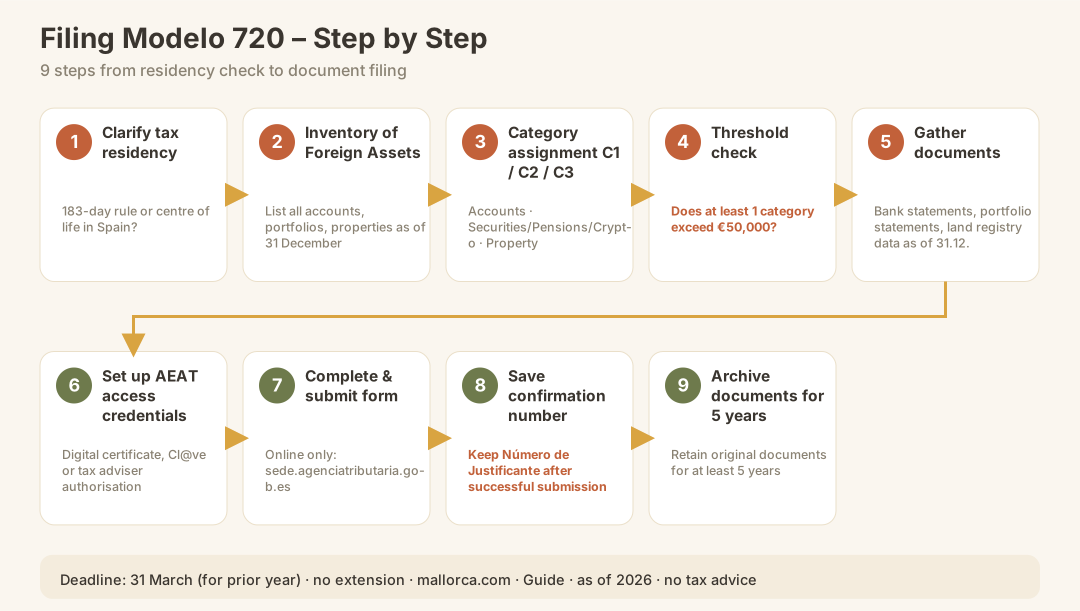
Clarify your tax residency: Are you genuinely tax resident in Spain? Check the 183-day rule and your centre of life.
Inventory of foreign assets: Draw up a complete list of all accounts, portfolios, properties and other rights held outside Spain as at 31 December.
Category assignment: Assign each asset to one of the three categories (C1/C2/C3) and total each category separately.
Threshold check: Does at least one category exceed 50.000 Euro? If so, you are required to report for that category.
Gather documentation: Bank certificates, portfolio statements, land registry extracts, insurance documents — all showing the reference value as at 31 December.
AEAT access credentials: Make sure you have a digital certificate or Cl@ve — or appoint a tax adviser with power of attorney (legally: representación).
Complete the form: In the AEAT portal under "Modelos y formularios" → Modelo 720. Fill in all mandatory fields, in particular the country code, IBAN/account number, balance as at 31.12. and average balance for Q4.
Submit and save confirmation: After successful submission you will receive a confirmation number (Número de Justificante). Make sure to keep this proof of submission.
File your documents: Retain original documents for at least 5 years.
Note: Most expats on Mallorca have their Modelo 720 submitted by a gestoría or a tax adviser specialising in international tax law. Costs typically range between 100 and 300 Euro depending on the provider and complexity — a manageable sum compared to potential fines.
Most common mistakes with the Modelo 720
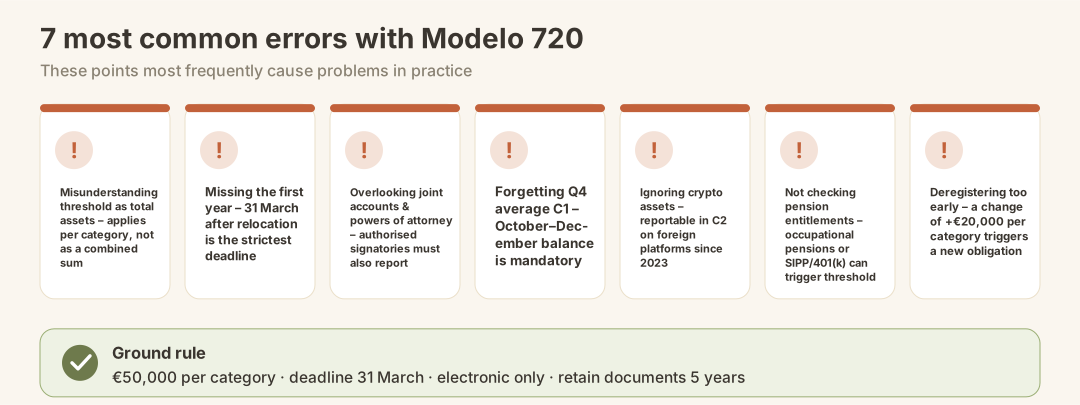
The following points cause problems most frequently in practice:
1. Misunderstanding the threshold
Many people think the threshold refers to total assets of 50.000 Euro. In fact, the limit applies per category independently. Anyone holding a German investment portfolio worth 55.000 Euro is required to report under C2 — even if all other categories fall below the threshold.
2. Missing the first year
The first year after moving is the most critical. Many people only find out about the obligation in autumn and miss the deadline of 31 March. A late Modelo 720 is possible, but automatically triggers penalties.
3. Overlooking joint accounts and authorised signatories
Anyone who merely holds signing authority on a foreign account is also subject to the reporting obligation — even if the account belongs to someone else.
4. Forgetting the quarterly average
For accounts (C1), the balance on 31 December alone is not sufficient. The average balance for the months of October to December is also a mandatory entry.
5. Ignoring crypto assets
Cryptocurrencies held on foreign custodial platforms must be reported under C2 from tax year 2023 onwards. Anyone trading on Binance, Coinbase or Kraken who exceeds the threshold is subject to the reporting obligation.
6. Failing to check pension entitlements
The question of whether an occupational pension or a foreign pension insurance policy exceeds the threshold is frequently overlooked. British and American expats with SIPPs or 401(k) accounts in particular regularly find themselves subject to the reporting obligation.
7. Cancelling in subsequent years too early
Anyone who mistakenly assumes they never need to file again after the initial submission overlooks the €20,000 change rule. Portfolio gains, property value adjustments, or fresh contributions can trigger a new obligation.
Modelo 720 and other tax obligations: how they interact
The Modelo 720 does not stand alone. It directly affects other tax obligations:
Tax / Declaration
Relation to the Modelo 720
IRPF (Modelo 100)
Income from declared foreign assets (interest, dividends, rental income) must be fully declared here
Wealth tax (Modelo 714)
Declared foreign properties and portfolios are included in the assessment basis
Modelo 721
Since 2023, a separate reporting obligation for cryptocurrencies; supplements the Modelo 720
Gift / Inheritance
Newly acquired foreign assets received through inheritance or gift must be declared following the transfer
Anyone filing their IRPF return as a resident in Mallorca should ensure that all assets declared in the Modelo 720 are also fully reflected in the income tax return. Inconsistencies between the two forms are a classic trigger for a tax audit.
You can find more information about income tax as a resident in Mallorca in the guide Taxes as a resident (IRPF).
What comes next? The Modelo 720 and relocating to Mallorca in the broader context
In our experience, the Modelo 720 is one of the first major surprises after the move — most people discover it together with their first tax consultation. It is worth tackling the most important administrative obligations in an orderly fashion:
Tax residency in Spain confirmed (183-day rule or centre of life)
Complete list of all foreign assets compiled
Accounts (C1): balance as at 31.12. and average balance October–December obtained
Securities/funds/pensions/crypto (C2): value as at 31.12. from custody or platform statement
Properties (C3): cadastral or purchase value, address of the property and land registry details
Threshold of 50.000 € per category checked
Joint accounts and authorisations on other accounts taken into account
Digital certificate / Cl@ve or tax adviser's power of attorney set up
Deadline 31. March entered in the calendar
Confirmation number saved after submission
Documents archived for at least 5 years
Conclusion
The Modelo 720 is not a tax form in the conventional sense — it does not trigger a payment and does not generate a refund. But it is a serious obligation with real consequences for non-compliance. Since the ECJ ruling of January 2022 and the reform introduced by Ley 5/2022, the penalties are considerably more moderate than they used to be, yet they do exist. For German, Austrian and Swiss newcomers to Mallorca, the following applies: anyone who holds a custody account, an owner-occupied flat or a savings account back home and lives on the island for more than 183 days a year is in all likelihood required to report.
The good news: with the right preparation and an experienced tax adviser, the form is perfectly manageable. The bad news: there is no extension of the deadline. The 31. March is absolute. Put it in your diary.
What is the difference between Modelo 720 and a tax return?
Modelo 720 is a purely informational declaration submitted to the Agencia Tributaria. No tax is assessed and no refund is granted. It simply informs Hacienda which assets you hold abroad, so that these can be cross-checked against your income and wealth tax returns.
Do I need to declare my German current account if it only contains 30.000 euros?
No. The reporting obligation only applies once the total value of all accounts in Category C1 (bank accounts held abroad) exceeds 50.000 euros as at 31 December. If your total balance across all foreign accounts is below that threshold, there is no obligation for this category — even if other categories exceed the limit.
I only moved to Mallorca in September — do I already need to file for this year?
If you become tax resident in Spain during this calendar year (e.g. by spending more than 183 days here up to 31 December), you are liable to tax for the full year and must submit a Modelo 720 for all relevant categories by the following 31 March.
What are the current penalties for non-filing?
Following the reform introduced by Law 5/2022 (in response to ECJ ruling C-788/19 of January 2022), fines for late or incorrect filing start at 300 euros per category and can reach approximately 20.000 euros per category depending on the severity and number of infringements. The previous practice of taxing undeclared assets as income with a 150% surcharge is no longer applicable.
Do cryptocurrencies need to be declared?
Yes, provided you hold cryptocurrencies on a foreign custodial platform (e.g. Binance, Coinbase, Kraken) and their value as at 31 December is 50.000 euros or more. Since the 2023 tax year they fall under Category C2. For crypto held in self-custody wallets, a separate Modelo 721 has been in place since 2023.
Do I need to submit a new Modelo 720 every year?
Only if, in at least one category, a change of more than 20.000 euros has occurred since the last filing, a new category crosses the threshold, or a previously declared asset has been sold or disposed of. In stable years, filing may not be required.
Am I required to file if I only have signatory authority over someone else's account?
Yes. The reporting obligation applies not only to account holders but also to authorised signatories and beneficial owners. If the account over which you hold authority has a balance of 50.000 euros or more, you are required to report it under Category C1.
Can I submit Modelo 720 myself, or do I need a tax adviser?
Technically you can file it yourself, provided you have a valid digital certificate or Cl@ve and are able to navigate the Spanish AEAT interface. In practice, most expats engage a gestoría or tax adviser — fees typically range between 100 and 300 euros and are money well spent given the potential for errors.