
Taxing a German Pension in Spain: Double Taxation Agreement, Withholding Tax & Tax Office Neubrandenburg
Anyone enjoying their German pension in Spain faces a question that many underestimate: which country is entitled to tax it — and how much? The answer lies in the German-Spanish double taxation agreement (DTA), which came into force on 18 October 2012 and has been applied since 1 January 2013. It replaced the previous arrangement dating from 1966. The outcome depends on the type of your pension, when your pension commenced, and whether you are genuinely tax-resident in Spain. This guide takes you through the taxation process step by step, covering which German and Spanish authorities are responsible, which deadlines apply, and which mistakes could cost you real money. You will also learn when the Finanzamt Neubrandenburg becomes relevant and how to file your Spanish income tax return (IRPF) correctly.

Have you already checked your pension start date, pension type, and residency status — or would you prefer to clarify this with a tax adviser?
- 📩 Submit a personal enquiry — We connect you with vetted tax advisers experienced in Spanish matters
- Tax as a resident in Spain (IRPF)
The old and the new DTA: what changed in 2013
Until the end of 2012, Germany and Spain were governed by an agreement dating from 1966. The rule was straightforward: the country in which you have your primary place of residence is entitled to tax your pension. If you lived in Spain, you paid tax only there — nothing in Germany.
The new DTA came into force on 18 October 2012 and has been applied since 1 January 2013. It was a response to the gradual introduction of deferred pension taxation in Germany from 2005 onwards. Germany wanted to retain at least a portion of the tax from pensioners living abroad. The result is a shared taxation right, the precise form of which depends on the type of your pension.
Please note: The new DTA does not apply retrospectively to pension commencement dates before 2015 in the same way. The exact transitional rules are complex — have them reviewed by a specialist.
The three pension types and where they are taxed
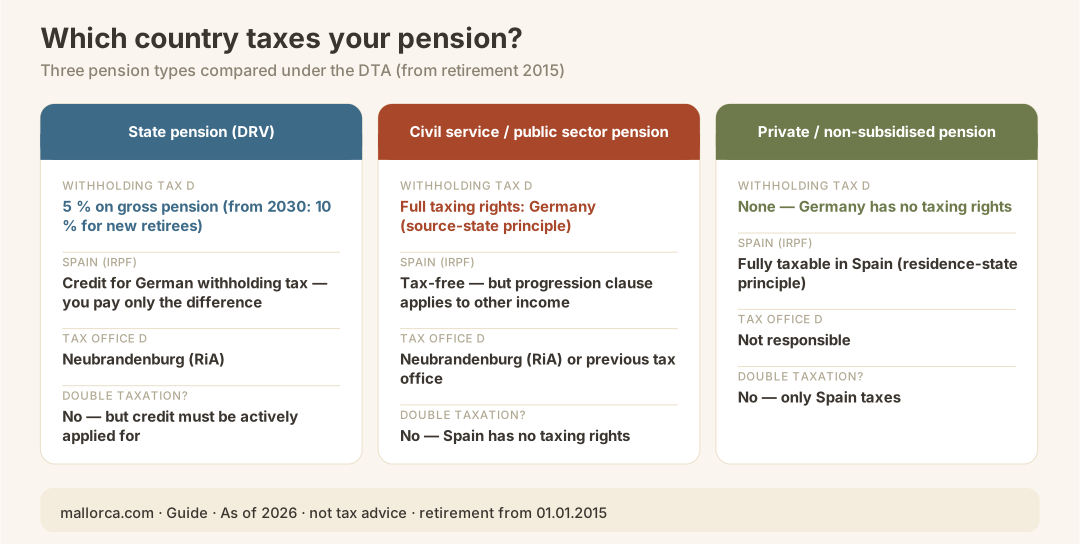
The DTA draws a fundamental distinction based on the origin and type of pension. The table below provides an overview:
| Pension type | Taxation right | Note |
|---|---|---|
| Statutory pension (DRV), pension commencing from 2015 | Germany (withholding tax) + Spain (credit) | 5 % withholding tax in Germany; from 2030, new pensioners 10 % |
| Statutory pension, pension commencing before 2015 | Spain (country of residence) | Old DTA rules may still apply |
| Civil service pension / public sector | Germany (source state) | Full taxation right: Germany |
| Occupational pension, state-subsidised (>12 years) | Germany (withholding tax) | Same withholding tax rates as statutory pension |
| Riester pension, Rürup pension (state-subsidised) | Germany (withholding tax) | 5 %, or from 2030 new pensioners 10 % |
| Private pension (not state-subsidised) | Spain (country of residence) | Country-of-residence principle |
| Occupational pension (not state-subsidised) | Spain (country of residence) | Country-of-residence principle |
| Ongoing early retirement payments (pension-type character) | Spain (country of residence) | Treated as a private pension |
| Lump-sum payments (capital settlements) | Germany (non-self-employed income) | Exception: 'earned' capitalised early retirement payments up to 1 year before retirement age → Spain |
Please note: Occupational pensions are only subject to withholding tax in Germany if they were state-subsidised and built up over more than 12 years. Non-subsidised occupational pensions remain taxable in the country of residence, Spain.
Withholding tax in Germany: who pays how much?
For pension recipients who first receive a statutory pension, occupational pension, Riester or Rürup pension from Germany on or after 1 January 2015 and are resident in Spain, Germany has a limited right of taxation in the form of a withholding tax:
| Pension commencement date | Withholding tax rate in Germany |
|---|---|
| From 01.01.2015 | 5% on the gross pension |
| From 01.01.2030 (new retirees) | 10% on the gross pension |
This German tax is not levied in addition to Spanish tax: Spain credits the withholding tax paid in Germany against the Spanish income tax (IRPF). There is therefore no genuine double taxation, but you must take active steps and apply for the credit.
Tax residency in Spain: the 183-day rule
Before you can determine in which country you are primarily liable to tax, you need to clarify your tax status. In Spain you are considered tax resident if you spend more than 183 days in the calendar year in Spain. Temporary absences are counted towards this total, provided you cannot demonstrate tax residency elsewhere.
As a tax resident you are liable to tax in Spain on your worldwide income — including your German pension, foreign investment income, and any other earnings.
If you spend fewer than 183 days in Spain and your centre of life is still in Germany, Germany remains the primary country of taxation. In that case you are subject to unlimited tax liability in Germany and benefit from the basic personal allowance.
Note: If you have applied for residencia (residence permit) in Spain but are no longer registered as resident in Germany, you will only be subject to limited tax liability in Germany — the basic personal allowance will generally no longer apply. This can result in a surprisingly high tax burden.
More on residencia and registration in Spain: Residencia Spain
The Finanzamt Neubrandenburg (RiA): your point of contact in Germany
For everyone living abroad who receives exclusively pension income from Germany, there is a single, central tax office in Germany: the Finanzamt Neubrandenburg (RiA). The 'RiA' stands for 'Rentenempfänger im Ausland' (pension recipients living abroad).
| Information | Details |
|---|---|
| Official name | Finanzamt Neubrandenburg (RiA) |
| Jurisdiction | All pensioners living abroad with German pension income (and no other German income) |
| Website | www.finanzamt-rente-im-ausland.de |
| Contact | Via the contact form on the website |
| Official assessment | Possible — the tax office can carry out an assessment without you submitting your own tax return |
| Payment by credit card | Online payment form available |
| Electronic notices | Administrative acts can be communicated electronically (§ 122a AO) |
If you receive additional German income alongside your pension (e.g. rental income from a German property), a different tax office may have jurisdiction. The Finanzamt Neubrandenburg will clarify on request whether it has jurisdiction in your case.
Please note: The Finanzamt Neubrandenburg offers an official assessment procedure: under certain circumstances you do not need to submit your own tax return — the tax office carries out the assessment itself. Check the website to find out whether this applies to you.
Limited vs. unlimited tax liability in Germany
This distinction determines how much tax you pay in Germany:
| Characteristic | Unlimited tax liability | Limited tax liability |
|---|---|---|
| Requirement | Place of residence or habitual abode in Germany | No place of residence in Germany, but German-source income |
| Basic personal allowance | Yes (applies to total income) | No (generally does not apply) |
| Worldwide income principle | Yes | No (domestic income only) |
| Typical situation | Retiree spends fewer than 183 days in Spain, still resident in Germany | Retiree with Residencia, no longer resident in Germany |
| Application for unlimited tax liability possible? | — | Under certain circumstances yes (§ 1 Abs. 3 EStG) |
The Finanzamt Neubrandenburg itself points out that individuals with limited tax liability can, under certain circumstances, save money by voluntarily applying to be treated as having unlimited tax liability — for example, if the basic personal allowance reduces their tax burden to zero. Have this assessed on an individual basis.
Spanish income tax (IRPF): how taxation works in Spain
As a tax resident in Spain, you must declare all your worldwide income — including your German pension — in your Spanish income tax return (Declaración de la Renta, IRPF).
The Spanish tax system differs fundamentally from the German one:
- There is no income-splitting for married couples
- The tax is split into two parts: the central government (Hacienda) and the autonomous region each levy their own portion
- The Autonomous Region (in the Balearic Islands: the Comunitat Autònoma de les Illes Balears) may set its own tax rates and deductions
- There are different calculation bases for allowances and deductions than in Germany
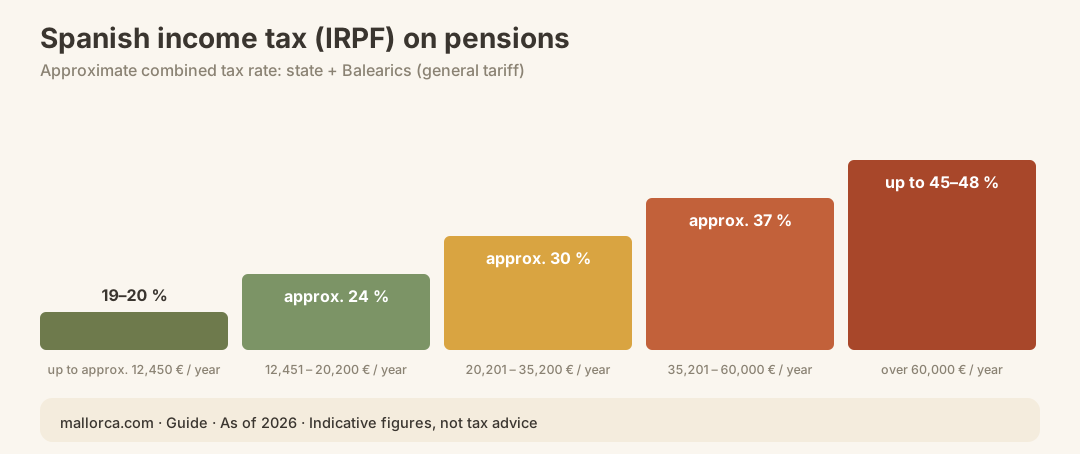
Spanish income tax rates on pensions (general rate, simplified)
| Taxable income (€/year) | Approximate overall tax rate (state + Balearic Islands) |
|---|---|
| Up to approx. 12.450 € | approx. 19–20 % |
| 12.451 – 20.200 € | approx. 24 % |
| 20.201 – 35.200 € | approx. 30 % |
| 35.201 – 60.000 € | approx. 37 % |
| Over 60.000 € | up to approx. 45–48 % |
Please note: These rates are indicative figures. The exact tax rate depends on your Autonomous Region, the available deductions, and your overall income situation. Investment income is often taxed more favourably in Spain (approx. 19–21 %) than in Germany (approx. 26,4 % flat-rate withholding tax).
Important deadlines for tax returns in Spain
| Obligation | Deadline |
|---|---|
| IRPF tax return (residents) | 30 June of the following year |
| Modelo 720 (foreign assets >50.000 €) | 31 March of the following year |
| Non-resident tax on owner-occupied properties | 31 December of the current year |
Important: The Spanish tax authority (Hacienda/AEAT) does not send invoices. You have a duty to act proactively: anyone who misses the deadline will incur penalty interest and surcharges.
More on the reporting obligations for foreign assets: Modelo 720
Crediting German withholding tax in Spain
If Germany deducts withholding tax on your pension (5 % or, in future, 10 %), this is credited against your Spanish IRPF liability in your Spanish tax return. You therefore only pay the difference in Spain between the Spanish tax and the withholding tax already paid in Germany.
For this to work, you must:
- Document the withholding tax deducted in Germany (assessment notice or notification from the Finanzamt Neubrandenburg)
- Enter the corresponding amount in your IRPF return as the "credit amount for foreign taxes"
- If necessary, engage a tax adviser in Spain who is familiar with the double taxation agreement (DBA)
Please note: The offset is not automatic — it must be actively claimed in the tax return. Anyone who forgets this ends up paying twice in practice.
Special case: civil service pensions and public sector employment
For former civil servants, judges, soldiers and employees of the German public sector, the source state principle applies: Germany retains full taxation rights, regardless of where you live. Spain may not tax this income — but must take it into account when calculating the tax rate on other income (progression clause).
What this means for you:
- You continue to file your German tax return in Germany (Finanzamt Neubrandenburg or, where applicable, the previously responsible tax office)
- In Spain you declare the pension as 'tax-exempt income subject to the progression clause'
- A higher tax rate may consequently apply to other Spanish income
Information exchange: Germany and Spain share data
An important point that many people underestimate: Germany and Spain automatically exchange tax data under the double taxation agreement and the EU Mutual Assistance Directive. The Deutsche Rentenversicherung and other bodies transmit pension payments to the Bundeszentralamt für Steuern, which shares the data with the Spanish authorities.
Anyone who thinks they can enjoy their German pension in Spain 'under the radar' risks:
- Back taxes plus interest
- Fines for failing to file an IRPF return
- In the worst case, criminal consequences for tax evasion
The most common mistakes when declaring a German pension in Spain
- Pension start date and pension type not checked — The taxation rules differ considerably depending on when the pension began (before/from 2015) and the type of pension (statutory, civil service pension, private).
- Withholding tax not offset — The withholding tax paid in Germany is overlooked in the IRPF return and goes unused.
- Basic personal allowance expected despite not being entitled to it — Limited taxpayers are not entitled to the German basic personal allowance.
- Tax return deadline in Spain missed — 30 June is a firm deadline; Hacienda does not send reminders.
- Modelo 720 not submitted — Anyone with foreign assets exceeding 50.000 € who fails to report them risks substantial fines.
- Incorrect assessment of tax residency status — Anyone who holds the Residencia but believes they are still a German tax resident is in a dangerous position from a tax perspective.
- One-off lump-sum payments treated like regular pension income — Lump-sum payments are classified as employment income and are taxable in Germany.
- No adviser experienced in double taxation agreements consulted — The double taxation agreement is complex; general tax advisers without international experience frequently make mistakes in this area.
What comes next? Further tax obligations as a retiree in Spain
Correctly declaring your pension is only the beginning. As a retiree residing on Mallorca or the Balearic Islands, further tax obligations may arise:
- Wealth tax (Impuesto sobre el Patrimonio): Spain levies a wealth tax on net assets above a tax-free allowance. The Balearic Islands have their own regulations.
- Modelo 720: Foreign assets exceeding 50.000 € must be declared (deadline: 31 March).
- Non-resident tax: Relevant for as long as you are not yet officially tax resident in Spain but own a property there.
- Inheritance and gifts: Spain and the Balearic Islands have their own inheritance tax regulations, which can differ significantly from German tax-free allowances.
For a full overview: Taxes & Finances in Mallorca
And on non-resident tax: Non-Resident Tax Spain
Checklist: Correctly paying tax on your German pension in Spain
- Clarify your tax status: Am I a tax resident in Spain (>183 days)?
- Check residencia status: Has the residencia been applied for and is it valid?
- Determine pension type: State pension, civil service pension, occupational pension, Riester/Rürup, private?
- Note pension start date: Before or from 1 January 2015?
- Contact Finanzamt Neubrandenburg: Clarify jurisdiction, check official assessment if applicable
- Retain withholding tax assessment notice: For offsetting against Spanish IRPF
- Prepare IRPF declaration: Meet the deadline of 30 June
- Check Modelo 720: Foreign assets exceeding €50,000? Deadline 31 March
- Engage a tax adviser experienced in double taxation agreements: For your individual tax strategy
- Be aware of data exchange between Germany and Spain: Do not conceal any income
More on registering in Spain: Empadronamiento Mallorca
Conclusion
Paying tax on a German pension in Spain is not a simple yes-or-no question. The DBA of 2013 allocates taxing rights according to the type of pension: state pensions and state-subsidised retirement provision are subject to German withholding tax (5 % for new pensioners from 2015, 10 % for new pensioners from 2030), which is offset against tax in Spain. Civil service pensions remain fully taxable in Germany. Private and non-subsidised occupational pensions are taxed exclusively in Spain.
Finanzamt Neubrandenburg (RiA) is the sole German point of contact for everyone who receives only pension income from Germany and lives abroad. In Spain, 30 June is the strict deadline for the IRPF declaration. Anyone who understands both systems, correctly offsets the withholding tax, and keeps the Modelo 720 obligation in mind will not pay a single cent too much — and will not fall into the costly trap of double taxation or penalties.
Get a tax adviser with proven DBA experience early on: the subject is complex, the figures are real — and ignorance is no defence before Hacienda.
Official sources
- Finanzamt Neubrandenburg (RiA) — Central tax office for pensioners living abroad: www.finanzamt-rente-im-ausland.de
- German-Spanish Double Taxation Agreement (in force from 18.10.2012, applicable from 01.01.2013): Bundesgesetzblatt / Bundesfinanzministerium
- § 49 EStG — Income subject to limited tax liability: www.gesetze-im-internet.de/estg/__49.html
- § 22 EStG — Other income / types of pension: www.gesetze-im-internet.de/estg/__22.html
- § 1 Abs. 3 EStG — Application for unlimited tax liability: www.gesetze-im-internet.de/estg/__1.html
- § 122a AO — Electronic notification of administrative acts: www.gesetze-im-internet.de/ao_1977/__122a.html
- Agencia Estatal de Administración Tributaria (AEAT) — Spanish tax authority, IRPF information: www.aeat.es
- Agència Tributària de les Illes Balears (ATIB) — Balearic tax authority: www.atib.es
- Deutsche Rentenversicherung Bund (DRV) — Information on pensions abroad: www.deutsche-rentenversicherung.de