
Overwintering in Mallorca: long-term stay from October to April
More and more Northern Europeans are spending the cold season not at home but on Mallorca – without emigrating completely. Those who overwinter on the island from October to April benefit from mild temperatures of around 10 to 15°C, empty hiking trails in the Tramuntana and significantly cheaper rents than in summer. At the same time, this long-term stay is not a legal no-man's-land: the 183-day rule for tax residency applies, along with a registration requirement after three months for EU citizens, and specific rules of the game for health insurance, housing and cars. This guide shows you what you need to know before departure, which deadlines really matter, and how to plan your winter on Mallorca practically and without nasty surprises – whether as a retiree, remote worker or couple staying temporarily.
Winter weather: what really awaits you on Mallorca
Mallorca in winter is neither snow nor bikini weather, but something in between – mild, often sunny, with cool to cold nights. Daytime highs are usually between 15 and 19°C, while at night, especially in December and January, it can drop to just above freezing. The sea is too cold for swimming from November onwards, but hiking, cycling and sightseeing without the crowds are the clear winter highlights.
| Month | Avg. temperature | Min. | Max. | Days of rain | Water temperature |
|---|---|---|---|---|---|
| November | 14.0°C | 8.8°C | 19.2°C | 6 | 18°C |
| December | 11.1°C | 5.8°C | 16.5°C | 5 | 16°C |
| January | 9.9°C | 4.3°C | 15.5°C | 5 | 14°C |
| February | 10.0°C | 4.3°C | 15.6°C | 5 | 14°C |
| Indicator | Value |
|---|---|
| Typical coldest nights (Dec./Jan./Feb.) | 0°C to -1°C |
| Absolute minimum ever recorded | -4.4°C (February 2012) |
| Hours of sunshine per day in winter | 5 to 6 hrs. |
| Humidity in winter | 79–81% |
| Day length in December | approx. 9 hrs. 25 min. |
Note: Even though daytime values of around 15–19°C seem pleasant, nights in stone houses and fincas without central heating feel considerably colder than the figures suggest. Factor in heating from the very start.
Who is allowed to stay, and for how long? EU citizens vs. non-EU citizens
The most important distinction when overwintering is your nationality. EU citizens enjoy freedom of movement with no time limit, whereas non-EU citizens (such as Britons since Brexit) are subject to the strict 90/180-day rule within the Schengen area.
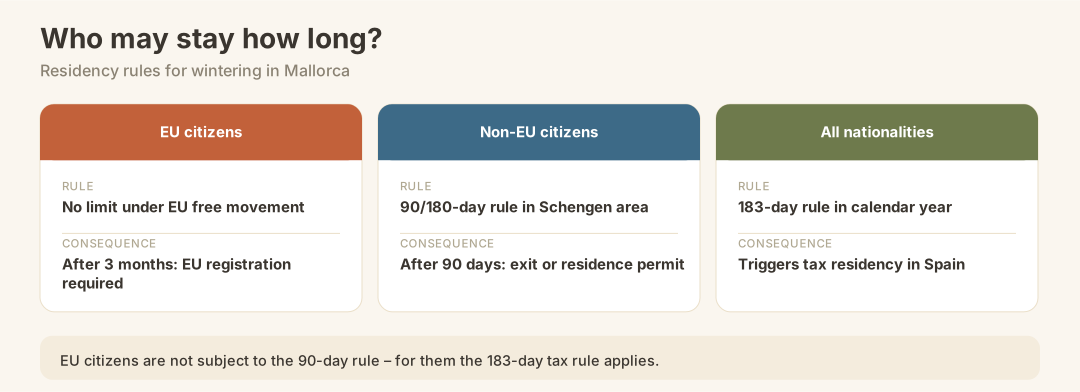
| Group of people | Rule | Consequence |
|---|---|---|
| EU citizens (DE, AT, other EU countries) | No upper limit due to EU freedom of movement | After 3 months' stay: EU registration required |
| Non-EU citizens (e.g. Britons) | 90/180-day rule within the Schengen area | After 90 days: departure or residence permit required |
| All nationalities | 183-day rule within the calendar year | Exceeding this triggers tax residency in Spain |
For EU citizens, the 90-day rule is simply not relevant – they may stay in Spain indefinitely. What matters instead is the tax-related 183-day rule: those who only stay from October to March or April usually split their stay across two calendar years, thereby remaining under the 183-day threshold in both years – so one typically remains a German tax resident. However, if additional summer stays in the same year are added, the threshold can be exceeded more quickly than expected.
Attention: Non-EU citizens should keep a very close eye on the 90/180-day rule – a violation can cause problems with future entries. Details on the calculation can be found in the guide on the 90/180-day rule. Britons with long-term plans should also inform themselves about the TIE card for Britons.
Registration requirement from three months: what EU citizens need to know
Even without firm emigration plans, EU citizens are formally required to register with the EU once their stay exceeds three months. The result is the green Certificado de Registro, which confirms your right of residence in Spain – it is not a registration certificate and does not replace the Empadronamiento in your municipality.
| Situation | Requirement | Responsible authority |
|---|---|---|
| Stay up to 3 months | No registration needed | – |
| Stay over 3 months (EU citizens) | Certificado de Registro advisable/formally required | Oficina de Extranjería / Comisaría |
| Relocation of residence to Spain | Deregistration in Germany (giving up residence) | German registration office |
| Permanent residence in Mallorca | Empadronamiento in the municipality of residence | Ayuntamiento |
Important for pure winter visitors: as long as your habitual residence remains in Germany, there is no obligation to re-register. Only once you actually relocate your centre of life to Spain do registration obligations such as the Empadronamiento and further steps towards Residencia.
Health insurance for the winter stay
Health insurance is one of the most common stumbling blocks when wintering. The European Health Insurance Card (EHIC) or an S1 form does cover medically necessary treatment within the Spanish public healthcare system – but neither the return transport to Germany nor treatment in private clinics, which on Mallorca is often faster and more comfortable.
| Coverage | Covers | Does NOT cover |
|---|---|---|
| EHIC / S1 form | Medically necessary treatment in the public system | Repatriation, private clinics |
| Long-term travel health insurance abroad | Repatriation, often also private treatment | Scope of cover varies depending on the tariff |
| Private comprehensive health insurance | Comprehensive treatment, optional extras | – (depending on the tariff) |
Note: For a stay of several months over winter, long-term travel health insurance abroad with repatriation cover is strongly recommended. More on this in the guides on Health insurance in Spain, on the S1 form and on the Healthcare system in Mallorca.
Living there in winter: long-term rentals, running costs and heating
From November to April, Mallorca goes into a kind of tourist off-season, meaning many holiday properties are offered as long-term rentals at significantly lower prices than during high season. At the same time, temperature data show that nights of 0°C to -1°C are not uncommon – especially in older stone houses or fincas without continuous heating, this can quickly become uncomfortable.
| Preparation step | Why it matters |
|---|---|
| Clarify the type of heating in the accommodation | Many fincas only have a fireplace or air conditioning in heating mode |
| Check insulation/double glazing | Old buildings cool down significantly at night |
| Check the electricity and water connection | With long-term rentals, a separate contract is often required |
| Test internet/mobile reception on site | Important for remote work and staying in touch with home |
Practical questions about housing are answered in the guides on heating in Mallorca, on registering electricity, on registering water and on internet connection. An overview of ongoing costs is provided in the article on living costs in Mallorca.
Car and mobility during a winter stay
Anyone staying on the island for several months will sooner or later face the question: bring your own car, rent one locally, or use a Spanish vehicle? Different rules apply to registration, insurance and technical inspection for each of the three options.
| Option | To clarify |
|---|---|
| Own vehicle with German number plate | Rules for foreign number plates in Mallorca |
| Permanently importing a vehicle to Spain | Re-registration, registration, possibly foreign customs |
| Rental car for the winter months | Annual rental often bookable more cheaply |
| Driving licence | Conversion relevant for permanent residence |
You can find further information in the guides on foreign number plates in Mallorca, on importing & re-registering a car, on ITV (technical inspection), on car insurance and for the transferring your driving licence. A complete overview is provided in the Cars & Traffic.
Everyday life and activities: the quiet side of the island
Winter shows Mallorca from its calm, unhurried side. The Tramuntana mountains lie in clear light on many days, the winding roads are almost empty, and hiking trails can be explored for hours without meeting a soul. The coast, too, remains appealing: the island has 43 harbour facilities with a total of 14,280 moorings, spread across destinations such as Port de Sóller, Port d'Andratx, Cala Ratjada or Puerto Portals – noticeably quieter in winter than during high season. Anyone wanting to overwinter their own yacht or boat can find background information in the guide on moorings in Mallorca.
Culinarily, some summer restaurants aimed at tourists close during the off-season, but many restaurants – especially those also frequented by locals – stay open year-round. Sights such as Palma Cathedral or the limestone caves can be visited in winter without long waiting times.
Working during your winter stay
More and more winter residents are combining their stay with remote work. It's important to know: as soon as you regularly work from Spain, tax and social security obligations can arise – regardless of whether you are formally "just overwintering" or have permanently emigrated. Those who are self-employed should look early into topics such as autónomo registration, pluriactividad, or avoiding falso autónomo situations.
Relevant guides: Remote Work Mallorca, Pluriactividad Spain, Falso Autónomo Spain and Autónomo with a foreign employer.
Taxes: what applies to a pure winter stay
Days spent in Spain
Explanation
Days of presence are every day you were in Spain, including days between two documented stays unless you can prove you were abroad. Arrival and departure days each count in full.
Explanation
Sporadic absences (“ausencias esporádicas” — short trips abroad) are days not included in the figure above. The law adds them rather than subtracting them.
Explanation
A tax residence certificate (“certificado de residencia fiscal”) is confirmation from a foreign tax authority that you are tax-resident there; it is valid for one year. It excludes only sporadic absences, not your presence in Spain.
Based on your entries, neither criterion is met.
Interim result: the calendar year is still in progress.
- Total residence days counted
- 150 days
- Statutory threshold (more than)
- 183 days
150 = 150 days
Days needed to cross the threshold: 34.
Legal status: 1 January 2007
This calculation is provided for guidance only and is not a substitute for tax or legal advice in specific cases.
As long as your stay is spread in the classic way from October to March or April, you generally remain below the 183-day threshold in Spain and thus continue to be liable for tax in Germany. However, exact counting is important: additional short stays in summer within the same calendar year can exceed the threshold and trigger Spanish tax residency – with consequences for income, assets and reporting obligations.
Note: Anyone who regularly overwinters and is unsure how many days have already accumulated in the current calendar year should document this (flight tickets, bookings) and, if in doubt, seek tax advice. Background information can be found in the guides on Taxes as a resident, on Non-resident tax and in the Taxes & Finance.
Most common mistakes when overwintering in Mallorca
- Confusing the 90-day rule with EU freedom of movement: EU citizens are not subject to it – it only applies to non-EU nationals.
- Ignoring the registration requirement from 3 months onwards: Even without firm plans to emigrate, the Certificado de Registro can become relevant.
- Underestimating health insurance: EHIC/S1 does not cover repatriation or private treatment.
- Misjudging cold nights: Daytime values of around 15–19°C are misleading, masking nights close to 0°C.
- Miscounting the 183-day rule: Additional summer stays in the same year can trigger tax residency.
- Ignoring car regulations: Foreign number plates, insurance and ITV deadlines should be clarified before departure.
Checklist: Preparing for a winter stay
| Step | Deadline/Timing |
|---|---|
| Secure long-term accommodation with working heating | well before arrival |
| Take out long-term travel health insurance abroad | before departure |
| Document the days of stay in the current calendar year | ongoing |
| For stays over 3 months: check registration requirements | from arrival |
| Clarify electricity, water and internet connections at the accommodation | before moving in |
| Clarify the vehicle question (bring, rent, import) | before departure |
| For remote work: check the tax situation | before departure |
What comes next? From wintering to permanent living
Many who have spent a winter in Mallorca toy with the idea of a permanent move. The transition from a pure long-term stay to genuine emigration is clearly defined in legal terms: as soon as one's habitual residence is relocated to Spain, empadronamiento, residencia and full tax residency come into effect. Anyone considering this step will find guidance in the basic guides on Emigration basics, on Residencia and to Authorities & Registration in general.
Conclusion
Wintering in Mallorca is more straightforward for EU citizens than many think – there is no 90-day limit, but there are clear rules regarding registration, taxes and health insurance. Anyone who keeps the 183-day rule in mind, arranges long-term health insurance with repatriation cover in good time, and prepares their accommodation for cold winter nights can enjoy the island's quiet, mild low season without worry. For those who want to make more of their winter stay, the further guides on authorities, taxes and housing offer the next step.
Official sources
- Sede electrónica del Ministerio del Interior – Registro de ciudadanos de la Unión Europea: https://sede.mir.gob.es
- Agencia Tributaria (AEAT) – Residencia fiscal en España: https://www.agenciatributaria.es
- BOE – Ley Orgánica 4/2000 sobre derechos y libertades de los extranjeros en España: https://www.boe.es
- Ministerio de Inclusión, Seguridad Social y Migraciones – Portal Extranjería: https://extranjeros.inclusion.gob.es
- Consell de Mallorca – Información institucional: https://www.conselldemallorca.es