
Tax on investment income and capital gains in Spain: Ahorro bands
Anyone who becomes tax-resident in Mallorca or elsewhere in Spain will sooner or later need to understand Spain’s tax on investment income and capital gains, known as the Ahorro tax bands. It covers dividends, interest and gains from selling shares, investment funds or property. Unlike Germany, Spain does not have a single flat-rate withholding tax on investment income. Instead, rates rise progressively from 19% to 30%. This guide explains how the Ahorro tax bands work, how the rules differ for residents and non-residents, how to credit German withholding tax on dividends, which forms (Modelo 100, 210, 211) you need to know about and which mistakes could cost you money unnecessarily.

What are the Ahorro tax bands, and who do they affect?
Spain’s Personal Income Tax Law (Ley del Impuesto sobre la Renta de las Personas Físicas, IRPF) distinguishes between two main categories of income: Renta General (employment and rental income) and Renta del Ahorro — income from savings and investments. Renta del Ahorro includes dividends, interest, gains from selling shares and funds, and gains from selling property. Tax is collected by the national tax authority, the Agencia Estatal de Administración Tributaria (AEAT), commonly known as ‘Hacienda’.
You are tax-resident in Spain — and therefore taxable there on your worldwide income — if you spend more than 183 days of a calendar year in Spain or have your centre of economic or personal interests there. For residents, the progressive Ahorro rates range from 19% to 30%. Non-residents are taxed under different rules, explained below.
Note: Establishing your tax residency correctly is the most important step before planning for tax on investment income and capital gains. Find out more in the guide Taxes as a resident.
Tax rates for 2026 at a glance
The Ahorro rates are progressive: the higher your annual income from savings and investments, the higher the applicable rate within the 19% to 30% range. The bands are 19% up to €6,000, 21% up to €50,000, 23% up to €200,000, 27% up to €300,000 and 30% above that. The top rate has been 30% since 1 January 2025 (Ley 7/2024) and has risen several times in recent years. It mainly affects residents with substantial gains, such as those from a major property sale or a large investment portfolio.
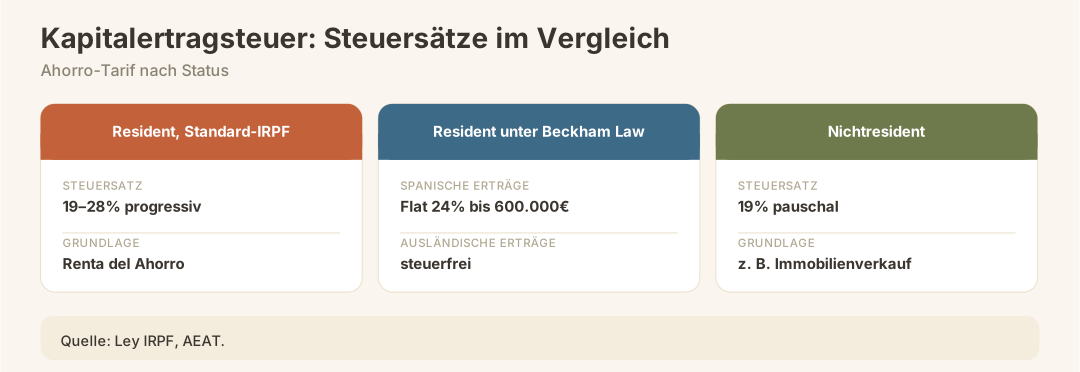
| Status | Tax rate on investment income and capital gains | Legal basis / source |
|---|---|---|
| Resident, standard IRPF rules | 19–30% progressive (Renta del Ahorro) | Ley IRPF, AEAT |
| Resident under the Beckham Law | Spanish-source income may be taxed at a flat 24% up to €600,000; foreign investment income and capital gains are tax-free | Special Beckham Law regime |
| Non-resident (e.g. property sale) | Flat rate of 19% | Single rate for all non-residents |
Important: The progressive Ahorro tax rates particularly affect larger capital gains, such as those from selling a holiday home in Mallorca. Plan the timing of the sale and the realisation of the gain with your tax adviser.
Dividends from Germany: avoiding double taxation
If you are a Spanish tax resident and still hold German shares or funds, you will have to deal with German withholding tax on investment income (Abgeltungsteuer). Germany withholds tax on dividends paid out. Under the double taxation agreement (DBA) between Germany and Spain, up to 15 per cent of this withholding tax can be credited against your Spanish tax liability, so the income is not taxed twice in full.
| Situation | Germany | Spain |
|---|---|---|
| Dividend from German shares paid to a Spanish resident | Withholding tax of up to 15% under the DBA | Credit of the 15% against Spanish tax liability |
| Declaration of income | reported through the German custodian bank | included in the annual tax return, Modelo 100 |
What to do:
- Collect the annual tax certificates from your German custodian bank (they show the withholding tax deducted).
- Enter the gross dividend and the German tax withheld as investment income on your Spanish tax return (Modelo 100).
- Ask your tax adviser to check the 15 per cent credit available to you. German withholding tax often exceeds the creditable amount, in which case it may be worth applying for a refund in Germany.
Note: A Spanish bank account makes handling dividend and interest payments much easier. For details, see our guide to opening a bank account in Spain.
Gains on shares and funds: the Traspaso rule
The Traspaso rule is a distinctive feature of Spanish tax law for investment fund investors. It allows you to transfer an investment from one fund to another without immediately triggering a taxable capital gain. Tax is deferred until money is actually withdrawn from the fund. For investors who regularly switch funds, this can provide a substantial tax-deferral benefit. By contrast, every sale of an individual share immediately gives rise to a taxable gain or loss.
Important: The Traspaso rule generally applies only to investment funds registered or authorised for sale in Spain, not automatically to every foreign fund product. Check eligibility with your bank or adviser before switching funds.
Non-residents: a flat 19 per cent rate and separate deadlines
If you are not tax resident in Spain but sell a property there, for example, different tax rules apply. For years, non-residents have been subject to a flat rate of 19 per cent on the capital gain, regardless of whether the seller is from an EU country or outside the EU.
| Procedure | Form | Deadline |
|---|---|---|
| Tax withheld by the buyer (3% of the sale price) | Modelo 211 | within 1 month of the sale |
| Tax return declaring the actual gain | Modelo 210 | 3 months after the Modelo 211 deadline (around 4 months after the sale) |
When a property is sold, the buyer automatically withholds 3% of the sale price and pays it to the tax authority using Modelo 211. If this exceeds the actual tax due at 19% of the gain, you can reclaim the difference using Modelo 210; if too little was withheld, you must pay the shortfall.
Example calculation: Sale price €250,000, purchase price €180,000, deductible costs (notary, lawyer, estate agent’s commission, ITP/IVA, property improvements) €10,000 → gain €60,000 → tax at 19% = €11,400.
Important: Non-residents are not eligible for tax relief: neither the reinvestment exemption nor the exemption for those aged 65 or over, which may be available to residents under certain conditions.
Residents: watch out for incorrect tax withholding when selling a property
In practice, notaries or buyers sometimes mistakenly apply the 3% withholding for non-residents to residents, for example because the seller’s residency status was not correctly documented at the time of sale. In such cases, tax on the capital gain has been withheld in error and must be actively reclaimed from the Agencia Tributaria.
Note: Make sure you provide clear proof of your resident status (Certificado de Residencia Fiscal, Empadronamiento) at the notary appointment to avoid unnecessary withholding. Read more about registration in our Empadronamiento guide.
Beckham Law: a special case for new arrivals
People moving to Spain who meet the requirements of the special regime known as Beckham Law may benefit from a different tax system: Spanish income of up to €600,000 is taxed at a flat rate of 24% for the year of arrival plus the following five years (six tax years in total). The key advantage for investors is that foreign investment income – including dividends, capital gains and rental income from abroad – is tax-free under this regime, as only Spanish income is covered.
| Feature | Beckham Law |
|---|---|
| Tax rate on Spanish income | Flat rate of 24% up to €600,000 |
| Duration | Year of arrival + 5 subsequent years (6 tax years) |
| Foreign investment income | tax-free (dividends, gains, rental income from abroad) |
Note: The Beckham Law regime must be applied for by the deadline and is subject to strict eligibility requirements. For details, see the guide Beckham Law in Spain.
Reporting obligations: Modelo 100, Modelo 720 and deadlines
For residents, the annual income tax return (Declaración de la Renta, Modelo 100) is the main way to declare all income, including investment income from Spain and abroad. Residents who also hold assets abroad may need to comply with the Modelo 720 reporting requirement.
| Form | Purpose | Who it applies to |
|---|---|---|
| Modelo 100 | Annual income tax return, including investment income | Residents |
| Modelo 210 | Declaration of capital gains (e.g. from property) | Non-residents |
| Modelo 211 | 3% withholding tax retained by the buyer | Non-residents (buyers) |
| Modelo 720 | Reporting assets held abroad | Residents with assets abroad |
Note: For details of the reporting requirement, see the guide Modelo 720 reporting requirement.
Most common capital gains tax mistakes
- Not providing proof of residency status: This leads to an unnecessary 3% withholding on a property sale, even though, as a resident, you would instead be taxed at the progressive Ahorro rates.
- Not claiming a credit for German withholding tax: If you do not claim the DBA tax credit of up to 15%, you effectively pay tax twice on the same dividend.
- Claiming cosmetic renovations instead of structural improvements: When selling a property, only genuine structural improvements qualify as deductible costs – painting and new flooring do not.
- Missing the deadlines for Modelo 210/211: The 4-month deadline after a sale for non-residents is often underestimated.
- Applying the Traspaso rule incorrectly: Not every foreign fund qualifies for tax-free switching.
What happens next? Review, refund or additional payment
After you file your tax return, the Agencia Tributaria reviews the investment income you have declared, particularly where larger sums or property sales are involved. If more than the actual tax due was withheld on a sale (Modelo 211), a refund is usually issued after Modelo 210 has been reviewed. If too little was withheld, the tax authority will demand the difference. If there are discrepancies or tax has been wrongly withheld, it is worth seeking legal advice to pursue a refund.
Checklist: paying tax on investment income correctly in Spain
- Tax residency clearly established (183-day rule, centre of vital interests)
- All investment income (from Spain and abroad) gathered for Modelo 100
- German annual tax statements available for the DBA tax credit
- Residency status documented with the notary/buyer when selling a property
- Deadlines for Modelo 211 (1 month) and Modelo 210 (3 months thereafter) in your calendar
- Checked whether the Beckham Law or Traspaso rule applies
- Checked whether Modelo 720 reporting requirements apply to assets abroad
- Appointed a tax adviser specialising in German-Spanish tax law
Conclusion
Spain’s tax on investment income follows its own rules under the Ahorro rates: progressive rates between 19 and 30 per cent for residents, a flat 19 per cent for non-residents, special rules for those eligible for the Beckham Law, and the practical Traspaso rule for fund investors. If you receive German dividends, do not overlook the DBA tax credit; if you sell a property, keep track of the deadlines for Modelo 210 and 211. With progressive rates reaching 30 per cent, it is all the more worthwhile to plan ahead with an adviser specialising in German-Spanish tax law.
Official sources
- Ley 27/2014, de 27 de noviembre, del Impuesto sobre Sociedades (LIS), Art. 21 – https://www.boe.es/buscar/act.php?id=BOE-A-2014-12328#a21
- Agencia Estatal de Administración Tributaria (AEAT) – the authority responsible for IRPF, Modelo 100, Modelo 210 and Modelo 211
- Ley del Impuesto sobre la Renta de las Personas Físicas (IRPF) – the legal basis for Renta del Ahorro
This guide provides a general overview of the legal position and does not replace legal or tax advice on your individual circumstances. Laws and deadlines may change; the linked official sources are authoritative.