Empadronamiento without a rental contract: how to prove your address as a foreigner
You've found a flat, you're staying with friends temporarily, or you've just arrived in Mallorca – but you don't yet have a formal tenancy agreement in hand. Nevertheless, you need to register with the Padrón Municipal, because Empadronamiento without a tenancy agreement is not an exceptional case, but rather a situation that many foreigners encounter when moving to the island. Spanish municipal law recognises several equally valid alternatives to a tenancy agreement as proof of residence. This guide explains which documents the town hall accepts, how to proceed if you are living with another person, what particular considerations apply in Mallorca, and which mistakes you should absolutely avoid. By the end, you will know exactly which documents you need before booking your appointment at the Ayuntamiento.
Do you need assistance with documents, appointments, and registration in Mallorca?
What is Empadronamiento – and why is it possible without a tenancy agreement?
Empadronamiento is the registration in the municipal residents' register (Padrón Municipal de Habitantes) of your municipality in Spain. The legal basis is Article 15 of the Ley de Bases del Régimen Local: anyone who resides permanently in a Spanish municipality is obliged to register – regardless of nationality or residence status.
The key point: the law requires proof that you live at the stated address – not necessarily a tenancy agreement. The Ayuntamiento accepts various documents as equivalent evidence. A tenancy agreement is the standard case, but expressly not the only option.
Please note: Empadronamiento is not a residence permit or a tax domicile. It merely confirms your residential address in the municipality – nothing more and nothing less. Residencia follows a separate procedure.
Which documents are accepted as proof of residence?
In addition to your national identity document or passport (plus a copy), the town hall requires one of the following proofs. The table below shows which alternatives are accepted in practice:
Document
Notes
Typical requirement
Tenancy agreement (contrato de arrendamiento)
Standard case
Original + copy
Title deed (escritura de compraventa)
Considered the strongest proof
Original or certified copy
Nota Simple from the Land Registry
Current, no more than a few months old
Original
Most recent IBI receipt (property tax)
Only if you are listed as the owner
Original + copy
Electricity, water or gas bill
Must be in your name or show the owner's details
Original, current bill
Landline telephone bill
Same as utility bill
Original, current
Written authorisation from the owner
If you are living at someone else's property (see section below)
With owner's ID + proof of ownership
Please note: Some municipalities in Mallorca additionally require proof of the most recent rent payment (recibo), when a tenancy agreement is submitted. Check with the relevant Ayuntamiento in advance as to which version they prefer.
Empadronamiento when living with someone else: the subletting or host arrangement
Are you temporarily staying with friends, family, or in a furnished room without a formal contract? This is not an insurmountable obstacle in Mallorca – you simply register at the address where you actually live.
For this, the owner or main tenant of the property will need the following:
Written authorisation (autorización) for your registration at their address – informal, but signed
Copy of their identity card or passport
Proof of ownership of the property (escritura, Nota Simple, IBI receipt)ortheir valid tenancy agreement, if they are themselves a tenant
If you are already registered at the property and another person wishes to be registered at the same address, the permission of the registered primary resident together with their identity document is generally sufficient.
Note: The written permission has no legally prescribed form – a simple document stating the date, address, first and last name of the person granting permission, their signature, and an indication of who they are authorising to register is sufficient. Many municipalities also provide a template form on their website.
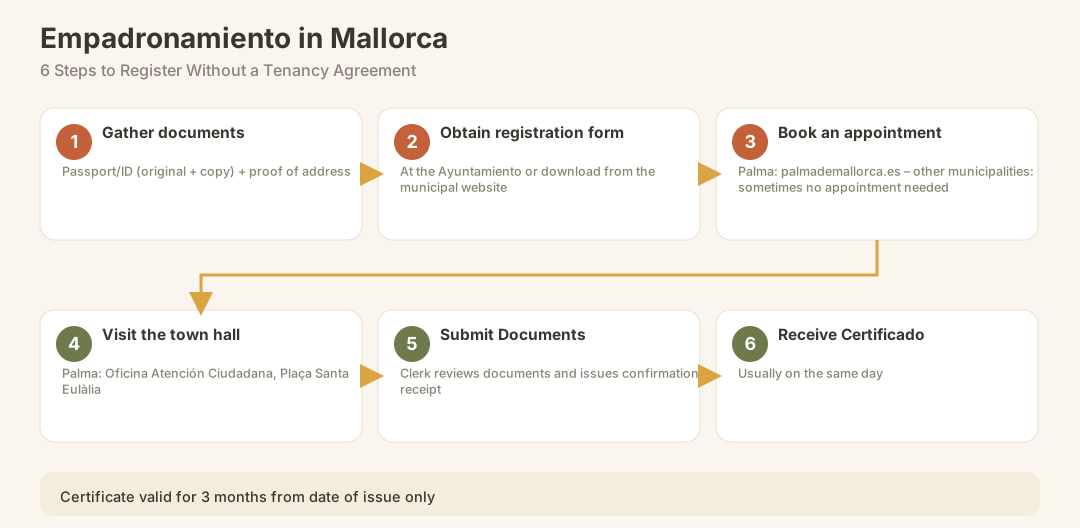
Step by step: how the empadronamiento works on Mallorca
Gather your documents – passport or identity card (original + copy) plus one of the above-mentioned proofs of residence
Obtain the registration form – available from the Ayuntamiento or often available to download from the municipal website
Book an appointment (cita previa) – in Palma via the website www.palmademallorca.es; in other municipalities via the respective town hall, sometimes also without an appointment
Go to the town hall – in Palma the citizens' office (Oficina de Atención Ciudadana) is located at the Plaça Santa Eulàlia; branch offices in other districts (addresses on the municipal website, some also available in German)
Submit your documents – the clerk checks that everything is complete and issues a receipt of submission
Receive your Certificado de Empadronamiento – usually on the same day or within a few days; in some municipalities it may take a little longer
Tip: Ask for several certified copies (volantes de empadronamiento) to be issued straight away – you will need to present the document multiple times at government offices, banks, and doctors' surgeries. Bear in mind: the certificate is only valid for 3 months.
Mallorca Specifics: What's Different Here Compared to the Mainland
Mallorca has no single unified municipality – the island consists of 53 Municipios, each with their own practices regarding the Empadronamiento.
Municipality / Area
Particularity
Palma
Appointments bookable online; several civic offices; website partially available in German
Artà, Llucmajor (and others)
According to practical reports, require the Residencia before the Empadronamiento – a reversal of the standard procedure
Smaller villages
Often no fixed appointment necessary; go directly to the town hall
All municipalities
Empadronamiento certificate valid for 3 months only
Important Mallorca-specific note: In some municipalities (including Artà and Llucmajor), according to practical reports, council staff require the Residencia before issuing the Empadronamiento. This contradicts the national standard, but is locally established practice. In this case, a personal conversation can help – or a Gestoría familiar with the process.
What the Empadronamiento provides – and what it doesn't
The Empadronamiento certificate is required for a surprisingly large number of everyday administrative matters – and yet it is not a residence permit.
75 % residents' discount on flights between the Balearic Islands and the mainland (from a certain number of months of registration)
Renewing the German passport at the embassy
What it is not:
Not a residence permit
Not tax residency (the 183-day rule applies for that)
No automatic health insurance coverage
Proof of address via utility bill: what actually counts
Bills from electricity, water, or gas suppliers (facturas de suministros) are a commonly used alternative proof of address – but they come with one important requirement: they must be issued in the name of the person wishing to register, or at the very least demonstrate the connection between the person and the address.
In practical terms, this means:
Electricity or water is still registered to a previous tenant or the landlord? → This will usually not suffice
You have just moved in and don't yet have your own bill? → Combine the landlord's written authorisation with their proof of ownership (IBI receipt or escritura)
You have already registered the electricity in your name (registering electricity in Spain)? → A recent bill will generally be sufficient
Situation
Recommended proof of address
Purchased your own property
Escritura (title deed) or Nota Simple
Owner, no escritura yet
IBI receipt + Nota Simple
Tenancy agreement in place
Tenancy agreement
Subletting / Living with a third party
Owner's authorisation + proof of ownership
Electricity/water in your own name
Current utility bill
Room without contract, utilities in landlord's name
Landlord's authorisation + their ID document + IBI
EU citizens vs. non-EU citizens: Are there any differences?
For the empadronamiento itself, nationality is generally not the deciding factor – the legal registration requirement applies to everyone. In practice, however, there are minor differences:
EU/EEA citizens and Swiss nationals register using a national identity card or passport. In some municipalities, the Certificado de Registro de Ciudadano de la UE (the green NIE certificate) is additionally required.
Non-EU citizens (Germans do not fall into this category, but British nationals do after Brexit, as do citizens of third countries) should additionally bring the following:
Please note: Germans are EU citizens and register using a national identity card or passport. For Germans on Mallorca, the process is therefore the most straightforward.
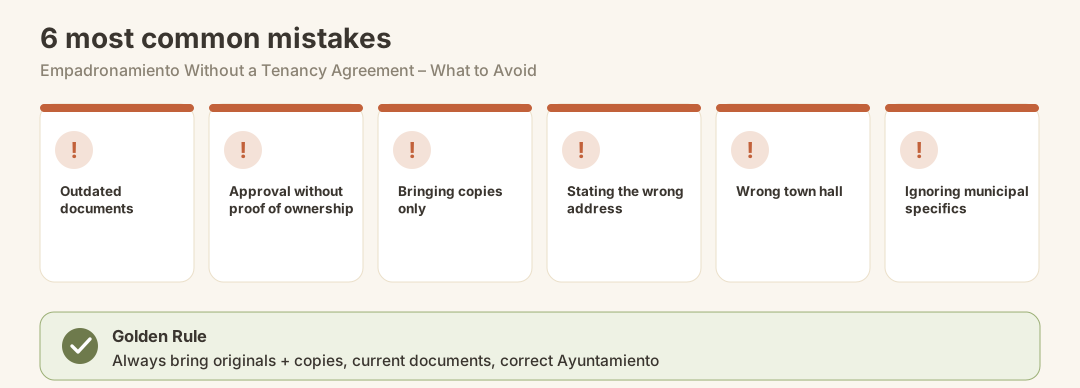
Most common mistakes when registering for the empadronamiento without a tenancy agreement
Bringing out-of-date documents – The certificate itself is only valid for 3 months; an IBI receipt should be current, not from 3 years ago
Authorisation without proof of ownership – A written permission from the host alone is not sufficient; always combine it with proof of ownership
Bringing copies only – Always bring both originals and copies; some offices keep the copy but verify against the original
Incorrect address given – The address provided must match the proof of residence exactly (street, house number, floor, door)
Going to the wrong town hall – You must register at the Ayuntamiento of the municipality in which you live – not the nearest or largest one
Ignoring municipality-specific requirements – In some municipalities of Mallorca (e.g. Artà, Llucmajor), check in advance whether the Residencia is required beforehand
Applying for the certificate for official appointments too late – It is only valid for 3 months; having it issued too early is pointless if the appointment is not for another 4 months
What comes next? The next steps after the Empadronamiento
The Empadronamiento is the foundation – but only the first step. Depending on your situation, here is what follows:
Checklist: Empadronamiento without a rental contract in Mallorca
Proof of residence organised (title deed, utility bill, owner's written permission)
Passport or national identity card valid + copy made
Registration form downloaded or collected from the town hall
Municipality-specific requirements checked (does your Ayuntamiento require the Residencia in advance?)
Appointment booked (Palma: palmademallorca.es; other municipalities: directly at the town hall)
Original documents complete (not copies only)
Address identical on all documents
Multiple copies of the certificate requested
Expiry date noted (3 months from date of issue)
Conclusion
The Empadronamiento without a rental contract is not a bureaucratic miracle in Spain – or in Mallorca – but is provided for by law. The Ayuntamiento must register you if you genuinely reside at the address and can prove this with suitable documents. A title deed, a current utility bill in your name, or the owner's written permission accompanied by their proof of ownership are all valid alternatives to a rental contract. The key is to bring all documents that are current, complete, and in their original form – and to familiarise yourself with the specific requirements of your municipality before booking your appointment.
Ajuntament de Palma – Oficines d'Atenció a la Ciutadania (OAC), Plaça Santa Eulàlia, Palma; appointment booking and information: https://www.palmademallorca.es
Can I register at the Ayuntamiento without a tenancy agreement?
Yes. Spanish municipal law accepts several equally valid alternatives: the title deed, a recent utility bill in your name, or written authorisation from the property owner combined with their proof of ownership.
What counts as proof of residence if I am staying with friends?
You will need a written, signed authorisation from the person you are staying with, plus a copy of their ID and proof of ownership of the property (Escritura, Nota Simple, or IBI receipt).
How long is the Certificado de Empadronamiento valid?
The certificate is valid for 3 months from the date of issue. Always request a fresh one before any dealings with official bodies.
What does the Empadronamiento cost?
In most municipalities it is free of charge. In some municipalities a small administrative fee, typically 3–5 Euro, may be charged.
Do EU citizens need to bring different documents from non-EU citizens?
EU citizens register using their national identity card or passport; some municipalities also require the green NIE certificate. Non-EU citizens (e.g. British nationals after Brexit) should also bring their valid residence permit.
Does the Empadronamiento count as tax residency in Spain?
No. The Empadronamiento only confirms your residential address within the municipality. Tax residency is determined by your actual length of stay (generally 183 days in a calendar year).
Do all members of a household need to consent to a registration?
No, however anyone registering at an address where other people are already registered will generally need the authorisation of the principal resident already registered there or of the property owner.
What happens when I move?
You must register again at the town hall of your new municipality. Your previous registration is automatically cancelled once the new municipality processes the change of address.