
Residencia permanente Spain: How to Apply for Permanent Residency After 5 Years
After five years of lawful, uninterrupted residence in Spain, the right to residencia permanente arises — automatically, without any application required. What many people don't realise is that the right and the document are two different things. You can — and often should — apply for an official certificate that confirms this right in writing. In this guide you'll find out exactly how the process works for EU and non-EU citizens, which documents you'll need, which special cases can shorten the path to permanent residence, and what tax and practical day-to-day consequences the residencia permanente brings with it — particularly for life on Mallorca.

Are you approaching the 5-year mark or already past it — and not sure how to proceed?
- 📩 Submit a personal enquiry — we'll connect you with experienced expats and local lawyers
- All official matters at a glance
What is the residencia permanente — and what is it not?
The residencia permanente is the right to reside in Spain permanently and without further conditions. It is the opposite of the residencia temporal, which is always tied to specific requirements (employment, sufficient means, health insurance) and must be renewed regularly.
Important: the right of permanent residence and the residence permit as a document are not the same thing.
| Term | Meaning |
|---|---|
| Residencia permanente (right) | Arises automatically after 5 years — no application required |
| Certificado de residencia permanente (EU citizens) | Optional document confirming the right |
| TIE de larga duración (non-EU citizens) | Physical residence card, to be applied for actively |
| Residencia temporal | Time-limited residence with a renewal obligation |
For EU citizens (Germans, Austrians, as well as Swiss nationals and EEA nationals under bilateral agreements), the EU freedom of movement provisions under Real Decreto 240/2007 apply. The right of permanent residence arises by operation of law as soon as the 5-year period has been completed. You can then apply for a certificado de residencia permanente — a document that looks identical to the standard registration certificate but carries the designation "permanente".
For non-EU citizens the general legislation on foreigners applies (Ley Orgánica 4/2000 and the associated Reglamento). Here, the document – the TIE (Tarjeta de Identidad de Extranjero) with the note "larga duración" – must be actively applied for before the existing residence permit expires.
Note: Swiss nationals enjoy similar rights of free movement to EU citizens under bilateral agreements with the EU. Their procedure generally follows the EU rules, but may differ in individual cases – if in doubt, seek advice from a lawyer.
Who is eligible? The 5-year rule in detail
The core requirement is an uninterrupted, lawful period of residence of at least five years in Spain. This sounds straightforward, but is full of pitfalls.
What counts as "uninterrupted"?
Not every absence interrupts the period. The legal basis (Real Decreto 240/2007, Art. 10) permits temporary absences. As a general rule:
| Type of absence | Interrupts the period? |
|---|---|
| Holidays and short trips | Generally no |
| Single absence of under 6 months per year | Generally no |
| Absence of more than 12 consecutive months | Yes – period starts again |
| Lack of tax residency (no Empadronamiento, no IRPF) | May be treated as an interruption |
Caution: Anyone who was formally registered in Spain but spent the majority of the year abroad risks the authorities questioning the continuity of their residence. Bank statements, medical appointments, utility bills and tax returns are valuable evidence here.
What counts as "lawful"?
The period of residence must have been lawful at every point during the 5 years. For EU citizens, this means: as an employee, self-employed person, retiree with sufficient means, or student – and always with a valid registration certificate (Residencia) and Empadronamiento.
Special cases: permanent residence before the 5 years
In certain situations, the right to permanent residence arises even before five years. These exceptions apply in particular to EU citizens and are governed by Real Decreto 240/2007.
| Special case | Requirement |
|---|---|
| Retirement in Spain | At least 3 years of residence, with the final year uninterrupted; employment in Spain up to retirement |
| Permanent incapacity for work | Residence of more than 2 years (waived in the event of a workplace accident or occupational disease) |
| Frontier workers | At least 3 years of employment in Spain, with residence in another EU member state |
| Death of the EU citizen from whom the right of residence was derived | Family members acquire their own permanent right of residence under certain conditions |
The procedure for EU citizens: step by step
For German, Austrian and other EU nationals, the process is comparatively straightforward. The responsible authority is the Oficina de Extranjería (foreigners' registration office) of the relevant province, or alternatively the local police station (Comisaría de Policía Nacional). On Mallorca, the Oficina de Extranjería of the Delegación del Gobierno en Illes Balears is the competent authority.
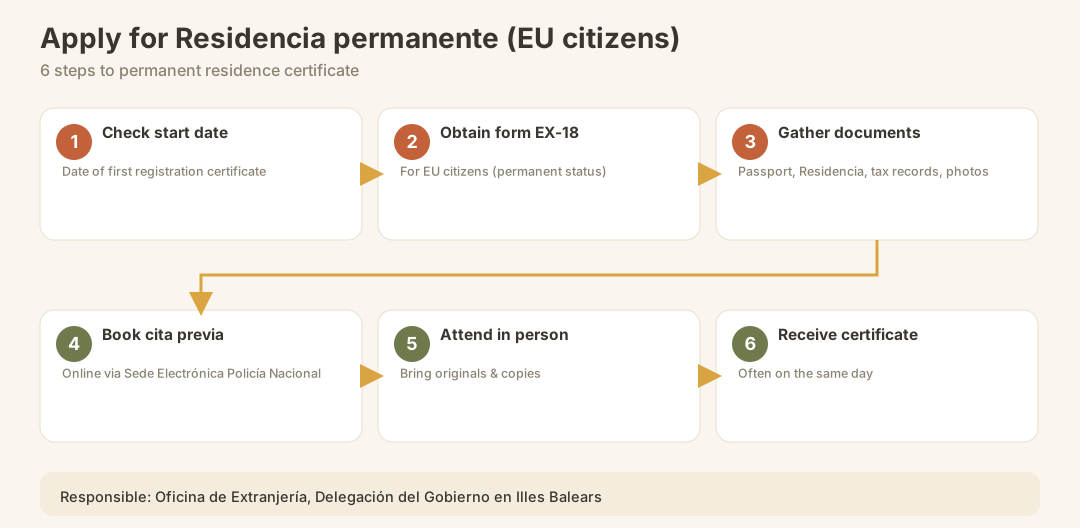
- Check when the deadline begins: The date on your first registration certificate (certificado de registro) is usually the starting point. Keep all your old documents.
- Obtain the form: As a rule, form EX-18 (for EU citizens) is used — the same form as for initial registration, but now for permanent-resident status.
- Gather the required documents (see the table below).
- Book a cita previa: You can book an appointment at the Oficina de Extranjería online via the Sede Electrónica of the Policía Nacional.
- Attend in person with all originals and copies.
- Collect your certificate: In many cases, the certificado de residencia permanente is issued on the same day.
Documents for EU citizens
| Document | Note |
|---|---|
| Valid passport or national identity card (original + copy) | Must be valid at the time of the appointment |
| Current registration certificate (certificado de registro) | Original, which you already hold |
| Proof of 5 years' residence | Tax returns, employment contracts, pension documents, etc. |
| Passport photos | Usually 2 recent photos |
| Proof of health insurance | Only if not covered by social security through employment |
| Completed form (e.g. EX-18) | Fill in on the day or in advance |
Please note: The exact requirements may vary slightly depending on the Oficina de Extranjería. Call ahead or check the current document list from the Delegación del Gobierno en Illes Balears.
The process for non-EU citizens: TIE de larga duración
For nationals from outside the EU – such as British citizens following Brexit, Americans, or Swiss nationals in situations not covered by the bilateral agreement – the process is more involved. In these cases, the TIE de larga duración (Tarjeta de Identidad de Extranjero) must be actively applied for before the existing residence permit expires.
Important: British citizens who were legally residing in Spain before 31 December 2020 and registered as residents in good time under the Withdrawal Agreement enjoy special protected rights. Their route to permanent residencia broadly follows the EU rules, but is governed by the Withdrawal Agreement. For British citizens who moved to Spain after Brexit, the general third-country national rules apply.
Requirements for non-EU citizens (general rule)
- 5 years of uninterrupted, lawful residence in Spain
- No convictions for serious criminal offences in Spain or in the country of origin
- No ongoing deportation proceedings
- Proof of sufficient financial means (the exact requirements vary and are subject to change; seek up-to-date advice from a solicitor or the relevant authority)
- Proof of health insurance
Documents for non-EU citizens (overview)
| Document | Note |
|---|---|
| Valid passport (original + copy of all pages) | Must still have sufficient remaining validity |
| Current TIE (original + copy) | All previous cards, if applicable |
| Proof of uninterrupted residence | Tax returns, padrón certificate, bank account statements |
| Proof of sufficient funds | Recent bank statements, pension notice, payslips |
| Proof of health insurance | Social security or private policy |
| Police clearance certificate from the country of origin | Apostilled + certified translation into Spanish |
| Completed application forms | EX-11 or similar, depending on the case |
| Passport photographs | Usually 2–3 recent photos |
| Proof of fee payment (Tasa 052) | Pay in advance online or at the bank |
Deadlines and processing times in Mallorca
Processing times at the Oficina de Extranjería of the Balearen can vary considerably depending on the volume of applications. The authority regularly publishes updated date tables for the acceptance and processing of applications.
| Phase | Timeframe (indicative) |
|---|---|
| Cita previa (appointment booking) | Lead time of several weeks to months is possible |
| Processing time for EU citizens | Often the same day or within a few days |
| Processing time for non-EU citizens | Usually several months |
| Validity period of the TIE larga duración | Usually 5 years, then renewal |
Note: The Oficina de Extranjería of the Delegación del Gobierno en Illes Balears publishes current appointment availability and processing status on the website of the Ministry of Territorial Policy (mptmd.gob.es). Check there regularly – and book your appointment early, even if the 5-year deadline has not quite been reached yet.
Tax implications of residencia permanente
The residencia permanente does not bring any new tax implications of its own – tax residency is a separate concept. If you have already been living in Spain for more than 183 days per year, you have been tax resident since your temporary residencia and are liable for IRPF.
What changes in practical terms: The residencia permanente gives you long-term planning certainty for all tax-related decisions – from wealth tax to estate planning.
Some tax-relevant connections:
- IRPF (income tax): As a resident, you are subject to unlimited tax liability. Read our guide on Taxes as a resident in Spain (IRPF).
- Modelo 720: The reporting obligation for foreign assets exceeding 50.000 € also applies to permanent residents – find out more in the guide on Modelo 720.
- Non-resident tax: This no longer applies to you once you are tax resident. If you are not yet sure what this means: Non-resident tax Spain.
- Balearic IRPF deductions: As a permanent resident, you benefit from all Balearic-specific tax advantages – a topic well worth getting to know: IRPF deductions Balearen.
For more complex situations – such as pensions from Germany, capital income, or corporate structures – we recommend a tax adviser with expat experience.
What changes in everyday life?
The residencia permanente is not a bureaucratic end in itself – it has real implications for daily life:
| Area | Impact |
|---|---|
| Right of residence | No more renewal applications, no proof of means or insurance required |
| Labour market | Full access without restrictions (including for non-EU citizens) |
| Social benefits | Equal footing with Spanish nationals in many areas |
| Citizenship | Prerequisite for naturalisation (for most nationalities after a total of 10 years; special rules apply, e.g. for Ibero-Americans) |
| Health insurance | No new requirements, existing situation remains unchanged |
| Inheritance law / estate planning | Long-term planning on a more stable footing becomes possible |
For EU citizens, health insurance in Spain is already a central issue from the point of temporary residencia. With permanent residencia this remains unchanged – but you no longer need to provide proof in order to maintain your right of residence.
The next logical step: Spanish citizenship
For anyone who eventually wishes to become a Spanish citizen, the residencia permanente is an important milestone – but not the final one. The general waiting period for naturalisation is, for most nationalities, 10 years of legal residence in Spain. For nationals of Ibero-American countries, the Philippines, Equatorial Guinea, Portugal, and Andorra, a shortened period of 2 years.
EU citizens – including Germans – can apply for Spanish citizenship once the residency requirements have been met. One important point: Spain generally requires applicants to renounce their existing nationality. Germany, however, permits retention of German citizenship in certain cases – this is worth examining on an individual basis.
The most common mistakes when applying for residencia permanente
Precisely because the right arises automatically, the document is often neglected – or the application fails due to avoidable errors:
- Gaps in the empadronamiento: Anyone who has deregistered at some point without registering a new address will have gaps in their residence history. These gaps can be difficult to explain.
- Missing tax returns: EU citizens without an obligation to pay income tax (e.g. retirees with a pension from abroad) sometimes fail to submit IRPF returns – this can call continuity into question.
- Appointment booked too late: Cita-previa appointments at the Oficina de Extranjería in the Balearic Islands are often booked up weeks or months in advance. Start the process early.
- Documents without an apostille or translation: Non-EU citizens require an apostille and a certified Spanish translation for foreign documents. Many people underestimate the time this takes.
- Confusing tax residency with the right of residence: Anyone living in Spain who has continued to file their tax returns in Germany has a problem – both aspects must be consistent with one another.
- No proof of employment or financial means: Gaps in proof of sufficient means are particularly common during extended career breaks, sabbaticals, or the transition into retirement.
- Invalid passport: The passport must be valid at the time of the appointment – and in some cases must have a minimum remaining validity.
Checklist: applying for residencia permanente
Use this checklist before booking your appointment:
- 5 years of uninterrupted, lawful residence documented
- Empadronamiento complete and uninterrupted for the full 5 years
- Tax returns (IRPF) for the last 5 years available
- All previous residencia documents (registration certificates, TIEs) gathered
- Passport valid (and renewed in good time if necessary)
- Cita previa booked online (Sede Electrónica of the Policía Nacional)
- Form completed (EX-18 for EU citizens, or the appropriate form for non-EU nationals)
- Passport photos up to date (no more than 6 months old)
- For non-EU nationals: criminal record certificate with apostille and translation ordered
- For non-EU nationals: Tasa 052 (fee) paid and receipt to hand
- Copies made of all documents (original + copy)
- If applicable, a relocation service provider contacted for support
What comes next?
Residencia permanente is not a final destination, but a solid foundation. Here are the next sensible steps:
- Setting up digital administrative access: With Cl@ve PIN as a permanent resident, you can handle almost all official administrative tasks online.
- Clarifying pension entitlements: Anyone who has brought pension entitlements from Germany should check early on how these will be affected in Spain – our guide applying for a pension in Spain can help with this.
- Checking citizenship: After meeting the residency requirements, Spanish citizenship is a realistic next step.
- Optimising tax planning: As a permanent resident, it is worth having a conversation about wealth tax in Spain and taxes & finances more broadly.
- Care provision: Anyone planning to remain in Spain long-term should also keep an eye on long-term care insurance in Spain.
Conclusion: Is it worth applying for the document?
The right to residencia permanente arises automatically – but having the document in hand has real value. Employers, banks, insurance companies, authorities: all will ask for proof when in doubt. The certificado de residencia permanente (EU citizens) or the TIE de larga duración (non-EU citizens) is your official proof that you are entitled to live in Spain permanently and without restriction.
The effort involved is manageable – particularly for EU citizens. Booking the appointment in good time, assembling the paperwork neatly, and documenting the continuity of your stay without any gaps: these are the three crucial pieces of homework. Anyone who does this will leave their appointment with a document that is valid for the rest of their life in Spain – and which proves indispensable as the foundation for everything that follows, from pension entitlements to citizenship.
Official sources
- Real Decreto 240/2007 (EU freedom of movement, permanent residence Art. 10): https://www.boe.es/buscar/act.php?id=BOE-A-2007-4184
- Ley Orgánica 4/2000 (Foreigners Act, third-country nationals): https://www.boe.es/buscar/act.php?id=BOE-A-2000-544
- Sede Electrónica Policía Nacional (Long-term residence card, prior appointment): https://sede.policia.gob.es/portalCiudadano/_es/tramites_extranjeria_tramite_tarjetaresidencia_largaduracion.php
- Delegación del Gobierno en Illes Balears – Extranjería (Appointments, documents, processing status): https://mptmd.gob.es/portal/delegaciones_gobierno/delegaciones/illesbalears/servicios/extranjeria
- Ministerio de Inclusión, Seguridad Social y Migraciones – Application forms: https://extranjeros.inclusion.gob.es/es/ModelosSolicitudes/
- AEAT (Agencia Tributaria) – Tax residency and IRPF: https://www.agenciatributaria.es