
Non-Lucrative Visa Spain: Residency Without Work for Non-EU Citizens
The Non-Lucrative Visa Spain (NLV, visa de residencia no lucrativa) is the most important residency route for non-EU citizens who wish to live in Spain without engaging in any form of employment. It is aimed at retirees, early retirees, people with passive income from rental income or investments – and, since the end of the Golden Visa in April 2025, also at property investors seeking a new pathway to Spain. In this guide, you will learn which financial evidence you need, which documents you must compile, how the application process works step by step, what applies when it comes to renewal, and which typical mistakes cause applications to fail. All information refers to the position as of 2026.

Are you considering emigrating to Mallorca or Spain with the Non-Lucrative Visa?
- 📩 Submit a personal enquiry — We help you find the right specialists for your specific situation
- All visas and residence permits at a glance
What is the Non-Lucrative Visa – and who is it for?
The Non-Lucrative Visa is a Spanish residence permit for non-EU citizens who wish to live in Spain without engaging in employment. It does not permit working for a Spanish employer or registering as an Autónomo (self-employed person). The central requirement: you must be able to cover your living costs entirely from your own means – without relying on Spanish social benefits.
Typical applicants:
- Retirees with a secured pension or pension entitlements
- Individuals with passive income (dividends, rental income, royalties)
- Early retirees who wish to enjoy a period of time in Spain
- Families entering together with the main applicant
- Former Golden Visa applicants who are looking for an alternative
Please note: Non-EU citizens who wish to work remotely for foreign clients are generally not on safe ground with the Non-Lucrative Visa. For this profile, Spain offers the digital nomad visa route. The NLV expressly does not permit any form of employment – including work for US LLCs or other foreign structures.
EU, EEA, and Swiss citizens do not require a visa to reside in Spain; they register directly through the Residencia procedure.
Financial requirements 2026
The income thresholds are based on the IPREM (Indicador Público de Renta de Efectos Múltiples), Spain's public income indicator. These figures have not been increased since 2022 – an advantage for applicants whose pension or passive income has risen over recent years.
Income thresholds at a glance
| Personal circumstances | Annual amount (2026) | Monthly reference figure |
|---|---|---|
| Main applicant (alone) | 28.800 € | approx. 2.400 € |
| Main applicant + 1 dependant | 36.000 € | approx. 3.000 € |
| Main applicant + 2 dependants | 43.200 € | approx. 3.600 € |
| For each additional dependant | + 7.200 € | + 600 € |
The main applicant must demonstrate 400 % of the IPREM; each additional dependant requires a further 100 % on top.
Which sources of income are accepted?
- Statutory pensions (including foreign pensions)
- Dividends and investment income
- Rental income from properties located abroad
- Interest income
- Savings in bank accounts (as supplementary evidence)
Please note: Since 2026, some consulates have required you to demonstrate that you have ceased active employment – for example, by providing a termination agreement or a retirement certificate. Consulates may no longer accept savings alone, without proof of income, as sufficient evidence. Clarify this in advance directly with the Spanish consulate responsible for your case.
Which documents do I need?
The list of documents is extensive and generally needs to be tailored to the specific consulate. Below are the core documents that, in our experience, are required by all consulates:
Document checklist
| Document | Notes |
|---|---|
| Completed visa application form (EX-01) | Official Spanish form |
| Valid passport | At least 1 year of remaining validity; copies of all pages containing information |
| Biometric passport photos | Recent photos meeting the consulate's specifications |
| Proof of income/assets | Bank statements (last 3–6 months), pension adjustment certificate, investment account statements |
| Private health insurance policy | Comprehensive cover in Spain, no excess, no co-payments |
| Police clearance certificate | Apostille required, no more than 3 months old; covering all countries of residence over the past 5 years |
| Medical certificate | Confirmation that no notifiable diseases are present (often required with Apostille) |
| Proof of accommodation in Spain | Rental agreement or proof of ownership |
| Proof of cessation of employment | Termination agreement, retirement certificate, or similar (depending on the consulate) |
| For dependants: marriage certificate / birth certificates | With Apostille and certified translation into Spanish |
Important: All foreign documents must generally be provided with a Hague Apostille and translated into Spanish by a sworn translator. Requirements may vary slightly between consulates – check the current checklist of the consulate responsible for your case.
Health insurance: what the policy must cover
Private health insurance is one of the most common stumbling blocks in the NLV application process. Not every policy will be accepted.
Minimum requirements for health insurance
| Criterion | Requirement |
|---|---|
| Area of cover | The entire Spanish territory |
| Excess | None (0 €) |
| Co-payments | None |
| Duration | Minimum 1 year (matching the visa duration) |
| Repatriation | Usually included or to be evidenced separately |
| Pre-existing conditions | Must be covered or explicitly listed |
Foreign travel health insurance policies or purely emergency cover policies are generally not accepted. Ensure that the insurer explicitly issues cover for residents in Spain — not merely for short-term stays.
More on this topic: Health insurance in Spain
The application process step by step
The application is submitted to the Spanish consulate responsible for your current place of residence. It is not possible to apply directly in Spain — you must submit your application from your home country.
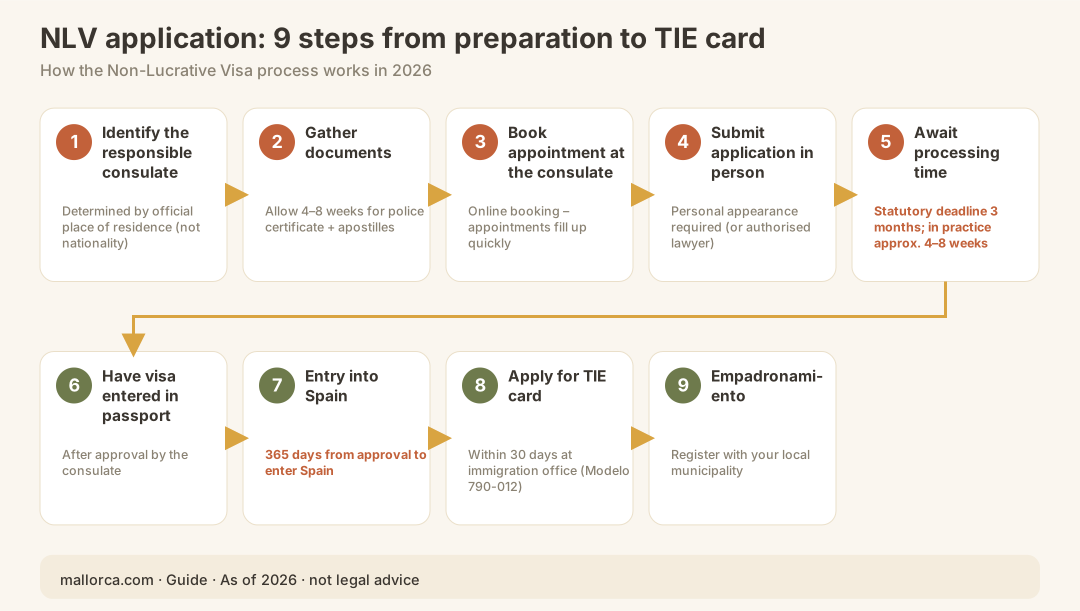
Identify the responsible consulate — What matters is your official place of residence at the time of application. For German nationals, this is usually the consulate responsible for the federal state in which you are registered (Berlin, Munich, Frankfurt, etc.).
Gather your documents — Obtain, have translated, and apostilled all documents. Allow at least 4–8 weeks for this, as criminal record certificates and apostilles take time to process.
Book an appointment at the consulate — Appointments must be booked online and can fill up very quickly depending on the consulate and the time of year. Allow plenty of lead time.
Submit your application in person — Personal attendance is generally required. Some consulates accept submission by an authorised lawyer.
Wait for the processing time — The statutory processing period in Spain is 3 months. In practice, applicants report processing times of around 4–8 weeks, depending on the consulate. Via the consulate in London, processing times of around 6 weeks have been reported according to recent accounts (end of 2025); via Manchester, waiting times are considerably longer due to a backlog of applications.
Have the visa entered in your passport — Once approved, the visa will be entered into your passport.
Enter Spain — You have 365 days from the date of approval to enter Spain. (Until summer 2024, the deadline was only 90 days.)
Apply for your TIE card — After entering Spain, you must apply for the Tarjeta de Identidad de Extranjero (TIE) at the responsible immigration office (Oficina de Extranjería) within 30 days. This is your actual residence permit in card form.
Empadronamiento — Register with your local municipality. More on this: Empadronamiento Mallorca
Costs and fees
The costs consist of the official consulate fee and the ancillary costs for documents.
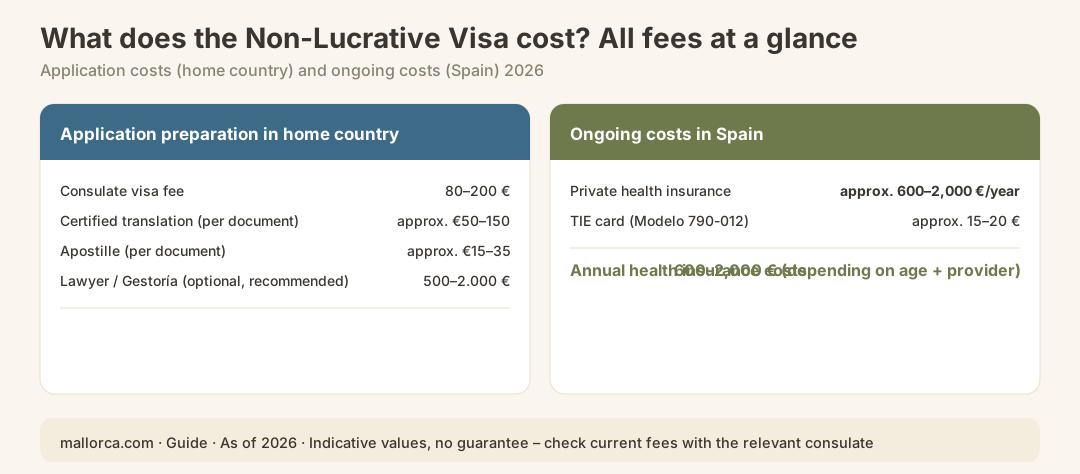
| Cost item | Approximate figure |
|---|---|
| Consulate fee for the visa | Usually between 80 and 200 € (depending on the consulate and reciprocity arrangements) |
| Certified translations (per document) | approx. 50–150 € |
| Apostille (per document) | approx. 15–35 € |
| Private health insurance (annually) | approx. 600–2.000 € depending on age and provider |
| TIE card (fee in Spain) | approx. 15–20 € (Modelo 790-012) |
| Lawyer/gestoría (optional, recommended) | 500–2.000 € depending on scope |
Please note: Official consulate fees may vary. Check the current fees on the website of the relevant consulate.
Period of validity and renewal
The NLV is initially granted for 1 year and can generally be renewed twice thereafter — making a total stay of up to 5 years possible on the basis of the NLV.
Renewal periods at a glance
| Phase | Period of validity | Cumulative stay |
|---|---|---|
| Initial visa | 1 year | Year 1 |
| 1st renewal | 2 years | Years 2–3 |
| 2nd renewal | 2 years | Years 4–5 |
| Permanent residence | possible from year 5 | from year 5 |
Important new rule for renewals: Since 2026, renewals are subject to a check as to whether you have actually and effectively spent more than 183 days in the calendar year in Spain. Anyone using the NLV purely as a Schengen safeguard without genuinely living in Spain risks losing the right to renew.
The renewal is applied for in Spain itself — at the foreigners' office or via the electronic portal. The application should be submitted in good time before the current residence permit expires.
Path to permanent residence: After 5 years of uninterrupted lawful residence in Spain, an application can be made for an indefinite residence permit (Residencia de Larga Duración). After 10 years, naturalisation is possible under certain conditions.
Tax implications: what you need to know
Anyone who lives in Spain for more than 183 days per year becomes tax-resident in Spain and must declare their worldwide income in Spain for tax purposes (IRPF). This also applies to German pensions, investment income, and rental income from Germany.
The double taxation agreement between Germany and Spain determines which country has the right to tax which types of income — it protects against double taxation but does not eliminate it entirely. In addition, there is a reporting obligation for foreign assets exceeding 50.000 € (Modelo 720).
Relevant guides:
Please note: Tax matters are complex and depend on your individual income situation. Consult a tax adviser registered in Spain before you relocate.
Family reunification: who may join you?
Dependent family members may enter together with the main applicant via the NLV (Family Unit Application). An additional €7,200 of annual income must be evidenced for each dependent.
The following are generally considered dependants:
- Spouses or registered civil partners
- Minor children
- Adult children who are fully financially dependent
- In certain cases, parents as well
All dependants require the same documents (criminal-record certificate, health insurance, etc.) together with the relevant proof of the family relationship (marriage or birth certificates with Apostille and certified translation).
More on this topic: Family reunification Spain
The most common mistakes when applying for the NLV
The following mistakes most frequently lead to rejection or significant delays:
Wrong health insurance: The policy has an excess or co-payments, does not cover the entire Spanish territory, or runs for a shorter period than the visa.
Out-of-date documents: Criminal-record certificate older than 3 months at the time of application, expired Apostille.
Missing or incorrect translations: Not all documents were translated by a sworn translator (Traductor Jurado); the translation does not match the original document.
Income just below the threshold: Demonstrating 400 % IPREM is the minimum — consulates can be critical if the account balance or income is only marginally above this level.
Application submitted to the wrong consulate: The relevant consulate is determined by your actual place of residence, not your nationality.
No proof that employment has ceased: Some consulates explicitly require proof in 2026 that no active professional activity is still being carried out.
Renewal application submitted too late: Anyone who applies for renewal too late, or not at all, loses their residence permit and must start the process from scratch.
183-day rule ignored: At renewal stage, it is now checked whether actual residence in Spain existed. Anyone who has spent most of the year abroad risks losing the renewal.
What comes next? Routes to permanent residency and citizenship
The NLV is not an end point, but the starting point of a longer residence status:
| Milestone | Requirement | Result |
|---|---|---|
| TIE card | Entry into Spain, application within 30 days | Residence permit in card form |
| 1st renewal | 1 year NLV, more than 183 days in Spain | +2 years NLV |
| 2nd renewal | 3 years NLV, more than 183 days in Spain | +2 years NLV |
| Permanent residence permit | 5 years of continuous residence | Long-term residence permit, access to state healthcare |
| Naturalisation | Generally 10 years of residence | Spanish citizenship |
Once you have obtained the permanent residence permit, you will have access, among other things, to the Spanish healthcare system (Sistema Nacional de Salud). More on this: Healthcare system Mallorca
Checklist: Before the application, after entry
Before the application
- Compile and check proof of finances (minimum 28.800 €/year)
- Take out a private health insurance policy (no excess, entire national territory)
- Apply for a police clearance certificate and have it apostilled
- Obtain a medical certificate
- Have all documents translated into Spanish by a sworn translator
- Secure proof of accommodation in Spain (tenancy agreement etc.)
- Book an appointment at the relevant consulate
- Engage a lawyer or gestoría (recommended)
After entry into Spain
- Apply for the TIE card at the foreigners' office within 30 days
- Complete the empadronamiento (municipal registration)
- Ensure your NIE number is in order: NIE number Mallorca
- Clarify tax residency
- Note the renewal deadline in your calendar
Conclusion
The Non-Lucrative Visa Spain is in 2026 the most important residence route for non-EU citizens without gainful employment – and has been in even greater demand since the end of the Golden Visa in April 2025. It offers a clear path from first entry through to permanent residence and ultimately citizenship. The requirements are manageable once you know them: 28.800 € annual income for the main applicant, a compliant health insurance policy with no excess, and properly apostilled and translated documents. The most important change in 2026: at renewal, actual physical presence counts – anyone living in Spain for more than 183 days is on safe ground. Allow at least 3–4 months for preparation, seek professional support from a lawyer specialising in immigration law, and keep a close eye on your renewal deadlines.
📩 Submit an enquiry now – we will help you find the right lawyer or gestoría for your NLV application.
Official sources
- Spanish Ministry of Foreign Affairs – Visa for non-lucrative residence: https://www.exteriores.gob.es (official information and application documents per consulate)
- Ministerio de Inclusion, Seguridad Social y Migraciones – Immigration Law: https://extranjeros.inclusion.gob.es
- Sede Electrónica of the Spanish Administration (renewal applications): https://sede.administracionespublica.gob.es
- AEAT – Agencia Tributaria (taxes as a resident): https://www.agenciatributaria.es
- BOE – Boletín Oficial del Estado (Ley Orgánica 4/2000 de Extranjería and Reglamento): https://www.boe.es