
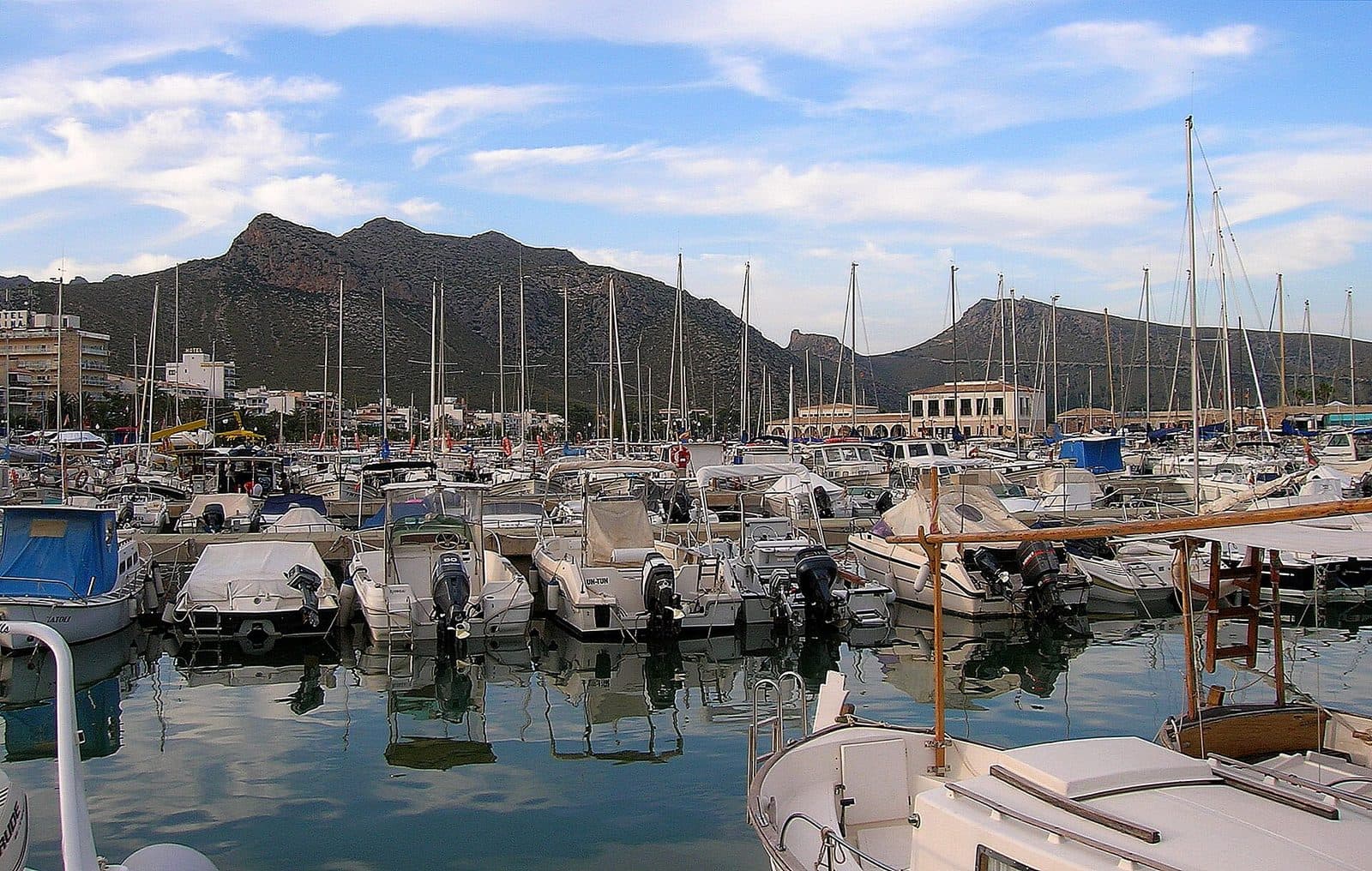
Port Pollença beach, Mallorca

Places to stay near Port Pollença
AdTo load the accommodation map by our partner Stay22, we need your consent for marketing cookies. Your consent applies to all marketing content on mallorca.com.
Port Pollença is the long sandy beach close to town, south of the harbour in Port de Pollença. Over 1,440 metres, it follows the bay between the harbour area and the coast towards Can Cullerassa. Its distinctive appeal lies not in seclusion but in the combination of shallow water, a promenade, pine trees, good infrastructure and open views across the Bay of Pollença towards the Formentor peninsula and the Serra de Tramuntana. The beach is also known as Platja del Port de Pollença or Llenaire.
However, this stretch of coast is less natural than it appears today. According to the Balearic Islands beach catalogue, the sandy beach was created only after a breakwater was built and coarse sand was later added. Pine trees stand just a few metres behind the shore, while hotels, residential buildings, shops and restaurants form the urban setting. Despite this development, Port de Pollença has retained a comparatively peaceful character. Agatha Christie chose the bay as the setting for “Problem in Pollença”, and the Catalan painter Anglada Camarassa lived near the harbour for a time.
Where is Port Pollença beach, and what is it like?
The beach lies within the municipality of Pollença, directly on the Bay of Pollença and south of the harbour in Port de Pollença. According to the Balearic Islands beach catalogue, Platja del Port de Pollença is six kilometres from the historic town of Pollença. To the south, the coast continues towards Can Cullerassa; north of the harbour are the smaller beach coves of Albercutx along the Pine Walk.
At 1,440 metres long and 40 metres wide, Port Pollença is an elongated sandy beach. The Balearic Islands beach catalogue describes it as narrow and several kilometres long, although the stated width may not appear consistent along its entire length. The beach lies directly in front of an established holiday resort and residential town. You will therefore not spend the day in a secluded natural cove, but you will have easy access to restaurants, shops and other amenities.
| Feature | Details |
|---|---|
| Municipality | Pollença |
| Beach name | Port Pollença, Platja del Port de Pollença or Llenaire |
| Beach type | Sand |
| Length | 1,440 m |
| Width | 40 m |
| Seasonal occupancy | high |
| Parking | free parking available |
| Accessible according to the Balearic Islands beach catalogue | yes |
| Protected natural area according to the Balearic Islands beach catalogue | yes |
The Balearic Islands beach catalogue lists the beach as part of a protected natural area, although its immediate surroundings are distinctly urban. If necessary, check local signs to understand exactly how the protected status, beach area and built-up surroundings relate to one another geographically.
How do you get to Port Pollença beach?
Driving to Port Pollença is straightforward, and the route is signposted locally. The beach runs along the waterfront road south of the harbour, so you can use different access points depending on which section you want to visit. For the central town beach, follow signs towards the harbour and main promenade; for the quieter Llenaire section, continue farther south towards Can Cullerassa.
You can also reach the beach by public bus. According to the Balearic Islands beach catalogue, the nearest stop is only a few metres from the beach. Line 301 is listed for the journey from Palma to Port de Pollença; travel guides give a journey time of about 1 hour and 10 minutes, with departures approximately every hour. As routes and frequencies can change, check the current TIB timetable before travelling.
Palma airport is around 65 kilometres away. Depending on traffic and your destination within Port de Pollença, the drive takes about 40 to 45 minutes.
Where can you park near the beach?
Free parking is available near the beach and along the coastal road, while the public car park by the harbour may charge a fee. The Balearic Islands beach catalogue describes parking near the beach as easy and free. Around the harbour, however, you should expect some spaces to require payment.
The section of beach you choose is therefore particularly important. If you want to arrive directly at the harbour or commercial centre, a paid car park may be the most convenient option. Free spaces are available along the coastal road beside the Llenaire section.
Note: Do not assume that every parking space in Port de Pollença is free. Pay attention to road markings, access signs and parking-fee notices; the car park near the harbour in particular may charge a fee.
The beach is very busy during the high season. Although parking is generally available, this does not mean that you will always find a free space immediately beside your preferred access point.
What are the sand, water and swimming conditions like?
Port Pollença has sand and, across large areas, clear, shallow water over a sandy seabed. The Balearic Islands beach catalogue states that the water reaches a depth of no more than approximately two metres within a short distance of the shore. The sheltered shape of the bay generally creates calm water and a gentle entry.
The texture of the sand varies between sections. The Balearic Islands beach catalogue refers to imported coarse sand, while elsewhere the sand appears lighter and finer. This is consistent with a long, artificially restored beach whose composition is not identical along its entire length.
The present-day beach has been shaped by human intervention. A breakwater made its formation possible, and additional sand was deposited to widen and preserve the coastal strip. This does not reduce its practical appeal, but it explains why the shoreline and sand cannot be compared with those of an untouched natural cove.
Despite the sheltered location, strong winds can blow from the east, southeast and south. Northerly winds can also create rougher water. Although high waves are considered relatively uncommon, conditions are not the same every day or along every section of the beach.
Warning: Shallow water is no substitute for checking current conditions. Follow flags, notices and lifeguard instructions, especially when the wind picks up.
What facilities are available at Port Pollença beach?
Several sections of Port Pollença are equipped with sun loungers, parasols, showers, public toilets and changing facilities. There are also children’s play areas and beach volleyball courts. These amenities are distributed along the extensive beach and may not be available to the same extent at every access point.
In the Llenaire area, pine trees, benches and tables stand close to the beach. South of the harbour, you will find small restaurants, minimarkets and a shaded picnic area. Closer to the harbour and main promenade, there is a wider selection of bars, restaurants and shops. This is the more practical section if you want to combine a beach day with easy access to food, drinks or shopping.
Water sports available at Llenaire beach include kayaks, pedal boats, small catamarans and windsurfing equipment. Depending on the season, banana boats, jet skis and water skiing are also offered. Snorkelling and diving excursions depart from the harbour, where motorboats and sailing boats can also be chartered. The range and availability depend on the season and weather.
Lifeguards supervise individual sections. Reliable operating hours are not listed consistently for all areas. At your chosen access point, check whether a supervised swimming zone is currently designated.
Is Port Pollença suitable for children and people with limited mobility?
Port Pollença is well suited to families thanks to its shallow entry, available services and location close to town. Play areas, toilets, showers and sun lounger and parasol hire make longer beach days easier. In the Llenaire section, pine trees and areas with benches and tables provide additional places to spend time.
The Balearic Islands beach catalogue identifies Port Pollença as accessible. Because the beach is very long, access quality and distances to toilets or other facilities may vary between sections. Choose your entry point carefully and check which forms of assistance are available there.
The shallow water is an advantage for children but does not guarantee safety. Winds from several directions can make the surface rougher, and water sports also take place within the bay. Stay within designated swimming areas and follow the current flag warnings.
Natural shade is not available everywhere directly beside the water. Pine trees stand just a few metres behind the shore and are especially prominent in the Llenaire area; rental parasols and a shaded picnic area are also available.
When is the best time to visit Port Pollença, and how crowded does it get?
If you want more space, avoid the busy months of July and August where possible or arrive early in the day. The Balearic Islands beach catalogue rates seasonal occupancy as high. The beach is often particularly crowded during the peak summer months.
Although the beach’s 1,440-metre length spreads visitors across several sections, the harbour area, main promenade and access points with extensive facilities attract correspondingly large numbers of people. The narrower side of the main beach is often considered quieter. Llenaire, on the southern edge of town, also feels more subdued than the commercial centre, although places around the benches and tables can fill up early on Sundays and public holidays.
Port de Pollença is inhabited throughout the year. Some businesses therefore remain open in winter. Outside the main season, however, you should not assume that the full range of beach services, including rentals, water sports and other seasonal facilities, will be available.
Note: If a particular service is important to you, such as sun lounger hire, lifeguard cover or water sports, check it directly at your chosen section of beach. Facilities vary between areas and may change seasonally.
What can you do near Port Pollença beach?
Immediately north of the harbour, the Pine Walk begins, following the waterfront past the small beach coves of Albercutx. Some of these coves are so narrow that there is barely enough room to lie down. They are particularly suitable if your accommodation is north of the harbour or if you want to combine a waterfront walk with a short swim.
Can Cullerassa lies south of Port Pollença. This stretch of coast is more pebbly, is frequented by local residents and offers greater peace and shade. Water sports enthusiasts use the wider bay for sailing, windsurfing and kitesurfing, among other activities.
For an excursion to the Formentor peninsula, Cala Formentor and Cap de Formentor are nearby. Road access to Cala Formentor may be restricted in summer; the bus is generally listed as the usual alternative. If you would rather visit the town, Pollença is six kilometres from the beach. A large market takes place on Plaça Major on Sunday mornings.
Port de Pollença itself combines the harbour, beach and restaurants within a compact area. The northern waterfront promenade has cafés and restaurants with shaded terraces, while smaller restaurants and minimarkets line the main beach south of the harbour.
What practical information should you know for your beach day?
Choose your section of beach according to your priorities: stay near the harbour for easy access to shops and restaurants, or choose Llenaire for pine trees, picnic areas and water sports. Since the beach is almost one and a half kilometres long, its atmosphere and facilities vary considerably. An access point with toilets or rental services may be quite far from a quieter section.
In the Llenaire area, there is a specially prepared and signposted section for dogs that is intended to remain open throughout the year. This rule does not automatically apply to the whole of Port Pollença beach. Follow the signs and, when visiting with a dog, use only the specifically designated area.
Despite the bay’s popularity, it is not ideal for boats in all conditions. According to the Balearic Islands beach catalogue, anchoring conditions are not optimal because of the shallow water and possible strong winds from the east, southeast and south. Nevertheless, many sailing boats anchor offshore during summer.
If you need shade, do not rely solely on the pine trees. They stand close to the coast but do not shade the entire stretch of sand. Parasols are available to hire in several sections; this service may be unavailable outside the season or away from equipped areas.
How do I get to Port Pollença beach?
Can I park for free at Port Pollença beach?
Is Port Pollença suitable for children?
Is there natural shade at the beach?
Are dogs allowed at Port Pollença beach?
How crowded is Port Pollença in summer?
What facilities are available at the beach?
Which beaches are alternatives to Port Pollença?
Weather
Currently in Pollença: 25°C · Sunny
Getting there by bus
Port de Pollença centre (42051) · 0.5 km as the crow flies
- 231Port de Sóller - Alcúdia · Daily
- 301Port de Pollença - Palma · Daily
Gotmar 1 (42041) · 1.0 km as the crow flies
- 231Port de Sóller - Alcúdia · Daily
- 301Port de Pollença - Palma · Daily
- 322Pollença - Port d'Alcúdia · Daily
- 334Alcúdia - Formentor · Daily
Gotmar 2 (42042) · 1.0 km as the crow flies
- 231Port de Sóller - Alcúdia · Daily
- 301Port de Pollença - Palma · Daily
- 322Pollença - Port d'Alcúdia · Daily
- 334Alcúdia - Formentor · Daily
Timetable data: official GTFS feeds (TIB/EMT), no real-time — check with the operator before travelling.
Food & drink nearby
Cafeteria Ca Les Monges
Restaurant· 67 m· 4.4(821)
Restaurante los Faroles
Restaurant· 76 m· 4.3(1276)
Yogurt House
Café· 78 m· 4.1(73)
Imperial Bar & Tapas
Restaurant· 88 m· 4.7(762)
Dolce Vita
Restaurant· 88 m· 4.1(37)
Restaurant BrisaMarina
Restaurant· 95 m· 4.4(1243)
Run a business near this beach?
Add your business to the directory for free and reach visitors right on this page.