
Antoni Maria Alcover – Monument to Mallorca’s Great Language Collector
.jpg)
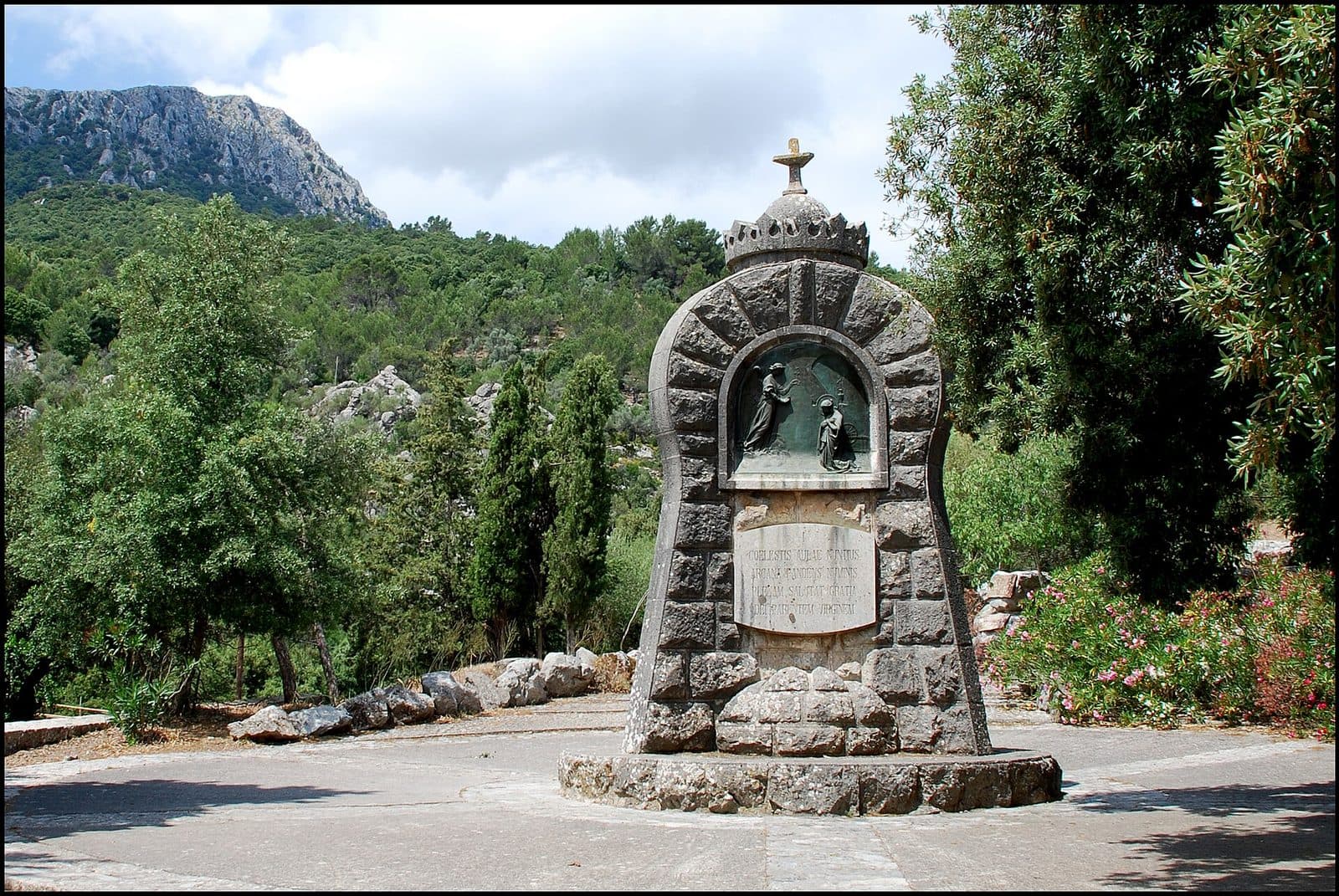
Among the gardens on the monastery grounds in Lluc, the Estàtua Antoni Maria Alcover commemorates a man who documented Mallorca’s language and storytelling tradition like few others. The monument stands on the sanctuary’s pilgrims’ square and is not a separate museum but a historic memorial within the wider Lluc complex.
Antoni Maria Alcover was a priest, linguist, folklorist, writer, and publicist. Many Mallorcans know him as Mossèn Alcover or by the pseudonym Jordi des Racó, under which he published traditional island stories. His name is associated above all with the Mallorcan Rondalles and the great Catalan-Valencian-Balearic dictionary.
The monument’s appeal therefore lies less in an extensive sightseeing program than in its cultural significance. Anyone walking through the grounds of Lluc encounters a figure whose work preserved voices, words, and stories that had previously been passed down mainly through oral tradition. The stop is particularly worthwhile for visitors who want to discover Mallorca not only through its landscapes but also through its language and cultural memory.
History and significance
Mossèn Alcover
At the age of fifteen, Antoni Maria Alcover left his family home in the countryside near Manacor and entered the diocesan seminary in Palma. There, he began collecting stories that had been passed down orally on Mallorca from generation to generation. This early interest grew into his life’s work: under the name Jordi des Racó, he published Mallorcan Rondalles and made stories permanently accessible that might otherwise easily have disappeared or changed beyond recognition.
Alcover was ordained a priest in 1886 and accepted a professorship at the seminary in Palma in 1888. Alongside church history, he taught language, literature, and the history of Mallorca. His career later took him to the offices of vicar general and canon of Mallorca Cathedral. Nevertheless, his work for the Church remained only one part of his unusually broad range of activities. He wrote, drew, painted, designed religious buildings, and maintained contact with linguists in various parts of Europe.
His plan to record the vocabulary of the Catalan language in all its diversity became decisive. Alcover did not want to document only a standardized written language but to gather words from different regions, dialects, periods, and social contexts. To accomplish this, he built a network of contributors throughout Catalan-speaking territories and made numerous journeys. He published progress reports, observations, and linguistic contributions in the Bolletí del diccionari de la llengua catalana.
The Diccionari català-valencià-balear
This undertaking produced the Diccionari català-valencià-balear, often called Alcover-Moll for short. Francesc de Borja Moll joined the project as editorial secretary in 1921, became Alcover’s closest collaborator, and continued the work after his death. The first volume appeared in 1926; the completed work comprises ten volumes. It documents Catalan vocabulary, including its Valencian and Balearic variants, and is among Alcover’s most important legacies.
The project’s scope explains why the monument in Lluc is more than a memorial to an individual writer. It also represents an attempt to recognize everyday language as cultural heritage. Words and expressions from Catalan-speaking territories became part of a scholarly endeavor. The Rondalles follow the same underlying principle: what people told and how they told it was, in Alcover’s view, worth preserving.
The 2001 monument
The sculpture on the pilgrims’ square was commissioned in 2001 at the initiative of the Fundació Antoni Maria Alcover. The public foundation had been established two years earlier to promote understanding of Alcover’s work and personality. By placing the memorial in Lluc, it received a location where religion and Mallorcan culture meet directly—two spheres that also shaped Alcover’s life.
The monument turns an extensive linguistic legacy into a visible point of reference. It draws attention to the person behind the dictionary and story collection. Those unfamiliar with his name are given a reason to learn more about him, while those who grew up with the Rondalles encounter a familiar figure from the island’s culture.
What to see
The Estàtua Antoni Maria Alcover
The main feature is the sculpture dedicated to Antoni Maria Alcover. It is not housed in an enclosed exhibition room but stands on the grounds of the Santuari de Lluc. This makes it feel like part of the site: pilgrims, day visitors, and walkers pass it as they move between the square, monastery buildings, and gardens.
The sources document neither an extensive exhibition at the monument nor a set visitor route. A visit therefore focuses on the sculpture itself, its dedication, and its historical context. This limited scope is important when setting expectations: Lluc is not home to the Institució Pública Antoni Maria Alcover and its collection and educational activities. Its headquarters are in Manacor. The attraction near Escorca is specifically the monument on the monastery grounds.
When pausing in front of the statue, visitors should not read Alcover’s name merely as that of an author. It represents two very different but closely related collecting projects. In the Rondalles, he recorded stories that had previously lived mainly through the spoken word. For the dictionary, he collected individual words, meanings, dialect forms, and linguistic variants. Both follow the same impulse: the ephemeral should be recorded without losing its regional character.
Plaça dels Pelegrins
The pilgrims’ square provides the physical setting for the monument. It is not an isolated sculpture garden. This changes the visitor experience. The statue is generally not approached as the sole destination but discovered during a walk through Lluc. It stands in surroundings that remain in active use and where religious visits, cultural history, and everyday tourism come together.
It is worth taking time to look rather than moving on immediately. The square reveals something about how a monument works: Alcover is not honored here in an academic library, although his lexicographical work would fit such a setting. His memory occupies a public place in a Mallorcan sanctuary. The tribute thus remains close to the island society whose language and stories he collected.
The gardens of Lluc
The maintained garden areas accompany the approach to the monastery and also surround the route to the monument. They give the statue a peaceful setting without being part of an Alcover exhibition themselves. A stop can therefore be combined easily with a walk through the grounds. The monastery complex also includes a botanical garden, for which additional time can be allowed during a more extensive visit.
The gardens are not merely a decorative backdrop. They ensure that the monument does not appear like an isolated object beside the road but as a stop within a historic and cultural complex. Anyone wishing to take photographs can view the sculpture in the context of the pilgrims’ square and landscaped approaches rather than separating it completely from its surroundings.
The name Antoni Maria Alcover
The name appears in several places on Mallorca. There is a public institution in Manacor, a former home and workplace in Palma, and streets named after Alcover. This distinction is essential when visiting Escorca: the attraction discussed here is exclusively the statue in Lluc. It does not feature a reconstructed printing workshop, a library, or a museum presentation of his books.
This clarity also prevents false expectations. The monument communicates Alcover’s importance symbolically. Anyone seeking original editions, in-depth exhibitions, or institutional information will need to visit a different location. Lluc is about remembrance in a public space—concise, visible, and set within a historic island sanctuary.
Visiting the monument
A stop during a walk through Lluc
The most logical way to encounter Antoni Maria Alcover is not as a separate sightseeing visit but during a walk around the monastery grounds. From the entrance, the landscaped areas lead to the pilgrims’ square where the statue stands. The monument itself does not require a prescribed route. Visitors can approach it, examine the dedication, and then include the location in the rest of their visit to Lluc.
It is difficult to assign a meaningful fixed duration to the visit. Someone who only wants to see the sculpture will need considerably less time than a visitor exploring Alcover’s biography, walking through the gardens, and visiting the rest of the sanctuary. For those interested in cultural history, the stop becomes more rewarding if they already know at least about the connection to the Rondalles and the Diccionari català-valencià-balear. Without that background, it can easily seem like no more than a monument to an individual.
Current opening hours and admission conditions should be checked before traveling. No reliable hours or prices are recorded for the attraction, and access is through monastery grounds that remain in active use. It is also not possible to recommend responsibly a specific time of day guaranteed to be quiet.
Understanding the monument
A good visit begins with the person rather than the photograph. The title “Mossèn” refers to Alcover as a clergyman; Jordi des Racó was his literary pseudonym; Alcover-Moll is the name of the dictionary project that Francesc de Borja Moll continued after Alcover’s death. These three names explain why a priest is also remembered as a folklorist and linguist.
Next, it is worth considering the setting. The statue stands on the pilgrims’ square and therefore in a lively public area. It is not separated from its surroundings. The coming and going of people is part of the experience of the monument, as are the gardens along the monastery approaches. Anyone looking for a quiet moment to view it can wait briefly instead of photographing it only in passing.
Who will enjoy the visit
This stop is particularly interesting for readers of Mallorcan folktales, language enthusiasts, and visitors who want to understand the island’s cultural background. Families can also use the stop to talk about orally transmitted stories: Alcover collected tales that for a long time were not read aloud from books but retold from person to person.
As the sole reason for a long journey, the monument is a more specialized destination. Its strength becomes apparent in connection with Lluc. Anyone already visiting the sanctuary and its grounds gains an additional historical perspective from the statue, one that can easily be overlooked during a conventional monastery tour.
Getting there and parking
From Palma and the airport to Escorca
From Palma Airport, the documented route first follows the Ma-30, then the Ma-13, and finally the Ma-2130. Escorca is 52 road kilometers away, and the drive takes around 64 minutes. These details refer specifically to Escorca and not to a parking area directly in front of the statue. For the final section, follow signs to Lluc and the Santuari.
From central Palma, the route follows the Ma-13 and the Ma-2130. The road distance to Escorca is 49 kilometers, and the drive takes around 68 minutes. Here too, the measured route ends at Escorca. The onward road leads to Lluc. No additional driving time to the monument is therefore given.
The statue itself is not located beside a through road. After arriving in Lluc, visitors continue on foot through the sanctuary grounds to the pilgrims’ square. For navigation, use the Santuari de Lluc as the destination rather than only the personal name Antoni Maria Alcover. Otherwise, navigation services may select streets with the same name, the institution in Manacor, or other memorial sites.
Parking in Lluc
No binding information is available about a specific parking area or fees for the statue. Because the monument stands on the monastery grounds, arrival by car is governed by the signposted access routes and parking regulations in Lluc. Vehicles cannot be parked directly beside the sculpture; the final section is covered on foot through the complex.
On the monastery grounds, visitors should follow local traffic directions and avoid using areas that are not explicitly designated for parking. Anyone combining the visit with the gardens and other parts of the Santuari should also remember that the walk does not end at the monument but continues across the grounds.
By bus
For travel by public transport, the Lluc stop is the key point of reference. Other stops are located around Coll de sa Batalla and Menut, but they do not necessarily provide direct access to the sanctuary. Timetables, operating days, and connections should be checked for the current date, as services in mountainous regions and seasonal routes may change.
From the stop in Lluc, visitors continue on foot through the monastery grounds. The destination within the complex is the Plaça dels Pelegrins. The bus therefore brings visitors close to the sanctuary, not directly to the statue.
Bus lines to Antoni Maria Alcover at a glance
| Line | Route | Departures/day | First | Last |
|---|---|---|---|---|
| 312 | Lluc - Inca - Muro | 32 | 08:32 | 18:03 |
| 231 | Port de Sóller - Alcúdia | 16 | 10:15 | 19:58 |
From the official GTFS feeds (TIB/SFM), no real-time data. The figures cover all stops in the town; weekend and holiday services differ — check with the operator before travelling.
Getting there by bus
Lluc (19011) · 0.1 km as the crow flies
- 231Port de Sóller - Alcúdia · Daily
- 312Lluc - Inca - Muro · Daily
Coll de sa Batalla 1 (19003) · 1.2 km as the crow flies
- 312Lluc - Inca - Muro · Daily
Coll de sa Batalla 2 (19002) · 1.2 km as the crow flies
- 312Lluc - Inca - Muro · Daily
Menut 1 (19015) · 1.3 km as the crow flies
- 231Port de Sóller - Alcúdia · Daily
Menut 2 (19014) · 1.4 km as the crow flies
- 231Port de Sóller - Alcúdia · Daily
Timetable data: official GTFS feeds (TIB/EMT), no real-time — check with the operator before travelling.
Nearby places
Lluc
Lluc is the immediate location of the attraction, even though it belongs to the municipality of Escorca. The monument stands on the grounds of the Santuari and can therefore be combined with the sanctuary without traveling elsewhere. Anyone navigating only to “Escorca” may plan a route that misses the actual destination; Lluc is the more precise reference for practical purposes.
The monastery grounds provide the monument’s cultural setting. In addition to the pilgrims’ square, garden areas and a botanical garden are possible stops during a walk. These places should not be misunderstood as parts of an Alcover exhibition. They do, however, make the visit more varied and explain why the statue is generally experienced as a discovery within a larger complex.
Escorca
Escorca lies in northwestern Mallorca and covers an extensive area whose settlements and excursion destinations are not concentrated around a compact town center. Distances within the municipality can therefore feel greater than the shared place name suggests. For the Estàtua Antoni Maria Alcover, the Lluc area is the relevant point of reference.
An excursion can be combined with a drive through the Serra de Tramuntana or a hike around Lluc. The statue should be planned as a brief cultural and historical highlight rather than as the starting point of a signposted Alcover-themed trail. There is no documented circular route from the monument to other places associated with the linguist’s life.
Other Alcover sites in Manacor and Palma
Anyone wishing to explore Alcover’s biography in greater depth will also encounter his name outside Escorca. In Manacor, his home region, a public institution is dedicated to his life, his work as a philologist, and the presentation of the Rondalles. Palma was home to his residence and workplace, including a library and private printing facilities. These are separate destinations, however, and should not be confused with the statue in Lluc.
This geographical spread reveals something about Alcover’s influence on Mallorca. Manacor represents his origins and the modern presentation of his legacy, Palma his ecclesiastical career and scholarly work, and Lluc his public commemoration in a historic island sanctuary. Because of their different locations, these stops should not be considered immediately adjacent when planning a single excursion.
The place it belongs to
Escorca in the place guidePractical visitor information
What to expect on site
Antoni Maria Alcover in Lluc is an outdoor monument, or one located in the open area of the monastery grounds, rather than a museum with multiple rooms. There is no documented permanent exhibition, reconstructed study, or collection of his books at this location. Visitors who arrive with this expectation will not be surprised by the attraction’s limited scope.
Its location in a sanctuary that remains in active use requires consideration. Religious celebrations, groups, and the normal operation of Lluc may shape the visit. The statue should not be treated as a closed-off photography studio; paths and entrances must be kept clear. Current instructions from the Santuari take priority.
Clothing and footwear
Hiking equipment is not required for the statue alone. Since a visit may include walking across the monastery grounds and possibly through the gardens, comfortable shoes are advisable. Anyone combining the stop with a hike around Lluc should choose equipment appropriate to the particular route and not confuse the brief monument visit with the requirements of the subsequent walk.
Part of the experience takes place outdoors. Clothing should therefore suit the current weather in northwestern Mallorca. No reliable statement can be made about continuous shade at the monument; sun protection or rain gear should be planned according to weather conditions.
Visiting with children
For children, the statue provides a good opportunity to explain Alcover’s work through a simple question: How do stories survive if no one writes them down? The Mallorcan Rondalles were passed on orally for a long time before Alcover collected and published them. This can turn a brief stop into an accessible introduction to folklore and language.
There is no documented extended children’s program at the monument. Families should therefore combine it with a walk through Lluc rather than expect a large interactive exhibition. Young children require the usual supervision on the busy monastery grounds.
Choosing the correct location
Before setting out, check the map to ensure that Lluc in the municipality of Escorca is actually marked. Search results for the name Antoni Maria Alcover often lead to Manacor, Palma, or a street with the same name. The correct destination is the Estàtua Antoni Maria Alcover on the Plaça dels Pelegrins at the Santuari de Lluc.
This check is especially important when planning several cultural destinations in one day. Although the monument, Alcover’s former places of work, and the institution dedicated to him all concern the same person, they are not in the same location and offer entirely different visitor experiences.