
Creu des Barracar near Lluc: Historic Cross in Escorca
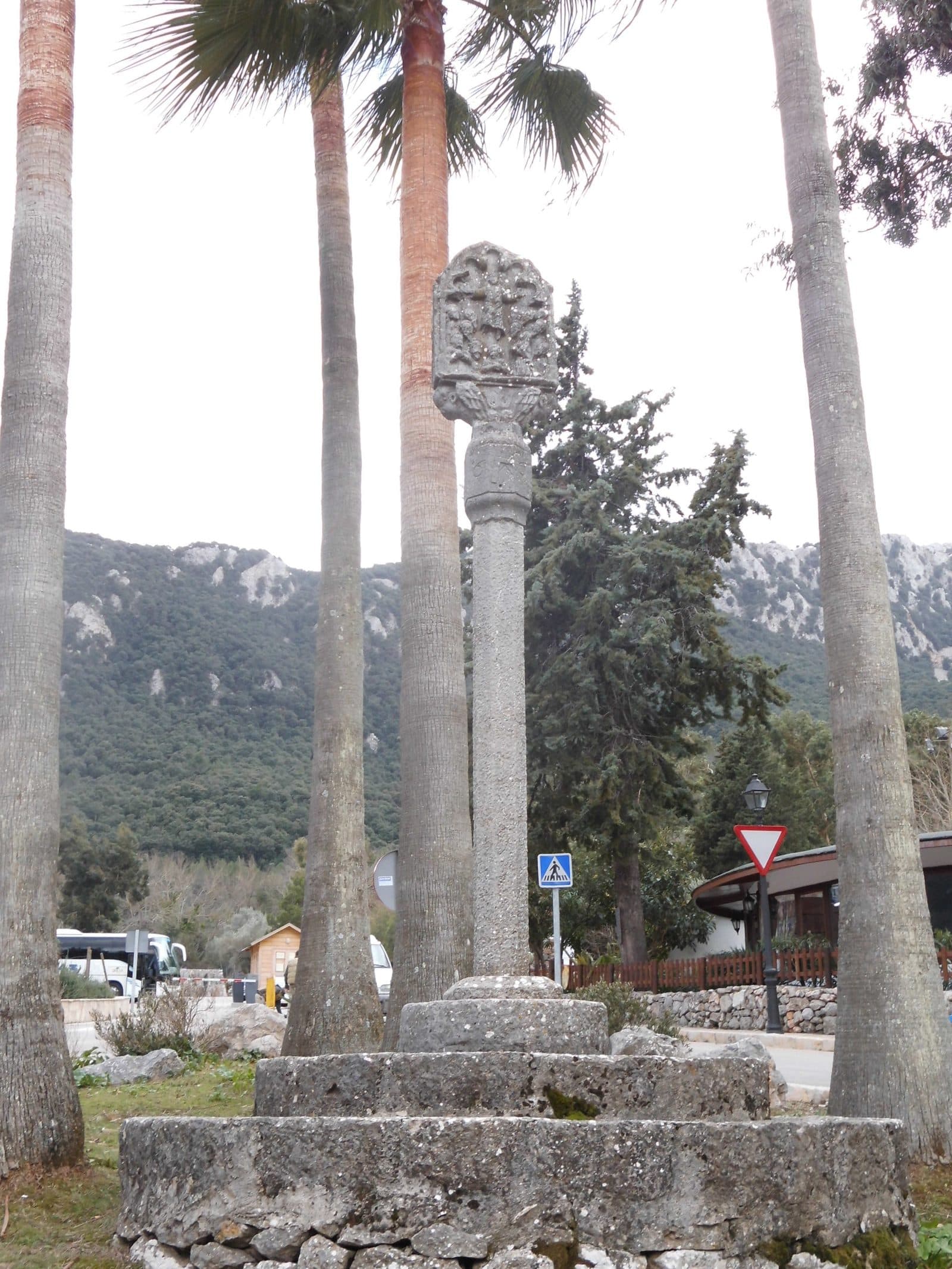

The creu des Barracar is one of those quiet historical landmarks that leaves an impression not through its size, but through its location and significance. The stone cross stands by the Santuari de Lluc in the municipality of Escorca, in Mallorca’s mountainous northwest. Palm trees frame the pale stone, giving the small monument a distinctive place within this religious ensemble.
A visit is particularly worthwhile for anyone who wants to see more than just the major buildings in Lluc. The Creu des Barracar draws attention to a smaller testament to Mallorca’s religious history. It is neither a museum with a visitor route nor a monumental viewing platform, but a historical detail that deserves to be observed with care.
That is precisely where its appeal lies. Between the landscape of the Serra de Tramuntana and the much-visited sanctuary, the stone column feels like a peaceful counterpoint. Anyone who appreciates architecture, popular religious culture, or historic stonework will find this a brief but rewarding stop. It makes sense not to plan the Creu as an isolated day-trip destination, but to include it while exploring Lluc.
History and significance
A testament to Lluc’s religious setting
The historical context of the Creu des Barracar leads directly to the religious setting of the Santuari de Lluc. The sanctuary is Mallorca’s spiritual center and has long been a destination for pilgrims. The cross should also be understood against this background: not as an arbitrary ornament, but as a visible symbol of faith and remembrance in a place whose identity has been shaped by pilgrimage and devotion.
A small monument with a great tradition
At the Creu des Barracar, this connection to its location remains immediately understandable today: the monument stands by the Santuari de Lluc and therefore belongs to a setting where religious symbols are more than mere historical decoration.
Its effect comes from the interplay of material, location, and spiritual context. It does not require a long visit. Instead, it serves as a reminder that Lluc’s history is found not only in the basilica, monastery buildings, and collections, but also in the smaller landmarks outdoors.
What to see
The stone column
The focal point is a historic upright stone column. The stone defines its appearance: solid, restrained, and without the long-distance impact of large summit crosses. From close up, it is easier to see how much the monument relies on its proportions and vertical form. The eye moves from the lower section of the column upward, where the monument’s religious character becomes visible.
The Creu des Barracar should therefore not be confused with the Creu de Sant Salvador, also known as the Creu des Picot, near Felanitx. That cross stands on a mountain in southeastern Mallorca and is a completely different monument. The Creu des Barracar belongs to Lluc and Escorca; its scale, location, and historical context are closely connected to the sanctuary.
For photographers, the most compelling composition is not an extreme close-up. From a little farther away, the column-like form becomes clearer and the location becomes part of the image. The cross is not detached from its surroundings; its impact comes precisely from the contrast between worked stone and vegetation.
The palm trees around the cross
The framing provided by the palm trees is particularly distinctive. Their trunks and fan-shaped leaves form a natural counterpart to the vertical stone. Depending on the viewing direction, either the historic stone or the green surroundings become more prominent. This composition makes the Creu des Barracar easy to recognize and distinguishes it from the island’s many freestanding wayside crosses.
The pale stone stands out clearly against the darker shapes of the vegetation. Those who pass quickly may see only a column; those who change their viewpoint will recognize the interplay of the cross shape, height, and surrounding plants.
The connection to the Santuari de Lluc
The most important visible connection lies beyond the stone itself. Its proximity to the Santuari de Lluc provides the Creu des Barracar with its wider context. Without this location, it would be a historical object that is difficult to interpret; here, it becomes clear why an outdoor religious symbol has been preserved and continues to be noticed.
It is therefore worth looking beyond the cross itself. Its spatial relationship with the sanctuary is part of the visit. The Creu is not an enclosed building with interiors, an exhibition, or a viewing terrace. Visitors should expect a compact historical monument whose meaning emerges from its location. For attentive visitors, this focus on a single symbol is precisely what makes the strongest impression.
Getting there and parking
From Palma city center to Escorca
From Palma city center, the route initially follows the Ma-13 and then the Ma-2130 toward Escorca. The distance to Escorca is 49 road kilometers, and the journey takes around 68 minutes. These details expressly refer to Escorca and not directly to the Creu des Barracar. For the final section, follow the signs to the Santuari de Lluc, as the cross is located by this sanctuary.
The distance alone should therefore not determine your schedule. The approach to Lluc is part of a mountain drive. On arrival, it is advisable to first get your bearings within the Lluc area and then find the Creu as part of your walk around the site.
From Palma Airport to Escorca
From Palma Airport, the route follows the Ma-30, Ma-13, and Ma-2130. The distance to Escorca is 52 road kilometers, and the journey takes around 64 minutes. Here too, the distance and driving time only refer to Escorca. From there, continue to the area of the Santuari de Lluc, where the Creu des Barracar stands.
Anyone driving directly after landing should not treat the mountain route like a short urban journey. Baggage collection, collecting a rental car, and navigating the airport exits all add to the driving time itself. At the destination, the cross is not a widely visible road landmark but a small historical object within the Lluc area. The sanctuary is therefore more useful as a navigation and orientation point than expecting a large monument visible from afar.
By bus to Lluc
For travel by public transport, Lluc is the most convenient stop. Other stops in the wider area include Coll de sa Batalla 1, Coll de sa Batalla 2, and Menut 1. Which connection is practical depends on your starting point, the season, and the current timetable. Before traveling, check not only the outbound journey but especially the return connection, as Lluc lies in an extensive mountain region.
The stop information is not a substitute for precise directions for the final section. From the chosen stop, check the route to the sanctuary area and then to the Creu des Barracar locally. For a relaxed visit, allow sufficient time between arrival and the return journey, and combine the cross with the other accessible parts of Lluc.
Bus lines to creu des Barracar at a glance
| Line | Route | Departures/day | First | Last |
|---|---|---|---|---|
| 312 | Lluc - Inca - Muro | 32 | 08:32 | 18:03 |
| 231 | Port de Sóller - Alcúdia | 16 | 10:15 | 19:58 |
From the official GTFS feeds (TIB/SFM), no real-time data. The figures cover all stops in the town; weekend and holiday services differ — check with the operator before travelling.
Getting there by bus
Lluc (19011) · 0.0 km as the crow flies
- 231Port de Sóller - Alcúdia · Daily
- 312Lluc - Inca - Muro · Daily
Coll de sa Batalla 1 (19003) · 1.1 km as the crow flies
- 312Lluc - Inca - Muro · Daily
Coll de sa Batalla 2 (19002) · 1.1 km as the crow flies
- 312Lluc - Inca - Muro · Daily
Menut 1 (19015) · 1.4 km as the crow flies
- 231Port de Sóller - Alcúdia · Daily
Menut 2 (19014) · 1.4 km as the crow flies
- 231Port de Sóller - Alcúdia · Daily
Timetable data: official GTFS feeds (TIB/EMT), no real-time — check with the operator before travelling.
Nearby attractions
Santuari de Lluc
The most obvious place to combine with a visit is the Santuari de Lluc itself. The Creu des Barracar does not stand nearby by chance; much of its significance comes from this religious setting. A walk around Lluc highlights the contrast between the small cross and the sanctuary’s larger buildings: here, a single symbol made of stone; there, a pilgrimage site that has developed over a long period.
The complex includes the basilica and a museum containing sacred art and historical objects. The tradition of the Escolania de Lluc, the renowned boys’ choir, is also part of the sanctuary’s identity. For the Creu des Barracar, this context is more important than a long list of distant excursion destinations. Those who first view the cross and then explore Lluc’s religious and cultural areas can better connect the different layers of the place.
Escorca and the Serra de Tramuntana
Escorca is not a compact village with a clearly defined center, but an extensive municipality in the heart of the Serra de Tramuntana. Its territory contains high peaks, forests, mountain roads, and some of Mallorca’s best-known landscapes. The Creu des Barracar reveals a different side of this region: the focus here is not dramatic nature, but religious history.
Those who wish to extend their stay can combine Lluc with a drive through the mountain landscape or a suitable hiking destination within the municipality. Escorca includes, among other places, the area around the Torrent de Pareis, Sa Calobra, and the Cúber reservoir. However, each of these destinations should be planned as a separate excursion; mountain roads and hiking trails mean that apparently nearby places are not automatically quick detours.
After a day focused on the landscape, the Creu offers a peaceful cultural accent. Alternatively, it can mark the beginning of a visit to Lluc before the route continues through the Serra. As a small monument, it takes little time, but it helps visitors see Escorca as more than a backdrop of rocks, gorges, and winding roads. The municipality’s history has also been shaped by pilgrimage, religious practice, and the Santuari de Lluc.
Local insider tips
Include the palm trees in your photo
The Creu des Barracar is most distinctive when the surrounding palm trees are visible alongside the stone column. A little distance shows more clearly than a close-up how the stone and vegetation define the location.
See it as part of Lluc
The cross is not a standalone destination that will fill an entire evening. The visit makes the most sense when the Creu des Barracar is deliberately included in a walk around the Santuari de Lluc area.
Do not confuse it with Es Picot
When planning the route, pay attention to the full name: the Creu des Barracar stands by Lluc in Escorca. The large summit cross Creu de Sant Salvador, also known as the Creu des Picot, near Felanitx is a different monument.