
Escorca – Mallorca’s Quiet Mountain World Around Lluc and Sa Calobra

Places to stay in Escorca
AdTo load the accommodation map by our partner Stay22, we need your consent for marketing cookies. Your consent applies to all marketing content on mallorca.com.
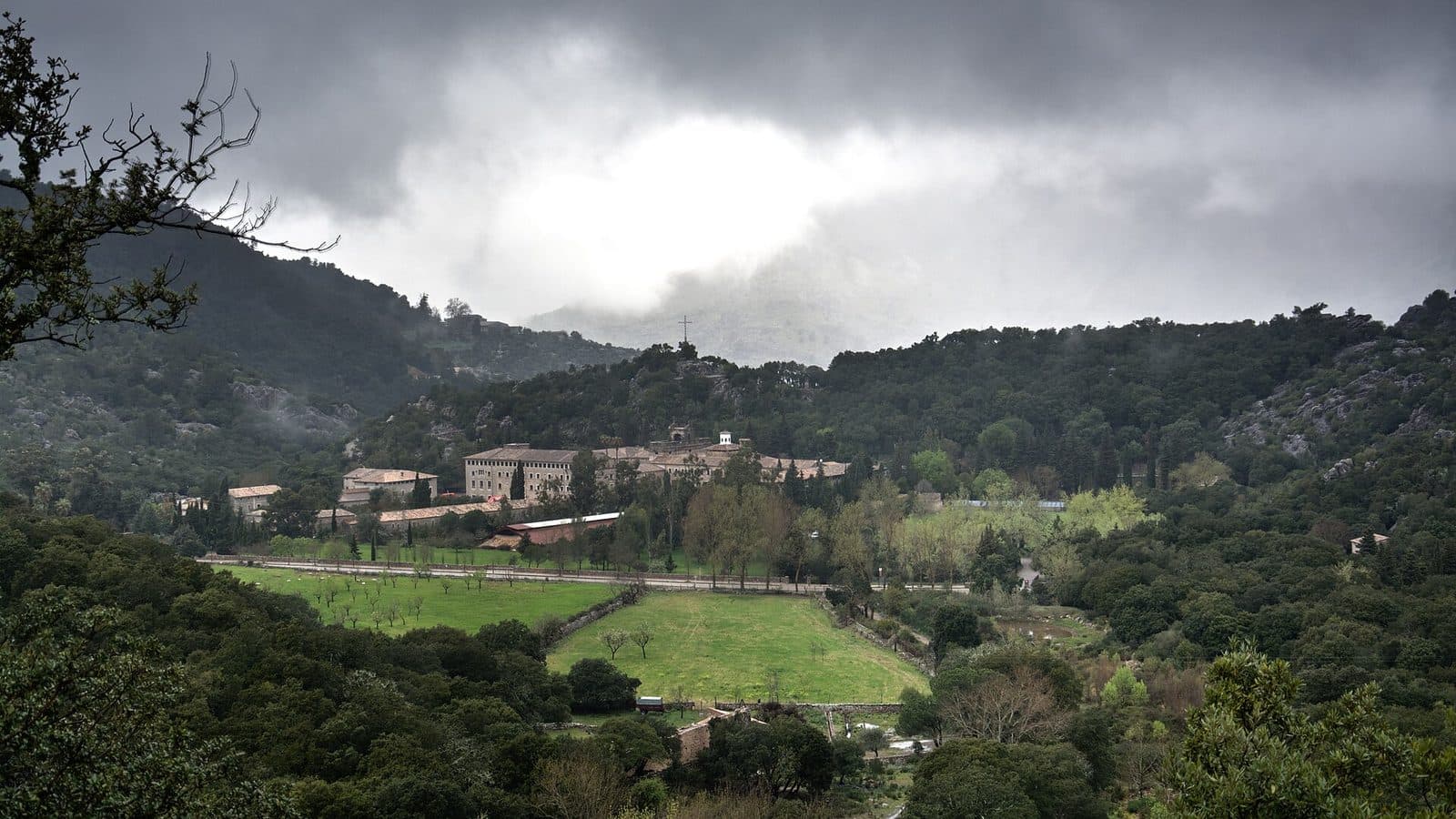
Escorca is not a Mallorcan village in the usual sense. The name refers to a widely dispersed settlement and mountain landscape in northwestern Mallorca, whose main landmarks are the Sanctuary of Lluc, the Torrent de Pareis gorge and the coast near Sa Calobra. There is no compact village center with a central shopping street and densely built-up lanes. Visitors to Escorca therefore travel between individual destinations rather than through a traditional village center.
Its location in the heart of the Serra de Tramuntana determines almost everything: the winding journey, the scattered residential areas, the rhythm of tourism and the types of activities available. Escorca is particularly suitable for hikers, cyclists, nature enthusiasts and visitors who want to discover Lluc as a religious or cultural-historical site. On the coast, the scenery changes again where the mountains meet the Mediterranean directly at the Torrent de Pareis and Sa Calobra.
For a day trip, it makes sense to choose a clear focus. Lluc can be visited at a relatively relaxed pace and combined with a hike; Sa Calobra and the Torrent de Pareis, by contrast, form a separate excursion destination. Anyone wishing to combine both in one day should not underestimate the long, winding roads or the time needed for parking and walking on site.
As a place to live, Escorca also follows different rules from the villages on the plains. Its small and dispersed population provides peace, abundant nature close at hand and unusually little urban density. At the same time, a car, forward planning for supplies and the organization of everyday journeys become more important. Escorca is therefore not only an excursion area but also a very distinctive way of life in Mallorca’s mountain landscape.
History of Escorca
The Human-Shaped Tramuntana
The history of Escorca cannot be read from a village square alone. It is embedded throughout the cultural landscape of the Serra de Tramuntana, where terraces, country estates, snow houses and watchtowers were created over centuries. These structures reflect the region’s rich history and culture.
These interventions are a key reason why the Tramuntana should not be understood as untouched wilderness. The natural environment and human labor have shaped each other here over a long period. The designation of the Serra de Tramuntana as a UNESCO World Heritage Site in two thousand eleven specifically recognizes this interaction between landscape, historical forms of land use and traditional knowledge. The region had already been declared a natural area in 2007.
The Origins of the Sanctuary of Lluc
Lluc forms the most important historical center of Escorca. According to tradition, after the conquest of Mallorca in twelve twenty-nine, a young shepherd and a monk found a stone image of the Virgin Mary in the forest. It was taken to the parish church of Escorca at the time but is said to have repeatedly returned to the place where it was found. A chapel was subsequently built there, developing into today’s Sanctuary of Santa Maria de Lluc.
The story belongs to religious tradition, while Lluc’s enduring significance as a pilgrimage site is directly visible in its complex of buildings and facilities. A small place of worship became a spiritual center with a church, pilgrim accommodation, a museum, gardens and spaces for community gatherings and events. In eighteen eighty-four, the venerated image of the Virgin Mary was crowned with the approval of Pope Leo XIII.
Roads, Pilgrimage and Modern Visitor Flows
Lluc was a destination for pilgrims long before modern excursion tourism. Later, the development of the mountain roads transformed access to the entire municipality. The Ma-10, which connects Escorca with the mountain regions toward Sóller and Pollença, opened at the end of July 1961. Near Lluc, the Ma-2130 provides a connection toward Inca and thus to the road network in the center of the island.
These transport routes explain why the widely dispersed municipality is now one of Mallorca’s best-known excursion landscapes despite lacking a village center. Pilgrims, hikers, cyclists, tour groups and coastal visitors all use the same few connections. At the same time, the underlying historical structure remains recognizable: instead of a town, a network of sanctuary, country estates, mountain trails, individual houses and small coastal settlements emerged.
Sights in Escorca
Santuari de Lluc
The Santuari de Lluc is the cultural and spiritual heart of Escorca. The church and other sanctuary buildings are grouped around a large square. The complex therefore conveys a stronger sense of a center than any other place in the municipality, even though Lluc is not a traditionally developed village center.
Inside, the veneration of the image of the Virgin Mary takes center stage. Visitors, however, experience Lluc through more than worship alone: the site also includes a museum with sacred art and historical objects, as well as garden areas. Anyone who does not treat the site merely as a tourist attraction but allows time for the interiors and quieter areas will better understand its significance for Mallorca.
Escolania de Lluc
Closely associated with the sanctuary is the Escolania de Lluc, the pilgrimage site’s renowned children’s choir. Its performances make the religious tradition audible and distinguish Lluc from a disused historical monument. A visit during an announced concert or liturgical performance therefore creates a different impression from a brief tour of the building complex.
The Escolania also demonstrates that Lluc remains in active use. Visitors are not entering a museum site alone, but a place where religious life, education, music, accommodation and tourism coexist. Respect for services and events is therefore part of an appropriate visit.
Museum of Lluc
The museum places the history of the sanctuary in context through sacred art and historical objects. It is particularly worthwhile for visitors who want to learn more about the development of the pilgrimage site after seeing the church. A museum visit deepens the impression that the architecture alone can convey only in part.
Because Escorca has no actual village center, this collection plays an important role in presenting the municipality’s cultural history. It connects Lluc’s religious origins with the site’s long history of use and offers a peaceful alternative when the weather or heat makes a longer hike less appealing.
Botanical Garden of Lluc
The botanical garden forms part of the sanctuary grounds and draws attention to the mountain region’s plant life. It is particularly well suited to a visit intended to combine culture and nature. Instead of driving on immediately after visiting the church, visitors can observe the transition between the built ensemble and the Tramuntana landscape here.
For families and visitors who do not want to undertake a demanding mountain tour, the garden offers an accessible way to discover more of Lluc beyond its buildings. It does not replace a hike, but it provides a concentrated impression of the surroundings and extends the visit without requiring another drive.
Torrent de Pareis
The Torrent de Pareis is one of Escorca’s most defining natural formations. The seasonal stream has carved a deep gorge through the mountains and reaches the Mediterranean at Sa Calobra. After heavy rain, water may flow through the Torrent; its appearance and accessibility are therefore closely linked to the weather and conditions in the mountains. The mouth of the gorge can be experienced as a scenic destination from Sa Calobra. There, visitors can see how closely the mountains and sea meet at the Torrent de Pareis.
Sa Calobra
Sa Calobra is the municipality’s small coastal settlement and one of the few places in Escorca with a recognizable concentration of tourist businesses. Restaurants and bars are located around the bay. Its true appeal, however, comes from its dramatic position between rock walls, the sea and the outlet of the Torrent de Pareis.
The drive is part of the experience, but it requires attention and time. Sa Calobra should therefore not be planned as a brief stop on a village tour. It makes more sense to treat the bay and access to the gorge as a destination in their own right and to account for the return journey along the mountain roads from the outset.
Cala Tuent
Cala Tuent is another coastal destination in Escorca and should be distinguished geographically from Sa Calobra. The municipality provides up-to-date capacity information for the parking areas at Cala Tuent and Sa Calobra, demonstrating the practical importance of car traffic at these remote bays.
In Escorca, mountains, access roads and individual parking areas determine how people move around. Cala Tuent is therefore better suited as a deliberately chosen destination than as a casual addition to an already full day’s itinerary.
Puig Major
At a height of 1.445 meters, Puig Major is Mallorca’s highest mountain and the municipality’s widely visible dominant landscape feature. Its significance for visitors lies primarily in the panorama and the orientation it provides within the central Tramuntana. It shapes numerous views from the roads and helps explain why Escorca feels so different climatically and topographically from the island’s coastal plains.
For visitors, it is a striking part of the landscape visible from roads, viewpoints and surrounding routes. Hiking destinations should be selected according to routes that suit each person’s abilities.
Sights in Escorca
Activities and Excursions
Hiking Around Lluc
Lluc is one of the most practical starting points for exploring Escorca on foot. Trails lead from the area around the sanctuary into the forest and mountain landscape, while the pilgrimage site’s infrastructure provides a clear starting and finishing point. This also makes the area suitable for visitors who do not want to commit immediately to a long or technically demanding tour.
Escorca’s tourism information explicitly distinguishes between family routes, accessible trails, cultural and spiritual paths, and tours for experienced hikers. This classification is practical because the landscape can easily lead to incorrect assumptions: a quick look at the map reveals little about the terrain, gradient or difficulty. The route, weather and fitness level should therefore be compatible.
Crossing the Torrent de Pareis
The Torrent de Pareis is one of Escorca’s defining natural formations. After heavy rain, water may flow through the Torrent. From Sa Calobra, visitors can experience the gorge’s outlet, where the scale of the Torrent becomes apparent.
Cycling in the Serra de Tramuntana
Escorca lies along important mountain roads in the Tramuntana and is therefore frequently crossed by road cyclists. The combination of long climbs, winding descents and major changes in elevation requires a realistic assessment of personal endurance. Routes through the central Tramuntana can be planned around Lluc, with the sanctuary serving as a prominent landmark.
Drivers should also expect cyclists and overtake patiently, especially on sections with limited visibility. For cyclists, meanwhile, the weather, drinking water and distances between reliable supply points are more important than in densely populated parts of the island. Escorca is not an area where a village with shops awaits around every bend.
Cultural and Pilgrimage Routes Near Lluc
Not every route in Escorca needs to be athletic. Around Lluc, the landscape, religious history and peaceful paths can be combined into a culturally focused visit. Together, the sanctuary, museum, botanical garden and surrounding area form a destination that supports an extended visit even without ambitions to reach a summit.
For spiritually minded visitors, the architecture is not the only focus. The traditional story of the discovery of the image of the Virgin Mary, the continuing pilgrimage and the music of the Escolania give the site a living purpose. Anyone visiting for these aspects should take announced services or choir performances into account and behave with appropriate restraint inside the sanctuary.
Excursion to the Coast
The drive from the mountain region down to Sa Calobra reveals the full range of Escorca’s landscapes particularly clearly. From the surroundings of Lluc, the road leads through increasingly rocky scenery to the coast. There, the focus is not on village architecture or shopping streets but on the bay, rock walls and mouth of the gorge.
A clear priority is advisable for an excursion of this kind. Anyone who wants to hike extensively or visit the Museum of Lluc at leisure does not necessarily need to add Sa Calobra on the same day. Conversely, the coast deserves enough time to prevent the drive, search for parking and walk to the Torrent de Pareis from becoming a rushed photo stop.
Getting There and Getting Around
By Car from Palma and the Airport
From Palma Airport, the road route follows the Ma-30, Ma-13 and Ma-2130 to Escorca. The route covers 52 kilometers by road and takes around 64 minutes. Most of the approach is initially quick via the road network around Palma and through the center of the island; only on the Ma-2130 does the route become considerably more mountainous and winding.
From central Palma, the route via the Ma-13 and Ma-2130 covers a total of 49 kilometers by road. The journey takes around 68 minutes. For commuters and regular journeys, distance alone is not the decisive factor: the final section cannot be calculated at motorway speeds and requires greater concentration, particularly in darkness or unfavorable weather.
Ma-10 and Ma-2130
The Ma-10 is the main longitudinal route through the Serra de Tramuntana. It connects the Escorca area toward Sóller and Pollença and provides access to numerous mountain landscapes. Near Lluc, the Ma-2130 branches off toward Inca. This road is particularly important for connections to the center of the island and onward to Palma.
Because Escorca does not have a single compact destination, visitors should establish before departure whether they are heading to Lluc, Sa Calobra, Cala Tuent or a hiking car park. Entering only the municipality’s name may be too imprecise for practical navigation. Mountain roads, rather than a few minutes’ walk through the same settlement, separate the individual destinations.
Bus and Getting Around Without a Car
Public buses serve Lluc and other points along the mountain roads. Visiting without a rental car is therefore possible in principle, especially when the sanctuary or a clearly defined hiking route is the destination. However, departure and return times must determine the day’s schedule; spontaneous travel between widely separated parts of Escorca is only practical to a limited extent without a private vehicle.
Anyone arriving by public transport uses the bus for the journey. For residents without a car, the dispersed structure means that appointments, shopping trips and connections must be planned more carefully than in a place with frequent services and a walkable center.
Parking on the Coast
At Sa Calobra and Cala Tuent, car traffic is concentrated in clearly limited parking areas. Current information on available capacity is provided for both destinations. This information is particularly useful before departure because a full car park at a remote bay cannot simply be replaced by a nearby side street.
Arriving early makes planning easier, especially on busy excursion days. Anyone driving to the coast later should allow sufficient time for the approach, finding a parking space, walking and the return journey. The mountain road itself is not a place for improvised stopping outside designated areas.
Bus lines to Escorca at a glance
| Line | Route | Departures/day | First | Last |
|---|---|---|---|---|
| 312 | Lluc - Inca - Muro | 24 | 08:32 | 18:00 |
| 231 | Port de Sóller - Alcúdia | 16 | 10:15 | 19:58 |
From the official GTFS feeds (TIB/SFM), no real-time data. The figures cover all stops in the town; weekend and holiday services differ — check with the operator before travelling.
Getting there by bus
Menut 1 (19015) · 0.6 km as the crow flies
- 231Port de Sóller - Alcúdia · Daily
Menut 2 (19014) · 0.6 km as the crow flies
- 231Port de Sóller - Alcúdia · Daily
Lluc (19011) · 0.9 km as the crow flies
- 231Port de Sóller - Alcúdia · Daily
- 312Lluc - Inca - Muro · Daily
Coll de sa Batalla 2 (19002) · 1.4 km as the crow flies
- 312Lluc - Inca - Muro · Daily
Timetable data: official GTFS feeds (TIB/EMT), no real-time — check with the operator before travelling.
Living in Escorca
Living Without a Traditional Village Center
The key difference from many other municipalities in Mallorca is the absence of an actual village center. The population lives dispersed throughout the mountain landscape, near Lluc and in small settlement areas such as Sa Calobra. Residential locations are therefore shaped less by a particular street or neighborhood than by access, elevation, distance from the main roads and the accessibility of the nearest everyday destinations.
Anyone considering a move to Escorca should not assess a specific property solely by its views and tranquility. The quality of the access road, turning space, parking and how quickly the Ma-10 or Ma-2130 can be reached are equally important. A house may geographically belong to the municipality yet offer a completely different daily routine from accommodation immediately near Lluc.
Local Amenities and Everyday Journeys
Administration, accommodation, restaurants and sanctuary facilities are concentrated near Lluc; on the coast, restaurants and bars primarily serve visitors. Before moving, the specific road connection should therefore be checked. The decisive factor is not only how far away a destination appears on the map, but how many mountain roads lie between the home and the destination.
Commuting to Palma
The journey from central Palma to Escorca covers 49 kilometers by road via the Ma-13 and Ma-2130 and takes around 68 minutes. Daily commuting is therefore possible, but it requires considerably more time than commuting from a suburb of the capital. In addition, the winding mountain section remains a permanent part of the route and cannot be replaced by a faster parallel road.
For regular journeys, the connection toward Inca may be more important than proximity to the Tramuntana coast. Homes with straightforward access to the Ma-2130 are more practical for Palma commuters than remote locations that must first be reached via smaller access roads or longer sections of the Ma-10. Working from home or locally reduces the greatest structural disadvantage of living in this area.
Everyday Life in Winter
Escorca lies among Mallorca’s highest mountains and has a more pronounced mountain climate than the coastal plains. At the same time, Escorca offers a degree of closeness to the landscape and low-density development that is difficult to find in Mallorca’s more urban areas.
Who Escorca Suits as a Place to Live
Escorca is best suited to people who seek peace and nature not only at weekends and who are prepared to handle the organizational demands of a dispersed mountain municipality. Anyone who enjoys exploring the Tramuntana on foot or by bicycle can live directly within one of the island’s most characteristic landscapes. Work connected with accommodation, restaurants, nature experiences and the sanctuary also shapes the local setting.
Escorca is less suitable for people who want to reach all daily destinations without a car, travel spontaneously to Palma frequently or expect a lively village with many shops and services on their doorstep. The low settlement density is not a romantic detail but the central factor of daily life. It creates freedom and tranquility while also making almost every practical journey longer.
Practical Information for Your Visit
Choose Your Destination Before Setting Off
Escorca cannot be visited like a compact old town. A specific destination should therefore be entered for navigation: the Santuari de Lluc, Sa Calobra, Cala Tuent or the starting point of a selected hiking route. Anyone who simply drives to Escorca expecting a central village square will misunderstand the municipality’s structure.
Lluc is suitable for a cultural and nature-focused visit, while Sa Calobra is ideal for a coastal day featuring gorge scenery. Both destinations can be combined, but the connection consists of mountain roads and therefore takes considerable time. Choosing a single focus usually results in a more relaxed and rewarding excursion.
Arrive Early and Plan the Return Journey
On the coast, arriving early is particularly advisable because the designated parking areas at Sa Calobra and Cala Tuent are limited. Current parking capacity should be checked before departure. An early start is also worthwhile at Lluc if a hike is planned afterward or if the church, museum and garden are to be visited without time pressure.
The return journey is part of the day’s planning. Winding roads feel more demanding after a long hike or in the evening than they do on the outward journey. Anyone using public transport should organize the entire route around the last suitable return service and avoid planning an additional stage that can be completed only if everything goes perfectly.
Match Your Equipment to Your Plans
Preparation for Lluc and the marked routes should be adapted to the planned activity. Sturdy footwear, water and weather-appropriate clothing are basic necessities for hiking in the Tramuntana. The mouth of the Torrent de Pareis can be experienced from Sa Calobra. Families can specifically choose one of the easier routes designated as family-friendly or combine visits to the sanctuary, museum and botanical garden.
What Escorca Does Not Offer
Escorca is not a destination for shopping along a long pedestrian street, nor is it a village where sights, restaurants and shops are clustered around a main square. A spontaneous walk without selecting destinations in advance also provides only an incomplete experience of the municipality. The area’s value lies precisely in its separate scenic and cultural destinations.
Lluc and Sa Calobra are suitable places for a break with restaurant facilities. Anyone undertaking a longer hike or traveling away from these points, however, should not expect regular opportunities to obtain supplies along the way. Water and necessary provisions are best organized before starting the tour.
Eating, drinking and staying in Escorca
The best-rated businesses from our directory, ordered by Google rating — not by advertising.
Local businesses and services
The best-covered sectors in our directory for Escorca — each with address, contact details and opening hours.
Run a business here? Add it to the directory for free and be found on this page. Add your business
Latest news from Escorca
- Mallorca night walk brings 5,000 walkers to Lluc
- Mallorca raises 180,000 plants for forests and dunes
- Marga Prohens joins Mallorca's Lluc pilgrimage mass
- Mallorca: Prohens joins Pujada a Lluc Sunday Mass