
Maria Costa Llobera near Escorca
.jpg)
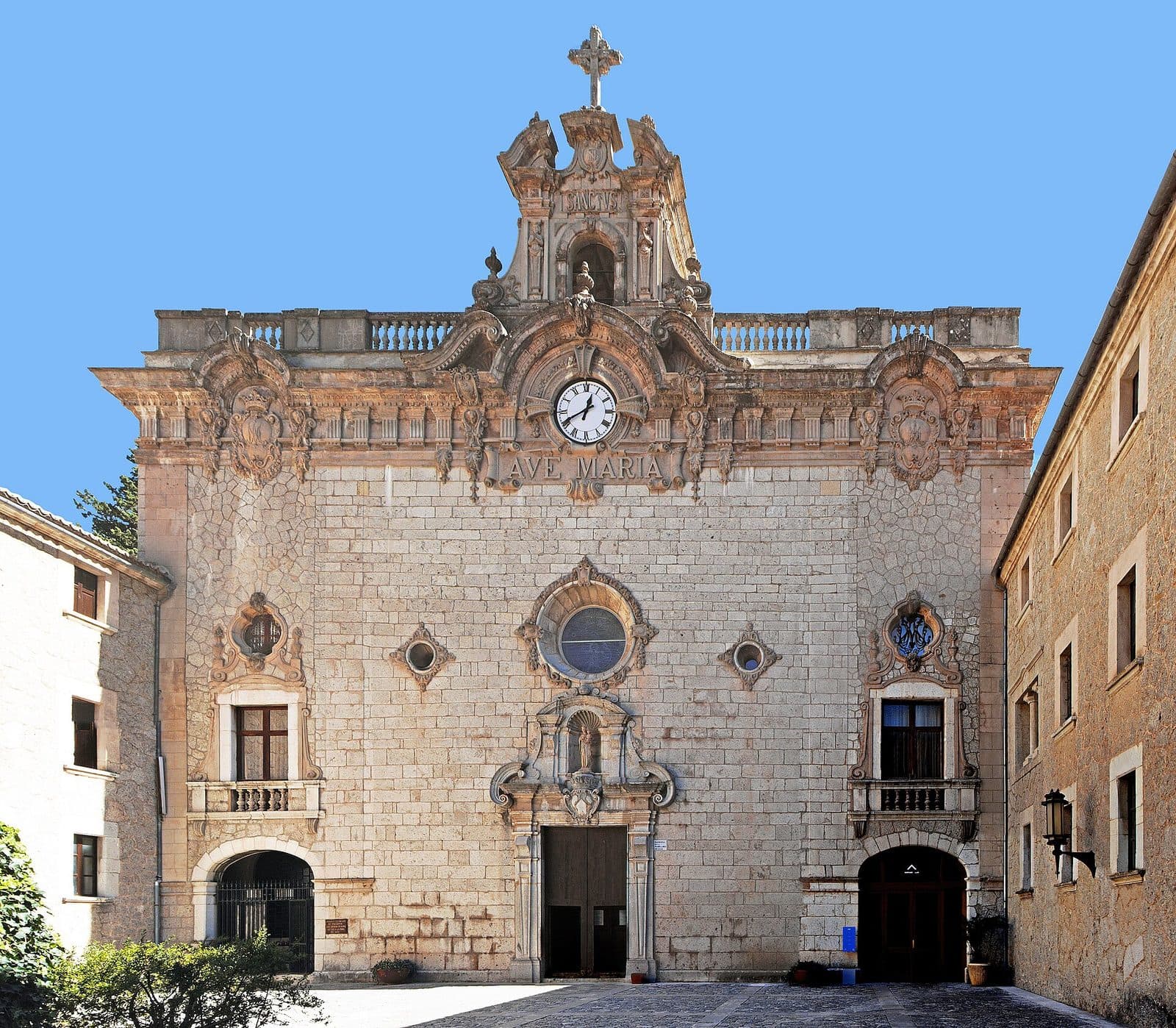
Maria Costa Llobera is a historic site near Escorca in northwestern Mallorca. It lies in an area that works differently from most destinations on the island: Escorca has no compact town center but extends across a vast section of the Serra de Tramuntana. Anyone entering the name into a navigation system should therefore not expect a traditional village street or central square.
The appeal of a visit lies primarily in experiencing the site within this mountain landscape. Around Lluc, historic traces, religious traditions, and smaller memorial sites are concentrated within a compact area, while just a few bends farther on, woodland, rock, and the roads of the Tramuntana once again define the scenery. Maria Costa Llobera is therefore better suited to a deliberately chosen stop within a day trip than as the sole activity for an entire day.
The site is particularly worthwhile for travelers already interested in Escorca, Lluc, or the history of Mallorca's mountain region. Since the name alone does not clearly reveal either the site's exact form or how to access it, it is worth checking the precise map location and current local information before setting out. This leaves enough time for the experience itself: seeing the historic trace not in isolation, but within its surroundings.
Visiting Maria Costa Llobera
Planning your visit
At Maria Costa Llobera, it is advisable to have different expectations than you would for a major museum or castle complex with a fixed visitor route. The site is one of the historic points of interest in the Escorca area and is best incorporated into an exploration around Lluc. Orientation therefore begins not only upon reaching the attraction but when choosing the correct map location, because in this extensive municipality, simply entering “Escorca” can lead somewhere other than intended.
Opening hours and admission details are not reliably documented. Visitors should therefore check current accessibility and any local regulations before their visit, especially if Maria Costa Llobera is the main reason for the journey. Those who plan the site as part of a day in Lluc remain more flexible and can adjust their stay to the actual circumstances without making the entire excursion dependent on a single historic point.
How much time to allow
No reliable average visit duration is available for Maria Costa Llobera. It is therefore practical not to plan the stay like a museum visit lasting several hours, but instead to allow sufficient time for orientation and exploring the surroundings. A route with some flexibility is more useful here than a rigid schedule.
Getting There and Parking
From Palma Airport
From Palma Airport, the calculated route initially follows the Ma-30, then the Ma-13, and finally the Ma-2130 toward Escorca. The road distance to Escorca is 52 kilometers, and the journey takes around 64 minutes. These details expressly apply only as far as Escorca, not directly to Maria Costa Llobera. The exact map location and local signs are therefore crucial for the final section. The route changes character noticeably along the way: the high-capacity roads around Palma and Inca are followed by the Ma-2130, which leads into the mountain region.
From central Palma
From central Palma, the route follows the Ma-13 and the Ma-2130. The road distance to Escorca is 49 kilometers, and the journey takes around 68 minutes. This calculated travel time also ends in Escorca; it does not automatically include finding the precise map location of Maria Costa Llobera.
For navigation, visitors should therefore not use only the municipality's name, because Escorca has no conventional town center where all roads converge. It is more helpful to save Maria Costa Llobera as the specific destination and check the final turns before setting out. In the mountain region, choosing the wrong access road can result in a noticeable detour despite the short distance shown on the map.
Parking and buses
Stops in the wider access area include Lluc, Coll de sa Batalla 1, Coll de sa Batalla 2, and Menut 1. Which of these is most convenient for a particular visit depends on the exact map location and the route from the stop. Before traveling by bus, visitors should therefore check not only the connection but also the walking route between the stop and Maria Costa Llobera.
Bus lines to Maria Costa Llobera at a glance
| Line | Route | Departures/day | First | Last |
|---|---|---|---|---|
| 312 | Lluc - Inca - Muro | 32 | 08:32 | 18:03 |
| 231 | Port de Sóller - Alcúdia | 16 | 10:15 | 19:58 |
From the official GTFS feeds (TIB/SFM), no real-time data. The figures cover all stops in the town; weekend and holiday services differ — check with the operator before travelling.
Getting there by bus
Lluc (19011) · 0.1 km as the crow flies
- 231Port de Sóller - Alcúdia · Daily
- 312Lluc - Inca - Muro · Daily
Coll de sa Batalla 1 (19003) · 1.2 km as the crow flies
- 312Lluc - Inca - Muro · Daily
Coll de sa Batalla 2 (19002) · 1.2 km as the crow flies
- 312Lluc - Inca - Muro · Daily
Menut 1 (19015) · 1.3 km as the crow flies
- 231Port de Sóller - Alcúdia · Daily
Menut 2 (19014) · 1.3 km as the crow flies
- 231Port de Sóller - Alcúdia · Daily
Timetable data: official GTFS feeds (TIB/EMT), no real-time — check with the operator before travelling.
Things to See Nearby
Escorca
Escorca is less a village than an extensive mountain municipality. This explains why destinations here are often described in relation to landscapes, road junctions, or well-known complexes rather than a central old town. The municipality forms part of the Serra de Tramuntana and stretches from the mountains to Mallorca's rugged northwestern coast. Winding roads, forests, gorges, and sparsely developed areas lie between its individual sites.
The Ma-10 runs through the municipality, connecting Sóller and Pollença across the Tramuntana. Near Lluc, it meets the Ma-2130 toward Inca. This junction is important for many excursions in the northwest and makes it easy to see why Maria Costa Llobera fits well into a day already passing through Escorca.
Lluc
Lluc is the municipality's nearest cultural focal point. The Santuari de Lluc has shaped the area for centuries and forms an ensemble with the pilgrims' square, historic pilgrim accommodation, and other buildings. On the pilgrims' square, the town hall stands on one side and the former accommodation for pilgrims arriving on horseback, known as the “Porxets,” on the other. This setting clearly shows that Lluc is both a pilgrimage site and Escorca's functional center.
Combining the visit with Lluc is particularly worthwhile if Maria Costa Llobera is not to be viewed in isolation. Instead of continuing immediately after a short stop, visitors can experience the historical setting of the mountain region. Enough time should be allowed to check routes and access points locally, as the individual sites are not comparable to a compact urban museum district.
Sa Calobra and Torrent de Pareis
Those wishing to extend the day to the coast can include Sa Calobra and Torrent de Pareis as additional destinations within the municipality. However, they represent a very different side of Escorca: the steep Tramuntana coast, a small bay, and the gorge through which water reaches the Mediterranean after heavy rain. Combining them demonstrates the municipality's remarkable variety.
Maria Costa Llobera remains the historic highlight of an excursion whose other stops may focus more strongly on pilgrimage, mountain scenery, or the coast. This clear division of roles is helpful when planning: the individual site receives due attention without being burdened by unsupported expectations of a major exhibition or extensive sightseeing route.