
Antonio Parietti Coll Monument on the Formentor Road
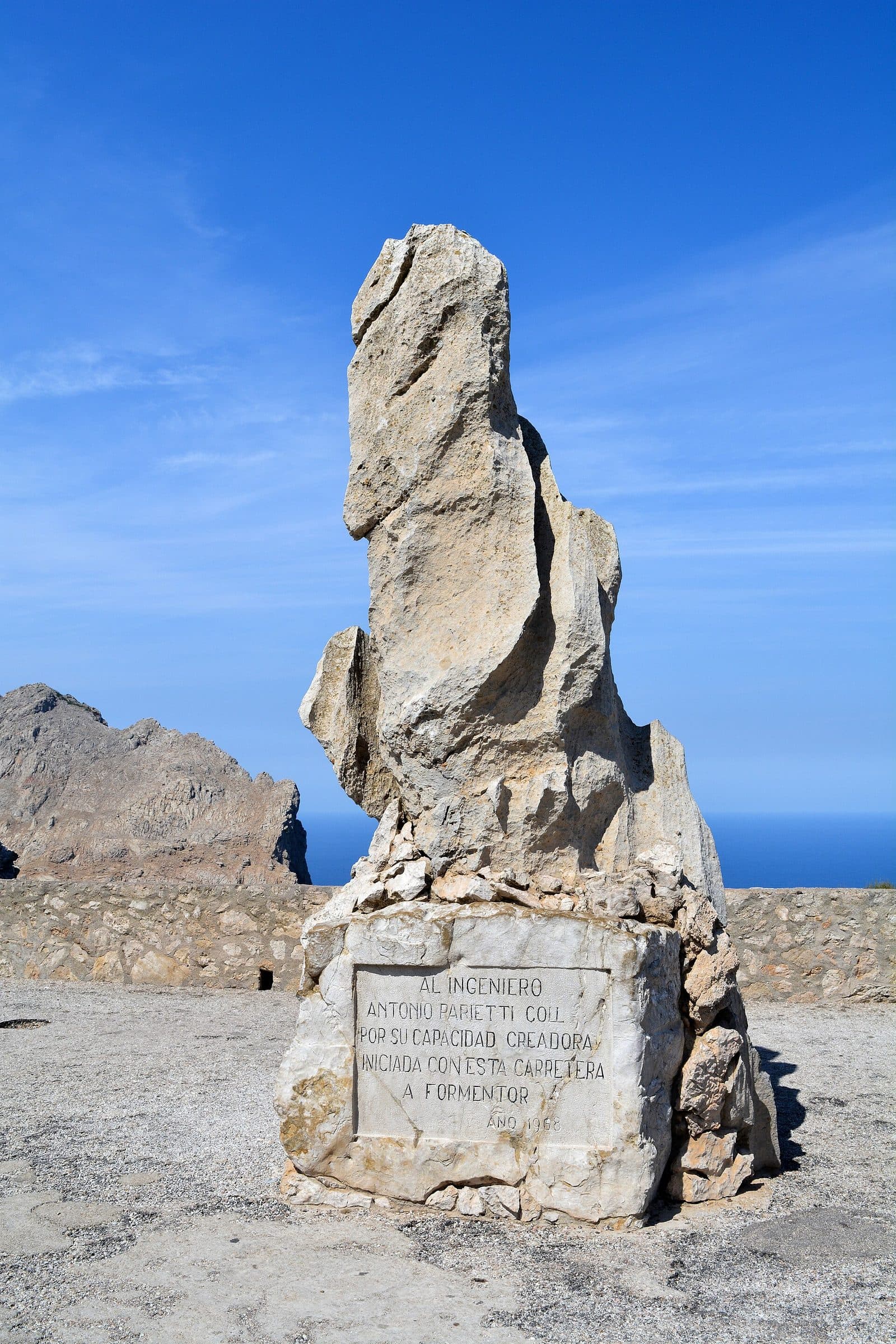

Anyone traveling from Port de Pollença to the Formentor Peninsula encounters Antonio Parietti Coll twice: first in the road's bends, then in the form of a monument at Mirador de Mal Pas in the Mirador del Colomer area. The monument commemorates the engineer who designed some of Mallorca's most famous mountain roads.
The monument is neither a museum nor an extensive historic site. It is a memorial at the very place where Parietti's achievement can be understood firsthand. Beyond the monument lies not an abstract history of engineering, but a road that winds through difficult limestone terrain toward Formentor.
The stop is therefore particularly interesting for travelers who want to understand Mallorca not only as a landscape but also as a shaped cultural environment. Road construction, viewpoints, and tourism development are also part of the island's history. The monument reveals the planner behind part of this development.
A visit can easily be planned as a deliberate break in the journey. Anyone who views the monument and then follows the road's course through the terrain will quickly gain a vivid insight into an important chapter of Mallorcan infrastructure history.
History and significance
When Antonio Parietti Coll worked on his projects during the early decades of motorized transport, the Serra de Tramuntana was far less accessible than it is today. Many projects of that period were not primarily intended to connect existing towns. They deliberately opened landscapes that had previously been difficult to reach to day-trippers and the emerging tourism industry.
Antonio Parietti Coll
Parietti was born in Palma in 1899 to an Italian father and a Mallorcan mother. After studying civil engineering in Madrid, he returned to the island. There, he headed the provincial administration's engineering and road construction department while also working with Foment del Turisme, Mallorca's tourism promotion organization. He died in Palma in 1979.
His work extended beyond individual roads: he also planned canals and port facilities. He became famous, however, for the routes that had to fit into the rugged terrain of the Tramuntana. Parietti sought solutions that followed the natural contours and required as few tunnels as possible. The routes also had to accommodate the comparatively weak engines of early automobiles.
The road to Formentor
The connection between Port de Pollença and Formentor, built in 1925, is one of Parietti's defining works. It opened the peninsula to tourism and made the construction of the hotel there possible, among other developments. From today's perspective, the route seems almost inevitable; when it was created, however, bringing a road for automobiles to the steep coastal slopes was a demanding undertaking.
That is precisely why the monument's location on this route is no coincidence. From the Mirador, visitors can see the challenge the engineer faced: a passable line had to be found between rock, slope, and coast. Here, the road is not merely the route to the monument but an essential part of its meaning.
Sa Calobra and other projects
Parietti's name is also associated with the road to Sa Calobra. Its best-known feature is Nus de sa Corbata, the “tie knot,” where the roadway crosses over itself in a broad looping bend. The project demonstrates particularly clearly his method of overcoming difficult terrain with an inventive route rather than a direct cutting.
Parietti also worked on a funicular railway to Puig Major. Construction began in 1936 but came to a halt with the Spanish Civil War; later attempts were prevented by the Second World War. The plan was eventually converted into a road project and taken over by the Spanish state. The monument on the Formentor road therefore honors not just one section of road, but an engineer whose ideas permanently changed how the Tramuntana was perceived and accessed.
The monument from 1968
A monument to Parietti was erected on the road to Cap de Formentor in 1968. He lived to see this recognition himself. Its location at Mirador de Mal Pas connects the man, his work, and the landscape in an unusually direct way: instead of honoring the engineer in an urban setting, the memorial was placed in the heart of one of his most important projects.
What to see
At Mirador de Mal Pas, the monument to Antonio Parietti Coll stands against the coastal landscape. Its location also directs attention back to the road whose engineering achievement it honors.
The monument
The monument commemorates Antonio Parietti Coll. At this particular location, it highlights the technical subject of the tribute: the road had to be planned not through level surroundings but through massive, highly fragmented terrain.
The tribute to Antonio Parietti
The monument turns the engineer, who is otherwise usually mentioned only in connection with road numbers and curve radii, into a tangible historical figure. It identifies him as the man being honored here.
The focus is on the memory of planning and execution. The true exhibit lies all around: the road moving through the slope and the terrain to which its route had to respond.
Road and landscape as part of the monument
From this location, the term “engineering skill” takes on an immediately understandable meaning. The coast of Formentor consists of steep rock faces, narrow ridges, and slopes that plunge sharply toward the sea. A road had to combine bends, gradients, and existing landforms in a way that allowed motor vehicles to pass.
Anyone who lets their gaze move from the monument to the roadway will read the landscape differently. Bends no longer appear merely as attractive photo opportunities but as responses to topographical obstacles. Rock cuttings, changes of direction, and the route's position on the slope become visible traces of planning decisions.
Mirador de Mal Pas and Mirador del Colomer
The monument stands at Mirador de Mal Pas in the area of the well-known Mirador del Colomer. This connects the historical tribute with one of the most striking viewpoints along the Formentor road. The location illustrates why this route is perceived as a scenic experience: the road and the views were not conceived separately; instead, the route was designed specifically to give visitors access to such vistas.
The monument therefore deserves more than a quick photo. The most revealing approach is to alternate between monument and panorama: first examine the memorial, then follow how the road continues through the rocky surroundings.
Visiting the monument
A typical visit begins not at an entrance but as a stop during the drive along the Formentor road. Even the journey from Port de Pollença is part of the experience, as it follows the route for which Parietti is honored. Once at the viewpoint, visitors can explore the monument without a prescribed route.
A short stop with historical context
The monument alone does not require a long visit. Spending more time is worthwhile if it is not viewed in isolation. The memorial, surrounding rock, location of the Mirador, and visible course of the road together explain why Parietti was important to Mallorca. Anyone previously familiar only with his name will quickly understand at the site how closely his life's work was connected to opening the Tramuntana to tourism.
A sensible sequence arises almost naturally: first view the monument, then change position and look for the road within the terrain. This turns a brief photo stop into a short lesson on shaping a mountain landscape in the age of the early automobile.
Crowds and planning your visit
Anyone wishing to spend time at the monument without feeling rushed should not simply squeeze the stop between two other activities, but allow some flexibility for the viewpoint.
This is especially true if the monument is to be part of a longer drive across the peninsula.
Who will enjoy the stop
The site is most rewarding for people interested in Mallorca's history, road construction, photography, and cultural landscapes. Even without technical knowledge, the basic idea is easy to grasp: an engineer is honored where his work is still used and experienced today.
Anyone expecting a museum, interiors, or an extensive exhibition, however, will not find them here. Antonio Parietti Coll is a small open-air historical stop. Its value lies in the connection between monument, viewpoint, and original setting, not in the number of objects on display.
Getting there and parking
From Palma and the airport, the first part of the journey leads to Port de Pollença. The stated distances and driving times apply expressly only as far as this coastal town; the final section to the monument requires an additional drive along the winding Formentor road.
From Palma Airport
The road distance from Palma Airport to Port de Pollença is 64 kilometers. The drive takes around 54 minutes and follows the Ma-30, then the Ma-13, and finally the Ma-2200. In Port de Pollença, the much more scenically demanding section toward Formentor begins.
The final section follows the Ma-2210. This road leads from the port town onto the peninsula and uphill to the area of Mirador del Colomer and Mirador de Mal Pas. As the elevation increases, the route becomes more winding and closely follows the rocky terrain—the very route design that makes a visit to the Parietti monument historically interesting.
From Palma
From the center of Palma, the road distance to Port de Pollença is 61 kilometers. The drive takes around 57 minutes and follows the Ma-13 and Ma-2200. From there, the route continues along the Ma-2210 toward Formentor.
The driving time to Port de Pollença should not be confused with the total journey time to the monument. Additional time should be allowed for the final section, as a mountain and coastal road requires a different pace from the Ma-13. At the same time, this section is not merely an extension of the journey: it passes through Parietti's own project and thus prepares visitors for the monument.
Bus services and the viewpoint stop
The bus stops Mirador del Colomer 1 and Mirador del Colomer 2 are located in the Mirador del Colomer area. They offer an alternative to traveling in a private vehicle, provided that the current routes and seasonal regulations suit the planned time of the visit. Timetables should be checked immediately before the excursion.
Bus lines to Antonio Parietti Coll at a glance
| Line | Route | Departures/day | First | Last |
|---|---|---|---|---|
| 334 | Alcúdia - Formentor | 232 | 09:47 | 21:48 |
| 322 | Pollença - Port d'Alcúdia | 4 | 16:17 | 17:37 |
From the official GTFS feeds (TIB/SFM), no real-time data. The figures cover all stops in the town; weekend and holiday services differ — check with the operator before travelling.
Getting there by bus
Mirador del Colomer 1 (42037) · 0.1 km as the crow flies
- 334Alcúdia - Formentor · Daily
Mirador del Colomer 2 (42036) · 0.1 km as the crow flies
- 334Alcúdia - Formentor · Daily
Can Singala 1 (42056) · 2.1 km as the crow flies
- 334Alcúdia - Formentor · Daily
Can Singala 2 (42055) · 2.1 km as the crow flies
- 322Pollença - Port d'Alcúdia · Daily
- 334Alcúdia - Formentor · Daily
Timetable data: official GTFS feeds (TIB/EMT), no real-time — check with the operator before travelling.
Nearby
After viewing the monument, the most natural continuation is not to turn back but to travel farther through Parietti's work. The Ma-2210 opens up the Formentor Peninsula with its viewpoints, rocky landscapes, and stretches of coastline. The monument is therefore well suited as a historical introduction or an intermediate stop on a trip to Formentor.
Port de Pollença
Port de Pollença developed from a small fishing port into a resort whose tourism growth began in the 1920s and accelerated considerably from the 1960s onward. The harbor, beaches, and promenade offer a peaceful contrast to the rocky road above the coast.
In connection with Parietti, the town is more than just a starting point. The road connection to Formentor completed in 1925 began here. Combining the port town with the monument therefore demonstrates how closely tourism development was linked to new transport routes.
Formentor
Farther along the route lie Formentor Beach and the peninsula's landscape. Anyone driving there experiences the road not simply as a connection between individual destinations but as a continuous work of engineering. Changes of direction, rock cuttings, and views repeatedly demonstrate why Parietti's planning still attracts attention today.
Mirador del Colomer itself is also part of the immediate visitor experience. The view and the monument address two sides of the same story: the impressive shape of the coast and the technical effort to make it accessible to travelers. Anyone who considers both together will understand the location better than they would during a purely panoramic stop.
Local insider tips
View the stele from the side
Do not stop only in front of the portrait: from the side, the rough shape of the pale stone stele becomes more distinct and can be compared directly with the limestone rock of the Formentor Peninsula.
Read the road
After reading the inscription, deliberately turn your attention to the Ma-2210. Its bends, position on the slope, and rock cuttings are the true key to the monument, as they reveal Parietti's planning achievement directly at the original site.
Start at the harbor
Port de Pollença is the ideal starting point: the connection to Formentor built in 1925 began there. This makes the drive to the monument itself part of the historical visit.
Frame the monument with the rock
A more meaningful image results when the photograph includes more than just the metal plaque. With the stele, rocky landscape, and a section of the road in the frame, it becomes clear why the monument stands precisely here.