
Mirador Es Colomer – Mallorca's Coast from Above
.jpg)
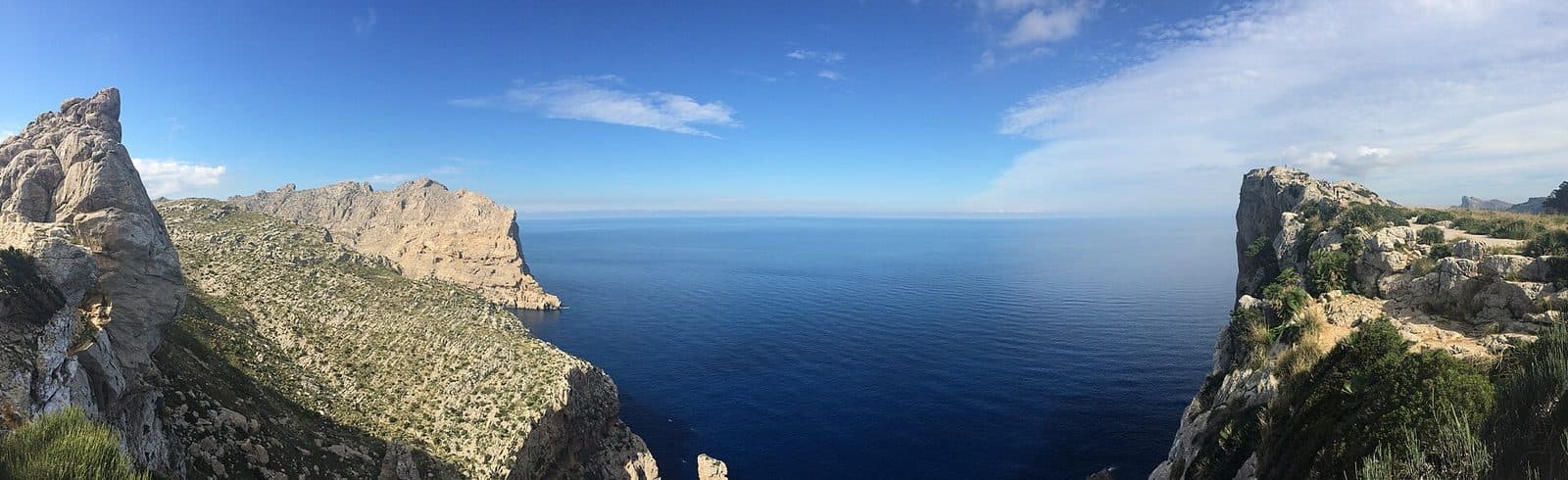
Even on the way up, it becomes clear why Mirador Es Colomer is one of Mallorca's best-known viewpoints. Beyond Port de Pollença, the road climbs through tight bends, the vegetation becomes lower, and the sea repeatedly flashes between the rocks. At the destination, there is no panorama behind glass: you stand amid the rugged landscape of the Formentor peninsula.
The view follows the steep foothills of the Serra de Tramuntana out into the Mediterranean. Offshore lies the rocky islet of Es Colomer. Its elongated silhouette is the Mirador's classic photo motif, but the location offers more than this single image. Depending on where you stand, coastlines, coves, mountain slopes and the vast expanse of water open up from constantly changing perspectives.
The visit itself consists of a short walk across steps, paved sections and several viewing terraces. This path is precisely what makes the experience so appealing: the panorama does not appear all at once but expands with every bend. The Mirador is worthwhile for landscape photographers, families with sure-footed children, day-trippers driving across Formentor and anyone who wants to experience northern Mallorca from a great height without a long hike.
Wind and crowds, however, are part of the experience. Those who arrive early usually find the viewpoint path quieter; around sunset, the special light attracts many photographers. For an enjoyable visit, sturdy shoes, sun protection and a little time to wait at the most popular photo spots are more helpful than a minute-by-minute sightseeing plan.
History and significance
The road to Formentor
Before a road opened up the peninsula, its rocky landscape was considerably harder to access from the rest of northern Mallorca. The name still associated with the road's design is Antonio Parietti. The engineer planned the winding route through terrain where steep slopes, rocky ridges and deep cuts left little room for a conventional road. Rather than following the coast in a straight line, the road therefore adapts to the mountains with hairpin bends and changing sightlines.
The Mirador can hardly be separated from this road. It is not a spot discovered by chance at the roadside but a deliberately accessible viewpoint within a designed scenic route. The drive, the alternation between inland slopes and open sea views, and the subsequent walk form a sequence. What now seems like a natural stopover is based on the engineering work that opened up the difficult-to-access coastal mountains in the twentieth century.
The monument to Antonio Parietti
At the viewpoint, a pointed monument commemorates Antonio Parietti. It does not stand apart in an enclosed museum but directly within the landscape that shaped his work. Surrounded by rock, wind and road, it becomes clear why the engineer is honored here: only a route adapted to the terrain made it possible to reach this perspective over the Formentor coast without a long mountain hike.
The monument is easy to overlook because almost everyone initially turns toward the sea. In terms of meaning, however, it is the key to the location. The Mirador does not tell the story of a military installation or a religious building, but of the idea of making a landscape accessible through paths and viewing terraces. Its historical value therefore lies less in a single old structure than in the combination of panoramic road, footpath and deliberately positioned viewpoints.
From roadside stop to landmark
Today, Mirador Es Colomer is one of the most photographed stops in northern Mallorca. Its significance rests on an instantly recognizable motif: the dramatically plunging coast with the rocky islet offshore. At the same time, the location illustrates Formentor's geography particularly clearly. The peninsula does not appear here as a flat tongue of land but as an extension of the Serra de Tramuntana, whose rocky ridges drop directly toward the sea.
This popularity changes the visitor experience. Coaches, rental cars, bicycles and public buses converge at a stop with limited space, while the viewpoint path remains narrow in places. The Mirador is therefore both a scenic location and a much-visited landmark. Anyone wishing to understand the historical idea behind the site should not simply take the famous coastal photograph but walk the entire path and observe how carefully the individual views are revealed one after another.
What to see
The viewpoint path
From the roadside area, a surfaced path leads over numerous shallow steps toward the main viewing terraces. The path follows the rock and climbs in sections. Walls and railings protect much of the route without completely obstructing the view. Because the passage narrows in several places, brief waits can occur when it is busy, especially where visitors stop to take photographs.
The path is more than a simple access route. At first, individual sections of the coast appear between rocks and boundary walls. Higher up, the sea increasingly takes center stage while the road and car park visually recede. At every turn, the relationship between the rocky edge, horizon and offshore islet shifts. Anyone who rushes straight to the outermost terrace misses precisely this carefully staged presentation of the landscape.
Although the steps are mostly shallow, the surface remains an outdoor path in an exposed location. Wind can make walking noticeably more difficult, and when it is busy, visitors traveling in opposite directions must pass each other along narrower sections. Sturdy footwear is therefore more practical than beachwear with smooth soles.
The viewing terraces
Several terraces distribute visitors across different heights and viewing directions. From the walled areas, the view extends over the rugged foothills of the mountains, which seem to plunge toward the sea directly below the viewpoint. Even where the full depth cannot be seen directly, the steep coastline creates a powerful sense of height.
The terraces do not all offer the same view. On the outward walk, the staggered rocky cliffs often dominate; at points farther out, the panorama opens more fully toward the sea. On the return walk, the inland mountains come into view and, depending on visibility, Port de Pollença appears between the ridges. On clear days, the direction of Cala Bóquer can also be identified. This variety makes it worthwhile to look back occasionally.
The light transforms the rocks more dramatically than the sea. In the morning, contours stand out clearly, while the low evening light already casts some slopes into shadow and illuminates other edges with a warm glow. A sunset can be impressive, but it does not automatically guarantee the most even illumination of the classic coastal motif. Photographers should therefore plan around their preferred viewing direction rather than the color of the sky alone.
The rocky islet of Es Colomer
Es Colomer rises from the water offshore. The long, bare rock forms the most striking fixed point in the vast expanse of sea. From some positions, the islet looks compact; from others, it appears narrow and almost like an extension of the coastal rocks. Just a few steps along the viewpoint path alter its silhouette.
For the classic photograph, it is worth finding a position where the rocky islet does not merge visually with the coast behind it. The best compositions are therefore not necessarily found at the first unobstructed spot. From the higher terraces, Es Colomer can often be separated more clearly from the sea, while lower positions emphasize the steep rock faces in the foreground.
The islet also helps convey the scale of the landscape. Without such a reference point, the sea and horizon could appear almost abstract. With Es Colomer in the picture, it becomes clear how far the coast projects into the landscape and how strongly the rock formations on this side of Formentor have been shaped by the water.
The Parietti monument
Amid the great natural motifs, the monument to Antonio Parietti provides a deliberately human accent. Its pointed form contrasts with the horizontal lines of the sea. Many visitors walk past because they are already heading toward the next viewpoint. A brief stop is still worthwhile: the monument is a reminder that this easily accessible panoramic view is the result of sophisticated road planning.
The layout itself can also be understood well from the area around the monument. Steps, walls and terraces follow the narrow rocky ridge rather than forming a single large platform. This staggered design preserves different viewing directions and spreads the elevation gain across the entire path. The Mirador is therefore less a single balcony than a small sequence of open-air viewing spaces.
Visiting the viewpoint
From the roadside to the outermost terrace
After arrival, the visit begins with the transition from the busy roadside area to the footpath. It can already become crowded at the entrance when groups arrive or return at the same time. People then spread out across the steps and terraces. Anyone walking at a relaxed pace will naturally stop several times: first for the lateral coastal views, then for Es Colomer and finally for the open panorama.
One to two hours are often allowed for a visit to the viewpoint. This is generous enough to walk the full route, spend time on the terraces and take photographs without rushing. Anyone who simply walks to the main motif and returns immediately will need correspondingly less time. Around sunset, additional flexibility should be planned because finding parking, passing people coming the other way and crowded photo spots can extend the visit.
Current access times should be checked before traveling. Up-to-date information is also recommended regarding admission, as no reliable details were available for this text. In any case, the weather, wind and traffic situation on the Formentor road are more important for planning a visit than a fixed time slot.
Early morning
In the early morning, the Mirador is usually the more pleasant choice for anyone wishing to experience the path and terraces with fewer crowds. The light defines the contours of the coast clearly, and at popular photo spots there is more time to adjust the composition. Parking may also be easier than during the busiest parts of the day.
The quiet is especially valuable at this location. Without a constant succession of tightly packed groups, the staggered layout is easier to appreciate, and the sound of the wind becomes more prominent than voices and road traffic. For landscape photographers, morning is therefore not merely an alternative time but offers a distinctive quality of light in its own right.
Late afternoon and sunset
Toward evening, the sun descends over the western landscape and casts warm light across parts of the rocky coast. The Mirador then becomes a popular meeting place for photographers and day-trippers. Anyone seeking this experience should not arrive at the last moment. The limited parking spaces and narrow passages may already be heavily used well beforehand.
Late light also means strong shadows. These can add depth to the coast but may obscure individual slopes depending on the season and viewing direction. Sunset is therefore not always better than morning for an evenly exposed landscape photograph. For atmosphere, however—with changing colors, darkening mountain slopes and the clearly defined silhouette of Es Colomer—it remains highly appealing.
Wind and weather
The viewpoint is exposed above the sea and can be exceptionally windy. Gusts are felt more strongly on the open terraces and narrower sections of the path than in the car park. Loose hats, light scarves and unsecured items should therefore be placed in a bag. A tripod should also be set up securely and never left unattended.
In hazy weather, the panorama loses some of its breadth, while strong wind can make the path unpleasant. It is therefore worth checking local conditions before setting off. A clear, calm morning often offers more than a spectacularly forecast evening with haze or powerful gusts.
Directions and parking
From Palma and the airport to Port de Pollença
From Palma Airport, the route initially follows the Ma-30, then the Ma-13 and the Ma-2200 to Port de Pollença. The road distance to that point is 64 kilometers, and the drive takes around 54 minutes. From central Palma, the route follows the Ma-13 and the Ma-2200. The 61 road kilometers to Port de Pollença take around 57 minutes.
These details expressly end in Port de Pollença, not at the Mirador. For the final section, the road climbs across the Formentor peninsula. It becomes more winding and the landscape rockier. The route to the viewpoint follows the Ma-2210. Tight bends, inclines and oncoming cars, buses and bicycles demand more attention than the preceding drive on the island motorway.
The panoramic road is part of the excursion but should not be confused with a leisurely coastal drive. The driver can enjoy the views to the side only to a limited extent and should expect cyclists, especially on the hairpin bends. A little extra time is advisable because high visitor numbers can slow down the final section.
Parking at the Mirador
A car park is located directly beside the road at the viewpoint. Its location makes access convenient, but its limited capacity also makes it the most frequent bottleneck of the visit. Especially during the summer months and around sunset, finding a free space can be difficult. Vehicles waiting or maneuvering then add pressure to an already heavily used section of road.
An early visit reduces this problem. Anyone unable to find a free parking space should not stop on blind bends or outside suitable areas. The Formentor road needs sufficient room for buses, oncoming traffic and bicycles. A spontaneous photograph from the roadside is neither a substitute for the viewing terraces nor a good solution when the car park is full.
By bus
The Mirador can also be reached by bus, with stops located directly beside the viewpoint. This is a sensible alternative to a rental car, especially during busy summer periods, because it avoids the search for parking. Buses depart from Port de Pollença toward Formentor. Although the bus removes the need to drive through the hairpin bends, visitors must still walk the path with its steps and terraces.
Bus lines to Mirador Es Colomer at a glance
| Line | Route | Departures/day | First | Last |
|---|---|---|---|---|
| 334 | Alcúdia - Formentor | 348 | 09:47 | 21:48 |
| 322 | Pollença - Port d'Alcúdia | 4 | 16:17 | 17:37 |
From the official GTFS feeds (TIB/SFM), no real-time data. The figures cover all stops in the town; weekend and holiday services differ — check with the operator before travelling.
Getting there by bus
Mirador del Colomer 2 (42036) · 0.1 km as the crow flies
- 334Alcúdia - Formentor · Daily
Mirador del Colomer 1 (42037) · 0.1 km as the crow flies
- 334Alcúdia - Formentor · Daily
Platja de Formentor 2 (42025) · 1.9 km as the crow flies
- 334Alcúdia - Formentor · Daily
Platja de Formentor 1 (42060) · 1.9 km as the crow flies
- 334Alcúdia - Formentor · Daily
Can Singala 1 (42056) · 2.0 km as the crow flies
- 334Alcúdia - Formentor · Daily
Can Singala 2 (42055) · 2.1 km as the crow flies
- 322Pollença - Port d'Alcúdia · Daily
- 334Alcúdia - Formentor · Daily
Timetable data: official GTFS feeds (TIB/EMT), no real-time — check with the operator before travelling.
Nearby
Port de Pollença
Port de Pollença is the natural starting point for Mirador Es Colomer. The coastal town lies on a sheltered bay and provides a clear contrast to the exposed rocky landscape above. Below, the beach, promenade, harbor and calmer water define the scene; just a few bends later, the peninsula's steep outer side opens toward the Mediterranean.
This proximity makes combining the two particularly easy. Before driving up, visitors can take a walk along the waterfront promenade; after the Mirador, they can stop at the harbor or beach. Anyone traveling to the viewpoint early can spend the busier part of the day in Port de Pollença afterward. For an evening visit, time can be spent by the water while waiting for the right light.
The town is also a convenient transfer point for buses toward Formentor. The car can remain in the valley while public transport handles the winding ascent. Particularly when traffic is heavy, this combination is often more relaxing than searching for a parking space at the Mirador.
The Formentor peninsula
Beyond the Mirador, the Ma-2210 continues through the Formentor landscape. The viewpoint is therefore a classic starting point for a longer exploration of the peninsula, not merely an isolated destination. Rocky heights, pine-covered areas, coves and further coastal views alternate along the route. Anyone continuing farther should, however, allow sufficient time for the winding road.
Platja de Formentor and Cap de Formentor are natural additions to the excursion. Both lie in the same direction but reveal different sides of the peninsula: the more sheltered coastline at the beach and the headland projecting far into the sea at the cape. Short visits to several locations are possible, but an overly tight schedule diminishes the appeal of the route. Even at the Mirador, photo stops and changing light often take more time than expected.
Pollença and Cala Bóquer
Anyone wishing to extend the excursion inland can combine Port de Pollença with the historic town of Pollença. This creates a contrast between a stone-built old town and the open coastal landscape. The order depends on the light: for a quiet visit to the Mirador, it is best to make the ascent early, while Pollença allows more flexibility later in the day. Cala Bóquer forms part of the mountainous surroundings of Port de Pollença and its direction can be identified from clear viewpoints.
The place it belongs to
Port de Pollença in the place guidePractical information for your visit
Footwear and sure-footedness
The path is surfaced but includes many steps and runs partly through exposed terrain. Shoes with good traction provide more security on the stone surfaces than sandals or smooth-soled casual shoes. This is especially true in strong winds, when the body instinctively braces against gusts, and on narrower passages with people coming the other way.
A mountain hike is not required to visit the Mirador. Nevertheless, the short path should not be mistaken for a completely level viewing terrace. Anyone who has difficulty with steps will only be able to experience the site to a limited extent. The most impressive perspectives are found along the staggered footpath, not directly beside the car park.
Sun, shade and wind
There is very little protection from direct sunlight on the viewing terraces. A hat, sunscreen and drinking water are therefore sensible even for a short stay. At the same time, the wind can make the strength of the sun easy to underestimate. The exposed location means that skin and eyes remain strongly exposed to light reflected by the sea and pale rock.
For hats and light garments, securing them is better than chasing after them. Gusts can sweep unexpectedly across the rocky ridge. On cooler days, a windproof layer is more useful than a thick sweater alone, because the exposed location can feel considerably colder than Port de Pollença below on the bay.
With children
For sure-footed children, the short viewpoint walk is manageable and varied. However, steps, narrow sections and the proximity of steep drops require constant attention. Small children should be kept by the hand; walls and railings are not an invitation to climb or sit on them. Particular caution is required in strong winds.
A stroller is poorly suited to the nature of the path because the site includes numerous steps. Families should choose a quieter time of day so there are fewer people coming the other way and fewer waiting photography groups on narrower sections. For children, the main appeal lies in the view of the rocks, sea and offshore islet.
What not to expect
The Mirador is an open-air viewpoint, not a visitor attraction park. The location depends entirely on the landscape, height, light and weather. Anyone seeking entertainment facilities will find little here; those wishing to observe the structure of the coast, however, will find several exceptionally clear perspectives within a compact area.
Nor should solitude be expected during peak visiting times. The viewpoint is one of Mallorca's well-known stops and is visited by independent travelers and groups alike. The most effective way to enjoy a quieter experience is not to search for a hidden side terrace but to visit early and bring sufficient patience for the narrow paths.
Local insider tips
Visit in the morning, not at peak time
In the early morning, the viewpoint path, photography spots and car park are usually less busy. The light also defines the coastal contours more clearly, while individual mountain slopes may already be deep in shadow later in the day.
Isolate Es Colomer in your composition
For the classic photograph, it is worth comparing several positions along the path. A few steps alter the rocky islet's silhouette; from the higher terraces, it often stands out more clearly against the open sea.
Remember to look back
The offshore rocky islet is not the only sight worth noticing. On the return walk, different sightlines open toward the inland mountains and Port de Pollença; in clear weather, the direction of Cala Bóquer can also be identified.
Store loose items securely
The wind can be considerably stronger on the open terraces than in the car park. Hats, scarves and lightweight items are better kept in a bag; a camera tripod should also be set up securely and held firmly.
Check the bus in summer
When visitor numbers are high, the small car park quickly becomes a bottleneck. Buses run from Port de Pollença toward Formentor and stop at the Mirador; the current timetable should be checked before the excursion.