
Far de Formentor – Lighthouse Above Mallorca’s North Coast
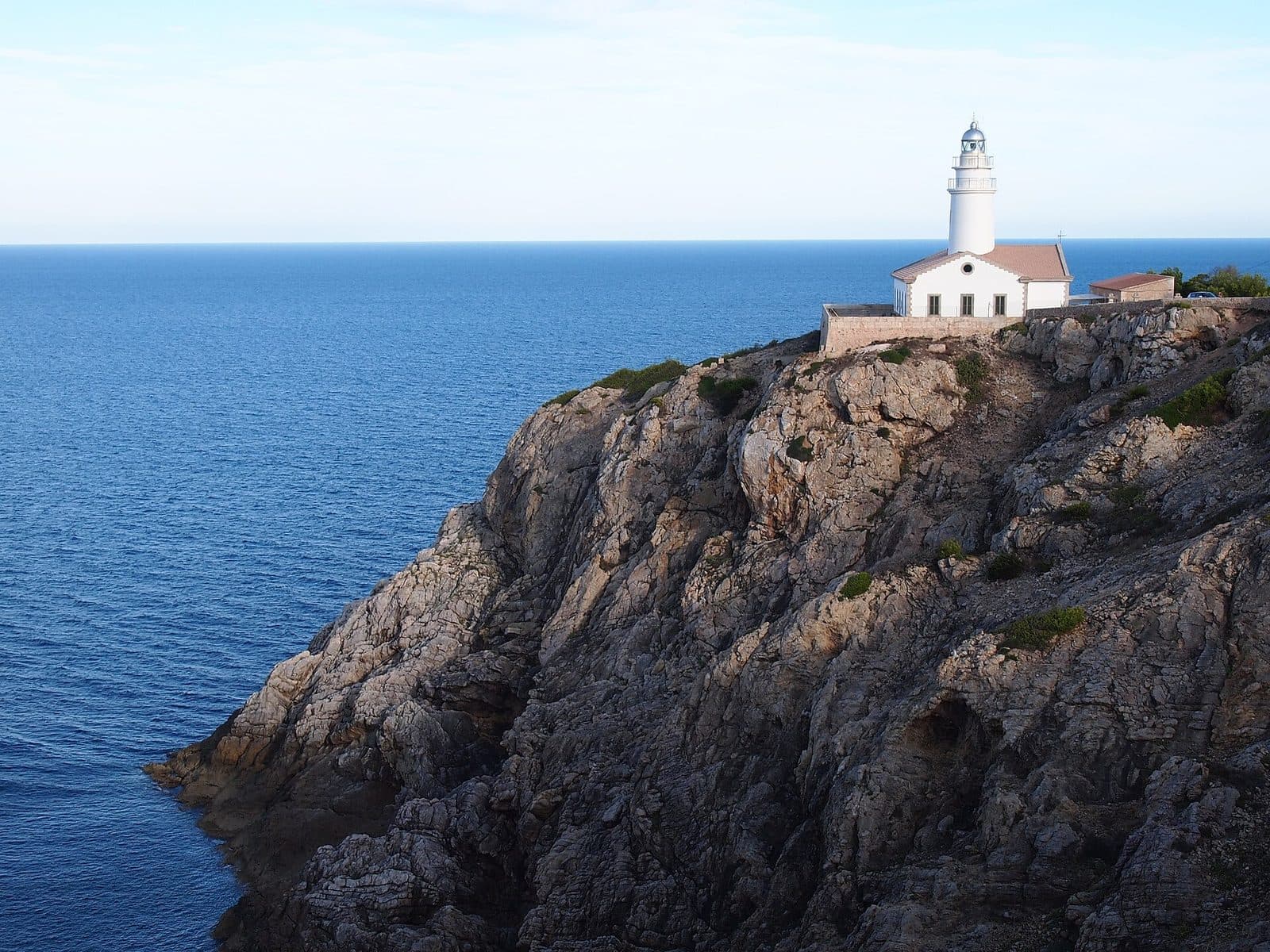

At the end of a winding road, a white tower stands above the open Mediterranean. Far de Formentor marks the outermost tip of the Formentor peninsula in northern Mallorca and is one of those destinations where structure, journey, and landscape are almost impossible to separate. The lighthouse is a navigational landmark, a historic testament to the 19th century, and a scenic viewpoint all at once.
The place does not owe its impact to monumental architecture. The tower remains comparatively simple; what is truly grand is the stage on which it stands. Rocky slopes plunge toward the sea, the coastline breaks apart into coves and headlands, and the exposed location makes it easy to understand why Formentor is described as a meeting place of the winds. In clear conditions, the view stretches far across the water.
Far de Formentor is worthwhile for landscape enthusiasts, photographers, and anyone who enjoys experiencing historic infrastructure in its original setting. The drive from Port de Pollença is also part of the excursion: Ma-2210 follows the mountainous peninsula through tight bends and past viewpoints. Anyone hoping merely to take a quick look at a single building therefore underestimates the character of the destination. Formentor is not a brief city stop but an excursion into a remote coastal landscape.
Its popularity does, however, have consequences: Space around the lighthouse is limited, while the access road is in high demand during summer. Seasonal traffic regulations, bus services, and the question of the best time to visit are therefore just as important to planning as a camera and sun protection.
History and Significance
Even before a modern road crossed the peninsula, a construction site at its outermost tip had to be supplied. Far de Formentor was built here between 1860 and 1863. Its position high above the sea later gave the beacon its long range, but it also made transporting people and construction materials an exceptional challenge from the outset. The workers not only built the tower but also had to negotiate routes through a rocky landscape that had previously been difficult to access.
Construction from 1860 to 1863
The Palma-born engineer Emili Pou y Bonet is named as the designer. Around 200 workers are said to have been employed at the remote construction site. One particularly vivid episode describes their working routine: Because work continued on Sundays, special ecclesiastical permission was required. To ensure that Mass could still be celebrated, an altar was set up at the lighthouse and a priest was brought in. The story shows just how far removed the construction site was from ordinary island life at the time.
A paved route was created from Cala Murta to transport materials. This old path, known as the antic camí, was laid through the terrain so that pack animals could negotiate the slopes and ravines. It was only much later that today’s road opened the cape to motor traffic. Building the lighthouse therefore involved far more than erecting a tower; it required its own logistics in a rugged coastal landscape.
A Light for Shipping
Since 1863, the beacon has guided ships along Mallorca’s north coast. The location was chosen deliberately: Rocky headlands, steep shores, and the cape’s exposed position made a widely visible navigational aid essential. The tower base stands 167 meters above the sea, while the light is at an elevation of 210 meters. Its nominal white range is 24 nautical miles, or 44.4 kilometers. Its characteristic consists of four flashes within 20 seconds, allowing the signal to be distinguished from other beacons.
Olive oil was initially used as fuel, followed later by paraffin. The lantern, optics, and technical equipment were adapted over time to reflect the latest developments in lighthouse technology. Electrification took place around 1960; today, the installation operates with solar power and can be controlled remotely. Behind the romantic image of a solitary lighthouse therefore lies a continuously modernized navigational system.
From Workplace to Visitor Destination
Automation fundamentally changed operations at the cape. Its nautical function has nevertheless remained: Far de Formentor is not a decommissioned monument but an active navigational beacon.
At the same time, its location became the main attraction for visitors. The lighthouse forms the visible endpoint of the Formentor road and an instantly recognizable symbol of the end of the headland. Its present-day significance is therefore twofold: At sea, it is a precisely defined navigational signal; on land, it recalls the technical development of one of Mallorca’s most remote coastal points.
What to See
From a distance, Far de Formentor appears almost small. Only upon arrival does it become clear how cleverly the complex sits on the narrow rocky plateau. The white-painted building stands out clearly against gray rock and blue sea without dominating the landscape. This simplicity is precisely what makes it appealing: The lighthouse is not a ceremonial palace but a functional building whose form was determined by visibility and reliable operation.
The White Lighthouse
The round tower rises from the base-building complex. A gallery and lantern room complete the structure at the top. During the day, the light-colored exterior creates a striking contrast with the rocky coast; at night, the individual flash characteristic provides identification. The light’s elevation of 210 meters is primarily the result of the natural setting above the sea, rather than the tower alone. This is exactly where the site’s technical strength lies: The topography increases the beacon’s visible range.
The low, horizontal sections of the building contrast with the rising tower, which remains part of an active technical structure to this day.
Lantern and Beacon
The most important component is hardly as spectacular up close as it is from a nautical perspective: the lantern and its optics. Its purpose is to transmit an unmistakable signal across the sea. Four flashes in 20 seconds form the characteristic of Far de Formentor. Anyone viewing the tower during the day is therefore seeing the shell of a system that becomes recognizable at night through rhythm rather than architectural size.
The technical development of the beacon can be traced through its history. Olive oil, paraffin, electricity, and finally solar-assisted, remotely controlled operation represent several generations of lighthouse technology. Despite these modifications, its purpose has remained unchanged: The light must reach far out to sea and be reliably distinguishable from other signals along the coast.
The Rocky Plateau and Views
The strongest impression comes from the open areas around the building. From here, the view extends across the Mediterranean and along the rugged coastline of the peninsula. Rocky ridges overlap, clefts open toward the water, and the road can be seen in places as a narrow line through the landscape. The lighthouse provides a fixed foreground, while the sea, clouds, and light continually transform the scene.
The elevation makes boats on the water appear small. At the same time, the coast remains close enough for its layers and steep drops to be clearly visible. Wind is often part of the experience at this exposed point. It can shape the perception of the place more strongly than any architectural detail and explains why the cape has long been associated with winds arriving from different directions.
Moll de Patronet and the Historic Access Route
One remarkable remnant is the staircase cut into the rock leading to Moll de Patronet. 272 steps descend through the rocky cleft. What now appears to be a curious historic side structure was once part of the site’s infrastructure and should not be mistaken for an ordinary visitor path. Together with the antic camí, the staircase reveals more about the historic development of the site than a simple list of technical data could convey.
Looking Back at the Road
From the lighthouse, the approach road also becomes part of the panorama. Ma-2210 winds across the peninsula, disappears behind rocky ridges, and reappears elsewhere. Looking back puts the distance from Port de Pollença into perspective and shows why the final section requires patience. Tight bends, changes in elevation, and the open mountain landscape are not merely part of the journey but part of the visual experience of Far de Formentor.
For photographs, it is therefore worth avoiding exclusively frontal views of the tower. Side perspectives combine the white structure with rock and sea, while views along the road tell the story of the site’s remoteness. In the early morning, warm light falls across the cliffs and road bends, while there are usually fewer visitors around.
Visiting Far de Formentor
The first glimpse of the tower usually comes at the end of a long sequence of bends. At the destination, the drive becomes a short walk: arrive, view the structure from different directions, follow the coastline, and find a suitable place for photographs. Light, weather, and landscape shape the experience on site.
Arriving at the Cape
Space at the end of the road is limited. Buses, bicycles, arriving visitors, and turning vehicles all converge here. Getting out calmly and taking a moment to orient yourself is more sensible than trying to head immediately for the first available viewpoint. Particularly in strong winds and during busy periods, road traffic should be watched carefully. Opening hours and possible access conditions for the building area may change and should be checked immediately before the excursion. The same applies to admission fees.
Early Morning
The atmosphere is generally calmer in the early morning than during the main wave of day-trippers. Photographers appreciate this time because the first warm light defines the rocks, tower, and bends of the access road. Traffic is also usually lighter. Those visiting primarily for the landscape often find better conditions for undisturbed photographs at this time.
An early visit has another practical advantage: During the warmer season, sunlight on the exposed plateau becomes considerably stronger later in the day. Only limited shade can be expected around the viewpoints. Setting out early does not, however, replace checking the applicable traffic regulations, as access to the peninsula is controlled seasonally.
Busy Periods
Visitor numbers increase as the day progresses. Because the cape is accessible by only one road and space at the lighthouse remains limited, even minor delays can affect traffic. Traffic controls were introduced specifically because of this pressure: During a pilot project, the flow of vehicles during peak periods fell from 300 to 20 vehicles.
Those with flexible schedules should avoid the most popular hours and allow generous time. The time spent at the tower itself is only part of the excursion; bus waits, slow traffic, cyclists, and stops at viewpoints can extend the day’s schedule. An appointment immediately after the Formentor excursion is therefore not a good combination.
Weather and Visibility
Clear skies provide the longest views, but clouds can also transform the coast dramatically. Safe weather conditions are more important than flawless photography weather. Wind is not a minor consideration at the exposed cape: It can be stronger than in Port de Pollença and can carry away light objects. Appropriate caution is therefore required in open areas.
Rockfalls or temporary restrictions on the access road can also occur after severe weather. Checking current road conditions is particularly worthwhile after stormy days. The remote setting that gives the lighthouse its appeal also means that alternatives are limited along the final section of the route.
Getting There and Parking
The route to Port de Pollença is more straightforward than the final section to the cape. From Palma Airport, the drive follows Ma-30, Ma-13, and Ma-2200; Port de Pollença is 64 road kilometers away, and the journey takes around 54 minutes. From central Palma, the route via Ma-13 and Ma-2200 covers a total of 61 road kilometers and takes around 57 minutes. Both figures explicitly apply only as far as Port de Pollença, not Far de Formentor.
Ma-2210 to the Lighthouse
Ma-2210 begins in Port de Pollença and is the only road access to the lighthouse. From there, it is another 20 road kilometers. Under normal conditions, this final section takes about 30 to 40 minutes without extended stops at viewpoints. The road soon begins to climb and crosses the peninsula through tight bends. Buses and numerous cyclists share the route with other traffic.
The road is part of the experience, but it requires concentration. Anyone who finds mountain roads stressful is better advised to take the bus. Travel times should not be treated as guarantees in any case: Oncoming traffic, slow bicycles, photography stops, and seasonal crowds can extend the journey.
Seasonal Access Restrictions
For the 2026 season, Ma-2210 between Port de Pollença and the lighthouse is closed to private motor traffic daily from 10 a.m. to 10 p.m. between 15 May and 18 October. Public transport, cyclists, and hikers, among others, remain permitted; exemptions apply to certain authorized vehicles. The regulation protects the sensitive landscape and prevents too many vehicles from gathering at the narrow end of the road.
Because access regulations may be adjusted from season to season, checking the latest official traffic information is essential for every visit. An earlier rule mentioned in an old travel report is not a reliable basis for planning. Checkpoints and traffic signs on Ma-2210 are binding, even if a navigation device continues to suggest the route.
Bus to Far de Formentor
The Far de Formentor bus stop has the code 42052 and is located directly at the destination. During the regulated season, the shuttle bus serves as the main connection across the peninsula. The route links the lighthouse with Port de Pollença, among other places; additional connections to the regional bus network are available there.
Those driving only as far as Port de Pollença can transfer to the bus there. Estació, Bóquer, and Can Singala are used as boarding points for services toward Formentor. The current timetable and seasonal routing should be checked before traveling because bus services and traffic regulations are interconnected.
Parking
There is very little space for parking and turning at the lighthouse. This bottleneck is one of the main reasons for the seasonal restriction. Outside the regulated periods, unrestricted access does not automatically mean that a parking space will be available. Anyone traveling by car should not expect to park conveniently right beside the structure.
During closure periods, transferring in Port de Pollença is the more reliable option. Parking areas and several bus stops for the onward journey are indicated along the bypass road. The same principle applies there: Allow time to find parking and transfer rather than combining the bus connection with an overly tight driving schedule.
Bus lines to Far de Formentor at a glance
| Line | Route | Departures/day | First | Last |
|---|---|---|---|---|
| 334 | Alcúdia - Formentor | 116 | 10:35 | 21:06 |
From the official GTFS feeds (TIB/SFM), no real-time data. The figures cover all stops in the town; weekend and holiday services differ — check with the operator before travelling.
Getting there by bus
Far de Formentor (42052) · 0.2 km as the crow flies
- 334Alcúdia - Formentor · Daily
Timetable data: official GTFS feeds (TIB/EMT), no real-time — check with the operator before travelling.
Nearby Places
Port de Pollença is both the starting point and the counterpoint to the excursion. After the windswept rocky tip, the sheltered bay with its promenade, harbor, and denser development feels almost like a different landscape. The town is suitable for a break before continuing or for a relaxed conclusion to the day without requiring another long journey.
Port de Pollença
For practical planning, Port de Pollença is the most important hub. Ma-2210 begins here, visitors can transfer to the bus here, and connections to other places in the north of the island are available here. Anyone who does not want to begin the journey to Far de Formentor under time pressure should take care of supplies, parking, and orientation in the town beforehand.
The harbor also provides an appealing thematic contrast. Boats lie in the bay below; from the lighthouse, shipping is seen from a great height. This makes the historic purpose of Far de Formentor particularly clear: It is not merely part of the cape’s scenery but belongs to a coastal environment that continues to be shaped by maritime traffic.
Mirador Es Colomer
Mirador Es Colomer lies along the Formentor route and offers a different perspective on the steep coast. While the open sea and the end of the road dominate at the lighthouse, the view from the Mirador focuses more strongly on the dramatic rock walls and offshore coastal formations. Both stops can be combined effectively in one excursion, provided the traffic situation and schedule leave sufficient flexibility.
The viewpoint is very popular. A stop should therefore not be planned as a quick roadside break. During busy periods, even the parking situation can require additional time. Those traveling by seasonal bus should plan the combination around current stops and departure times.
Platja de Formentor
Platja de Formentor offers a change of scenery from the high rocky cape to a sheltered bay. The long, narrow beach is lined with pine trees and slopes gently into the water. It is a suitable addition if the lighthouse excursion is to become a full day on the peninsula.
During summer, access to the beach is also affected by traffic controls, and parking is limited. Combining destinations by bus can therefore be more pleasant than searching for several parking spaces in one day. The lighthouse and beach should nevertheless be treated as separate stops: At Far de Formentor, views and technological history take center stage, while the bay is about swimming and spending time by the water.
Cala Murta
Cala Murta is closely connected with the lighthouse’s construction history. The old paved supply route began on this side, allowing pack animals to carry materials through the difficult terrain. Anyone including the bay in an excursion therefore encounters not only a natural destination but also a starting point in the historic development of Far de Formentor.
Fitness, heat, and the time required should be assessed realistically when combining destinations. A route to a bay is not a quick substitute for time at the lighthouse. Particularly during the warmer season, the return should not be scheduled so late that the bus timetable or traffic restrictions become a problem.
The place it belongs to
Port de Pollença in the place guidePractical Visitor Information
At Far de Formentor, the landscape sets the rules. The site is open, exposed to wind, and strongly affected by the sun. Supplies, traffic capacity, and space to move around are more limited than in Port de Pollença. Those who take these conditions into account will experience the lighthouse not merely as a crowded photography stop but as a historic workplace on an extraordinary coast.
Footwear and Clothing
Sturdy, slip-resistant shoes are more suitable for the uneven areas around the rocks and viewpoints than smooth soles. Even in sunny weather, a light windproof layer should be carried. The exposed position can be considerably breezier than the sheltered bay of Port de Pollença.
Hats and loose objects should be secured in strong winds. Footwear becomes even more important when combining the visit with viewpoints or coves, where paths and changes in elevation must also be considered. The historic staircase to Moll de Patronet is not an ordinary promenade and should not be planned as a casual stroll.
Sun, Shade, and Water
Shade is limited on the plateau and at the viewpoints. Sun protection and sufficient drinking water are therefore essential, particularly during the warmer season. Those arriving by bus should not assume they can spontaneously return to the nearest place for supplies at any time.
Early morning usually combines smaller crowds with softer light. Later, exposure to both sun and visitors increases. Cloudy skies may feel more comfortable but do not provide reliable protection from UV radiation; wind can also make the strength of the sun easy to underestimate.
Visiting with Children
For children, the drive and its many bends can be as impressive as it is tiring. Breaks and a schedule that is not too tightly packed are more helpful than a long sequence of additional viewpoints. At the same time, the lighthouse can be interesting as a historic technical structure set within the coastal landscape.
Close supervision is necessary in open coastal areas, around traffic, and during strong winds. Children should not be left unattended near the roadway and turning area or close to steep rocky sections. For families, combining the excursion with the more sheltered Platja de Formentor can provide a good balance, provided seasonal transport arrangements are clarified in advance.
What Not to Expect
Far de Formentor is primarily an active navigational beacon in a spectacular location. Its appeal lies in the combination of technological history, simple lighthouse architecture, long-distance views, and the experience of the extended journey to the tip of the peninsula.
A solitary wilderness should not be expected during popular visiting hours either. The view is famous, space is limited, and visitor numbers can be high. Anyone seeking quiet should set out early, check traffic regulations carefully, and allow enough time so that a missed photography spot or a full bus does not determine the entire excursion.
Local insider tips
Early Light Instead of Day-Trip Crowds
Warm light and generally smaller crowds come together in the early morning. Viewpoints that include not only the tower but also the rocky slopes and bends of Ma-2210 are particularly appealing.
Know the Flash Characteristic
The beacon emits four flashes within 20 seconds. This inconspicuous technical detail explains how sailors can clearly distinguish Far de Formentor from other lighthouses at night.
Look for the Old Transport Route
The antic camí and the 272 steps to Moll de Patronet recall how materials once had to be brought to the construction site and station without a modern road.
Transfer in Port de Pollença
During the seasonal access restrictions, the bus is usually the more relaxing choice. The Far de Formentor stop is located directly at the destination, and Port de Pollença has several boarding points.
Do Not Photograph Only from the Front
Side perspectives better reveal why the lighthouse has such an impact here: The white complex is framed by rock and sea, while the view back makes the winding access road visible as part of the story.