
Talaia d'Albercutx: Formentor Watchtower and Viewpoint
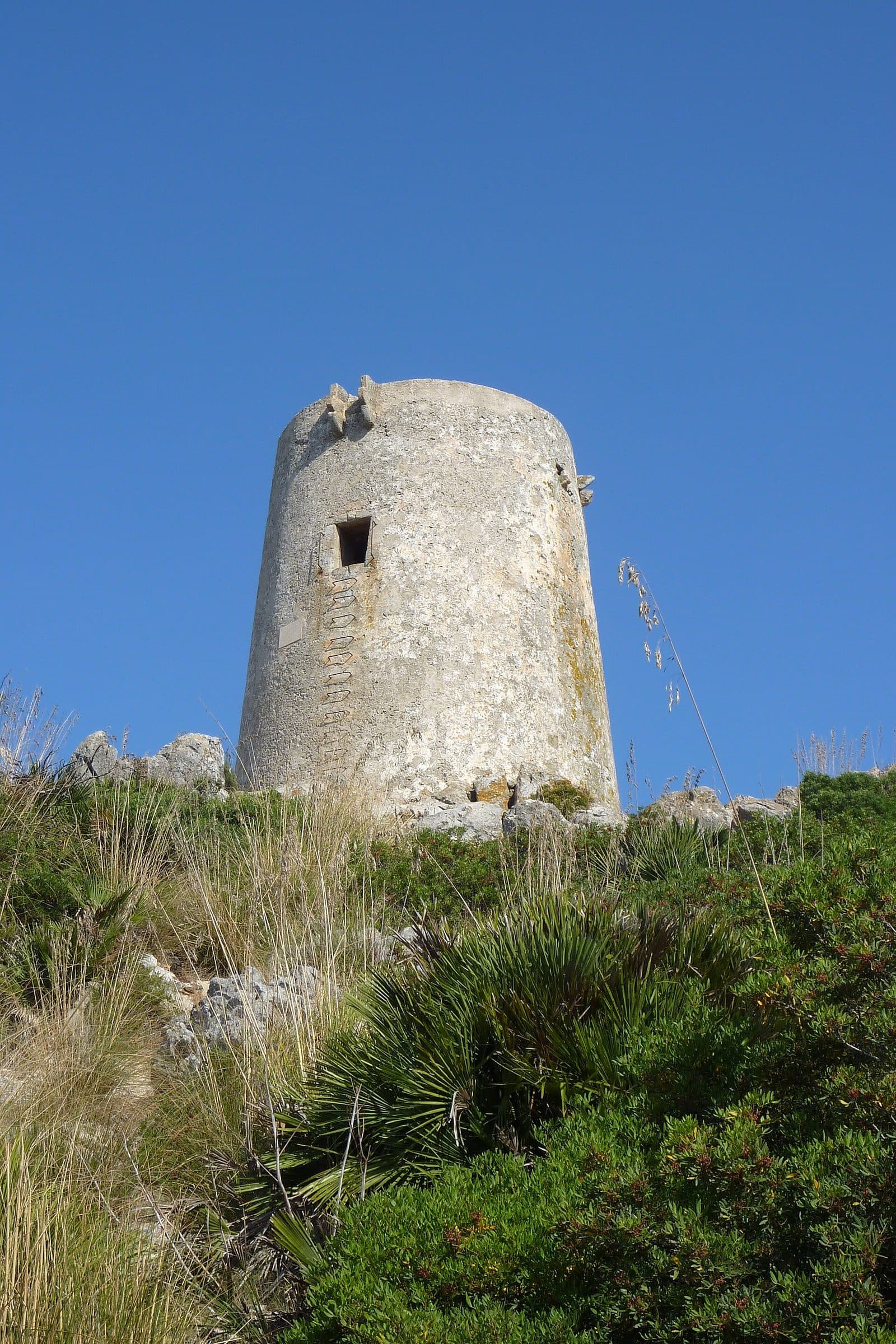

High above the rugged Formentor peninsula, Talaia d'Albercutx stands in a location that immediately reveals its original purpose. From here, the view extends across Cap de Formentor, the Bay of Pollença, the rock of Es Colomer, and the northern foothills of the Serra de Tramuntana. What now delights visitors as a viewpoint was once a strategic observation post guarding against attacks from the sea.
Its appeal lies in the change of perspective. From the coastal road below, the cliffs of Formentor appear almost like a solid wall; from above, they become a sprawling landscape of ridges, coves, and projecting headlands. The old tower does not merely stand before this panorama—it explains it: only a place with such far-reaching views could provide effective surveillance of the coast.
Talaia d'Albercutx is ideal for visitors who want to combine scenery with history and are prepared to cover the final stretch along a narrow mountain road or on foot. Photographers will also find an unusual variety of perspectives here. The tower, its exposed position, and the surrounding terrain together create the experience.
As a cultural monument, Talaia d'Albercutx is protected as a Bien de Interés Cultural. This status suits a structure whose value extends far beyond its stone walls: it recalls a time when early warnings were vital to the coastal settlements of northern Mallorca.
History and significance
Long before a fortified tower stood here, guards had to watch the coast in the open air. During the day, they kept watch; at night, they listened for suspicious sounds. The official account provided by the municipality of Pollença describes this older method as slow and dangerous: unprotected observers might notice attackers too late or become their first victims. The elevated position was advantageous, but without a permanent station and a rapid warning system, surveillance remained incomplete.
The coastal warning system
Toward the end of the 16th and beginning of the 17th centuries, a network of fortified and armed watchtowers was established across Mallorca. It was created in response to attacks by pirates and corsairs, which threatened coastal settlements and rural estates. Talaia d'Albercutx was one of the system's major observation points. Its position high above the coast made it possible to spot ships early and pass on warnings.
The towers did not operate as isolated fortresses. Their true strength lay in visual contact and a simple communication method that could be recognized from afar. In times of danger, smoke signals were used by day and fire signals by night. A message could thus be relayed from tower to tower until threatened communities had time to take protective measures. The Talaia was therefore primarily the eye and voice of the defensive system.
Joan Binimelis and the network of Talaies
Joan Binimelis is associated with the planning of the island-wide, systematic network of observation posts. The key idea was not simply to construct as many towers as possible, but to choose their locations so that warning signals could be relayed across longer stretches of coastline. Albercutx was particularly suitable: from this height, several prominent points in northern Mallorca can be seen at the same time.
The Catalan or Mallorcan term “Talaia” means a lookout or watchtower and derives from an Arabic root. It should not be confused with the prehistoric Talayots. Those date from a much earlier period and differ in both construction and purpose. Talaia d'Albercutx clearly belongs to Mallorca's early modern coastal defenses.
From warning post to cultural monument
Once the immediate threat had passed, the historic signaling system lost its purpose. What remains is a tower whose location still explains its function more convincingly than any map. The far-reaching views that once helped guards spot hostile sails now make Albercutx one of the most striking viewpoints around Port de Pollença and Formentor.
The structure's protection as a Bien de Interés Cultural underlines its historical significance. It is preserved not merely as a picturesque ruin but as part of an island-wide security network. Looking from the Talaia toward the coast therefore reveals more than a beautiful panorama: the geography of northern Mallorca becomes legible as a historic defensive landscape.
What to see
Even from some distance, the tower appears small beside the mountains and the open sea. Up close, that impression is reversed. Its compact masonry sits like a stone cap on the summit, while the slopes drop away steeply all around. The architecture is functional and restrained; decoration would have served no purpose at an observation post. What mattered was a protected interior, an elevated position, and an unobstructed view.
The stone watchtower
Talaia d'Albercutx is a solid, rounded stone tower. Weathered surfaces and its simple silhouette reveal its military origins without making the structure appear like a large fortress. Instead, it is a compact outpost that provided shelter and the highest possible observation point.
The structure clearly illustrates why Mallorca's coastal towers were built in exposed locations. The tower itself did not need to be monumental; the mountain performed a substantial part of its function. The terrain alone gave the guards the necessary height advantage. The walls then protected the post from which signals could be sent and the sea monitored.
Access from the outside
Iron climbing aids on the exterior wall lead to a small opening in the tower. This access is very different from the comfortable staircase of a modern observation structure. It requires sure-footedness, sturdy shoes, and confidence at height. Anyone uncomfortable with climbing can view the tower from outside and still enjoy far-reaching views from the surrounding terrain.
Beyond the opening lies the austere interior of the historic observation post. Its sparseness, however, makes it especially clear that the Talaia was not intended as a prestigious building. It served a specific purpose: to observe, warn, and provide shelter in an emergency.
The upper platform
The tower opening leads to the upper platform. Here, the difference between looking toward the tower and looking from the tower becomes particularly clear. The platform forms the immediate foreground, with the landscape opening behind it in almost every direction. Because of the exposed position, wind can make standing and taking photographs noticeably more difficult, so loose items should be securely stowed.
Consideration and patience are important when several people want to climb at the same time. The ascent is worthwhile primarily for the additional panoramic views, but the location remains impressive even without it.
Cap de Formentor and Es Colomer
To the north and east, the Formentor peninsula dominates the view. Rocky ridges extend one behind another into the sea, while the coastline partly disappears and then reemerges elsewhere depending on the viewpoint. The offshore rock of Es Colomer adds a distinctive accent in front of the cliffs. From the well-known Mirador, it is seen head-on; from Albercutx, it appears as part of a larger geological setting.
This elevated perspective explains why the two viewpoints feel different despite their proximity. At the Mirador, the dramatic cliff edge is the main focus. At the Talaia, the view expands: coast, mountains, bay, and inland areas can be seen together. This provides more possibilities for landscape photography because the composition is not defined by just one primary direction.
The Bay of Pollença
On the other side, the Bay of Pollença opens out below. From above, its sheltered waters form a clear contrast to the rugged outer coast of Formentor. Port de Pollença can be placed within the coastal landscape, and the peninsula's position in relation to the wider north of the island also becomes apparent.
Historically, this view was especially important. Ships approaching the bay could be spotted earlier from an elevated post than from the shore. Today, the same sightline leads the eye across the water, coastal settlements, and plains beyond. In clear conditions, the panorama reaches far into Mallorca's interior.
Serra del Cavall Bernat and Tramuntana
To the west and southwest rise the ridges of the Serra del Cavall Bernat and the Serra de Tramuntana. Their long crests form a stone frame around the bay. As the day progresses, the changing light alters the appearance of their folds and bands of rock: low morning or evening light emphasizes the contours, while around the bright middle of the day the mountains may appear more compact.
This view in particular makes Albercutx more than a coastal mirador. Although the sea dominates much of the horizon, the Talaia also reveals the transition from Formentor into the northern Tramuntana mountains. The location connects landscapes that are often perceived as separate from below.
Visiting Talaia d'Albercutx
A visit usually begins not at the tower but with the decision of how to cover the final stretch. A narrow side road branches off the Formentor road near Mirador del Colomer and climbs uphill. It is also used as a walking route. Those starting at the Mirador experience the tower as the destination of a short mountain walk; those driving closer reduce the distance on foot but must deal with a narrow road and very limited parking.
From the Mirador to the tower
The route climbs toward the tower. Because the same road may be used by pedestrians, cyclists, and, depending on current regulations, vehicles, attentiveness is more important than advanced hiking experience. Even before reaching the destination, the bends reveal initial views of the bay and mountain ranges. The route is therefore not merely an access road but part of the scenic experience.
Anyone walking the entire route from the Mirador should allow enough time for the outward journey, exploring the tower, scenic pauses, and the return walk. A visit that involves driving close to the tower can be considerably shorter. A fixed recommended duration would be of little help: photographers often stay longer, while visitors who do not climb to the platform may explore the site more quickly.
Crowds and time of day
Mirador del Colomer is one of the most frequently visited stops on the Formentor road, especially during the main travel season. Some visitors, however, remain there and do not follow the turnoff to the Talaia. Albercutx therefore often feels quieter than the large viewing platform below, although the tower is no longer an unknown destination.
Early morning and late afternoon are particularly suitable for a quieter visit and more sculptural light. The location is popular with photographers at sunrise; evening and twilight also create effective contrasts between the coastline and mountains. Anyone visiting outside the bright middle of the day should carefully consider the return journey and road conditions.
Time at the tower
At the destination, visitors usually spread out across the terrain surrounding the tower, the access point, and the upper platform. In windy conditions or when it is crowded, it may be sensible to enjoy the views from the ground first and wait before climbing. The different perspectives are best discovered by walking around the tower rather than immediately heading only for the highest point.
Reliable opening hours and admission information have not been recorded. Because access rules on the Formentor peninsula and the availability of individual road sections may change, current conditions should be checked before departure. This is particularly important during busy travel periods.
Getting there and parking
From Palma, the journey initially heads north across Mallorca, then through Port de Pollença and into the mountains along the winding Formentor road. The distances and driving times given in the travel information apply expressly only as far as Port de Pollença. The final stretch to the Talaia is slower: the Ma-2210 gains elevation through tight bends, passes the area around Mirador del Colomer, and reaches the turnoff for Camí de la Talaia d'Albercutx.
From Palma Airport
The road distance from Palma Airport to Port de Pollença is 64 kilometers. The journey takes around 54 minutes and follows the Ma-30, Ma-13, and Ma-2200. The Ma-2210 then continues toward Formentor. Motorway speeds should not be expected on this final section; bends, viewpoints, cyclists, and seasonally heavy traffic require careful driving.
From central Palma
From central Palma, the road distance to Port de Pollença is 61 kilometers. The journey takes around 57 minutes via the Ma-13 and Ma-2200. The mountain drive along the Ma-2210 must then be added. The turnoff for the Talaia lies near Mirador del Colomer, on the opposite side from the well-known viewpoint.
Parking at the Mirador and the tower
The parking area at Mirador del Colomer is the most straightforward starting point for the walk. However, it is used by many visitors to Formentor and may therefore be full. Higher up, closer to the tower, there are only a very small number of places to leave a vehicle. The access road is narrow and offers little space when traffic approaches from the opposite direction, so an available parking space at the end should not be assumed.
Valuables should never be left visible in a parked car. There are explicit warnings about vehicle break-ins in the area below the tower. Documents, cash, camera bags, and luggage should be taken along or stored in a safe place before setting out.
By bus and on foot
The Mirador del Colomer 1 and Mirador del Colomer 2 stops are located at a practical starting point for the walk to the Talaia. Other stops are situated at Platja de Formentor but do not provide direct access to the tower. Because timetables and seasonal traffic regulations may change, the specific connection should be checked on the day of the visit.
From the Mirador, Camí de la Talaia d'Albercutx leads uphill. The road is easy to identify as the access route, but it remains narrow and is not used exclusively by walkers. It is therefore advisable to remain visible at the side of the road and take particular care on blind bends.
Bus lines to Talaia d'Albercutx at a glance
| Line | Route | Departures/day | First | Last |
|---|---|---|---|---|
| 334 | Alcúdia - Formentor | 348 | 09:47 | 21:48 |
| 322 | Pollença - Port d'Alcúdia | 4 | 16:17 | 17:37 |
From the official GTFS feeds (TIB/SFM), no real-time data. The figures cover all stops in the town; weekend and holiday services differ — check with the operator before travelling.
Getting there by bus
Mirador del Colomer 2 (42036) · 0.6 km as the crow flies
- 334Alcúdia - Formentor · Daily
Mirador del Colomer 1 (42037) · 0.6 km as the crow flies
- 334Alcúdia - Formentor · Daily
Platja de Formentor 2 (42025) · 1.4 km as the crow flies
- 334Alcúdia - Formentor · Daily
Platja de Formentor 1 (42060) · 1.4 km as the crow flies
- 334Alcúdia - Formentor · Daily
Can Singala 1 (42056) · 2.3 km as the crow flies
- 334Alcúdia - Formentor · Daily
Can Singala 2 (42055) · 2.4 km as the crow flies
- 322Pollença - Port d'Alcúdia · Daily
- 334Alcúdia - Formentor · Daily
Timetable data: official GTFS feeds (TIB/EMT), no real-time — check with the operator before travelling.
Nearby places
After the wind and vastness around the tower, Port de Pollença feels almost like its opposite: a sheltered harbor town on the bay, with a waterfront promenade, beach, and views back toward the mountains. It makes a good base because the Ma-2210 climbs from the coast toward Formentor here. It is also an appealing place for a break beside the water after returning.
Mirador del Colomer
Mirador del Colomer can easily be combined with the Talaia without the two viewpoints offering the same experience. Its constructed paths and platforms direct the view toward the steep coast and the offshore rock of Es Colomer. Albercutx stands higher and offers a broader overview of the bay, peninsula, and mountains. Those visiting both first experience a dramatic close-up of the cliffs and then the complete geographical panorama.
Port de Pollença
Port de Pollença is the obvious place to begin or end the excursion. From the waterfront, the bay appears broad and open, while the Talaia remains hidden high above the approach to Formentor. The transition between harbor, beach, and mountain scenery can easily be experienced in one day without having to combine several widely separated areas of the island.
The harbor town is also important for practical planning. By this point at the latest, visitors should check whether current traffic regulations permit continued travel along the Ma-2210 or whether a bus or walking route is the better option. Seasonal access restrictions may apply on Formentor.
Platja de Formentor and Cap de Formentor
Those wishing to extend the excursion can continue toward Platja de Formentor or Cap de Formentor, provided current traffic conditions permit. Platja adds a peaceful, wooded stretch of coastline to the day, while the Cap leads farther out onto the elongated peninsula. Both destinations reveal different sides of the same landscape seen as one broad panorama from the Talaia.
For a well-balanced day, it is advisable not to plan too many stops. The winding Ma-2210 takes time, and the Talaia is most rewarding when the visit is not reduced to a brief photo stop. The Mirador, the tower, and a break in Port de Pollença already provide a varied combination of cliffs, history, and bay scenery.
The place it belongs to
Port de Pollença in the place guidePractical visitor information
The route to the Talaia looks more straightforward on maps than it may feel on a hot or windy day.
Footwear and ascent
Shoes with sturdy soles are clearly preferable for entering the tower and reaching the platform. The iron climbing aids on the exterior wall require secure footing and free hands. Bags should be closed, and cameras should not swing loosely from the body. Extra caution is advisable in wet conditions or strong winds.
No one has to climb to the platform to experience the site. Views from the terrain around the tower already encompass Formentor, Es Colomer, the Bay of Pollença, and the Tramuntana. Anyone with a fear of heights or who feels uncertain at the entry point will therefore not miss the entire panoramic experience.
With children
The route to the tower is also used by families and is considered relatively straightforward. Nevertheless, it is not a protected walking path: vehicles and bicycles may approach from the opposite direction, some bends have limited visibility, and the terrain at the destination is rocky and exposed. Children should therefore be closely supervised.
Climbing into the tower requires a separate assessment. The exterior iron steps, small opening, and elevated platform demand greater confidence than the walk itself. Whether a child should climb must depend not only on age but also on sure-footedness, calmness, and experience. If in doubt, enjoying the view from the foot of the tower is the more sensible choice.
Wind, sun, and photography
The exposed location makes Albercutx vulnerable to wind. Even when conditions in Port de Pollença seem calm, the tower can be considerably breezier. A light extra layer is useful outside the hottest summer periods. Hats, lightweight scarves, and other loose items should be secured.
Morning and evening light are particularly interesting for photographers. At sunrise, the orientation offers good possibilities, while later light may model the mountain ranges and coastal formations more strongly. The calmer images are often captured from the terrain beside the tower in any case.
The tower tells its story through its location: through sightlines, the open sea, and its connection to other points along the coast. Those who arrive with time, secure footwear, and respect for the historic masonry receive not only a panorama but also a vivid impression of how Mallorca's early modern warning system functioned.