
Mirador d'es Colomer: Mallorca's Spectacular Formentor Viewpoint
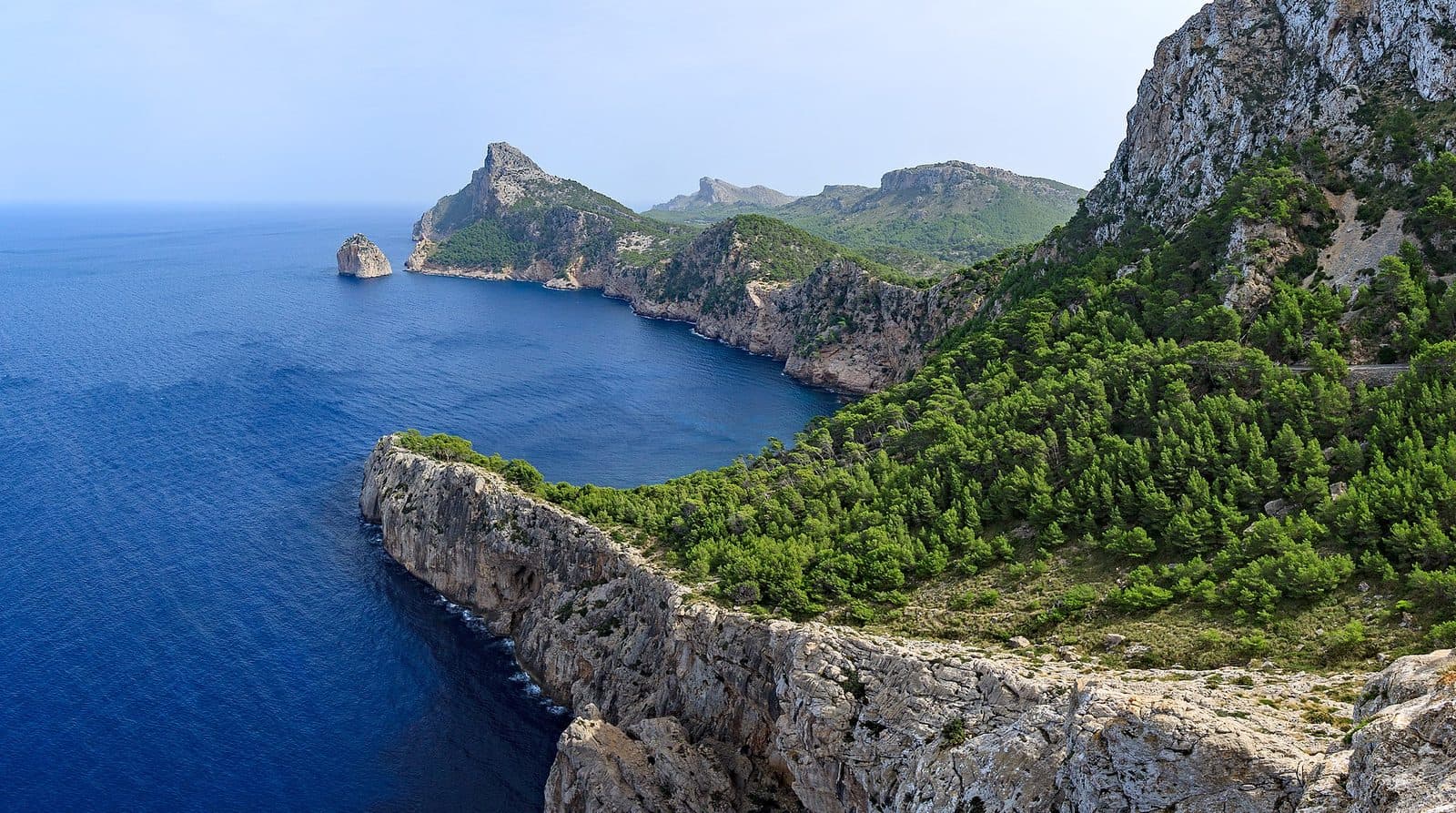

At Mirador d'es Colomer, Mallorca's north coast suddenly makes sense. Rocky ridges push out into the Mediterranean, the coast drops steeply to the water, and the slender Illa del Colomer lies off the cliffs. The viewpoint near Port de Pollença is not a casual roadside pull-off but a purpose-built sequence of paths, steps, and viewing terraces above the sea.
Its appeal lies in the changing perspectives: the first glimpses of the coast open up along the way, becoming a broad panorama higher up. Depending on the direction you look, you can see the rugged coastline of the Serra de Tramuntana, the open Mediterranean, the offshore rocky island, and parts of the landscape around Port de Pollença. Wind and changing light can make the same place look different within a short time.
The Mirador is particularly rewarding for landscape photographers, nature enthusiasts, and anyone who wants to experience Formentor without taking a long hike. It does require some walking, however: a paved path with numerous shallow steps leads from the roadside area to the terraces. Anyone uncomfortable with heights should be prepared for pronounced drops and an exposed location.
The Mirador is also a fitting start to a drive across the Formentor peninsula. Even so, it is worth treating it as more than a brief photo stop. Those who follow the path to the different vantage points, examine the monument, and look in both directions will discover more than the familiar postcard view.
History and significance
At the entrance, a pointed monument commemorates Antonio Parietti Coll. His name is part of the Formentor landscape because the engineer designed both the road and the Mirador. The viewpoint is therefore not merely a rocky ledge that happens to be accessible.
Antonio Parietti Coll
Parietti's achievement becomes clear on the approach. The road leaves the sheltered surroundings of Port de Pollença and gains height through bends and steep slopes. This stretch demands attention from drivers; for passengers, it stages the landscape almost like a slow revelation. The monument at the Mirador therefore draws attention to the person behind this access route, not only to the natural scenery.
At the Mirador, a constructed path leads out to several terraces from which the rocky formations can be understood spatially. The design turns difficult terrain into a shared viewing place without concealing the character of the steep coast.
The landscape as an artistic subject
Long before landscape photographs made the Mirador famous, the area attracted artists. According to the municipality of Pollença, painters from the Escola de Pollença and other artists repeatedly captured the panorama from the late 19th century onward. In the process, Illa del Colomer developed into a symbol of the wild Tramuntana coast.
This artistic tradition explains why the view seems so familiar, even when you stand there for the first time. Island, cliff, and horizon form a clear sequence: light or dark rock in the foreground, the sea beyond it, and the open sky above. Today, cameras and mobile phones do what was once done on canvas. Yet the Mirador remains more than a photographic backdrop because it shows how closely natural space, engineering, and the visual history of northern Mallorca are connected on Formentor.
The terrace has also gained significance as a communal place. Particularly late in the day, people gather to watch the sunset over the Mediterranean. It is then especially clear that the Mirador cannot be reduced to a single structure: its true purpose is to arrange movement, viewing direction, and landscape into one experience.
What to see
The first thing you notice is not the panorama but the path. It runs from the roadside area across the rocky ridge and climbs numerous shallow steps to the viewing areas. The view shifts with every section: sometimes the slope hides part of the sea, then the entire edge of the coast opens up again. The full route is therefore worth walking, provided fitness, weather, and comfort with heights allow it.
The terraced path
The paved path forms the backbone of Mirador d'es Colomer. It follows the terrain instead of reshaping it with a single large platform, creating several places to stop. On the way out, attention is usually focused on the destination above the rock; on the return, other sections of coastline and the road become more prominent.
The steps are considered shallow, but they are numerous. The path is therefore not a difficult mountain trail, but neither is it a completely level viewing promenade. On busy days, progress may be slower in narrower passages because people stop, take photographs, or wait for oncoming visitors. Anyone who wants to appreciate the panorama at leisure should not turn back at the first available view.
The viewing terraces
Several terraces spread out visitors and open up slightly different sightlines. From the spacious platform, you look down from a considerable height onto the sea and the foothills of the Tramuntana, which drop steeply directly below the viewpoint. One source puts the platform at 232 metres above the sea; the municipality also describes the Mirador as standing more than 200 metres high.
The height is more than just a number: boats in distant coves appear small, rock faces reveal their layers, and the coastline looks not like a flat edge but like a sequence of projecting ridges and deep inlets. In clear conditions, the view extends towards Cala Bóquer; in the other direction, Port de Pollença can be seen between the mountain ridges.
Because the terraces show different sections of the landscape, it is worth looking around slowly. The most famous view faces the sea, but the view back across the mountains, road, and bay is also part of the place. This very contrast prevents the Mirador from being reduced to a single photographic angle.
Illa del Colomer
The rocky island after which the viewpoint is named lies off the coast. The municipality of Pollença states that Illa del Colomer rises 112 metres above the sea and is 300 metres long. From the elevated perspective, its elongated shape stands out clearly against the water.
Depending on the light, the rock can appear almost black, grey, or warmly coloured. Its isolated position makes it the natural focal point of many photographs. Even so, the view should not rest solely on the island: its scale becomes apparent only in relation to the cliffs rising behind and beside it. Illa del Colomer is therefore less an individual object than the striking keystone of the entire coastal scene.
The cliffs of Formentor
Below the terraces, the mountain formations of the Serra de Tramuntana continue all the way to the sea. The eye follows rugged slopes, bare rock surfaces, and the contours of the peninsula. Pine trees grow in sheltered parts of the surrounding area; on more exposed slopes, low vegetation, wild grasses, and dwarf palms shape the scene.
Wind is part of the experience of this coast. It can move the vegetation and become distinctly noticeable on the exposed sections. At the same time, the sea below changes colour with the weather, the position of the sun, and the viewing direction. The calm blue horizon and the angular, steeply descending coast create the powerful contrast for which the Mirador is known.
The Parietti monument
The monument to Antonio Parietti Coll is easily overlooked when all attention immediately turns to the sea. Yet it stands in a thematically fitting location: precisely where constructed access and natural topography meet. Its pointed form rises above the rock and commemorates the designer of the road and viewpoint.
Looking at the monument deliberately changes how you perceive the Mirador. Bends, steps, walls, and terraces no longer seem like ordinary infrastructure but like parts of a designed route. The monument is not a sideshow but the key to understanding the idea behind the place.
Visiting the viewpoint
A typical visit does not begin only on the platform. The winding ascent from Port de Pollença already sets the scene, although it demands concentration behind the wheel. Once at the roadside area, the path leads up the steps to the terraces. The visit is usually divided into several short stops: a view of Illa del Colomer, the coastal panorama, a look back towards the bay, and finally the monument.
From the entrance to the highest viewpoint
Anyone who takes in only the first view sees only part of the site's character. It is advisable to follow the paved path to the terraces farther out and higher up. The route is more of a scenic ascent than a hike, but the steps, photo stops, and oncoming visitors require attention.
For planning purposes, it makes more sense to think in terms of types of visit than minutes. A quick photo stop remains brief; anyone visiting every terrace, reading the monument, and waiting for changing light should allow considerably more flexibility. The winding approach, search for parking, and onward journey across Formentor may require additional time.
Crowds and time of day
The Mirador is one of the best-known stops in northern Mallorca. Tour groups, hire cars, bus passengers, cyclists, and day-trippers converge in a confined space, especially during the main travel season. At such times, parking becomes more difficult, while the path and most popular photo positions can also become crowded.
Experience suggests that it is quieter outside the busiest periods of the day. An older travel report describes a late visit during the early season, when the tour buses had already left. For photography, however, the later part of the day involves a trade-off: the mountains can cast long shadows across parts of the landscape. Those who prefer clear, more even light should choose an earlier part of the day; those seeking atmosphere and sunset should expect more visitors.
Sunset and weather
Late in the day, groups regularly gather to watch the sunset over the Mediterranean. It is atmospheric, but no secret occasion. For this kind of visit, allow enough time before the colours actually begin to change so that searching for parking and climbing to the terraces do not become rushed.
Wind can shape the experience more strongly than the temperature in Port de Pollença might suggest. Gusts are possible on the exposed terraces; tripods and loose items then require particular attention. Caution is advisable in difficult weather conditions because the power of the place comes precisely from its open position high above the coast.
Current access times and possible regulations should be checked before travelling. It is also advisable to verify current admission information because no reliable details have been recorded and visiting conditions may change.
Getting there and parking
The long-distance journey does not end at the Mirador but first in Port de Pollença. From Palma Airport, the route follows Ma-30, Ma-13, and Ma-2200. Port de Pollença is 64 kilometres away by road, and the journey takes around 54 minutes. From central Palma, the route follows Ma-13 and Ma-2200, covers 61 kilometres by road, and takes around 57 minutes.
These figures expressly apply only as far as Port de Pollença. From there, the considerably more winding final section follows the panoramic road towards Formentor. The road climbs from the coastal town into the rocky peninsula. Hairpin bends, oncoming traffic, and numerous cyclists require attentive driving; the passenger should be the one to focus on the landscape.
Parking at the Mirador
There is a car park directly at the viewpoint. Its capacity, however, is clearly out of proportion to the site's popularity, so spaces can be particularly scarce during the summer months. Searching for parking should therefore not be treated as an insignificant part of the visit, especially when trying to arrive for a particular position of the sun or for sunset.
Anyone arriving by car should neither brake abruptly on the winding road nor pull onto unsuitable verges. During periods of heavy demand, it is better to expect a delay or choose a different time of day. After parking, the actual visit begins on foot; the terraces are not directly beside the vehicle.
By bus
The stops Mirador del Colomer 1 and Mirador del Colomer 2 are listed for the viewpoint. This means the Mirador can also be reached without a private vehicle. The bus is an obvious alternative from Port de Pollença, particularly when summer parking pressure is high.
Timetables should be checked immediately before the trip. The stops Platja de Formentor 1 and Platja de Formentor 2 are farther along the peninsula and are mainly relevant when combining the viewpoint with the beach at Formentor.
Bus lines to Mirador d'es Colomer at a glance
| Line | Route | Departures/day | First | Last |
|---|---|---|---|---|
| 334 | Alcúdia - Formentor | 295 | 09:55 | 21:48 |
From the official GTFS feeds (TIB/SFM), no real-time data. The figures cover all stops in the town; weekend and holiday services differ — check with the operator before travelling.
Getting there by bus
Mirador del Colomer 2 (42036) · 0.3 km as the crow flies
- 334Alcúdia - Formentor · Daily
Mirador del Colomer 1 (42037) · 0.3 km as the crow flies
- 334Alcúdia - Formentor · Daily
Platja de Formentor 1 (42060) · 1.8 km as the crow flies
- 334Alcúdia - Formentor · Daily
Platja de Formentor 2 (42025) · 1.8 km as the crow flies
- 334Alcúdia - Formentor · Daily
Can Singala 1 (42056) · 2.3 km as the crow flies
- 334Alcúdia - Formentor · Daily
Timetable data: official GTFS feeds (TIB/EMT), no real-time — check with the operator before travelling.
Nearby places
Port de Pollença is the practical starting point for Mirador d'es Colomer. The harbour town lies on a sheltered bay and provides a calm contrast to the exposed cliffs. Below, the beach, promenade, harbour, and broad waters of the bay define the scene; above, the road to Formentor enters a rockier landscape shaped more strongly by the wind.
Port de Pollença
Before or after visiting the viewpoint, consider spending time on the waterfront promenade in Port de Pollença. From there, the surrounding elevations can be viewed from the opposite perspective: not from above the bay and town but from the water's edge up towards the mountains. Port de Pollença is also the most sensible place for a break because the Mirador itself should not be expected to have the infrastructure of an excursion destination with restaurants and shops.
The town is also a suitable transfer point for buses towards the viewpoint. Anyone who would rather avoid the winding drive or does not want to deal with the parking situation can arrange the onward journey from here. This makes the contrast between the lively coastal town and the exposed viewing terrace particularly clear.
Formentor peninsula
The Mirador lies on the road that continues across the peninsula. It can therefore be easily combined with Platja de Formentor or a drive towards Cap de Formentor. These destinations should not, however, become a rushed checklist: bends, traffic, and stops make journeys across the peninsula slower than a glance at the map might suggest.
For nature enthusiasts, a route also leads from the area around the Mirador to Talaia d'Albercutx. The historic watchtower stands at an altitude of 380 metres and can already be seen from the viewpoint. It belongs to a system of fortified, armed towers once used for coastal surveillance. The excursion is a separate undertaking and should not be confused with the Mirador's short terraced path.
Cala Bóquer can also be linked thematically with the viewpoint because the cove is visible from above in clear conditions. For a balanced day, combining the Mirador, Port de Pollença, and one other destination on Formentor is often sufficient.
The place it belongs to
Port de Pollença in the place guidePractical visitor information
The Mirador is a viewpoint, not an equipped visitor centre. Restaurants and shops are not part of the site itself. Water, sun protection, and anything else needed for the short stay should therefore be brought along. All waste should be taken back to town.
Footwear, steps, and heights
Mountain boots are not required for the paved path, but shoes with a secure grip are more sensible than smooth soles. Numerous shallow steps and the exposed location make this visit different from a level roadside stop. Extra care is advisable after rain or in strong winds.
People with a fear of heights should know that the steep downward views are a substantial part of the experience. It is possible to limit the visit to less exposed vantage points, but the impression of the coast plunging steeply into the sea remains. Anyone who feels uncomfortable should not approach a barrier merely for a photograph.
Sun and wind
Sun protection is advisable even if only a short visit is planned. At the same time, it can be windier above than in Port de Pollença. A light extra layer and securely fastened hats, scarves, or camera accessories help prevent unpleasant surprises.
A tripod is not always the best choice for photographers. Gusts can catch large surfaces, and when it is crowded, an erected tripod takes up considerable space. A steady hand or compact support is often more practical. Anyone who does use a tripod should never leave it unattended.
Visiting with children
Children usually find the rocky island and high coastline impressive, but they must be supervised continuously on the steps, in narrower sections of the path, and near the steep views. A pushchair is poorly suited to a route with numerous steps. For families, a quieter time of day is more pleasant than a period when crowds gather on the terraces.
Do not expect play areas, an exhibition, or food and drink facilities. The Mirador rewards attention to landscape and perspective. Those who allow enough time instead of taking only one photograph and immediately driving on will recognise the monument, the different terraces, and the views back towards the bay as equally important parts of the visit.
Local insider tips
Do not turn back at the first view
The paved path climbs shallow steps to several terraces. Farther up, additional sightlines open onto Illa del Colomer, the cliffs, and, in the opposite direction, the landscape around Port de Pollença.
Notice the Parietti monument
The pointed monument at the entrance is easily overlooked beside the sea view. It commemorates Antonio Parietti Coll, the engineer who designed both the Formentor road and the viewpoint.
Evening light comes with a trade-off
Sunset regularly attracts groups. It may become quieter later in the day after tour groups leave, but the mountains then cast long shadows. Photographers should make this trade-off deliberately.
Secure your tripod against gusts
The terraces are exposed and can be very windy. A tripod provides a large surface for gusts to catch and should be held securely; when it is crowded, compact photography equipment is more practical anyway.
Avoid parking stress
The car park fills quickly during the summer months. The stops Mirador del Colomer 1 and 2 make the bus from Port de Pollença a sensible alternative, provided the current timetable is checked beforehand.