
Can Crespí in Palma: Historic Townhouse with a Courtyard
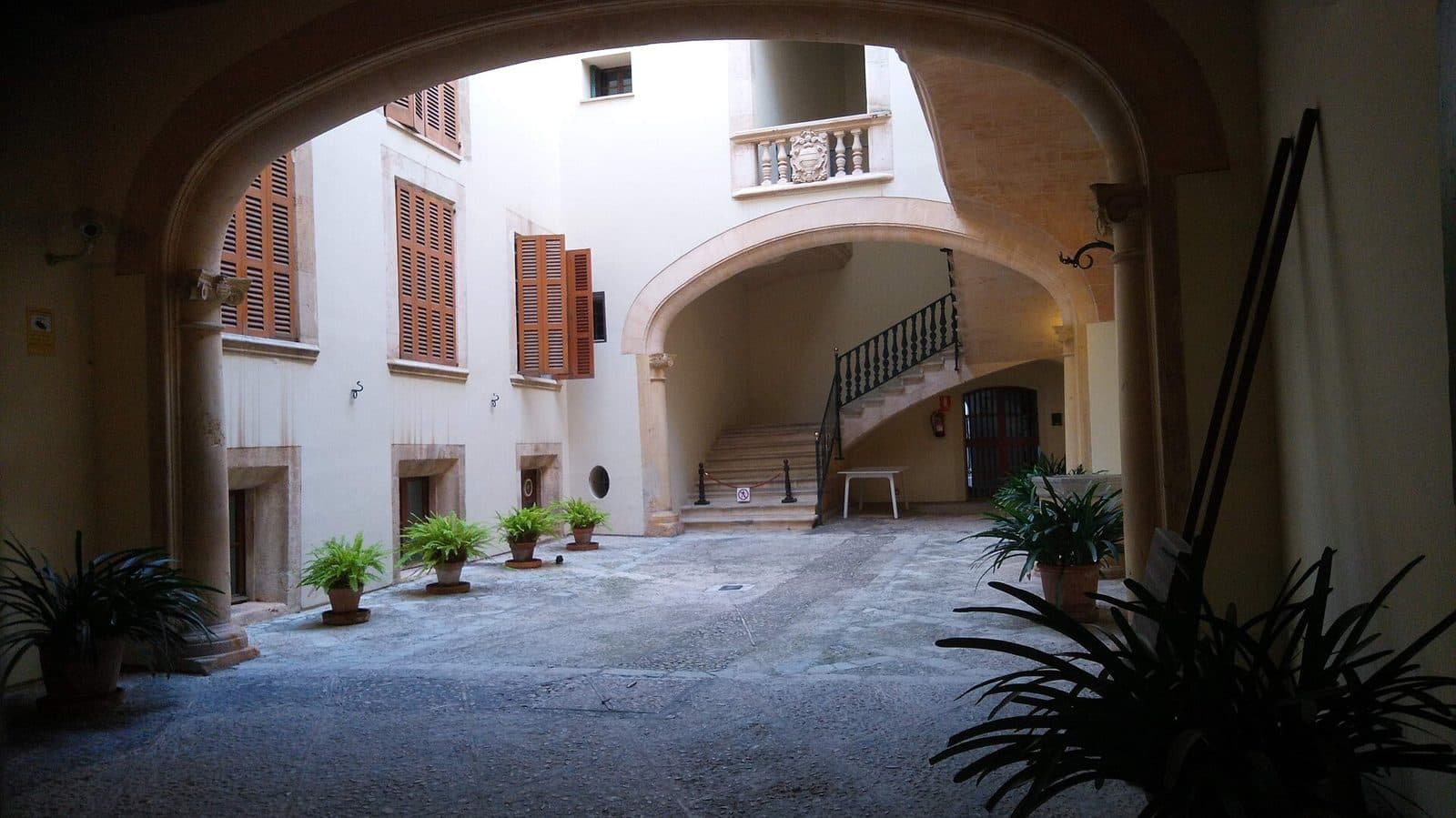

Between the prominent monuments and narrow streets of the old town, Can Crespí tells a quieter story of Palma. The historic townhouse, also known as Can Ribera, is a Casal in Palma. Its appeal lies in a short architectural sequence: A round arch leads to the entrance, while beyond it a segmental arch provides the transition to the courtyard. It is precisely this spatial progression that makes the house interesting for visitors who want to discover Palma through more than its cathedral, squares, and museums.
Can Crespí represents the residential architecture that shapes the character of the historic districts just as much as the major public buildings. Here, the focus is on transitions: from the street into the house, from the entrance into the interior, and finally to the courtyard. Can Crespí is hardly the right main destination for a dedicated trip across the island, but it gains considerable value as a stop on a walk through the old town. Anyone interested in historic houses, portals, and the organization of traditional urban buildings will find a striking example here that can easily be combined with other architectural monuments in central Palma.
It is important to have the right expectations: Can Crespí is not a winery of the same name, an estate outside Palma, or a biographical memorial to someone named Crespí. It refers exclusively to the historic house in Palma that the city’s tourism website lists as Can Crespí or Can Ribera.
What to See
The defining experience begins not only in the courtyard, but at the entrance itself. Can Crespí is understood through its arches: The first marks the entry, while the second structures the transition to the courtyard. Just a few architectural elements create a clear spatial sequence. Instead of looking at the building only from the front, it is worth following the sightlines one after another.
The Round-Arch Entrance
The clearly identified feature of the house is its round-arch entrance. This kind of arch does not form an abrupt rectangular opening, but spans it with a smooth curve. At Can Crespí, it leads to the entrance and thus serves a dual purpose: It is part of the architecture and also points the way into the building.
For the best view, begin from some distance away. This makes it possible to see how the arched opening is set into the rest of the façade and how strongly it emphasizes the entrance. Only then is it worth taking a closer look at the curve and the transition between the wall and the opening. The round arch should not be viewed in isolation, because its true effect emerges through its interaction with the passage beyond it. The architecture draws the eye onward instead of letting it stop at the portal, and the entrance already hints at the interior organization of the house.
The Segmental Arch
The round-arch entrance is followed by a segmental arch connected to the courtyard. Its shape appears flatter than a full round arch. As a result, moving forward or looking inside changes the spatial perception: The first arch emphasizes entry, while the second provides the transition into the area deeper within the house.
This distinction is the most important detail for an attentive visit. Anyone who sees the openings merely as two similar arches will miss the subtle architectural choreography. The round arch and the segmental arch do not serve the same purpose; together, they structure the route from outside to inside and make the circulation through the house legible.
It is best to take in the first arch in full and then look for the flatter arch line behind it. Depending on your position, the openings may overlap visually. A slight change in perspective is then more helpful than a quick glance while passing. Can Crespí rewards observation of depth and spatial layering rather than simply checking off a single photo motif.
The Courtyard
The courtyard forms the interior focal point of the architecture described here. Because the segmental arch is connected to it, the courtyard does not appear to be a random open space, but rather the destination of the entrance sequence. Historic townhouses are often judged solely by their street façades, but that approach falls short at Can Crespí. The essential feature lies in the movement behind the façade: street, round arch, entrance, segmental arch, and courtyard follow one another. Even if not every area is accessible during a visit, this sequence remains the central motif on which to focus.
For photographs, it is not only the courtyard itself that is interesting, but also the way the view is framed. A photograph through the round arch or along the two openings positioned one behind the other can convey the structure of the house better than a tightly framed detail shot. The passageway should, of course, not be blocked.
Can Crespí as an Urban House
Its designation as a Casal identifies Can Crespí as a historic townhouse in Palma. This is important for setting expectations: What you see is not a fortress, church, or rural estate, but the architecture of urban living. The round-arch entrance is followed by the doorway, the segmental arch, and the courtyard.
A comparison with other historic houses in the old town makes it particularly clear how strongly portals and courtyards shape Palma’s cityscape. Can Crespí is therefore well suited as an example on a themed walk. Anyone viewing several houses in succession should pay particular attention here to the two different arch forms and their relationship to the courtyard. This is the specific feature that makes the building recognizable.
Visiting Can Crespí
A good visit begins with a slow approach. Instead of walking directly up to the entrance, first find a position from which the round arch is fully visible. Your gaze can then move through the opening to the segmental arch and onward toward the courtyard. In this way, an apparently brief stop becomes a small architectural exploration.
Route and Time Required
Can Crespí does not require a long, fixed tour. Anyone who only wants to view and photograph the entrance sequence can include the visit as a compact stop on a walk through Palma. Architecture enthusiasts will spend longer comparing the two arch forms, their proportions, and the spaces arranged one behind the other from several angles.
No reliable fixed visit duration can be derived from this. It depends primarily on whether you only view the structure visible from outside or whether the interior is accessible on the day of your visit. For planning purposes, it is therefore advisable not to treat Can Crespí as a standalone attraction with a tightly scheduled time slot, but as part of a route through the historic city.
Access, Opening, and Admission
Current opening hours and admission conditions should be checked immediately before visiting. This is especially useful for a historic townhouse because viewing the exterior architecture and accessing interior areas do not necessarily follow the same conditions. An open door should also not automatically be understood as an invitation to enter every area.
Even without confirmed interior access, the architectural core of the house remains understandable as long as the round arch and passageway can be seen. Anyone who specifically wants to see the courtyard should clarify current access in advance. This avoids building an old-town route around an unconfirmed interior visit.
The Best Time to View It
For Can Crespí, a clear view of the entrance is more important than a particular time of day. If passersby or groups are standing in front of the house, it is worth waiting briefly or returning to the stop later. Because the building fits easily into a walking route, this change of perspective does not require a major detour.
The most important motif is the sense of depth created by the successive arches. This is easiest to appreciate when the entrance is unobstructed and there is enough time to shift your position slightly. Anyone who takes a photograph only while passing may capture the round arch but overlook the flatter arch leading to the courtyard—the very detail that defines Can Crespí architecturally.
Conduct at the Historic House
Can Crespí should be treated as a townhouse, not as a freely accessible backdrop. Passageways should remain clear, thresholds and barriers must be respected, and the interior should be entered only when access is clearly permitted. This restraint does not diminish the visit, because much can already be understood from the arrangement of the openings.
Groups should avoid giving explanations directly in the entrance. A position slightly farther away provides a better overview and prevents the passage from being blocked. Individual details can then be viewed up close. This keeps the visit pleasant and makes the architecture easier to understand.
Getting There and Parking
From Palma Airport, the route initially follows the Ma-19 into the island’s capital. The road distance to Palma is 11 kilometers, and the journey takes around 20 minutes. These figures apply specifically to the route from the airport to Palma, not directly to Can Crespí. For the final section in the center, traffic conditions, access rules, and the chosen parking facility will determine the journey.
By Car via the Ma-19
The Ma-19 takes travelers from the airport toward Palma. Once the center is reached, driving differs considerably from the straightforward main road: Pedestrian areas, one-way streets, and restricted access shape the road network in the old town. An up-to-date navigation system is therefore useful, but it should not tempt drivers to enter every suggested lane.
For a visit, it is advisable to leave the car outside the narrowest old-town streets or in a regular parking garage and complete the remaining distance on foot. This is usually more pleasant than looking for a parking space directly beside the historic house. Drivers should also pay attention to ACIRE signs, which identify areas with restricted access.
Parking in the Center
A centrally located parking garage from which the house can be combined with a walk through the old town is more practical. Anyone parking on the street must follow the relevant signs and colored markings; the rules may differ depending on the zone.
The walk from the parking area is not wasted time. The final streets in particular reveal the urban setting in which a Casal such as Can Crespí stands. Other portals, historic façades, and courtyards prepare the eye for the house. Anyone combining several old-town destinations should therefore choose a parking garage based on the entire route, not solely on its proximity to Can Crespí.
By Bus
The Plaça de Cort and Plaça de la Reina–Catedral stops are useful reference points in the center. From there, continue the visit on foot. Plaça de Cort is a practical starting point for a route through the historic center, while Plaça de la Reina connects your arrival with the area around the cathedral.
The best route in each case depends on your starting point in Palma and the current timetable. For planning purposes, the stop is therefore more useful than a blanket recommendation for a particular route. After getting off, navigation should be set to walking directions, as direct routes through the center do not always follow the road network used by cars.
Bus lines to Can Crespí at a glance
| Line | Route | Departures/day | First | Last |
|---|---|---|---|---|
| 35 | Aquàrium - Pl. Reina | Catedral | 8 | 07:10 | 13:50 |
| 3 | Pont d'Inca / Joan Carles I | 6 | 07:37 | 09:46 |
| 25 | s'Arenal - Pl. Reina | Catedral | 6 | 09:35 | 12:41 |
| 20 | Portopí - Son Espases | 2 | 07:17 | 07:19 |
From the official GTFS feeds (TIB/SFM), no real-time data. The figures cover all stops in the town; weekend and holiday services differ — check with the operator before travelling.
Getting there by bus
662-pl. de Cort · 0.1 km as the crow flies
- CCCircular Centre Ciutat · 08:00–08:00 · Daily
453-pl. de la Reina - Catedral · 0.3 km as the crow flies
- 25s'Arenal - Pl. Reina | Catedral · 06:36–21:01 · Daily
7-pl. de la Reina - Catedral · 0.3 km as the crow flies
- 35Aquàrium - Pl. Reina | Catedral · 06:21–22:41 · Daily
986-pl. de la Reina - Catedral · 0.3 km as the crow flies
- 35Aquàrium - Pl. Reina | Catedral · 06:21–22:41 · Daily
- CCCircular Centre Ciutat · 08:00–08:00 · Daily
663-pl. d'en Coll · 0.3 km as the crow flies
- CCCircular Centre Ciutat · 08:00–08:00 · Daily
106-pl. del Mercat · 0.3 km as the crow flies
- 3Pont d'Inca / Joan Carles I · 08:00–08:00 · Daily
- 4Ses Illetes - Pl. Columnes · 08:00–08:00 · Daily
- 7Son Gotleu - Son Serra - Sa Vileta / Son Vida · 08:00–08:00 · Daily
- 20Portopí - Son Espases · 06:06–22:40 · Daily
52-pl. del Mercat · 0.4 km as the crow flies
- 4Ses Illetes - Pl. Columnes · 08:00–08:00 · Daily
- 7Son Gotleu - Son Serra - Sa Vileta / Son Vida · 08:00–08:00 · Daily
- 20Portopí - Son Espases · 06:06–22:40 · Daily
- 35Aquàrium - Pl. Reina | Catedral · 06:21–22:41 · Daily
105-pl. de Joan Carles I - Catedral · 0.4 km as the crow flies
- 3Pont d'Inca / Joan Carles I · 08:00–08:00 · Daily
- 4Ses Illetes - Pl. Columnes · 08:00–08:00 · Daily
- 7Son Gotleu - Son Serra - Sa Vileta / Son Vida · 08:00–08:00 · Daily
- 20Portopí - Son Espases · 06:06–22:40 · Daily
1048-pl. de Joan Carles I · 0.4 km as the crow flies
- 25s'Arenal - Pl. Reina | Catedral · 06:36–21:01 · Daily
- 35Aquàrium - Pl. Reina | Catedral · 06:21–22:41 · Daily
985-pl. de Joan Carles I · 0.4 km as the crow flies
- CCCircular Centre Ciutat · 08:00–08:00 · Daily
664-pl. de sa Quartera · 0.4 km as the crow flies
- CCCircular Centre Ciutat · 08:00–08:00 · Daily
1982-Parc de la Mar - Catedral · 0.4 km as the crow flies
- 25s'Arenal - Pl. Reina | Catedral · 06:36–21:01 · Daily
- 30Marivent-Palau de Congressos · 08:00–08:00 · Daily
Timetable data: official GTFS feeds (TIB/EMT), no real-time — check with the operator before travelling.
Nearby Attractions
Can Crespí gains meaning through Palma. The house does not stand in isolation, but becomes easier to understand when other historic streets and squares are visited before or afterward. The capital of the Balearic Islands has numerous remarkable residences in its old districts; buildings from the 16th to the 18th century are among the defining elements of this cityscape.
Plaça de Cort
Plaça de Cort is a useful urban reference point. The Ajuntament is located here, and from this square the walk can continue into the surrounding old-town streets. Its connection with Can Crespí is particularly appealing from a thematic perspective: A public square and an important civic building are followed by a house whose qualities lie in its portal, passageway, and courtyard.
Visiting Can Crespí in this order reveals two different levels of historic urban architecture. Cort represents public space and city life, while the Casal represents the transition between the street and a more private interior. No extensive guided tour is necessary; simply comparing the entrances consciously reveals the different functions of the buildings.
Plaça de la Reina and the Cathedral
The area around Plaça de la Reina and the cathedral can also be easily combined with Can Crespí. The cathedral establishes a monumental scale, while the historic residence calls for a much more intimate form of observation. This contrast helps prevent Palma’s smaller architectural monuments from being overlooked beside its widely known attractions.
A worthwhile route therefore does not simply run from highlight to highlight, but alternates between large urban spaces and individual houses. Can Crespí functions as a quiet observation point within it: After the openness and representative effect of the cathedral district, attention shifts to an arch line, a passageway, and the orientation toward a courtyard.
Other Historic Houses
Can Crespí is a useful starting point for a walk focused on Palma’s residential architecture, but it should still be viewed on its own terms. Within such a route, it has an especially memorable theme to observe: the sequence of round arch, segmental arch, and courtyard. Anyone who consciously notices this motif at the beginning of the walk will often start paying closer attention at subsequent houses to entrances, sightlines, and the separation between street space and courtyard.
The Old Town as a Setting
Palma’s old town is more than the route between individual attractions. It is the spatial setting in which a house such as Can Crespí reveals its meaning. Narrow streets, squares, public buildings, and historic residences stand close together. The visit is therefore particularly suitable for travelers exploring on foot who take small architectural details as seriously as the famous monuments.
For a varied walk, Can Crespí can be included between Plaça de Cort and the cathedral area without turning the route into a rigid program. What matters is allowing enough time for detours and changes in perspective. The house itself remains a concentrated stop; the surrounding streets provide the comparison that makes its spatial organization easier to understand.
The place it belongs to
Palma in the place guidePractical Information for Your Visit
Can Crespí is a destination for close observation. The visit focuses on a historic townhouse and the architectural sequence from the round-arch entrance through the segmental arch to the courtyard.
For Architecture Enthusiasts
A small change in perspective is more useful here than a long equipment list. First, view the round arch from the front, then follow the sightline to the second arch. From a slightly offset position, it is often easier to distinguish which opening belongs to the entrance and how the segmental arch creates the transition to the courtyard.
Notes or photographs can help you compare Can Crespí later with other Casas and Casals in the old town. It is useful to take not only a picture of the façade but also one that shows the spatial depth. Anyone waiting exclusively for decorative features may miss the true quality of the place: its clear organization from outside to inside.
With Children
For families, Can Crespí works well as a brief discovery stop. The two different arch forms provide a simple observation task: Where does the round arch begin, where does the flatter opening appear, and where does the view lead? This makes it possible to explain the architecture directly without using many technical terms.
Because the visit takes place in an urban setting, children should be kept close near passageways and on the adjacent streets. The entrance should not be treated as a play area. The stop is most enjoyable when combined with a varied walk rather than expected to provide entertainment on its own for an extended period.
Clothing and Footwear
No special hiking equipment is required for Can Crespí. Comfortable shoes are nevertheless advisable because the visit is most rewarding as part of a longer walk through Palma. Historic streets, changing surfaces, and multiple stops are more comfortable with sturdy everyday footwear than with plans focused solely on the short stop at the house.
Sun and weather protection should also be chosen with the entire city walk in mind. Can Crespí is not a countryside destination with a long, exposed approach, but the route between Plaça de Cort, the cathedral area, and other historic houses crosses a variety of streets and squares. Water and light sun protection are therefore sensible additions to your city gear on warm days.
What Can Crespí Is Not
The name can be misleading. Can Crespí in Palma should not be confused with Son Crespí de Passatemps and its winery near Santa Maria del Camí. Nor is it a work about the historical Juan or Joan Crespí. Such similarities in names lead to information that does not apply to this destination.
Visitors should also not expect a palace, cathedral, or large museum. The value of the visit lies in a precise example of Palma’s historic residential architecture. Those who arrive with this expectation will see the round arch as more than a doorway and the courtyard as more than an open space, instead understanding the sequence between them as the true subject of the house.
Local insider tips
Look for Both Arches
Do not stop at the round arch: Behind it is the flatter segmental arch leading to the courtyard. Only when both openings are seen along the same sightline does the spatial character of Can Crespí become clear.
Begin from a Distance
It is better not to take the first photograph directly at the entrance. From farther back, the round arch can be captured in full; afterward, a slightly offset position reveals the spatial progression toward the courtyard.
Architecture Route from Cort
Can Crespí can easily be combined with Plaça de Cort and other historic houses in Palma. This turns a brief stop into a walk focused on portals, passageways, and courtyards.
Explore the Old Town on Foot
The Plaça de Cort and Plaça de la Reina–Catedral stops are useful starting points. From there, walking through the old town is more scenic and usually more practical than searching for parking near the house.