
en Figuera – Palma’s Historic Clock and Bell
.jpg)
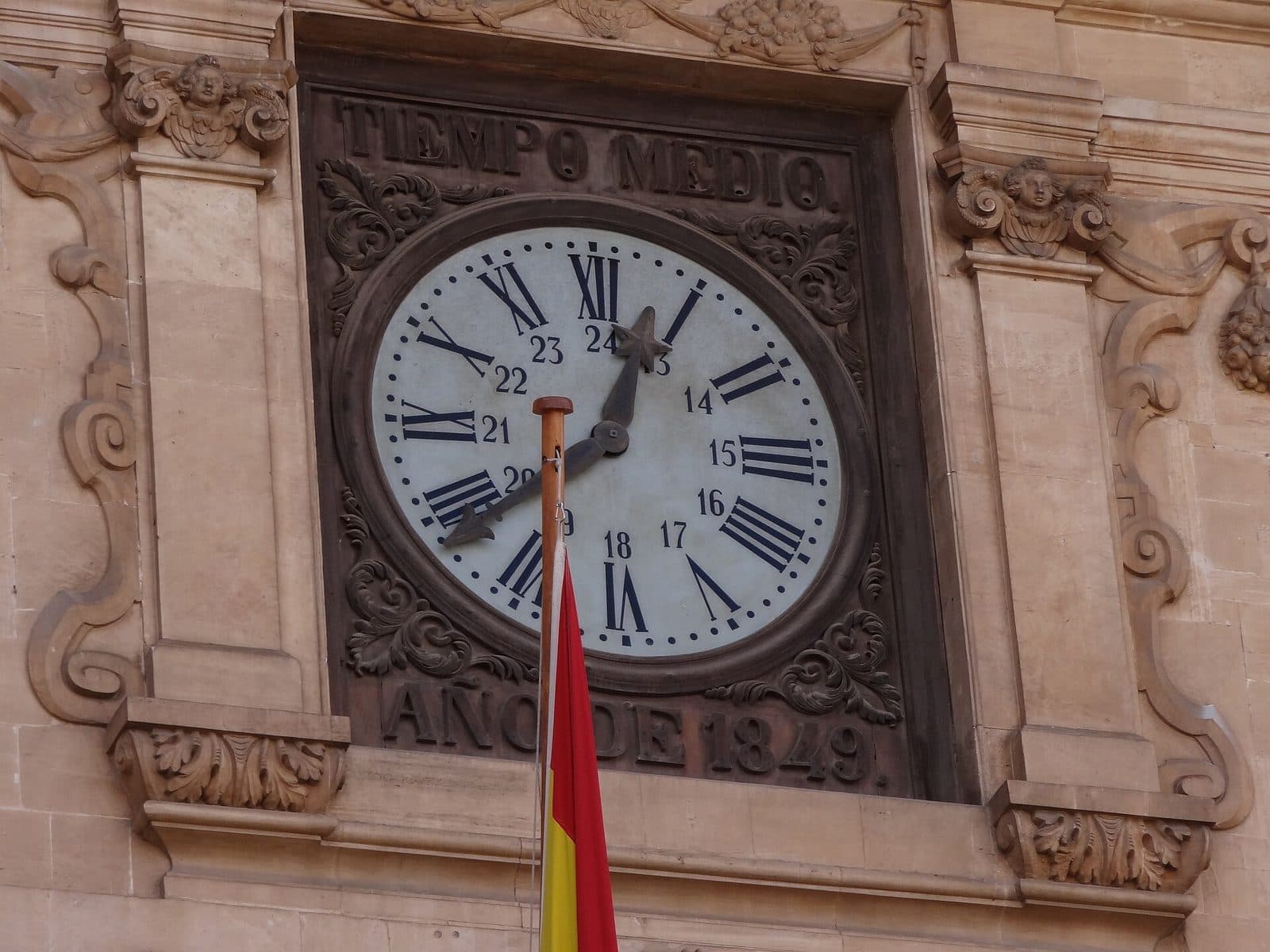
In the heart of Plaça de Cort, visitors encounter a piece of urban history that is easy to overlook: en Figuera, the historic clock with its namesake bell at Palma City Hall. Those who focus only on the monumental façade may see the ensemble merely as a decorative detail. In fact, its predecessor was already regulating the city’s daily rhythm in the Middle Ages.
En Figuera is neither a museum nor a separate building. The attraction is part of City Hall and can be viewed from Plaça de Cort. Its appeal lies less in an elaborate visit than in its combination of technological, urban, and everyday history: for centuries, a bell audible across the city made time a shared public matter.
This brief stop is particularly worthwhile for travelers who want to experience Palma’s old town as more than a succession of major monuments. En Figuera tells of an era when a mechanical clock was still a technological novelty, when hours were counted differently than they are today, and when a storm ultimately forced the familiar timekeeper to move to a new location.
History and Significance
The Torre de les Hores
The story does not begin at the present-day City Hall. In 1386, Mallorca’s Great and General Council bought a tower from the Dominicans at the upper end of today’s Carrer del Conqueridor, only a short distance from the later City Hall. A mechanical clock and a heavy bell were installed there. The tower received a name that described its purpose unmistakably: Torre de les Hores, the Tower of the Hours.
For late medieval Palma, such an installation was far more than a convenient timekeeper. En Figuera was among Spain’s early tower clocks. Its chimes transformed time into a public signal. They structured the day across rooftops, streets, and squares and could be heard whether or not someone was able to see the clock face.
The original bell weighed 1.880 kilograms. It was made by Pere Joan Higuera, a silversmith whose name passed to the ensemble. The name en Figuera, still used today, therefore does not simply refer to a place or a fig tree. In a slightly altered form, it preserves the name of the craftsman who created the first bell.
Hours Following the Sun
The original method of measuring time is particularly revealing. The medieval clock did not follow today’s familiar continuous system of 24 hours. Instead, it operated in two cycles based on the sun’s course. The first began at sunrise and the second at sunset. One hour after the sun rose, the first hour sounded; after sunset, the count began again.
The chimes therefore did not indicate a fixed year-round time in the modern sense. They translated the transition between day and night into an audible order. This difference is precisely what makes en Figuera culturally and historically interesting: the clock is a reminder that even something as seemingly ordinary as dividing the day has evolved over time.
Anyone looking at the City Hall façade today is therefore seeing more than a forerunner of modern public clocks. En Figuera represents a concept of time more closely tied to light and darkness. The beginning of the day was determined not solely by abstract numbers, but by the actual sunrise over the city.
Recasting and Storm
At the beginning of the 17th century, the first bell was damaged and covered in cracks. Joan Cardell recast it in 1680. The resulting bell is today’s en Figuera; at 1.843 kilograms, it remained an extraordinarily heavy instrument. A Latin inscription on the lower part of the bell contains religious invocations, including references to Christ, the Lion of the Tribe of Judah, Mary, and Saint Anne.
The old hour tower, however, did not survive permanently. A tornado damaged it so severely that it had to be demolished. The clock and bell moved to City Hall on Plaça de Cort in 1848. This relocation explains why a medieval timekeeper is now attached to a building that was not its original home.
In 1863, the clock was replaced once again. The new mechanism came from the French manufacturer Collin and sounded for the first time on the birthday of the Spanish queen Isabel II. The present installation thus combines several historical layers: its origins in the 14th century, the bell recast in the 17th century, the move in the 19th century, and the clock mechanism, also dating from the 19th century.
What to See
The Clock on the City Hall Façade
The most important view begins by looking upward. En Figuera is located on the façade of Palma City Hall and can be seen from the open space of Plaça de Cort. The ensemble should not be equated with the entire City Hall: the historic attraction is the combination of clock and bell, whose story began long before they were installed on this building.
From a distance, the clock appears to be part of the City Hall architecture. Only with knowledge of its former location does the break left here by urban history become apparent. What now seems inseparable from Plaça de Cort stood for centuries on the Torre de les Hores on Carrer del Conqueridor. Looking at the façade is therefore also a way of seeing a historic relocation.
The clock face can be read as the most recent clearly visible layer of a much older tradition. The present system dates from the French mechanism installed in 1863, while public timekeeping itself reaches back to the Middle Ages. This chronological layering is precisely what makes the object more interesting than a clock that had remained unchanged in its original position.
The en Figuera Bell
The true namesake is not the clock mechanism but the bell. It bears the name derived from the silversmith Pere Joan Higuera and passed it on to the entire ensemble. This connection is easy to miss in passing because, in current usage, the clock itself is often called en Figuera.
The present bell was created when Joan Cardell recast it in 1680. Its weight of 1.843 kilograms gives some idea of the technical achievement involved in making and suspending it, as well as later transporting it to City Hall. As a historic instrument, it was not designed for close-up viewing but for acoustic reach: its purpose was to make time audible across the city.
An extensive Latin inscription appears around its lower section. It is not a simple maker’s mark but connects the bell with the religious worldview of its era. Christ, Mary, Saint Anne, and the Lion of the Tribe of Judah are invoked in it. The bell was therefore simultaneously a technical tool, a public signal, and an object carrying symbolic meaning.
Plaça de Cort as Its Setting
Plaça de Cort is integral to experiencing en Figuera. The clock and bell are located on the façade of City Hall.
The square is also the key to understanding their original function. A public clock had to be seen or heard. En Figuera was not a private precision instrument in an enclosed room; it addressed the city as a community. Its present location at City Hall continues this public character, even though the technological and social significance of tower clocks has fundamentally changed.
Visitors who include Carrer del Conqueridor in their old-town walk can also appreciate the short distance between the former hour tower and the present location. Although the tornado drove the clock and bell from their original architectural setting, it did not remove them from Palma’s historic center.
Several Eras in One Object
En Figuera is best understood not as a work created all at once, but as a historical composition. The tradition of publicly announcing the time survived from the first ensemble of the 14th century. In its present form, the bell belongs to the 17th century, while its location at City Hall and the clock mechanism date from the 19th century.
This layering also explains why the attraction may appear less striking from the outside than its history suggests. There is no route through medieval rooms and no surviving Torre de les Hores. What matters lies in the relationships between the craftsman, the bell, the method of counting time, the destroyed tower, and the new City Hall façade. Those who understand these connections see more than a clock on Plaça de Cort: they see an urban memory passed down across centuries.
Visiting en Figuera
The First View from the Square
En Figuera is located on the upper part of the City Hall façade. The clock and bell are positioned above the public space.
En Figuera is better suited to a focused historical stop than to a long standalone visit. There is no documented fixed duration for viewing it. Anyone who simply wants to photograph the clock face will finish quickly, while those exploring the history of the old solar hours, the casting of the bells, and the relocation will spend considerably longer studying the façade.
In daylight, the architectural context and details of the upper façade are easier to see. No reliable time of day with guaranteed low visitor numbers can be specified. The advantage of this outdoor attraction is that viewing it is not tied to a guided interior tour. If the square is busy, the visit can simply be postponed until a later point in an old-town walk.
Listen, Don’t Just Look
Historically, en Figuera was primarily intended to be heard. The bell made the hours public. A slight change of perspective is therefore helpful when viewing it: the core of the installation was not the clock face alone, but the reach of the bell’s chimes.
The old system of two cycles based on the sun’s course is especially easy to imagine on site. The count began after sunrise and started again after sunset. The present view of an apparently ordinary public clock thus leads to an unusual question: how would this same square have sounded when the hour was not yet given according to a continuous modern daily schedule?
Current opening hours and admission conditions have not been recorded and should be checked before visiting if access to City Hall is planned. For understanding en Figuera historically, however, the view from Plaça de Cort is already decisive. The attraction can be appreciated from outside the building; an interior visit is not required to understand its position and role in the urban space.
A Brief Stop with Some Preparation
Without background knowledge, en Figuera can easily be overlooked among the stronger impressions of the old town. A little preparation significantly changes the experience. Three points are especially helpful: the name originally belongs to the bell, the ensemble first stood on another tower, and the medieval clock counted the hours from sunrise and sunset.
With children, this can become a small search activity: where are the clock and bell, and why did the entire city need to hear their chimes? The combination of a visible clock, a heavy bell, and a way of measuring time that now seems unfamiliar can provide an accessible introduction to the city’s history.
Getting There
From the Airport to Palma
From Palma Airport, the journey initially follows the Ma-19 into the island’s capital. Palma is 11 road kilometers away, and the drive takes around 20 minutes. These figures apply specifically to the route as far as Palma, not to a direct drive up to en Figuera. The final stretch leads into the historic city center to Plaça de Cort and depends on city traffic and the chosen starting point.
En Figuera has no separate access independent of City Hall. Plaça de Cort is the destination to use for orientation. The clock is located on the City Hall façade and is viewed from the square.
By Bus to the Center
Several bus stops are located around the historic center. The stop name Plaça de Cort leads particularly clearly to the correct square; Plaça d’en Coll and Plaça del Mercat are also suitable starting points for the final walk. The best connection in each case depends on the point of departure in Palma.
After leaving the bus, the landmark is no longer a tower peak visible from afar, but the City Hall façade on Plaça de Cort.
The Final Walk
Approaching through the old town is already part of the visitor experience. Plaça de Cort opens up between the narrower streets. En Figuera is located there on the City Hall façade.
Palma, Plaça de Cort, and City Hall are unambiguous destination details.
Bus lines to en Figuera at a glance
| Line | Route | Departures/day | First | Last |
|---|---|---|---|---|
| 35 | Aquàrium - Pl. Reina | Catedral | 8 | 07:10 | 13:50 |
| 3 | Pont d'Inca / Joan Carles I | 6 | 07:37 | 09:46 |
| 25 | s'Arenal - Pl. Reina | Catedral | 6 | 09:35 | 12:41 |
| 20 | Portopí - Son Espases | 4 | 07:17 | 07:31 |
From the official GTFS feeds (TIB/SFM), no real-time data. The figures cover all stops in the town; weekend and holiday services differ — check with the operator before travelling.
Getting there by bus
662-pl. de Cort · 0.0 km as the crow flies
- CCCircular Centre Ciutat · 08:00–08:00 · Daily
663-pl. d'en Coll · 0.2 km as the crow flies
- CCCircular Centre Ciutat · 08:00–08:00 · Daily
106-pl. del Mercat · 0.2 km as the crow flies
- 3Pont d'Inca / Joan Carles I · 08:00–08:00 · Daily
- 4Ses Illetes - Pl. Columnes · 08:00–08:00 · Daily
- 7Son Gotleu - Son Serra - Sa Vileta / Son Vida · 08:00–08:00 · Daily
- 20Portopí - Son Espases · 06:06–22:40 · Daily
52-pl. del Mercat · 0.2 km as the crow flies
- 4Ses Illetes - Pl. Columnes · 08:00–08:00 · Daily
- 7Son Gotleu - Son Serra - Sa Vileta / Son Vida · 08:00–08:00 · Daily
- 20Portopí - Son Espases · 06:06–22:40 · Daily
- 35Aquàrium - Pl. Reina | Catedral · 06:21–22:41 · Daily
664-pl. de sa Quartera · 0.3 km as the crow flies
- CCCircular Centre Ciutat · 08:00–08:00 · Daily
453-pl. de la Reina - Catedral · 0.3 km as the crow flies
- 25s'Arenal - Pl. Reina | Catedral · 06:36–21:01 · Daily
986-pl. de la Reina - Catedral · 0.3 km as the crow flies
- 35Aquàrium - Pl. Reina | Catedral · 06:21–22:41 · Daily
- CCCircular Centre Ciutat · 08:00–08:00 · Daily
105-pl. de Joan Carles I - Catedral · 0.3 km as the crow flies
- 3Pont d'Inca / Joan Carles I · 08:00–08:00 · Daily
- 4Ses Illetes - Pl. Columnes · 08:00–08:00 · Daily
- 7Son Gotleu - Son Serra - Sa Vileta / Son Vida · 08:00–08:00 · Daily
- 20Portopí - Son Espases · 06:06–22:40 · Daily
7-pl. de la Reina - Catedral · 0.3 km as the crow flies
- 35Aquàrium - Pl. Reina | Catedral · 06:21–22:41 · Daily
1048-pl. de Joan Carles I · 0.4 km as the crow flies
- 25s'Arenal - Pl. Reina | Catedral · 06:36–21:01 · Daily
- 35Aquàrium - Pl. Reina | Catedral · 06:21–22:41 · Daily
985-pl. de Joan Carles I · 0.4 km as the crow flies
- CCCircular Centre Ciutat · 08:00–08:00 · Daily
53-pl. de Joan Carles I - Catedral · 0.4 km as the crow flies
- 4Ses Illetes - Pl. Columnes · 08:00–08:00 · Daily
- 7Son Gotleu - Son Serra - Sa Vileta / Son Vida · 08:00–08:00 · Daily
- 20Portopí - Son Espases · 06:06–22:40 · Daily
Timetable data: official GTFS feeds (TIB/EMT), no real-time — check with the operator before travelling.
Nearby
Plaça de Cort
En Figuera is one of those attractions where the object and its setting are almost impossible to separate. Plaça de Cort is not merely the square in front of the clock, but its present public space of resonance. Here it becomes clear why a heavy bell made sense for regulating time in the city: its signal was not directed at individual visitors to a building, but at the city’s people.
The visit should therefore not be reduced to a quick photograph of the upper façade. At the same time, the square reveals City Hall’s role as a representative new home after the damaged Torre de les Hores had been demolished.
Palma’s Old Town
Its location makes en Figuera a fitting part of a walk through historic Palma. The old town itself, the cathedral area, and the Banys Àrabs combine well thematically with a visit. Extensive detours are unnecessary: simply comparing different eras reveals how many historical layers stand close together in the city center.
A connection with Carrer del Conqueridor is particularly worthwhile. The former Torre de les Hores stood at its upper end before the tornado damaged it. The tower has not survived, but the walk helps visitors understand the relocation of the clock and bell within the city. An abstract date thus becomes a tangible change of place within old Palma.
Visitors to the cathedral area or the Arab baths encounter larger monuments with accessible interiors. En Figuera provides a deliberately smaller counterpoint. The clock does not tell the story of an enclosed sacred or residential space, but of the organization of daily life: when did an hour begin, who could hear it, and how did the city preserve its timekeeper after losing the old tower?
The place it belongs to
Palma in the place guidePractical Visitor Information
The Former Clock Tower
En Figuera is the historic clock and bell at Palma City Hall. Plaça de Cort in Palma is the correct point of reference.
Visitors should likewise not expect a freestanding medieval clock tower. The Torre de les Hores was demolished after being damaged by a tornado. The clock and bell were preserved and moved to City Hall; through its new location, the present ensemble tells the story of the loss of the original structure.
Viewing Angles and Equipment
No special equipment is required for viewing it.
Daylight provides better conditions for photography and for understanding the precise architectural setting. The bell’s inscription is located on its lower section, but it was not designed as exhibition text for people reading it from the square. The historical value comes primarily from knowing what to look for.
Visiting with Children
Children can enjoy en Figuera as a brief stop on a city walk. The bell’s weight, its role as a public signal, and the former system of counting from sunrise and sunset are easy to illustrate.
Its strength lies in a manageable story that can be connected directly to a visible object. During a longer day in the old town, en Figuera is therefore better suited as a focused discovery between larger attractions than as the sole item on the itinerary.
Check Current Details in Advance
Specific opening hours and admission prices have not been recorded. Anyone wishing to enter City Hall in addition to viewing the exterior or to take part in a special tour should check current conditions in advance. Times and access rules may change.
For the view from Plaça de Cort, the façade remains the key location. En Figuera is not explored through a sequence of interior rooms, but through careful observation and historical context. Those who know the bell’s name, the old system of solar hours, and the relocation after the tornado will discover in a seemingly familiar City Hall clock one of Palma’s most distinctive records of public timekeeping.
Local insider tips
Look Beyond the Clock Face
The name en Figuera originally belongs to the bell, not just the clock. When looking at the City Hall façade, it is therefore worth searching for the entire ensemble and remembering its former purpose as a time signal audible across the city.
Think in Solar Hours
The medieval clock counted in two cycles: after sunrise and again after sunset. Knowing this turns a brief look at the façade into a small journey through a daily order that now seems unfamiliar.
Take a Few Steps Back
Directly in front of City Hall, the viewing angle for en Figuera is unfavorable. From farther out on Plaça de Cort, the position of the clock and bell on the façade is much easier to see.
Look for the Lost Tower
The original Torre de les Hores stood at the upper end of Carrer del Conqueridor. A detour there helps visitors visualize the relocation of the clock and bell after the tower was damaged by a tornado.