
Can Lladó – Medieval Courtyard House in Palma
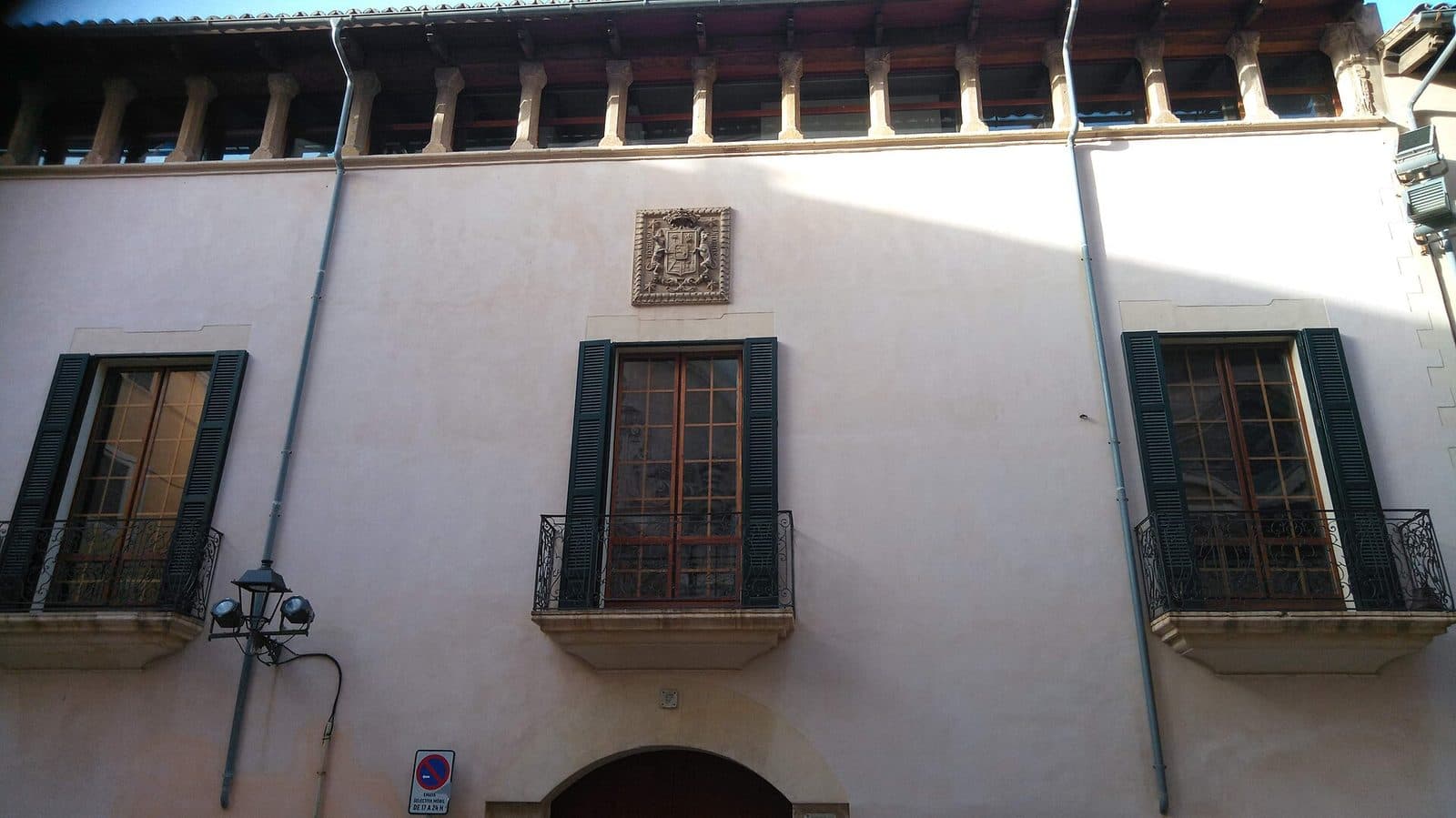

Can Lladó is tucked away not behind a grand entrance plaza, but on Carrer del Vent, a narrow lane in Palma's historic center. Opposite stand the walls of Montesión church. From the outside, this protected courtyard house appears understated, yet studies suggest that its fabric may date back well before the Christian conquest of Mallorca.
It is precisely this quiet presence that makes the house so interesting. Can Lladó tells its story not through monumental halls or a museum-style presentation, but through wall thicknesses, proportions, shadows, and preserved traces of use. After standing vacant for decades, it was comprehensively restored and returned to use as a family home.
A visit is especially worthwhile for anyone wishing to understand Palma's historic residential architecture. One important expectation should be clarified: Can Lladó is not a conventional museum with a regular visitor route, but a private residence and historic monument. Its significance is therefore best understood in the context of the lane, the church opposite, and the dense fabric of the old town.
History and Significance
The house stood empty for decades. Behind its closed walls, however, an exceptionally old architectural structure survived. Rather than simply being renovated, it eventually became the subject of a comprehensive investigation. Archaeologists, historians, and restorers closely accompanied the work; the construction process also provided an opportunity to better interpret the house's different layers.
Medieval Origins
Can Lladó is considered a protected building of medieval origin. Some studies link parts of its fabric to the 12th century, suggesting that it may have originated before 1229. For a surviving residential building in Palma, this would be a remarkably early date. The cautious wording is essential: Not all of the house visible today necessarily dates from that period, but very old structures may have been incorporated into the building as it was altered over time.
Its historical appeal therefore lies less in a uniform architectural style than in its long history of use. An old-town house was adapted, repaired, and extended over generations. Openings, wall thicknesses, sequences of rooms, and artisanal details preserve traces of these changes. Can Lladó cannot be reduced to a single era; rather, the building is an evolving archive of domestic life in old Palma.
Vacancy and Revival
After decades of abandonment, the restoration was not an attempt to return the house to a supposedly perfect original state. The project's explicit aim was to work with the existing fabric. Surviving proportions, irregularities, shadows, courtyards, and traces of use were meant to remain legible rather than disappear behind a newly created historicizing design.
Today, Can Lladó once again serves as a family home. This use continues the building's original character: It remains residential architecture and has not been transformed into an artificial stage set. This is precisely how the house demonstrates that heritage conservation in Palma's old town can mean more than simply maintaining façades. Historic fabric must also be treated in a way that allows it to become part of urban life once again.
Carrer del Vent
The lane itself is also part of the house's history. Carrer del Vent was so distinctive in local memory that verses about it have been passed down. They describe the constant wind and how few people would pass through. This gives the street name an almost audible background: Can Lladó did not stand on a prestigious main thoroughfare, but in a narrow, lightly frequented part of the old town.
This tradition anchors the building in the everyday life of the neighborhood. The memory of the place is shaped not by a courtly event or a famous person, but by an observation from daily life in the lane. Wind, confinement, and sparse foot traffic became characteristics by which residents recognized their street.
What to See
Anyone standing in front of Can Lladó should not look for a symmetrical show façade or decorative monumentality. The house reveals itself through its spatial logic: from the entrance into the interior, onward to the courtyard and the living areas arranged around it. During the restoration, the elements that make this sequence understandable remained especially important.
The pas d’entrada
Known in Mallorcan as the pas d’entrada, the entrance area forms the transition between the lane and the house and is more than a simple passageway. At Can Lladó, this entrance was recovered as a historical element in its own right. Anyone studying the architecture should therefore pay attention to the progression between street, entrance, and courtyard. It often explains the house better than any single decorative detail.
The Courtyard
The courtyard is the spatial heart of Can Lladó. The restoration preserved not merely a courtyard as a visible space, but the inherited logic by which the building is organized around this open area. Light and shadow, indoors and outdoors, passage and pause all come together here. The designers did not treat the courtyard as a newly styled decorative space; its proportions, the adjoining wall surfaces, and the existing traces were what mattered.
Walls, Traces, and Irregularities
Among the most revealing features are precisely those things that would often be smoothed away during a conventional renovation. Varying wall thicknesses, areas of shadow, irregularities, and visible traces of time were understood as part of the house. The existing structure was not meant to appear as though it had been created at a single moment.
This requires a different way of looking than in a lavishly furnished city palace. Can Lladó does not impress through a long sequence of named state rooms. What makes it interesting is how old building elements and later interventions remain legible side by side. Here, an irregular surface can reveal more about the age of the house than an immaculately renewed wall.
Historic Woodwork
Surviving woodwork was also among the elements preserved and highlighted again during the restoration. The careful treatment of these components follows the same principle as the treatment of the walls: What survives is not replaced with an invented historical version. New interventions are subordinated to the existing fabric, while signs of age and distinctive craftsmanship remain part of the architectural expression.
The Relationship with Montesión Church
Directly opposite the walls of Montesión church, Can Lladó occupies a distinctive urban setting. The residence and the religious building face one another across the narrow Carrer del Vent. This vividly illustrates the fine-grained structure of the old town: Important ecclesiastical architecture and private homes are not separated from one another, but share the same limited street space.
When viewing the house from outside, it is worth photographing more than just the frontage in isolation. The true impression emerges from the opposing walls, the width of the lane, and the transition to the house's entrance. Can Lladó is as much a component of this urban space as it is an individual historic monument.
Visiting Can Lladó
A visit to Can Lladó begins with a limitation that also explains the character of the place: The building was revived as a private family home. This does not imply that it operates as a freely accessible museum. Anyone specifically wishing to see the interior, courtyard, and historic woodwork should therefore check in advance whether a scheduled viewing opportunity or special access is currently available.
Reading Can Lladó from the Outside
Even without access to the interior, the house is revealing as part of an architectural walk through Palma. Carrer del Vent, the entrance, the location opposite Montesión, and the dense surrounding development convey the historic scale of the neighborhood. Instead of merely checking off a point on the map, it is worth walking a short distance along the lane and then looking back. Only from changing perspectives does it become clear just how limited the space is between the residence and the church wall.
The building is not a destination for a long exhibition visit. As an exterior architectural stop, a visit is likely to be fairly brief; it becomes more rewarding when Can Lladó is included in a walk through the historic center. Its quiet residential architecture can then be compared with the old town's more prestigious streets, squares, and churches.
What to Expect
Do not expect a conventional visitor center, a collection, or a signposted route. The qualities of Can Lladó lie in its historic structure and in a restoration that respects the surviving traces. Anyone primarily seeking spectacular interiors could easily overlook the house. Those interested in the layout of a courtyard house, heritage conservation, and Palma's medieval urban fabric will instead find an unusually concentrated example.
Because the information provided lists neither fixed visiting hours nor an admission fee, current access details should be checked before planning a dedicated visit. Regardless of access, the exterior remains a worthwhile stop during a spontaneous walk through the old town.
Getting There and Parking
From Palma Airport, the route initially follows the Ma-19 into the island's capital. The road distance to Palma is 11 kilometers, and the drive takes around 20 minutes. These figures apply specifically to the journey as far as Palma, not to the area directly outside Can Lladó. The final stretch leads into the historic center and Carrer del Vent, where the house stands opposite the walls of Montesión church.
The Final Stretch Through the Old Town
The area around Can Lladó is characterized by narrow old-town lanes. Carrer del Vent is therefore a more useful point of reference than a broad street view, especially since the house's understated frontage is easier to overlook than a freestanding monument.
Specific parking options and access regulations in the center may change and should be checked before traveling. Driving directly to the house is not necessary for the visitor experience in any case: The spatial effect of Can Lladó is best appreciated while walking along Carrer del Vent.
By Bus
Useful reference points when arriving by public transport are the stops pl. de Cort, pl. de sa Quartera, and Porta des Camp. From there, the route continues through the center. The most convenient connection in each case depends on the starting point and the current timetable.
These stops also illustrate how well Can Lladó works as part of an old-town walk. Instead of treating the house as an isolated destination, visitors can arrive at a central square or on the edge of the historic core and combine the visit with a walk through the old streets.
Bus lines to Can Lladó at a glance
| Line | Route | Departures/day | First | Last |
|---|---|---|---|---|
| 501 | Manacor - Campos - Palma | 208 | 05:38 | 23:58 |
| 504 | Tolleric - Palma | 109 | 06:13 | 23:13 |
| 501e | Campos - Palma, exprés | 59 | 06:50 | 20:50 |
| 515e | Cala d'Or - Palma | 10 | 10:30 | 19:15 |
| N1 | Portopí - Porta des Camp | 4 | 00:55 | 23:55 |
| 25 | s'Arenal - Pl. Reina | Catedral | 2 | 10:38 | 10:44 |
| 512 | Portocolom - Felanitx | 1 | 08:05 | 08:05 |
From the official GTFS feeds (TIB/SFM), no real-time data. The figures cover all stops in the town; weekend and holiday services differ — check with the operator before travelling.
Getting there by bus
662-pl. de Cort · 0.3 km as the crow flies
- CCCircular Centre Ciutat · 08:00–08:00 · Daily
664-pl. de sa Quartera · 0.4 km as the crow flies
- CCCircular Centre Ciutat · 08:00–08:00 · Daily
Porta des Camp 2 (40002) · 0.4 km as the crow flies
- 501Manacor - Campos - Palma · Daily
- 501eCampos - Palma, exprés · Mon-Sat
- 504Tolleric - Palma · Daily
- 515eCala d'Or - Palma · Mon-Fri
458-Porta des Camp · 0.4 km as the crow flies
- 23s'Arenal / Parc Aquàtic - Pl. Espanya · 06:27–21:50 · Daily
- 25s'Arenal - Pl. Reina | Catedral · 06:36–21:01 · Daily
- 30Marivent-Palau de Congressos · 08:00–08:00 · Daily
- 31Sant Jordi - Sindicat · 08:00–08:00 · Daily
- 35Aquàrium - Pl. Reina | Catedral · 06:21–22:41 · Daily
- A1Aeroport - Palma Centre · 08:00–08:00 · Daily
- N1Portopí - Porta des Camp · 08:00–08:00 · Daily
663-pl. d'en Coll · 0.4 km as the crow flies
- CCCircular Centre Ciutat · 08:00–08:00 · Daily
450-Porta des Camp · 0.4 km as the crow flies
- 19UIB i Parc Bit - Porta des Camp · 05:46–22:12 · Daily
- 23s'Arenal / Parc Aquàtic - Pl. Espanya · 06:27–21:50 · Daily
- 31Sant Jordi - Sindicat · 08:00–08:00 · Daily
- 35Aquàrium - Pl. Reina | Catedral · 06:21–22:41 · Daily
- A1Aeroport - Palma Centre · 08:00–08:00 · Daily
- N1Portopí - Porta des Camp · 08:00–08:00 · Daily
Porta des Camp 1 (40108) · 0.4 km as the crow flies
- 501Manacor - Campos - Palma · Daily
- 501eCampos - Palma, exprés · Mon-Sat
- 504Tolleric - Palma · Daily
- 512Portocolom - Felanitx · Daily
- 515eCala d'Or - Palma · Mon-Fri
983-Jutjats Nous · 0.4 km as the crow flies
- CCCircular Centre Ciutat · 08:00–08:00 · Daily
451-Escola Graduada · 0.4 km as the crow flies
- 12Sa Garriga - Nou Llevant · 08:00–08:00 · Daily
- 24Antiga Presó - Nou Llevant · 06:33–21:18 · Daily
- 31Sant Jordi - Sindicat · 08:00–08:00 · Daily
- N1Portopí - Porta des Camp · 08:00–08:00 · Daily
457-Escola Graduada · 0.5 km as the crow flies
- 31Sant Jordi - Sindicat · 08:00–08:00 · Daily
- N1Portopí - Porta des Camp · 08:00–08:00 · Daily
969-Porta des Camp · 0.5 km as the crow flies
- 30Marivent-Palau de Congressos · 08:00–08:00 · Daily
106-pl. del Mercat · 0.5 km as the crow flies
- 3Pont d'Inca / Joan Carles I · 08:00–08:00 · Daily
- 4Ses Illetes - Pl. Columnes · 08:00–08:00 · Daily
- 7Son Gotleu - Son Serra - Sa Vileta / Son Vida · 08:00–08:00 · Daily
- 20Portopí - Son Espases · 06:06–22:40 · Daily
Timetable data: official GTFS feeds (TIB/EMT), no real-time — check with the operator before travelling.
Nearby Sights
Montesión stands directly opposite. This proximity is more important to understanding Can Lladó than a long list of other sights: Ecclesiastical walls and a residence with medieval roots meet within an exceptionally confined space. The contrast reveals how densely historic Palma developed and how naturally different types of buildings share the same lanes.
Palma's Historic Center
Can Lladó makes a peaceful stop on a walk through the old town. In Palma, churches, courtyards, residences, and small squares lie close together. La Seu Cathedral, the Basílica de Sant Francesc, and the central squares can be included in the same city walk without reducing Can Lladó to a mere appendage of the better-known monuments.
Especially after visiting the major religious buildings, the house sharpens the eye for the everyday side of historic heritage. A city's history consists of more than prestigious façades. It also resides in private sequences of rooms, old woodwork, reused walls, and a courtyard that formed the heart of a home over a long period.
From the Old Town to the Coast
Anyone wishing to continue the cultural walk toward the sea can later add Palma's waterfront or the urban beach Can Pere Antoni. The character changes noticeably: The narrow streets and sheltered courtyards of the center give way to open urban spaces along the coast. For Can Lladó itself, however, the old town remains the essential setting. Only here do its medieval origins, understated location, and relationship with Carrer del Vent become fully understandable.
Local insider tips
Look Beyond the Façade
Walk a short distance along Carrer del Vent and look back: Only when Can Lladó and the walls of Montesión church are seen facing each other does the narrowness of the historic street space become clear.
Notice the Sequence of Spaces
If access is announced, first focus on the pas d’entrada and the courtyard beyond it. This sequence explains the organization of the house better than any single decorative detail.
Read the Irregularities
At Can Lladó, uneven surfaces, wall thicknesses, and signs of age are not flaws. The restoration deliberately preserved such features instead of giving the house an invented, immaculate original state.
Plan It as an Old-Town Stop
Can Lladó works best as part of a walk through Palma's historic center. Comparing it with churches, squares, and more prestigious residences sharpens the eye for private residential architecture.