
Monti-sion in Palma – Baroque Church Above the Old Synagogue
.jpg)
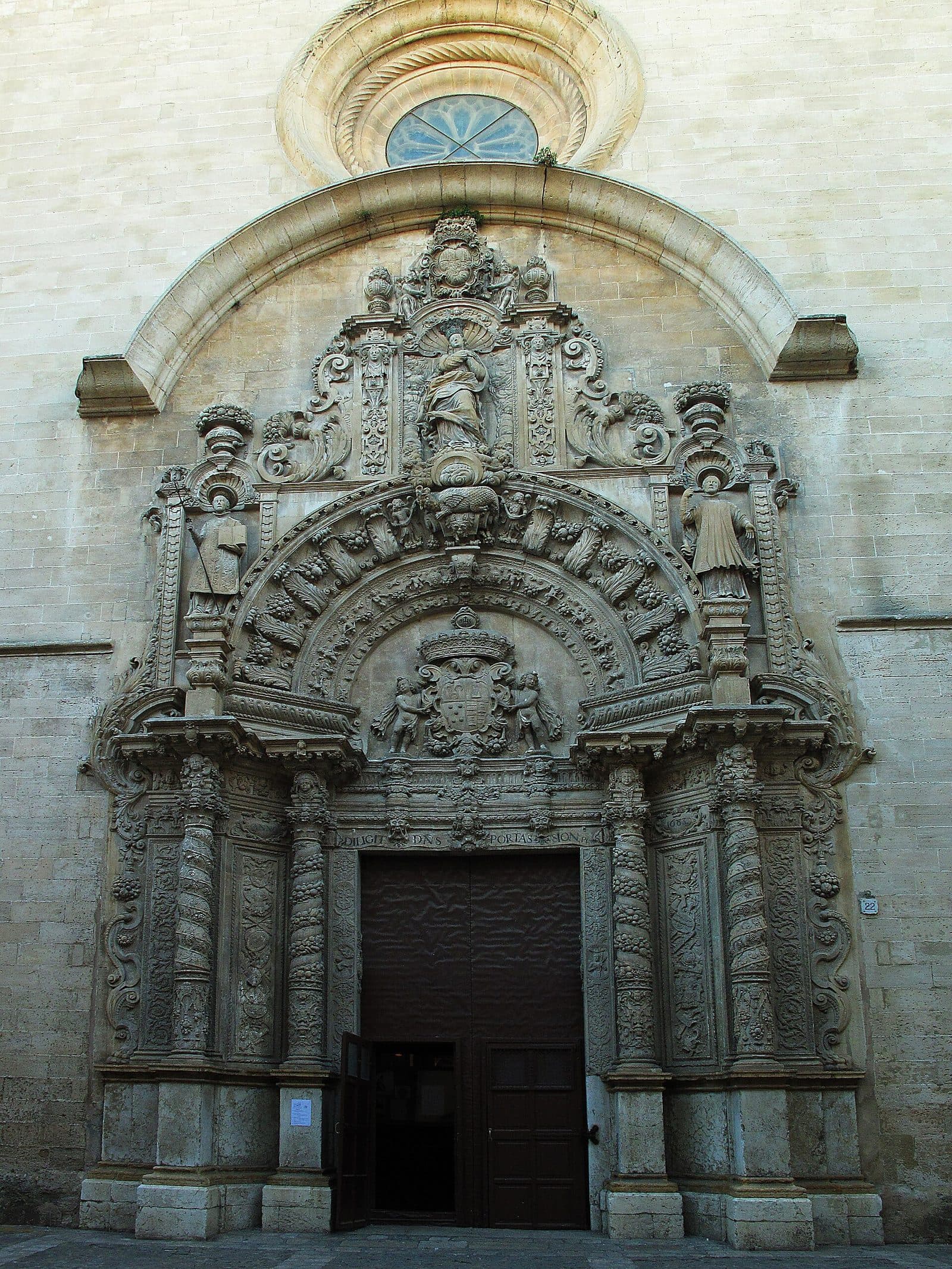
In the heart of Palma’s densely built old town, the façade of Monti-sion opens up like a picture book carved in stone. Twisted columns, statues of saints, coats of arms and religious symbols cover the portal. Those who merely hurry past see a Baroque church; those who look more closely encounter a place where Jewish history, Jesuit history and Catholic imagery overlap.
Monti-sion is the historic church in Palma’s former Jewish quarter. Its appeal lies in the city’s history and in its distinctive church portal. The building is especially worthwhile for visitors who regard architecture as more than an attractive backdrop: the façade reveals the founder, the first saints of the Jesuit order, the Immaculate Conception and the coat of arms of Ignatius von Loyola. Inside, the clear spatial arrangement continues with a single-nave church and side chapels.
Even without a long stay, Monti-sion adds an important perspective to a tour of the old town. The church stands where the main synagogue of the Jewish quarter once stood. The present building therefore tells not only of Baroque piety but also of the profound historical ruptures in Palma’s Call Major.
History and Significance
The Main Synagogue of the Call Major
Beneath the church lies the oldest and at the same time most difficult layer of its history. Monti-sion was built on the walls or over the remains of the former main synagogue. The site belonged to the Call Major, Palma’s large Jewish quarter. Around the year 1300, King Jaume II. ordered the Jewish population to relocate to this part of the city. The present church therefore cannot be understood separately from its quarter: long before its construction, the site had already been shaped by religion and community life.
The visible church building does not preserve the synagogue as an unchanged historical space. Instead, through its location and construction history, the site recalls the fundamental transformation of the quarter. It is precisely this layering that makes Monti-sion significant: the Baroque façade confidently displays the Catholic and Jesuit identity of the later building, while the history of the property extends far beyond it.
The Arrival of the Jesuits
The Jesuits came to Mallorca in 1561, and Monti-sion became their first seat on the island. This connection can still be seen in several places today. Ignatius von Loyola and Franz Xaver, two central figures in the early history of the order, flank the main portal. Higher up, the coat of arms of Ignatius appears again. Inside the church, the tomb of the Jesuit brother Alphonsus Rodríguez recalls the community’s everyday life. He served for many years as the porter of Monti-sion and was later venerated as a saint.
Suppression and Return of the Order
The history of the Jesuits at Monti-sion was not without disruption. Because of its religious, cultural and social influence, the order was politically controversial and was suppressed between 1767 and 1815. As a result, the church’s original custodians temporarily lost their institutional position. The building itself, however, remained as evidence of the era in which the Jesuits had permanently expressed their presence on Mallorca in stone.
Today, Monti-sion is chiefly of interest as a historic church and as part of the old town’s cultural memory. Its significance does not derive from a single construction phase: a Jewish sacred site, a Jesuit establishment and a Baroque church succeeded one another in the same place. Those familiar with this sequence see the portal differently—not merely as elaborate decoration, but as a visible explanation of who shaped the site in the modern era.
What to See
The Main Portal
The eye is almost inevitably drawn to the entrance. Solomonic columns, meaning columns twisted into a spiral, and pilasters give the portal depth. Floral motifs visually soften the heavy architectural forms and draw the eye from the lower structural elements to the figures and coats of arms above. Instead of a smooth wall, the result is a dynamic showpiece whose details only gradually fall into place.
The tympanum contains the large coat of arms of Ramon de Verí, the church’s founder. Two angels carry or accompany it. The coat of arms is therefore not treated as a minor signature but occupies a prominent position on the façade. It links personal patronage, religious representation and the building’s history.
A step-by-step approach is worthwhile. First, take in the columns, pilasters and plant ornaments; then the figures and their relationships to one another emerge. Individual details impress at close range, while from a little farther away the rigorously structured overall composition becomes clear.
Ignatius von Loyola and Franz Xaver
Ignatius von Loyola stands to the left of the tympanum and Franz Xaver to the right. Both are among the first saints of the Jesuit order and identify the building’s spiritual affiliation before visitors even enter the church. Their symmetrical arrangement is not incidental façade decoration: they frame the entrance like two symbolic guardians and immediately identify Monti-sion as a Jesuit site.
At Monti-sion, the two figures form a concise depiction of Jesuit identity in stone. Those who recognize them will also understand that the coat of arms of Ignatius placed higher up is not an isolated ornament, but a repetition and affirmation of the order’s visual program.
The Immaculate Conception
The Immaculate Conception appears above the portal. The figure of Mary stands over a crescent moon; beneath her, the devil is depicted as an animal-like creature. The motif translates a theological statement into an immediately readable hierarchy: Mary is above, while vanquished evil lies below. This vertical drama makes the façade vivid even when not every symbol is familiar at first glance.
Higher still is the coat of arms of Ignatius von Loyola. A semicircular projection protects the sculpturally elaborate portal area. Above it, the façade becomes visibly calmer: a rose window with comparatively simple surrounds and a triangular pediment complete the composition. The contrast between the lavish portal and the more restrained upper section is one of the front’s most appealing features.
The Nave
Behind the densely narrative façade lies a clearly structured interior. Monti-sion has a single main nave. Six side chapels open along each side, so that the eye is directed straight toward the rectangular chancel while also being repeatedly drawn to the sides.
A barrel vault with lunettes spans the nave. Fluted pilasters support and articulate the wall sections. This arrangement gives the space a distinct rhythm: chapel, pilaster and section of vault follow one another, while the longitudinal axis leads to the presbytery. The architecture thus feels cohesive without appearing completely undifferentiated.
Visitors who can enter the interior should not immediately move from chapel to chapel. A first view along the central axis makes the layout clear. The side spaces can then be understood more easily as parts of a coherent system. The church is not a collection of independent artworks but a carefully composed sacred space.
The Tomb of Ramon de Verí
The tomb of Ramon de Verí is located to the left of the presbytery. Visitors will already know his name from the façade, where the coat of arms flanked by angels highlights the founder. This creates a direct connection between exterior and interior: outside the church, visitors encounter his heraldic emblem; near the liturgical center, they find his burial place.
This interplay is easy to overlook if the façade and interior are viewed separately. Yet it provides a key to understanding the building. The act of patronage is not preserved only in an inscription or a remote monument but forms part of the entrance’s visual program and the church’s spatial organization.
The Chapel of Alphonsus Rodríguez
Alphonsus Rodríguez is buried in the first side chapel on the left. The Jesuit brother served for many years as the porter of Monti-sion. His role may initially sound unremarkable, but it involved direct contact with everyone who came to the community’s door. He was later canonized, and his tomb gave his everyday service at the entrance a significance extending far beyond his lifetime.
For visitors, the chapel is one of the church’s most personal details. Among the great names in the order’s history and the prominent founder appears a man whose work was associated with opening the door and welcoming people. The location in the first chapel on the left is remarkably appropriate to his biography: his memory remains physically close to the entrance where his service began.
The Calle del Vent
A local legend is connected to a former side exit leading into the narrow Calle del Vent. The lane takes its name from the draft that can be felt there. According to the story, the devil demanded the souls of the congregation. Jesus, however, allowed him to take only those people who left the church through this side exit.
The story is not part of the documented architectural chronology, but it is a vivid piece of local tradition. It links the tangible character of a windy lane with religious morality and the old side exit. Those who walk through the quarter after visiting the church therefore encounter not only streets and façades but also a setting to which a story has been attached for generations.
Visiting Monti-sion
Read the Façade First
Monti-sion is best explored from the outside inward. In front of the portal, first choose a position with enough distance to see the rose window, pediment and portal area together. Then examine the twisted columns, floral motifs, angels and figures at close range. This sequence prevents the wealth of detail from obscuring the overall structure.
The façade is easy to navigate: Ignatius von Loyola stands on the left and Franz Xaver on the right. Between or above them come the coat of arms of Ramon de Verí, the depiction of the Immaculate Conception and, higher up, the coat of arms of Ignatius. Those who know this sequence before visiting do not need a lengthy art-historical explanation to understand the program.
Inside the Church
If the church is accessible, the most useful route first leads through the main nave toward the presbytery. From there, the spatial arrangement of the side chapels and barrel vault can be understood clearly. On the way back, visitors can specifically look at the tomb of Ramon de Verí to the left of the presbytery and the chapel of Alphonsus Rodríguez on the left side.
Monti-sion is a sacred space, not an exhibition hall. Quiet and respectful behavior is therefore expected. No extensive planning is needed for the visit; anyone wishing to connect the façade, interior and history of the former Jewish quarter, however, should not reduce the stop to a quick photograph.
Check Access in Advance
Reliable general opening hours and a current admission price have not been recorded. Anyone planning a dedicated visit should therefore check access shortly beforehand. This is especially important if the interior is the main reason for going. The façade, by contrast, can be examined in detail as part of a tour of the old town regardless of access.
There is no generally documented best time of day for avoiding crowds. Rather than following a rigid recommendation, it is more practical to include Monti-sion in a quiet section of an old-town walk and return later if access is restricted. Even when the door is closed, the portal, the setting within the Call Major and the nearby Calle del Vent remain worth seeing.
Getting There and Parking
From the Airport to Palma
From Palma Airport, the route follows the Ma-19 into the island’s capital. The road distance to Palma is 11 kilometers, and the journey takes around 20 minutes. These details apply explicitly to the route from the airport into the city, not directly to the church portal. Monti-sion is then located in the historic center, where the final streets are significantly narrower and more intricate than the approach via the Ma-19.
For the onward journey, the name of the church alone should therefore not serve as the destination. What matters is its location in Palma’s old town, in the former Jewish quarter. The final section is easiest to cover on foot. This also places the church within its historic urban setting instead of merely allowing visitors to get out at the façade and then drive away again.
By City Bus
Several stops are within walking distance of the quarter. These include pl. de Cort, Porta des Camp 2, Porta des Camp and pl. de sa Quartera. From there, the remainder of the route leads through the old town. Pl. de Cort is suitable for approaching from the central part of the city; Porta des Camp approaches Monti-sion from the eastern edge of the historic center.
The most convenient stop depends on the particular bus route and the rest of the planned old-town itinerary. Since the church lies within a dense network of streets, the shortest walking distance is not the only consideration. Those who also wish to explore the Call Major can deliberately route their walk through the quarter and visit Monti-sion as a historical focal point rather than an isolated destination.
Parking and the Final Approach
The immediate surroundings consist of narrow old-town streets. From the edge of the old town, the character of the route changes quickly: Palma’s large approach roads give way to smaller streets, closely spaced façades and short sightlines. This transition itself forms part of the approach to Monti-sion, since the façade belongs to a historically evolved urban quarter.
Bus lines to Monti-sion at a glance
| Line | Route | Departures/day | First | Last |
|---|---|---|---|---|
| 501 | Manacor - Campos - Palma | 208 | 05:38 | 23:58 |
| 504 | Tolleric - Palma | 109 | 06:13 | 23:13 |
| 501e | Campos - Palma, exprés | 59 | 06:50 | 20:50 |
| 515e | Cala d'Or - Palma | 10 | 10:30 | 19:15 |
| N1 | Portopí - Porta des Camp | 4 | 00:55 | 23:55 |
| 25 | s'Arenal - Pl. Reina | Catedral | 2 | 10:38 | 10:44 |
| 512 | Portocolom - Felanitx | 1 | 08:05 | 08:05 |
From the official GTFS feeds (TIB/SFM), no real-time data. The figures cover all stops in the town; weekend and holiday services differ — check with the operator before travelling.
Getting there by bus
662-pl. de Cort · 0.3 km as the crow flies
- CCCircular Centre Ciutat · 08:00–08:00 · Daily
Porta des Camp 2 (40002) · 0.3 km as the crow flies
- 501Manacor - Campos - Palma · Daily
- 501eCampos - Palma, exprés · Mon-Sat
- 504Tolleric - Palma · Daily
- 515eCala d'Or - Palma · Mon-Fri
458-Porta des Camp · 0.3 km as the crow flies
- 23s'Arenal / Parc Aquàtic - Pl. Espanya · 06:27–21:50 · Daily
- 25s'Arenal - Pl. Reina | Catedral · 06:36–21:01 · Daily
- 30Marivent-Palau de Congressos · 08:00–08:00 · Daily
- 31Sant Jordi - Sindicat · 08:00–08:00 · Daily
- 35Aquàrium - Pl. Reina | Catedral · 06:21–22:41 · Daily
- A1Aeroport - Palma Centre · 08:00–08:00 · Daily
- N1Portopí - Porta des Camp · 08:00–08:00 · Daily
664-pl. de sa Quartera · 0.4 km as the crow flies
- CCCircular Centre Ciutat · 08:00–08:00 · Daily
450-Porta des Camp · 0.4 km as the crow flies
- 19UIB i Parc Bit - Porta des Camp · 05:46–22:12 · Daily
- 23s'Arenal / Parc Aquàtic - Pl. Espanya · 06:27–21:50 · Daily
- 31Sant Jordi - Sindicat · 08:00–08:00 · Daily
- 35Aquàrium - Pl. Reina | Catedral · 06:21–22:41 · Daily
- A1Aeroport - Palma Centre · 08:00–08:00 · Daily
- N1Portopí - Porta des Camp · 08:00–08:00 · Daily
Porta des Camp 1 (40108) · 0.4 km as the crow flies
- 501Manacor - Campos - Palma · Daily
- 501eCampos - Palma, exprés · Mon-Sat
- 504Tolleric - Palma · Daily
- 512Portocolom - Felanitx · Daily
- 515eCala d'Or - Palma · Mon-Fri
663-pl. d'en Coll · 0.4 km as the crow flies
- CCCircular Centre Ciutat · 08:00–08:00 · Daily
451-Escola Graduada · 0.4 km as the crow flies
- 12Sa Garriga - Nou Llevant · 08:00–08:00 · Daily
- 24Antiga Presó - Nou Llevant · 06:33–21:18 · Daily
- 31Sant Jordi - Sindicat · 08:00–08:00 · Daily
- N1Portopí - Porta des Camp · 08:00–08:00 · Daily
983-Jutjats Nous · 0.4 km as the crow flies
- CCCircular Centre Ciutat · 08:00–08:00 · Daily
969-Porta des Camp · 0.4 km as the crow flies
- 30Marivent-Palau de Congressos · 08:00–08:00 · Daily
457-Escola Graduada · 0.5 km as the crow flies
- 31Sant Jordi - Sindicat · 08:00–08:00 · Daily
- N1Portopí - Porta des Camp · 08:00–08:00 · Daily
106-pl. del Mercat · 0.5 km as the crow flies
- 3Pont d'Inca / Joan Carles I · 08:00–08:00 · Daily
- 4Ses Illetes - Pl. Columnes · 08:00–08:00 · Daily
- 7Son Gotleu - Son Serra - Sa Vileta / Son Vida · 08:00–08:00 · Daily
- 20Portopí - Son Espases · 06:06–22:40 · Daily
Timetable data: official GTFS feeds (TIB/EMT), no real-time — check with the operator before travelling.
Nearby Sights
The Call Major
Monti-sion belongs on a walk through the former Call Major. The quarter was a center of Jewish life in Palma and became the compulsory residential area for the Jewish population around the year 1300. The church above the former main synagogue is therefore one of the places where the eventful history of this district becomes especially clear.
A walk should not be limited to searching for visible remains of the synagogue. The structure of the quarter itself is more revealing: narrow streets, closely spaced buildings and the alternation between religious, private and representative architecture. Monti-sion provides the historical anchor from which the transformation of the former Jewish urban space can be understood.
La Seu, Cort and La Calatrava
Within the old town, the Monti-sion quarter borders La Seu, Cort, Sindicat and La Calatrava. This makes it easy to include the church in a longer walk through historic Palma without a detour. From the central area around Plaça de Cort, the route leads toward the former Jewish quarter; from the city wall and Porta des Camp, the approach passes through La Calatrava.
Between these different urban areas, Monti-sion is particularly suitable as a transition point: from the familiar center to a history that is less immediately visible in the ordinary cityscape.
The Calle del Vent
The Calle del Vent is more than an attractive name on the city map. The narrow lane was named for its constant draft and was once connected to the church by a side exit. Its legend of the devil gives a short detour a narrative twist.
Those leaving Monti-sion can regard this lane as a continuation of the church visit. The portal explains the official Jesuit imagery, while the Calle del Vent preserves a popular tradition. Both form part of the same site’s history and reception: here, the carefully composed stone façade; there, a story probably passed down chiefly by word of mouth.
The place it belongs to
Palma in the place guidePractical Information for Your Visit
Identifying Monti-sion in Palma
The site in question is the church of Monti-sion in Palma’s old town. It can be recognized by its urban setting and richly elaborated Baroque portal. The Call Major, the proximity of Plaça de Cort and Porta des Camp, and the name Església or Iglesia de Monti-sion provide additional orientation.
For Families
With children, the visit works best as a search for specific details on the façade. The twisted columns, the two angels beside the coat of arms, Ignatius on the left, Franz Xaver on the right and the animal-like creature beneath Mary create a manageable sequence of discoveries. In this way, the complex religious imagery becomes an observable story.
Inside, the building’s function as a church requires quiet behavior. The visit can easily be combined with a walk through the short old-town lanes without having to tackle an extensive exhibition. The legend of the former exit to the Calle del Vent is especially memorable, provided it is presented as a local story rather than a historical fact.
What Monti-sion Is Not
Do not expect a large museum-style presentation. Its appeal lies in looking closely: at the portal’s structure, the link between the founder’s coat of arms and his tomb, and the location above the former main synagogue. Even when the interior is closed, the site is therefore not without significance.
Monti-sion in Palma is an urban historical site. Its strongest impressions emerge at close range—between the church façade, the narrow lane and the knowledge of the different faith communities that shaped this place.
Respect and Accessibility
Monti-sion is a church, so conversations should remain quiet. Visitors should observe the applicable guidance regarding photography inside.
Reliable information about step-free access is not available; anyone with corresponding requirements should therefore check current accessibility before visiting. The same applies to access to the church interior. Regardless of this, the façade and its setting within the old-town quarter can be included in a city walk.
Local insider tips
Read the Portal from the Bottom Up
First examine the twisted columns and floral motifs, then let your gaze travel over the coat of arms of Ramon de Verí and the figure of Mary to the rose window. This turns the richly ornamented front into an understandable sequence of images.
First Chapel on the Left
Alphonsus Rodríguez is buried in the first side chapel on the left. The later saint served for many years as the porter of Monti-sion—a quiet detail that fits the location of his chapel near the entrance.
Detour to the Windy Lane
The nearby Calle del Vent owes its name to the draft that can be felt there. A legend connects the church’s former side exit with a pact under which the devil was to receive only the souls of those who left through it.
Keep the Call Major in Mind
Monti-sion gains depth when the visit forms part of a walk through the former Call Major. The church was built over the former main synagogue and therefore also tells of the ruptures in Jewish history in Palma.
Find the Old-Town Church
Look for the old-town church in Palma with its Baroque portal. The Call Major, the proximity of Plaça de Cort and Porta des Camp, and the name Església or Iglesia de Monti-sion provide useful orientation.