
Can Muntaner Palma: Historic Patio on Carrer de Sant Alonso
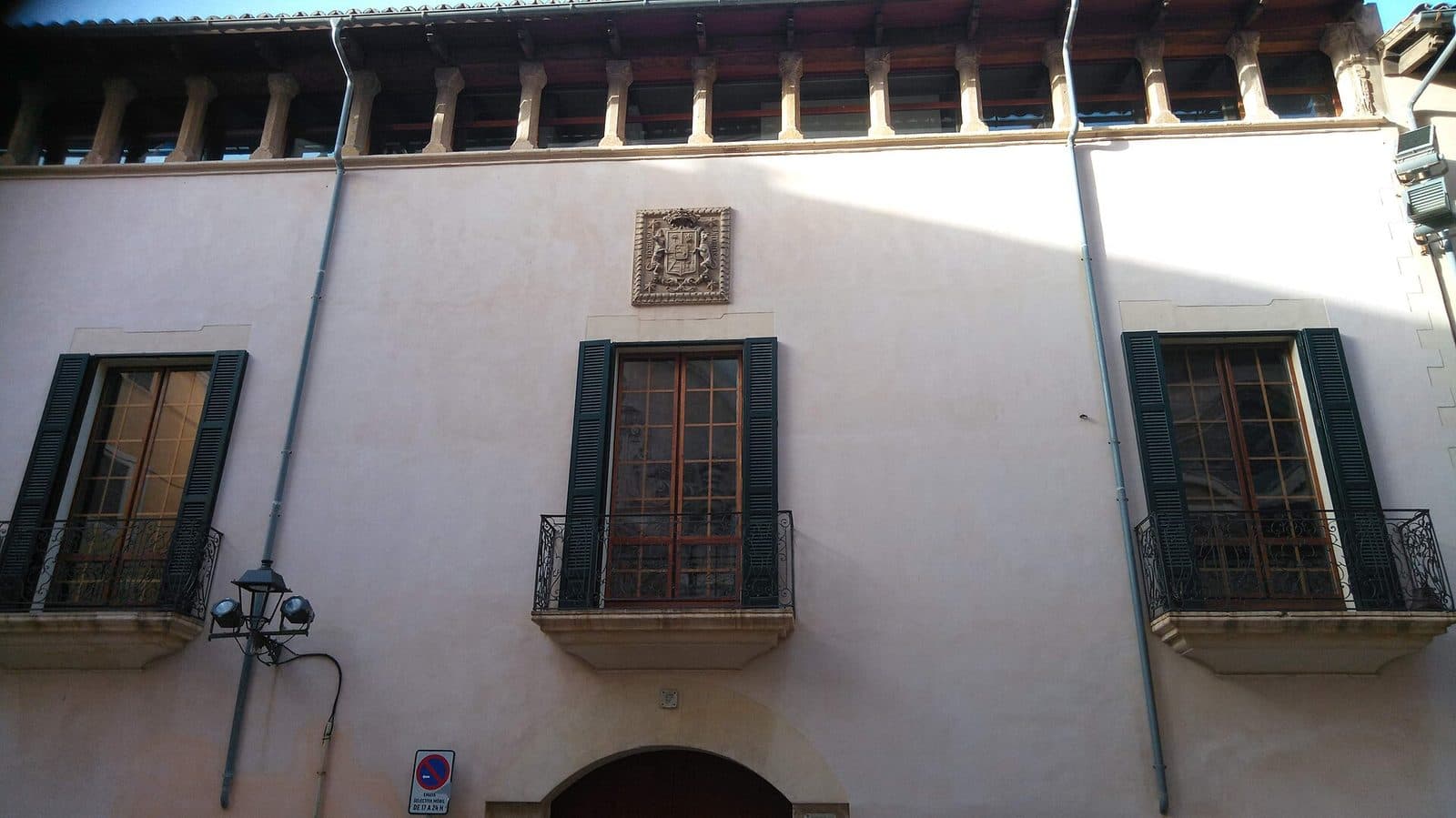

Can Muntaner is one of Palma's historic houses whose importance cannot be read from a monumental façade. The building stands on Carrer de Sant Alonso in the southeastern Old Town. Its true historical testimony is the patio: it is considered the only surviving remnant of an earlier building, preserving an older layer of the city's history within a house constructed later.
A visit is especially worthwhile for travelers who want to understand Palma beyond its major landmarks. Can Muntaner does not tell a story of kings, sieges, or ecclesiastical splendor, but of the city's private architecture. A wood-ceilinged entrance area, a shallow arch, and a Catalan-style staircase are enough to show how a townhouse organized its spaces and staged the transition from the street to the interior. Can Muntaner is therefore not a conventional museum with a sequence of halls, but a focused architectural stop where close observation is more rewarding than a long tour.
Anyone who appreciates patios, historic residences, and the quieter lanes of the Old Town will find a vivid detail of Palma's architectural history here. As a destination in its own right, it is fairly small; it works particularly well as a stop on a walk through the old southeastern part of the city.
History and significance
The house's present form is dated to the late 18th or early 19th century, while its patio apparently preserves parts of an older structure. This distinction is important: the house seen today and the earlier building that survives within it represent two different historical layers.
The house of the late 18th and early 19th centuries
At Can Muntaner, this survival is especially clear in the patio. The house was not built as an isolated new structure on a site without history; part of the previous complex was retained and incorporated into the later building.
The accepted dating deliberately describes a transition between two centuries, as no more precise year has been established for Can Muntaner. The Muntaner family gave the house its name, but no direct connection to the chronicler Ramon Muntaner has been documented.
The patio as a remnant of the earlier building
The courtyard is considered the probable sole remnant of the earlier building. This gives an architectural element that might initially appear merely to be an access and transitional space within a townhouse particular value as historical evidence. The patio demonstrates that houses in an organically developed Old Town rarely belong to only one period. New construction, alterations, and reuse can overlap within a confined space.
Restraint is part of an accurate interpretation: based on the available information, the earlier building can neither be dated with certainty nor comprehensively reconstructed. Can Muntaner does not tell its story through a fully preserved sequence of old rooms, but through one surviving architectural remnant. For that very reason, attention turns to its construction and transitions—to the entrance, the arch, and the staircase that structure the patio.
A testament to private urban architecture
Among the cathedral, palaces, and monasteries, it is easy to overlook the extent to which Palma's historic appearance is also shaped by residential buildings. Can Muntaner makes this private side of the Old Town tangible. The building represents an architecture not designed for impact from afar. Its quality becomes apparent only beyond the street frontage, where the route unfolds from the entrance into the courtyard and onward through the house.
Its significance therefore lies less in a single spectacular artwork than in its preserved spatial organization. Can Muntaner shows how an older patio could continue to exist within a later house. This understated evidence is valuable for understanding Palma: the city's history consists not only of clearly separated stylistic periods, but also of reused structural elements and floor plans carried forward over time.
What to see
The essential view at Can Muntaner leads from the street inward. What follows is not an extensive palace complex, but a short, clearly legible sequence: entrance area, arch, patio, and staircase. The few securely documented architectural elements deserve attention because each performs a distinct role in organizing the house.
The patio
The patio is the historic heart of Can Muntaner. It is regarded as the only surviving remnant of the earlier building and is therefore older than the house's present form, which is dated to the transition from the 18th to the 19th century. Visitors should consequently not regard the courtyard merely as a decorative interior space. It is the architectural element that provides evidence of the house's earlier history.
At Can Muntaner, this spatial transition survives in particularly compact form. The architecture is not explained through a single frontal view, but by mentally passing through it: from the entrance through the vestibule, beneath the wooden ceiling, and under the arch toward the staircase.
The patio is also the best reason not to confuse Can Muntaner in passing with another historic house. Here, the name refers specifically to the building on Carrer de Sant Alonso. The Son Muntaner golf course, villas with the same name, and people with the surname Montaner have no connection to this architectural monument.
The entrance area with its wooden ceiling
Before the courtyard is a Zaguán, a traditional entrance and passageway. Its most striking feature is the wooden ceiling. It marks the first section between the street and the patio, giving the entrance its own spatial frame. Instead of revealing everything immediately, this area guides visitors gradually into the house.
It is especially worthwhile to shift your line of sight here. The wooden ceiling is not merely a material detail overhead, but part of the architectural composition. It visually unifies the passage before the adjoining arch announces a new zone. Can Muntaner can thus be read as a sequence of thresholds, even though only a few elements have been documented and publicly described.
The segmental arch
A shallow segmental arch separates the entrance area from the adjoining staircase. Unlike a semicircular round arch, a segmental arch rises only relatively gently. At Can Muntaner it has a clear organizational function: it brings the covered entrance to a close and visually leads toward the area containing the staircase.
The arch is one of those details easily overlooked when attention is focused exclusively on the patio. Yet it is precisely this feature that explains the interior organization: it separates spaces without completely dissolving their spatial connection. Together, the wooden ceiling and arch form the best-documented architectural introduction to the house.
The Catalan-style staircase
Beyond the segmental arch is a Catalan-style staircase. Today it stands within an enclosed or covered area. The term used in the sources refers to its construction and regional tradition; however, no reliable details about its decoration, railings, or precise sequence of steps have been recorded.
For visitors, its position is particularly important. The staircase continues from the passage and connects the ground-level patio with the house's other levels. This makes the courtyard not merely an open interior space, but a circulation hub within the residence. The entrance, arch, and staircase establish a clear direction of movement, even if not all adjoining areas are accessible.
How the architectural elements work together
The strength of Can Muntaner lies in the relationship between these elements. Viewed individually, the wooden ceiling, arch, and staircase would remain isolated architectural terms. In sequence, however, they show how access was organized: first a covered transition, then a boundary marked by an arch, and finally vertical circulation beside the patio.
This is not a place with a long list of lavish state rooms. Visitors should instead consider the logic of the floor plan: Where does the street end? At what point does the courtyard begin? How is the route to the staircase framed? Can Muntaner rewards this precise, almost archaeological way of looking.
Visiting Can Muntaner
Can Muntaner is best experienced as a brief architectural stop. The visit begins on Carrer de Sant Alonso itself, as the house forms part of a densely built Old Town street and was not designed as a freestanding monument. The key is to identify the correct entrance and then pay attention to the spatial sequence inside.
Access and viewing opportunities
No reliable general opening hours or confirmed admission price have been recorded. Before planning a dedicated visit, you should therefore check whether and to what extent the patio is currently accessible. A historic courtyard inside an occupied building is not automatically open at all times like a public museum, and an open entrance door is not an invitation to enter private or restricted areas.
This limitation changes what visitors should expect. Can Muntaner is not a destination that requires half a day in the city on its own. Instead, the patio works well as a deliberately planned stop on a route through the southeastern Old Town. If a view inside is possible, attention should focus on the entrance's wooden ceiling, the segmental arch, and the staircase beyond it.
Length and nature of a visit
It is not meaningful to specify a fixed visit duration because this depends on the access available at the time. A focused stop is sufficient for the architecture itself; anyone wishing to study the forms, transitions, and historical context more closely will naturally stay longer. There is no evidence of a tour through numerous rooms or an extensive exhibition, so neither should be expected.
The visit is most rewarding when Can Muntaner is not treated as an isolated box to tick. The patio gains meaning when compared with Palma's other historic courtyards and residences. After walking through several Old Town lanes, it becomes clear that the threshold between street, Zaguán, and courtyard is a recurring theme in local architecture—with the special distinction at Can Muntaner that the courtyard is considered a remnant of an earlier building.
Time of day and crowds
There is no reliable information about typical peak visiting times. As the possibility of access is more important than any supposedly ideal time for light or quiet, current access conditions should be checked first. Anyone combining the site with other Old Town destinations can fit the stop flexibly into a walk instead of making the entire route dependent on Can Muntaner.
Consideration matters more than speed here. The entrance area is a confined transitional space, not a place for groups to gather for long periods. Anyone wishing to take photographs should observe notices on site, keep passageways clear, and avoid entering closed areas. This allows the patio to remain perceptible as a historic place without disrupting its present-day use.
Getting there and parking
From Palma Airport, the route initially follows the Ma-19 into the island's capital. The road distance to Palma is 11 kilometers, and the journey takes around 20 minutes. These figures refer expressly to the route as far as Palma, not directly to Can Muntaner's entrance. The final section leads into the denser city center and onward to Carrer de Sant Alonso in the Old Town.
The final stretch to Carrer de Sant Alonso
Carrer de Sant Alonso lies in the southeastern part of the historic center. Narrow streets, one-way systems, and zones with restricted vehicle access shape the journey there. An up-to-date navigation system is helpful but does not replace close attention to road signs. Notices concerning ACIRE zones should be taken particularly seriously, as vehicle access may be restricted in these areas.
For a visit, it is usually more pleasant to leave your vehicle outside the narrowest Old Town lanes and cover the final section on foot. Can Muntaner has no documented visitor parking directly at the house. Attempting to drive right up to the entrance therefore offers little advantage and can become unnecessarily complicated on the narrow streets.
Parking in Palma
Visitors arriving by car will find regulated street parking and parking garages in Palma. Searching for a space in the Old Town is more demanding than in the outer districts, however. Colored road markings and local access rules must be checked on site; an open stretch of road does not automatically mean that unrestricted parking is permitted there.
A practical option is to leave the car in a regular parking garage or at a clearly permitted space and make Can Muntaner part of a longer walk. This not only reduces the need to search through narrow lanes, but also suits the attraction better: historic patios, façades, and streetscapes can be appreciated far more closely on foot.
Arriving by bus
Several bus stops serve this part of the Old Town. The areas around Plaça de Cort, Plaça de sa Quartera, and Porta des Camp are useful reference points. From there, the route continues on foot through the historic street network to Carrer de Sant Alonso. The most convenient connection depends on your starting point and the current timetable.
Traveling by public transport avoids the access and parking issues of the Old Town. Since Can Muntaner is best combined with a walk anyway, the route from the bus stop is not merely a final connecting section, but part of the approach to the house and its urban surroundings.
Bus lines to Can Muntaner at a glance
| Line | Route | Departures/day | First | Last |
|---|---|---|---|---|
| 501 | Manacor - Campos - Palma | 208 | 05:38 | 23:58 |
| 504 | Tolleric - Palma | 109 | 06:13 | 23:13 |
| 501e | Campos - Palma, exprés | 59 | 06:50 | 20:50 |
| 515e | Cala d'Or - Palma | 10 | 10:30 | 19:15 |
| N1 | Portopí - Porta des Camp | 4 | 00:55 | 23:55 |
| 25 | s'Arenal - Pl. Reina | Catedral | 2 | 10:38 | 10:44 |
| 512 | Portocolom - Felanitx | 1 | 08:05 | 08:05 |
From the official GTFS feeds (TIB/SFM), no real-time data. The figures cover all stops in the town; weekend and holiday services differ — check with the operator before travelling.
Getting there by bus
662-pl. de Cort · 0.3 km as the crow flies
- CCCircular Centre Ciutat · 08:00–08:00 · Daily
664-pl. de sa Quartera · 0.4 km as the crow flies
- CCCircular Centre Ciutat · 08:00–08:00 · Daily
Porta des Camp 2 (40002) · 0.4 km as the crow flies
- 501Manacor - Campos - Palma · Daily
- 501eCampos - Palma, exprés · Mon-Sat
- 504Tolleric - Palma · Daily
- 515eCala d'Or - Palma · Mon-Fri
458-Porta des Camp · 0.4 km as the crow flies
- 23s'Arenal / Parc Aquàtic - Pl. Espanya · 06:27–21:50 · Daily
- 25s'Arenal - Pl. Reina | Catedral · 06:36–21:01 · Daily
- 30Marivent-Palau de Congressos · 08:00–08:00 · Daily
- 31Sant Jordi - Sindicat · 08:00–08:00 · Daily
- 35Aquàrium - Pl. Reina | Catedral · 06:21–22:41 · Daily
- A1Aeroport - Palma Centre · 08:00–08:00 · Daily
- N1Portopí - Porta des Camp · 08:00–08:00 · Daily
663-pl. d'en Coll · 0.4 km as the crow flies
- CCCircular Centre Ciutat · 08:00–08:00 · Daily
450-Porta des Camp · 0.4 km as the crow flies
- 19UIB i Parc Bit - Porta des Camp · 05:46–22:12 · Daily
- 23s'Arenal / Parc Aquàtic - Pl. Espanya · 06:27–21:50 · Daily
- 31Sant Jordi - Sindicat · 08:00–08:00 · Daily
- 35Aquàrium - Pl. Reina | Catedral · 06:21–22:41 · Daily
- A1Aeroport - Palma Centre · 08:00–08:00 · Daily
- N1Portopí - Porta des Camp · 08:00–08:00 · Daily
Porta des Camp 1 (40108) · 0.4 km as the crow flies
- 501Manacor - Campos - Palma · Daily
- 501eCampos - Palma, exprés · Mon-Sat
- 504Tolleric - Palma · Daily
- 512Portocolom - Felanitx · Daily
- 515eCala d'Or - Palma · Mon-Fri
983-Jutjats Nous · 0.4 km as the crow flies
- CCCircular Centre Ciutat · 08:00–08:00 · Daily
451-Escola Graduada · 0.5 km as the crow flies
- 12Sa Garriga - Nou Llevant · 08:00–08:00 · Daily
- 24Antiga Presó - Nou Llevant · 06:33–21:18 · Daily
- 31Sant Jordi - Sindicat · 08:00–08:00 · Daily
- N1Portopí - Porta des Camp · 08:00–08:00 · Daily
969-Porta des Camp · 0.5 km as the crow flies
- 30Marivent-Palau de Congressos · 08:00–08:00 · Daily
457-Escola Graduada · 0.5 km as the crow flies
- 31Sant Jordi - Sindicat · 08:00–08:00 · Daily
- N1Portopí - Porta des Camp · 08:00–08:00 · Daily
106-pl. del Mercat · 0.5 km as the crow flies
- 3Pont d'Inca / Joan Carles I · 08:00–08:00 · Daily
- 4Ses Illetes - Pl. Columnes · 08:00–08:00 · Daily
- 7Son Gotleu - Son Serra - Sa Vileta / Son Vida · 08:00–08:00 · Daily
- 20Portopí - Son Espases · 06:06–22:40 · Daily
Timetable data: official GTFS feeds (TIB/EMT), no real-time — check with the operator before travelling.
Nearby attractions
Around Carrer de Sant Alonso, Palma reveals a more intimate side than it does along its major squares and shopping streets. The lanes of the southeastern Old Town are shaped by historic residences, religious buildings, and former city entrances. Can Muntaner fits into this setting as a quiet architectural point that works best as part of a city walk.
The southeastern Old Town
Several historical themes can be connected in this part of Palma: private townhouses and patios, as well as religious architecture. Can Muntaner provides the residential scale. Rather than creating a monumental external impression, the house shows how history can survive in an entrance and an interior courtyard.
Nearby stops include the Banys Àrabs and the Museu de Mallorca. Both have a different focus from Can Muntaner and, for that very reason, help place it in context. While the patio is a single piece of architectural evidence within a house, the museum and historic baths offer broader perspectives on Palma's past.
Porta des Camp and the historic street network
Porta des Camp is a useful reference point on the edge of this part of the Old Town, from which Can Muntaner can be reached on foot through older streets. Plaça de Cort and Plaça de sa Quartera can also be included in a walking route. They serve not only as areas with bus stops, but also connect different parts of the historic center. Travelers without a rigid itinerary can plan Can Muntaner as a short, precise architectural episode between these points.
The cathedral and Almudaina
La Seu and the Almudaina royal palace lie within the wider Old Town and provide a deliberate contrast. There, representative architecture, large volumes, and the history of secular and ecclesiastical power dominate the scene. Can Muntaner then redirects attention to the smaller scale of an urban residence.
Such a combination is more rewarding than expecting Can Muntaner itself to provide an extensive sightseeing program. The patio becomes easier to understand when other forms of Palma's architecture are seen before or afterward. The understated courtyard remnant then becomes evidence of how many layers the Old Town contains beyond its famous monuments.
The place it belongs to
Palma in the place guidePractical information for your visit
The most important practical point concerns expectations: Can Muntaner is a historic house with a noteworthy patio, not a comprehensively documented museum. There is no evidence of a permanent exhibition, publicly accessible state rooms, or a regular tour through every floor. Anyone visiting specifically for the courtyard should check the current access situation in advance.
Look closely rather than expecting a lot
The visit focuses on a small number of elements. First comes the covered entrance area, followed by the wooden ceiling, the shallow segmental arch, and the Catalan-style staircase. This sequence helps visitors see the patio not merely as an attractive subject, but as part of a functioning residential structure. The essential features lie in the transitions between the architectural elements.
For photography, a complete view through the entrance is often less informative than examining the details separately. Before taking a picture, however, check whether any notices restrict photography. Doors, barriers, and the visible separation of private areas must be respected. The house's historical value does not justify entering areas that have not been opened to visitors.
Visiting with children
For families, Can Muntaner is best suited to a short stop during a walk through the Old Town. Children can look for the three clearly recognizable architectural features: the wooden ceiling, the arch, and the staircase. There is no evidence of a dedicated children's program, play areas, or interactive exhibition elements. The site should therefore not be visited with the expectations associated with a family museum.
Consideration is required in the narrow Old Town and the confined entrance area. Passageways should remain clear, and any private areas are off limits. For children who enjoy exploring buildings, one question can be especially engaging: Which part of the house is older? The patio is considered a remnant of an earlier building, while the house seen today is dated only to the transition from the 18th to the 19th century.
Avoiding confusion
The name Muntaner appears in several contexts on Mallorca. Can Muntaner on Carrer de Sant Alonso is neither the Son Muntaner golf course nor a villa of the same name. Nor should the house be classified as a work by the Catalan architect Lluís Domènech i Montaner. For navigation, always use the full name together with Carrer de Sant Alonso in Palma.
A medieval date for the present house would also be misleading. Its classification in the late 18th or early 19th century is established; only the patio is attributed to an earlier building. Anyone who keeps these two layers separate will recognize the true distinguishing feature of Can Muntaner.
Local insider tips
Read the space from the entrance
Do not focus immediately on the patio alone: the most revealing impression comes from following the sequence of wooden ceiling, segmental arch, and staircase. This shows how Can Muntaner organizes the route from the street into the house.
Look for the older remnant
The patio is considered the only surviving part of an earlier building. The present house, by contrast, is dated to the late 18th or early 19th century—this precise transition between layers is what makes the site interesting.
Plan it as an Old Town stop
Can Muntaner works best as a focused stop on a walk through southeastern Palma. Banys Àrabs, Museu de Mallorca, Porta des Camp, and the Old Town's major monuments can all be connected meaningfully.
Enter the correct name
For navigation, always use Can Muntaner together with Carrer de Sant Alonso in Palma. This avoids confusion with the Son Muntaner golf course, villas with the same name, or people named Montaner.