
Can Dusai in Palma: Historic House in the Jewish Quarter
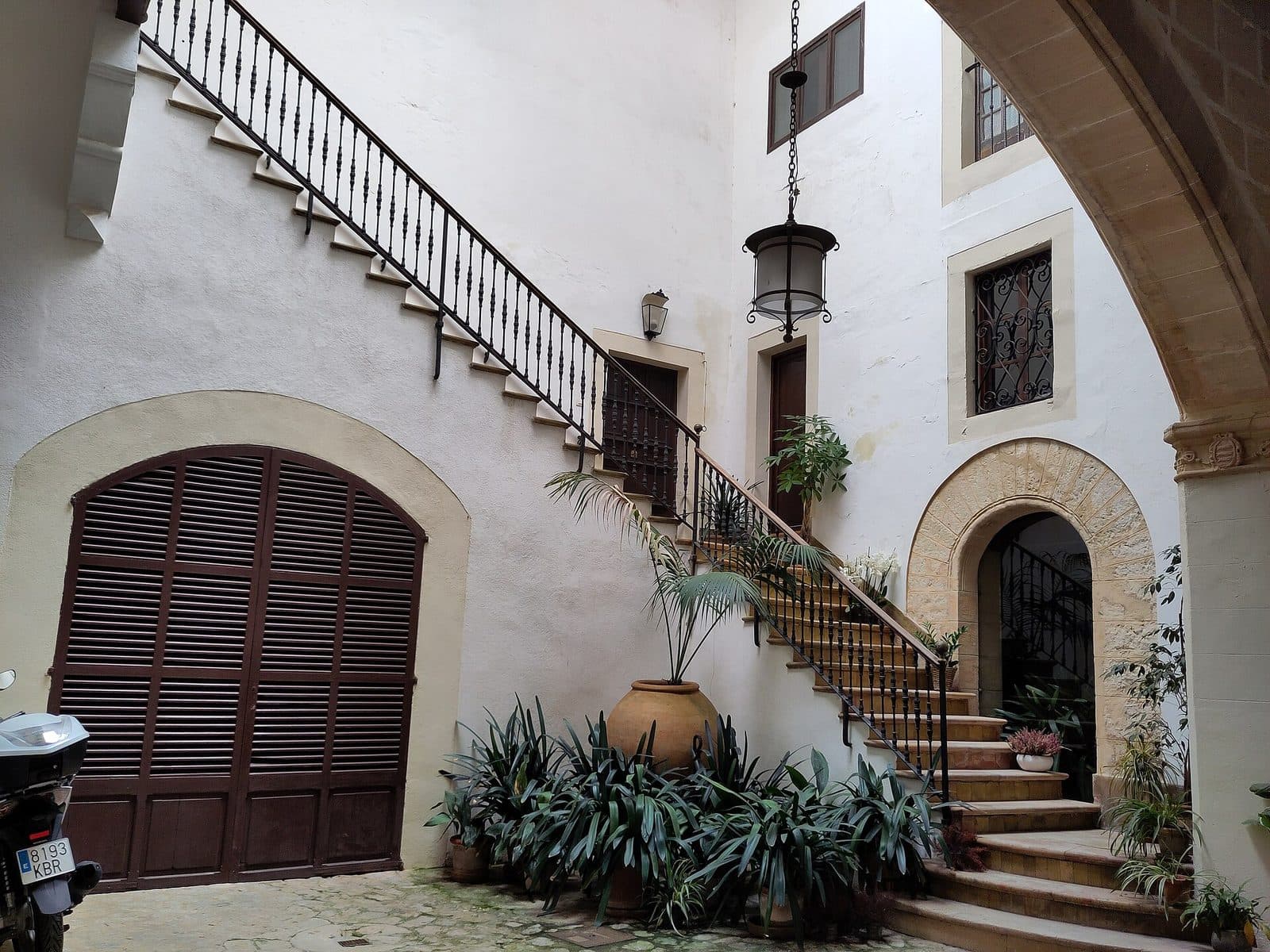

Can Dusai is a historic townhouse within the maze of streets in Palma’s Old Town, in the area of the former Jewish quarter. Its name recalls Dusai, a wealthy Jewish merchant of the Middle Ages, and also lives on in Carrer de Can Dusai. Anyone who pauses here is therefore looking at more than a single building: the house name, street, and quarter connect the site with the merchant.
A visit is particularly worthwhile for travelers who explore Palma on foot and appreciate historical connections. There is a former residence, a street name, and a site in the former Jewish quarter to discover. The place therefore makes its strongest impression as part of an Old Town walk. Those who visit Can Dusai with this knowledge will discover a remarkable piece of the city’s memory at what initially seems like a quiet address.
History and Significance
The name Dusai leads back to Jewish Palma in the Middle Ages. Dusai is recorded as a wealthy Jewish merchant who lived in the 14th century. The house and the street named after him anchor his memory in what was then the city’s Jewish quarter. The history of the neighborhood can thus be connected with a name and a place of residence.
Dusai and the Merchant’s House
Can Dusai is classified as an elegant courtyard house and recalls Dusai, a wealthy Jewish merchant of the Middle Ages. The proper name is itself an important historical record: the specific name Carrer de Can Dusai is translated as “street of the house of Dusai,” while Can Dusai essentially means the house of Dusai. The house’s name also became the street name Carrer de Can Dusai.
The Call Major
Can Dusai stands in the area of Palma’s former Jewish quarter. The city’s Jewish population initially lived in the Call Menor near the old harbor and the Almudaina Palace. In the 14th century, it was relocated to the eastern part of the city by order of King Jaume II. The Call Major developed there and is associated with the present-day area of La Calatrava.
This relocation was not a minor episode in the city’s development. It determined where the Jewish community lived and organized its daily life. In this context, Can Dusai should be understood as a house in the former Jewish quarter.
A Name as a Historical Trace
A complete picture of a medieval quarter rarely survives intact. Buildings are altered, plots are repurposed, and streets are adapted over long periods, but names can endure through such disruptions. This continuity is particularly important at Can Dusai: the building gave the street its name, which in turn keeps the memory of the merchant and his house alive.
Can Dusai consequently has a different kind of significance from a museum with labeled exhibits. The site asks visitors to read today’s Old Town as a historical document. Its memory lies not only in the masonry but also in the language of the city map. Anyone who notices the name on the street encounters a small but tangible connection to Jewish Palma in the 14th century.
What to See
The most important impression emerges as you approach, because the surrounding street draws attention to the relationship between the house and the quarter.
The Historic Townhouse
Can Dusai is classified as a historic townhouse and elegant courtyard house, making it an example of an urban residential form characteristic of Palma. When viewing it, this architectural concept is more important than searching for a monumental showpiece facade. Its historical significance lies in the combination of its urban setting, private architecture, and the name of the Jewish merchant. Those who look only for striking decoration may easily overlook the site’s true value.
Carrer de Can Dusai
The street is an essential part of the attraction. Its name literally identifies it as the street of the house of Dusai and connects it with Dusai and his home. During a walk, it is therefore worth looking beyond a single facade. The quarter was not an ensemble of freestanding monuments but an inhabited urban neighborhood. Can Dusai becomes easier to understand when the entire streetscape is viewed as a historical context.
House Name and Street Sign
An easily overlooked detail is the linguistic connection between the building and its address: at Can Dusai, the name links the house with Dusai. The street sign thus almost assumes the role of a small historical inscription. It preserves the name Dusai in the everyday cityscape, even though the medieval world from which it originated has long since disappeared. Particularly for visitors interested in Jewish history, this understated clue is often more meaningful than a setting staged at a later date.
The House in the Cityscape
The experience of Can Dusai combines the street, the house frontage, and its classification as a courtyard house. Its restrained appearance suits the site’s history because it was a residence. Can Dusai therefore tells its story less through individual showpieces than through its location, building type, and name. This connection is especially revealing for architecture enthusiasts.
Visiting Can Dusai
Can Dusai is located on Carrer de Can Dusai and makes a worthwhile stop on a slow walk through the Old Town. The first task is to find the address within the network of lanes in the former Jewish quarter and view the house in relation to its immediate surroundings.
A Short Stop with Plenty of Context
How much time to allow depends less on the size of the house than on your interest in the surrounding area. Those who simply want to see the historic location and street name can include Can Dusai as a brief stop on a walk. Anyone exploring the Call Major in greater depth should proceed more slowly through the neighboring streets and trace the relationship between the house, the quarter, and the medieval urban structure.
A brief introduction to Dusai and the history of the Jewish quarter is helpful. Without this background, the house may appear unremarkable. With it, it becomes clear why a single residence gave its name to a street and why that name remains important to Palma’s culture of remembrance today.
Access and Current Visiting Conditions
Fixed opening hours and admission conditions are not documented. Before visiting, you should therefore check whether access beyond the public street is currently possible and, if so, to what extent. The location and historic street name can be included in an Old Town walk regardless, but access to private or non-public areas should not be assumed.
This distinction helps prevent false expectations. Can Dusai is primarily a historic townhouse and is particularly relevant to those who want to explore architecture, Jewish history, or Palma’s development through specific addresses.
Look Quietly and Considerately
Visitors are advised to behave respectfully. Entrances should be kept clear, and private areas must be respected.
Getting There and Parking
From Palma Airport, the route initially follows the Ma-19 toward Palma. The distance to the city is 11 kilometers by road, and the drive takes around 20 minutes. These details expressly apply only as far as Palma. Can Dusai is then located in the historic center, where narrow streets, pedestrian zones, and access restrictions affect any direct approach.
The Final Stretch into the Old Town
The former Jewish quarter is best explored on foot. Within the fabric of the Old Town, short lanes, squares, and sequences of narrow streets alternate, so a vehicle offers no practical advantage at the destination. When navigating, Carrer de Can Dusai should therefore be used as the destination for the walk rather than automatically as the destination for the drive. This helps prevent a route app from directing you into restricted Old Town streets.
The final stretch thus becomes a deliberate approach: with each change of street, the modern traffic environment recedes while the structure of the historic city becomes more apparent.
Access Restrictions and Parking
Parts of the Old Town are governed by ACIRE regulations. In these areas, only residents and authorized vehicles are generally permitted to drive; even authorized access does not automatically mean that parking is allowed at the destination. On-street spaces in the affected areas may be reserved for residents. A rental or private car should therefore be left outside the restricted network of lanes or in a public parking garage.
Before entering the Old Town, always pay attention to current signs, as access rules take precedence over an apparently direct navigation route.
By Bus
Several stops are located in the central Old Town area, including Plaça de Cort, Plaça d’en Coll, Plaça de sa Quartera, and Porta des Camp. Which one is most convenient depends on the selected route and your point of departure. From each of these stops, the final stretch continues on foot through the Old Town.
Plaça de Cort and Plaça d’en Coll are suitable for approaching from the central urban core. The narrow streets around Can Dusai make the walk not an inconvenient final leg but an integral part of understanding the historic setting.
Bus lines to Can Dusai at a glance
| Line | Route | Departures/day | First | Last |
|---|---|---|---|---|
| 501 | Manacor - Campos - Palma | 208 | 05:38 | 23:58 |
| 504 | Tolleric - Palma | 109 | 06:13 | 23:13 |
| 501e | Campos - Palma, exprés | 59 | 06:50 | 20:50 |
| 515e | Cala d'Or - Palma | 10 | 10:30 | 19:15 |
| 25 | s'Arenal - Pl. Reina | Catedral | 8 | 09:35 | 12:41 |
| N1 | Portopí - Porta des Camp | 4 | 00:55 | 23:55 |
| 512 | Portocolom - Felanitx | 1 | 08:05 | 08:05 |
From the official GTFS feeds (TIB/SFM), no real-time data. The figures cover all stops in the town; weekend and holiday services differ — check with the operator before travelling.
Getting there by bus
662-pl. de Cort · 0.3 km as the crow flies
- CCCircular Centre Ciutat · 08:00–08:00 · Daily
663-pl. d'en Coll · 0.3 km as the crow flies
- CCCircular Centre Ciutat · 08:00–08:00 · Daily
664-pl. de sa Quartera · 0.3 km as the crow flies
- CCCircular Centre Ciutat · 08:00–08:00 · Daily
Porta des Camp 2 (40002) · 0.4 km as the crow flies
- 501Manacor - Campos - Palma · Daily
- 501eCampos - Palma, exprés · Mon-Sat
- 504Tolleric - Palma · Daily
- 515eCala d'Or - Palma · Mon-Fri
458-Porta des Camp · 0.4 km as the crow flies
- 23s'Arenal / Parc Aquàtic - Pl. Espanya · 06:27–21:50 · Daily
- 25s'Arenal - Pl. Reina | Catedral · 06:36–21:01 · Daily
- 30Marivent-Palau de Congressos · 08:00–08:00 · Daily
- 31Sant Jordi - Sindicat · 08:00–08:00 · Daily
- 35Aquàrium - Pl. Reina | Catedral · 06:21–22:41 · Daily
- A1Aeroport - Palma Centre · 08:00–08:00 · Daily
- N1Portopí - Porta des Camp · 08:00–08:00 · Daily
983-Jutjats Nous · 0.4 km as the crow flies
- CCCircular Centre Ciutat · 08:00–08:00 · Daily
450-Porta des Camp · 0.5 km as the crow flies
- 19UIB i Parc Bit - Porta des Camp · 05:46–22:12 · Daily
- 23s'Arenal / Parc Aquàtic - Pl. Espanya · 06:27–21:50 · Daily
- 31Sant Jordi - Sindicat · 08:00–08:00 · Daily
- 35Aquàrium - Pl. Reina | Catedral · 06:21–22:41 · Daily
- A1Aeroport - Palma Centre · 08:00–08:00 · Daily
- N1Portopí - Porta des Camp · 08:00–08:00 · Daily
Porta des Camp 1 (40108) · 0.5 km as the crow flies
- 501Manacor - Campos - Palma · Daily
- 501eCampos - Palma, exprés · Mon-Sat
- 504Tolleric - Palma · Daily
- 512Portocolom - Felanitx · Daily
- 515eCala d'Or - Palma · Mon-Fri
106-pl. del Mercat · 0.5 km as the crow flies
- 3Pont d'Inca / Joan Carles I · 08:00–08:00 · Daily
- 4Ses Illetes - Pl. Columnes · 08:00–08:00 · Daily
- 7Son Gotleu - Son Serra - Sa Vileta / Son Vida · 08:00–08:00 · Daily
- 20Portopí - Son Espases · 06:06–22:40 · Daily
451-Escola Graduada · 0.5 km as the crow flies
- 12Sa Garriga - Nou Llevant · 08:00–08:00 · Daily
- 24Antiga Presó - Nou Llevant · 06:33–21:18 · Daily
- 31Sant Jordi - Sindicat · 08:00–08:00 · Daily
- N1Portopí - Porta des Camp · 08:00–08:00 · Daily
453-pl. de la Reina - Catedral · 0.5 km as the crow flies
- 25s'Arenal - Pl. Reina | Catedral · 06:36–21:01 · Daily
457-Escola Graduada · 0.5 km as the crow flies
- 31Sant Jordi - Sindicat · 08:00–08:00 · Daily
- N1Portopí - Porta des Camp · 08:00–08:00 · Daily
Timetable data: official GTFS feeds (TIB/EMT), no real-time — check with the operator before travelling.
Nearby Attractions
Can Dusai stands in a part of Palma where history does not end at a single attraction. The former Jewish quarter extends through a network of narrow streets in the eastern Old Town. Those who continue beyond the house move through the area of the former Call Major and can read the medieval urban structure as a connected whole.
The Former Jewish Quarter
The most logical combination is a walk following the traces of Jewish Palma. Can Dusai provides a personal connection: Dusai, a merchant known by name, emerges from the broader history of the quarter. Other streets and historical clues expand the picture of the former Jewish district.
The value of such a walk does not lie in a sequence of spectacular individual buildings. Names, street layouts, and historical context are all part of the route. Can Dusai therefore works well as a starting point or intermediate stop where the history of the former Jewish quarter is connected with a specific address.
La Calatrava
The present-day neighborhood of La Calatrava overlaps with key areas of the historic Call Major.
Cathedral, Almudaina, and Banys Àrabs
For a broader historical route, the Cathedral of La Seu, the Almudaina Palace, and the Arab Baths can also be included. The Almudaina also recalls the location of the older Call Menor before the Jewish population was required to move to the eastern part of the city in the 14th century. This gives the route between the two Old Town areas a clear historical meaning.
The Arab Baths and the medieval religious buildings reveal other layers of Palma’s past. They should not overshadow Can Dusai but instead broaden its chronological and cultural context. On this route, the merchant’s house represents everyday life and the social history of a neighborhood, while the major monuments primarily make political and religious power visible.
The place it belongs to
Palma in the place guidePractical Information for Your Visit
Can Dusai is classified as a historic townhouse and elegant courtyard house. Its historical significance lies in the house as a residential form, in the name Dusai, and in its location within the former Jewish quarter.
Footwear and Orientation
The visit makes most sense as part of a walk through the Old Town. Anyone moving only from one navigation point to the next will miss part of the experience because the house is understood through its surroundings. Along the way, it is worth paying attention to traditional house names, street signs, and the sequence of lanes. This reveals how individual residences helped people navigate the old city.
Respect for the Residential Setting
Can Dusai is not located within an enclosed archaeological site. Its immediate surroundings are part of everyday life in modern Palma. House entrances and passageways should be kept clear, and any lack of access to interior areas must be respected. Groups in particular should avoid gathering for long periods in front of doors or in narrow passages.
What Makes Can Dusai Special
Its strength lies in the connection between the house, its name, and the memory of Dusai. A wealthy Jewish merchant of the 14th century remains linked with Palma through his house and the name of the street. This understated form of survival is precisely what makes Can Dusai remarkable. It demonstrates that urban history is preserved not only in palaces, churches, and fortresses. Sometimes a house name is enough to open a window onto an almost vanished world.
Local insider tips
Look for the Street Sign
The name Carrer de Can Dusai is itself a historical record: it essentially means the street of the house of Dusai. Viewing the sign together with the house and lane reveals the site more effectively than searching for a monumental showpiece facade.
Plan It as a Call Major Stop
Can Dusai becomes significantly more meaningful as part of a walk through the former Jewish quarter. The Jewish merchant’s residence gives the quarter’s history a specific name and an address that can still be found today.
Walk from Porta des Camp
Porta des Camp is a suitable starting point for approaching through the eastern part of the Old Town. The route leads through La Calatrava and therefore through the area where the historic Call Major developed.
Photograph the Whole Street
A photograph of the entire streetscape tells more than a tight shot of the facade. The house, street name, and neighboring buildings should therefore be included in the same image.