
Carrer del Calvari in Pollença: 365 Steps Above the Old Town
.JPG)
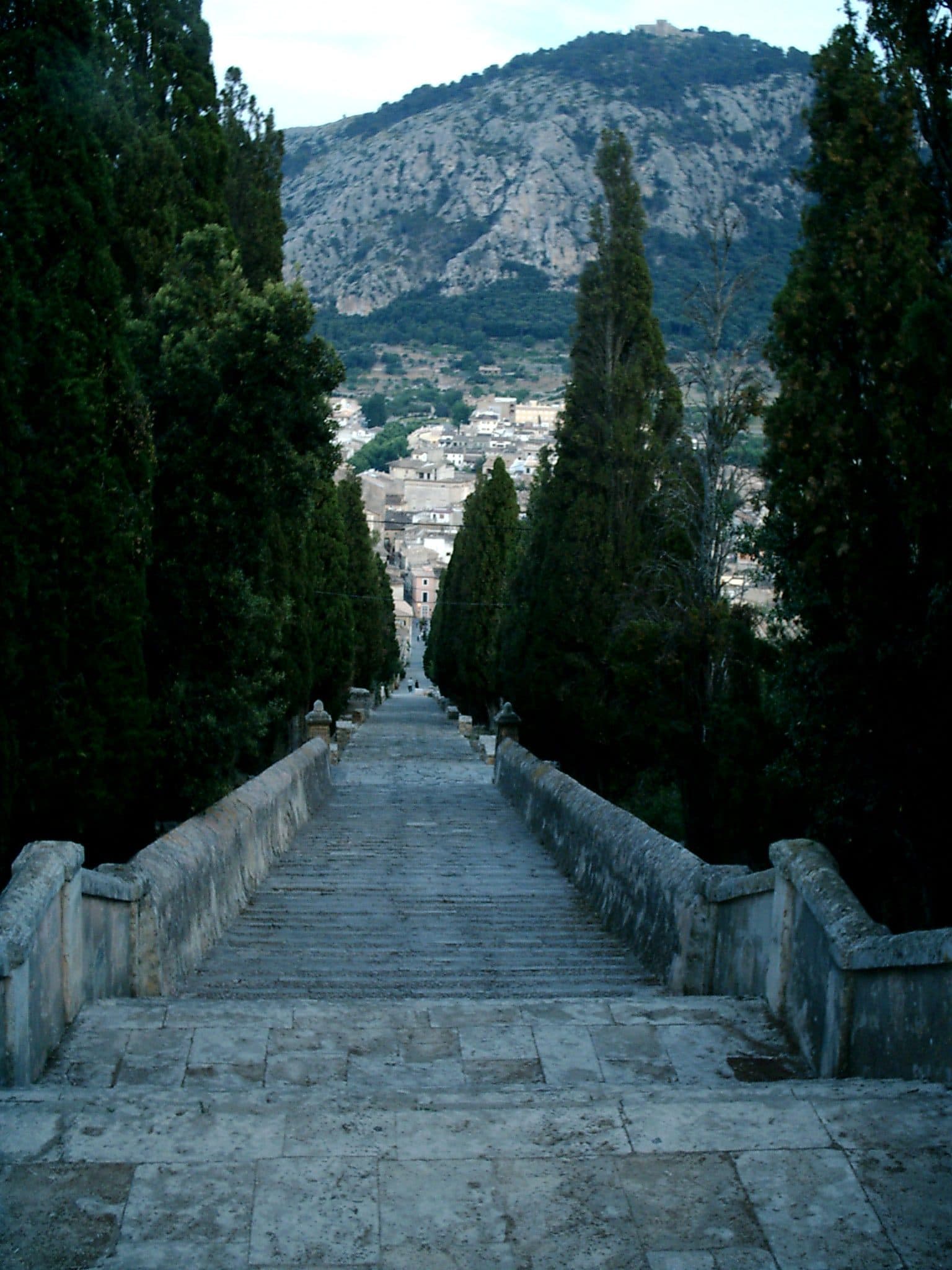
Rising from the heart of Pollença’s narrow streets, Carrer del Calvari climbs almost perfectly straight up Calvary Hill. What initially looks like a steep street soon becomes the monumental staircase that features in some of the town’s best-known images: 365 steps, lined with cypresses and crosses, lead from the historic center to the Església del Calvari chapel.
The appeal lies not only in the destination, as the view changes at every landing during the ascent. The old town houses recede below, the landscape opens beyond the rooftops, and the small chapel forms a peaceful conclusion to the strikingly clear sightline at the top. The staircase is simultaneously a footpath, viewpoint, and place of religious remembrance.
A visit suits travelers who want to discover more of Pollença than the Plaça Major. Carrer del Calvari does not require a full day of hiking, but it does demand enough energy for a steep climb and descent. Anyone interested in architecture, local history, or photography will find more along the steps than a quick panoramic view. The site becomes particularly evocative on Good Friday, when the staircase is the setting for one of Pollença’s defining Passion ceremonies.
History and significance
The famous staircase is younger than the religious site to which it leads. Calvary Hill was already accessible by an older path before the present Carrer del Calvari was built. According to the history preserved by the municipality of Pollença, the hill initially belonged to the Knights Templar. Its lasting importance, however, developed through its role as a Christian place of devotion and as the route to the chapel on the hilltop.
Guillem Cerdà Cànaves and the construction of the staircase
A decisive step came in 1860. In that year, Guillem Cerdà Cànaves, who lived from 1815 to 1887, acquired property on Calvary Hill. He made part of the land available to the town of Pollença so that a suitable approach to the chapel could be created. The monumental staircase was not built in a single phase but section by section. Its upper part, completed as early as the 19th century, was given Neoclassical forms.
This construction history explains why Carrer del Calvari is not uniform throughout, despite its seemingly consistent perspective. The steps are lower, particularly in the upper section. The staircase was far more than a decorative enhancement of the hillside: it organized and improved the traditional route to the chapel and gave religious ceremonies a stage visible from afar.
The Way of the Cross
The number of steps is interpreted as a symbol of the year: 365 steps, one for each day. Along the ascent stand 14 crosses representing the Stations of the Cross and Christ’s path to Calvary. According to the municipality, they reach a height of three meters. The ascent itself thus becomes a Way of the Cross—not inside an enclosed church, but in the middle of the townscape and beneath the open sky.
The strictly upward alignment reinforces this meaning. The destination remains visible for much of the route, while the crosses and cypresses divide the ascent into distinct sections. Even outside church celebrations, it is clear that the staircase was not originally intended merely as an access route to a viewpoint.
The Davallament on Good Friday
The religious function becomes especially clear on Good Friday. During the ceremony known as the Davallament, a figure of Christ is taken down from the cross and then carried from the chapel down the staircase to the parish church of Mare de Déu dels Àngels. Members of various brotherhoods accompany the procession with torches, and the ritual takes place in silence.
The descent in particular makes Carrer del Calvari an essential part of the ceremony. The long, straight axis of the staircase becomes a processional route, with torchlight and the carried figures involving the entire hillside. The monumental staircase, normally used by walkers and photographers, visibly returns to its religious origins. Its popularity with visitors has not displaced this significance: it remains a living site of Holy Week in Pollença.
What to see
The basic concept of the site is immediately apparent from the bottom. The steps rise along a long axis up the hillside, with the chapel appearing as the final point at the upper edge. Even so, it is worth looking at more than the destination. Differences in the shape of the steps, the crosses beside the route, and the steadily widening views tell the staircase’s story better than a single photograph taken at the foot of the hill.
The 365 steps
The defining architectural feature is the uninterrupted sequence of 365 stone steps. Their number has earned Carrer del Calvari its reputation as a staircase for every day of the year. The climb is short enough to appear fully visible at a glance, yet steep enough for the perspective to change quickly. Landings between the individual sections provide opportunities to stop and look back along the staircase’s axis.
The lower section continues the transition from Pollença’s streets. Houses and small shops initially line the route before it begins to feel more distinctly like an independent monumental staircase. Farther up, the cypresses become more prominent. The lower steps in the older, Neoclassical section are particularly noticeable. This change is not an incidental detail but visible evidence of the staircase’s phased construction.
The staircase works differently in each direction. During the ascent, the chapel draws the eye upward; on the descent, Pollença lies at your feet. Anyone who takes photographs only at the summit therefore misses an essential part of the composition. The view along the central axis is especially expressive, with the steps, trees, crosses, and old town appearing in successive layers.
The cypresses
Tall cypresses line Carrer del Calvari. They frame the staircase vertically, emphasize the straight route toward the chapel, and stand out with their dark, slender forms against the pale stone and sky. From a distance, this makes the staircase look more austere than it feels when climbed slowly. Up close, the symmetrical lines dissolve into individual steps and landings. It is precisely this shift between monumental impact from afar and an everyday footpath at close range that makes the site unusual.
The 14 crosses
The crosses are not incidental decoration. They transfer the Stations of the Cross onto the hillside and give the ascent its religious context. At the height of three meters stated by the municipality, they remain clearly visible even from some distance. Their arrangement breaks up the long flight of steps and serves as a reminder that the familiar photographic subject is also a place of Christian Passion devotion.
This context is easy to overlook during an ordinary visit because the view commands so much attention. A slow ascent changes the impression: the crosses appear one after another as the town center falls farther below. The route thus develops a sequence defined by more than the number of steps alone.
The upper Neoclassical section
The staircase’s historical development is most apparent shortly before the destination. This upper section was built as early as the 19th century and displays Neoclassical design elements. The steps here are lower than in other parts of the staircase. Together with the flanking cypresses, they create a more clearly framed and ceremonial approach to the chapel.
Anyone paying attention to the rhythm of their steps during the climb will notice the difference immediately. The staircase does not feel like a modern structure calculated according to a uniform grid, but like a route that developed over a long period. This is precisely where its architectural value lies: different construction phases were joined to create one convincing overall axis.
The chapel as the final point
The Església del Calvari stands at the top. It is the destination toward which the entire staircase was aligned, but the Carrer and the chapel should not be confused: the attraction of Carrer del Calvari primarily encompasses the ascent itself. The small church provides a clear conclusion to the long sequence of steps and explains why the route was created in the first place.
The view opens back across Pollença in front of the chapel. You can see the town’s roofs and streets, the surrounding landscape, the foothills of the Tramuntana, and, in the distance, the Bay of Pollença. Depending on the viewpoint, cypresses or parts of the staircase fill the foreground. Rather than looking only as far as possible across the landscape, it is therefore also worth turning back to see the geometric connection between the chapel and the old town.
Visiting Carrer del Calvari
Carrer del Calvari is most impressive when the ascent is not treated as a compulsory athletic exercise. From the center of Pollença, the route leads via Plaça dels Seglars to the beginning of the steps. The destination is already visible above the town. From there, the route follows its clearly visible axis uphill without complicated turns.
The climb and the view
The ascent alone requires no extensive hiking plan. How much time the visit takes, however, depends greatly on fitness, breaks, and photography stops. The 365 steps can be climbed quickly, but the route becomes more interesting when you pause to examine the crosses, the different step heights, and the view behind you. It is therefore best to allow one continuous block of time for the ascent, view, and descent rather than treating it as a rushed stop between other activities.
At the top, the area in front of the chapel forms the natural turning point. From here, Pollença’s position between the northern foothills of the Tramuntana and the plain is easy to appreciate. The return follows the same staircase. Care is needed during the descent, as the broad view across the town can easily distract attention from the steps.
Time of day and crowds
Early morning and late afternoon are considered the best times for the ascent. These periods avoid the most intense heat. The angled light also defines the steps, crosses, and cypresses more clearly. Sunrise and sunset are therefore popular times for photographs along the axis of the staircase.
Sunday mornings bring a different rhythm: the weekly market fills the center of Pollença with activity and makes combining the climb with an old-town visit especially appealing, but it also brings more people into the streets. Anyone hoping to experience the staircase in relative peace should choose an early time or another day of the week. During the Good Friday ceremony, it is not an ordinary scenic walk but part of a religious event that should be approached with appropriate respect.
Chapel and current conditions
The available visitor information records neither fixed opening hours nor an admission charge for Carrer del Calvari. In any case, the site’s real appeal lies not in an elaborate interior or exhibition but in the combination of the ascent, Way of the Cross, historic staircase architecture, and views.
Getting there and parking
The stated driving routes end in Pollença, not directly beside the steps. From Palma Airport, the route follows Ma-30, Ma-13, and Ma-2200. It covers 57 road kilometers, and the drive takes around 45 minutes. From central Palma, the route via Ma-13 and Ma-2200 covers a total of 54 road kilometers; allow around 50 minutes to reach Pollença.
The final stretch in Pollença
Carrer del Calvari begins in the historic part of town, where narrow streets and pedestrian routes define the setting. It therefore makes sense to leave the car at the edge of the center and complete the final section on foot. From the old-town area, walk toward Plaça dels Seglars, where the lower approaches to Carrer del Calvari and eventually the monumental staircase begin.
The northern side of town near Ma-10 and Pont Romà is a useful reference point when looking for parking. A larger parking area is described there, from which the route into the old town can be continued on foot. Another option is the area around Carrer de Cecili Metel. From there, the walking route follows Carrer de Sant Domingo and Carrer d’Antoni Maura to Carrer del Calvari.
Arriving by bus
Pollença has several bus stops that provide convenient access to the town center. These include the Pont Romà and Pollença stops. From there, continue through the town on foot. Allow sufficient extra time for the return journey, as the descent and walk through the old town still need to be completed before departure.
Bus lines to Carrer del Calvari at a glance
| Line | Route | Departures/day | First | Last |
|---|---|---|---|---|
| 322 | Pollença - Port d'Alcúdia | 753 | 00:06 | 23:40 |
| 301 | Port de Pollença - Palma | 133 | 06:15 | 22:38 |
| 321 | Cala de Sant Vicenç | 102 | 07:49 | 22:08 |
| 231 | Port de Sóller - Alcúdia | 12 | 10:38 | 20:21 |
From the official GTFS feeds (TIB/SFM), no real-time data. The figures cover all stops in the town; weekend and holiday services differ — check with the operator before travelling.
Getting there by bus
Pollença 1 (42001) · 0.6 km as the crow flies
- 301Port de Pollença - Palma · Daily
Pollença 2 (42002) · 0.6 km as the crow flies
- 301Port de Pollença - Palma · Daily
- 321Cala de Sant Vicenç · Daily
- 322Pollença - Port d'Alcúdia · Daily
Poliesportiu (42004) · 0.9 km as the crow flies
- 301Port de Pollença - Palma · Daily
- 321Cala de Sant Vicenç · Daily
- 322Pollença - Port d'Alcúdia · Daily
CEIP Joan Mas (42005) · 0.9 km as the crow flies
- 301Port de Pollença - Palma · Daily
- 321Cala de Sant Vicenç · Daily
- 322Pollença - Port d'Alcúdia · Daily
La Font 1 (42009) · 1.0 km as the crow flies
- 231Port de Sóller - Alcúdia · Daily
- 301Port de Pollença - Palma · Daily
- 321Cala de Sant Vicenç · Daily
- 322Pollença - Port d'Alcúdia · Daily
La Font 2 (42033) · 1.0 km as the crow flies
- 231Port de Sóller - Alcúdia · Daily
- 301Port de Pollença - Palma · Daily
- 321Cala de Sant Vicenç · Daily
- 322Pollença - Port d'Alcúdia · Daily
Polígon de Pollença 1 (42043) · 1.9 km as the crow flies
- 231Port de Sóller - Alcúdia · Daily
- 301Port de Pollença - Palma · Daily
- 321Cala de Sant Vicenç · Daily
- 322Pollença - Port d'Alcúdia · Daily
Timetable data: official GTFS feeds (TIB/EMT), no real-time — check with the operator before travelling.
Nearby attractions
The visit does not end at the final step after the descent. Carrer del Calvari connects directly with historic Pollença and is therefore particularly well suited to a circular walk. Plaça dels Seglars and Plaça Major restore the everyday life of the town after the quieter, strictly aligned staircase: cafés, shops, and old-town façades replace the sacred axis of the route.
Pollença Old Town
The parish church of Mare de Déu dels Àngels on Plaça Major is closely connected with the significance of the Calvary route. The Good Friday procession descends from the chapel to this church. Even outside the festival, the relationship is easy to understand: the Calvari above as a place of devotion and the central parish church below in the heart of the town.
A longer walk can also include the former Dominican monastery Convent de Sant Domingo with the Museum of Pollença and the Joan March gardens. They should not be treated merely as additional stops between arrival and departure; rather, they reveal other aspects of local cultural history. Carrer del Calvari remains the strongest topographical feature because it visibly connects the old town with the hilltop.
Pont Romà and the northern edge of town
Anyone parking near Pont Romà or arriving there by bus can include the stone bridge in the walk. It lies on the other side of the historic center and is therefore suitable as either the beginning or end of a circuit through town. From there, the route passes through Pollença to Plaça Major and continues to the foot of the Calvari staircase.
Weekly market and excursions in the north
On Sunday, the weekly market fills the streets and squares around the center. Food, plants, and handicrafts combine the visit to the staircase with a lively contrast to the quiet chapel above. Anyone primarily seeking peace and unobstructed photographic perspectives should, however, expect more activity.
Pollença can also be used as a starting point for other destinations in the north. Port de Pollença, the bay, and the Formentor peninsula are natural additions because they contribute to the landscape visible from above. Carrer del Calvari itself, however, requires no journey beyond the town: its character is best understood through the transition between the old town, staircase, and Calvary Hill.
The place it belongs to
Pollença in the place guidePractical visitor information
The greatest challenge is not navigation but the sequence of 365 steps. The route is short and straightforward, but it requires a genuine climb and descent. Anyone expecting only a level town walk may be surprised by the gradient. Conversely, this is not a mountain hike involving a long approach or remote trails.
Footwear and sure-footedness
Sturdy, well-fitting shoes with grippy soles are advisable. The stone steps are not uniformly high and can feel uneven; their rhythm also changes in the upper historic section. During the descent, regularly shift your gaze from the view back to the surface beneath your feet. Sandals without adequate support are less suitable for this route than shoes that allow the many steps to be negotiated with control.
Sun, heat, and water
Early morning or late afternoon is recommended on warm days. These times not only avoid the more intense midday heat but often provide more interesting light along the staircase’s long axis. Bring water from the town rather than starting the climb as an unplanned detour without preparation. Although the cypresses define the appearance of the upper section, they do not provide continuous shade along the route.
Visiting with children
Carrer del Calvari can easily be included in a visit to Pollença with children who enjoy walking. The manageable distance and visible destination make the climb easy to understand. Even so, there are still 365 stone steps: young children need particular assistance during the descent, and strollers do not suit the character of this route. Combining the climb with a town walk and a break in the center is more family-friendly than immediately continuing onto other steep routes.
What not to expect
Carrer del Calvari is neither a museum nor a staged visitor attraction. Its impact comes from the historic monumental staircase, the 14 crosses, the cypresses, the chapel as the destination, and the view across Pollença. Anyone who consciously observes these details will experience far more than on a quick climb for a single panoramic photograph.
Local insider tips
Look back during the descent
The strongest view is not found only at the top: during the descent, the long axis of the staircase and Pollença’s rooftops appear together. Stop on a landing rather than taking photographs while walking.
Choose the quieter hours
Early morning and late afternoon combine more pleasant light with less heat. The steps, crosses, and cypresses stand out more clearly then than beneath the high midday sun.
Notice the change in the steps
The steps are lower in the older upper section. This easily overlooked change makes the phased construction history of Carrer del Calvari directly perceptible as you walk.
Show respect on Good Friday
During the Davallament, the staircase becomes a silent processional route illuminated by torches. Anyone visiting at that time is not entering an ordinary photographic setting but witnessing one of Pollença’s important religious rituals.
Plan a circular town walk
A rewarding circuit leads from Pont Romà through the old town and across Plaça Major to Carrer del Calvari. This makes it clear how the staircase connects the town center with Calvary Hill.