
Monti-sion in Pollença: Church, College and Town History
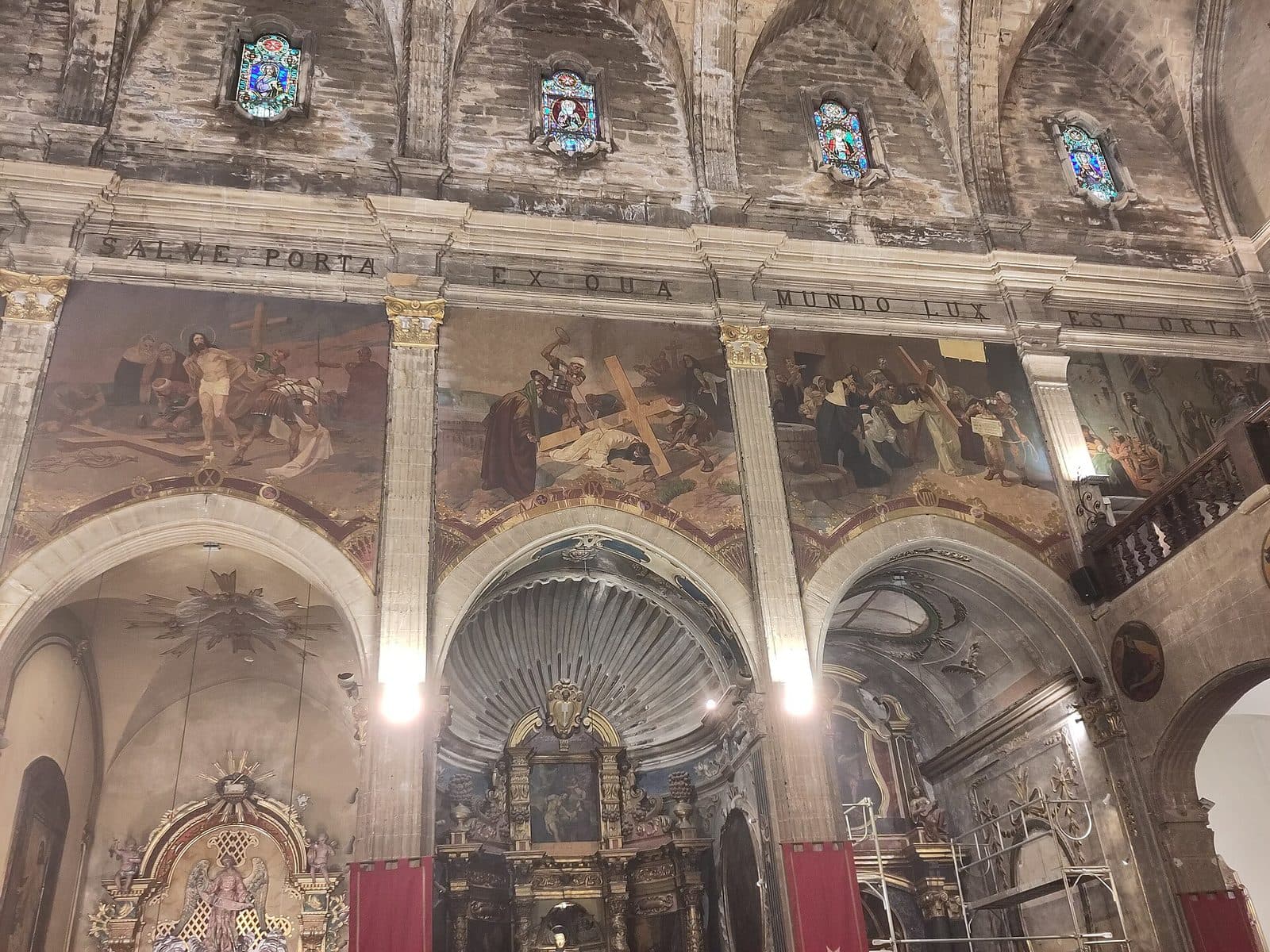

Monti-sion is a historic building in Pollença. The name refers to a former Jesuit college with a church and convent whose rooms served religious, educational and civic purposes over the centuries. This changing role is precisely what makes the complex so revealing for anyone who wants to understand Pollença not merely as a picturesque backdrop but as a town that has evolved over time.
Confusion is understandable: a sanctuary near Porreres on Mallorca is also called Monti-sion. However, it is a different place. The Monti-sion described on this page stands in Pollença in the north of the island. Its history is closely linked to the Jesuits, local education and several well-known figures from Pollença.
It is particularly worth visiting as part of a walk through the old town. Monti-sion is best understood less as a collection of individual artworks than as a building with many biographies: first a college and religious house, then long abandoned after the expulsion of the Jesuits, and later once again a church, administrative centre, courthouse and school. Those who know these layers see in its walls not only a religious monument but also part of the town's institutional memory. Monti-sion is therefore as fascinating for those interested in art and cultural history as it is for visitors who want to trace Pollença's development.
At the same time, the site requires some attention. Not every piece of furniture or painting comes from the original furnishings; some arrived only through later transfers and restorations. That is precisely where one of its most interesting stories lies.
History and Significance
Sant Ignaci College
Between 1696 and 1738, the Jesuits had Sant Ignaci College built. In Pollença, it has long been known primarily by its popular name, Edifici Monti-sion. The order did not wait for its final completion: it began using the building as early as 1703. From the outset, the complex included a church and a convent. Monti-sion was therefore simultaneously a place of worship, a religious house and an educational institution.
The combination of religion and teaching was characteristic of a Jesuit college. In Pollença, it left behind a building whose use extended far beyond that of a mere monastic church. People did not only pray here; the building also represented the transmission of knowledge. Monti-sion is therefore evidence of an era in which education, church life and social authority were closely linked.
The Expulsion of the Jesuits
In 1767, the first phase came to an abrupt end. King Carlos III. ordered the expulsion of the Jesuits from Spain. The church and convent in Pollença were subsequently abandoned. Their original use ceased, and the complex later had to be adapted for new purposes.
Monti-sion therefore does not tell an uninterrupted monastic story. Between its foundation and the present lie abandonment, conversion and reclamation. Anyone standing before the building is not looking at a religious house that remained unchanged for centuries, but at a structure that visibly survived political decisions and the town's changing needs.
Restoration in the Late Nineteenth Century
An extensive restoration began in the late nineteenth century. An important impetus came in 1885 from Mateu Rotger, who is regarded as Pollença's first historian. The poet and priest Miquel Costa i Llobera later continued the project. He came from a wealthy and prominent local family and was himself connected to Monti-sion as a clergyman.
The restoration was more than a structural repair: it gave the long-neglected complex new purposes. The church was used for worship again, while other parts served civic functions. Municipal offices and local courts were housed there. In the twentieth century, Monti-sion also accommodated a state school. The building thus brings together the history of a religious order, municipal administration, the judiciary and public education.
Three Names from Pollença
Monti-sion is associated with three well-known citizens of Pollença. Mateu Rotger represents historical research and the beginning of the restoration, while Miquel Costa i Llobera represents literature, the priesthood and the continuation of the restoration. There is also the composer Miquel Capllonch, who lived from 1861 to 1935. He wrote several works for the church choir and helped introduce classical music, previously often regarded as elitist, to a wider local audience.
These three lives show why Monti-sion is more than a former college to Pollença. The building became a place where historiography, poetry, music, religion and public life intersected. Its significance lies not only in the age of its walls but also in the people who preserved and used them and connected them with the town's culture.
What to See
The Church
The church forms the religious heart of Monti-sion. It was already part of the complex planned by the Jesuits and was used as a place of worship again after the major restoration in the late nineteenth century. When viewing it, it is important to distinguish between the building itself and the furnishings assembled later. The space preserves the complex's ecclesiastical function, but its present inventory does not simply reflect its condition during the early Jesuit period.
This distinction helps sharpen the eye. Monti-sion should not be interpreted as a completely preserved religious interior in which every object has stood in the same place since the building was constructed. The expulsion of the order and the long interruption in use left discontinuities. The church regained its liturgical role after the building had been abandoned for a time. Its appearance today is therefore the result of several eras.
Anyone able to enter should first consider the space as a whole: where is its original function as a college church apparent, and where can the later revival be seen? For Monti-sion, this question is more rewarding than searching for a single famous masterpiece. Above all, the church tells how Pollença brought an abandoned religious building back into its public and spiritual life.
The Former Convent
Alongside the church, a convent formed part of the original complex. It made Monti-sion a complete religious and college complex rather than merely a freestanding church. The Jesuits used the building from 1703, even though construction continued until 1738. The construction period and early use therefore overlap within its walls: the college was already occupied while the complex as a whole was still unfinished.
After 1767, the convent rooms lost their original purpose. Parts of the building were later adapted for administrative offices and courts, and in the twentieth century it was also used as a state school. This sequence can serve as a guide when viewing the building. Figuratively speaking, one door may lead to the history of the religious order, and the next to that of municipal government or education. Not every area may be accessible during an ordinary visit, but the layout of the complex alone makes clear that it accommodated several different institutions.
Monti-sion is therefore a good example of the adaptability of historic architecture. Instead of disappearing completely after the monastery was abandoned, the building was reclaimed by the town. Its rooms had to change without erasing the memory of the college. This tension between its old form and new functions is one of the most important things to see here.
Furniture and Paintings
The furnishings require particularly careful attention. A large proportion of the furniture and paintings now associated with Monti-sion did not form part of the Jesuit college's original holdings. Pieces came from other churches or were added during the extensive restoration in the late nineteenth century. This does not diminish their value, but it changes what they convey: rather than documenting an untouched historical state, they record the effort to furnish the sacred space appropriately again after a long interruption.
For visitors, this history of provenance is a key to understanding the site. In many churches, it is easy to assume that the altar, paintings and furniture have always belonged together unchanged since the building was constructed. Caution is appropriate at Monti-sion. The space is an ensemble that evolved over time, composed of preserved, transferred and later-added elements. A close look is therefore more rewarding than a quick tour.
Questions about the origins of these objects lead directly back to the expulsion of the Jesuits and the restoration. Here, the furnishings become historical evidence: they show that after a rupture, a building cannot simply return to its past. Pollença restored Monti-sion, but did not create an exact reconstruction of its first period under the order. What is visible instead is the interpretation of the late nineteenth century.
The Architectural Complex
Even without full access to every room, Monti-sion can be appreciated as an ensemble. The church, former convent and college belong together, although they were used differently over time. The site should therefore not be reduced to the church door. A slow examination of how the different parts of the building connect already explains why worship, teaching, administration and the judiciary could all be accommodated here.
In Pollença, much of the appeal lies in the relationship between the building and the town. Monti-sion was part of local life, and its architecture gained meaning through the people who came here every day to learn, work, pass judgment, make music or pray.
Visiting Monti-sion
A Tour with Historical Context
Monti-sion is best explored in two stages. First, it is worth viewing the entire building from outside and mentally bringing together the church, college and former convent areas. Then, if the church is accessible, attention can turn to the later furnishings and the traces of renewed religious use. Without this context, it is easy to come away with only the impression of yet another old church.
The visit should not be paced solely according to the number of visible artworks. The real value emerges when the building's different phases of life are compared. The Jesuit period, the rupture of 1767, the restoration beginning in 1885 and the subsequent municipal and educational uses form a clear sequence. Anyone familiar with these stages before visiting does not need a large exhibition to understand the building.
Access and Visit Planning
Current opening hours and admission conditions are not reliably documented. Before planning a specific interior visit, it is therefore advisable to check access shortly beforehand, either locally or with the relevant authority in Pollença.
The exterior can easily be included in a walk through the town. For the interior, however, visitors should not assume that every part of the former college and convent is freely accessible, as sections of the building served other public functions for a long time.
Duration and Time of Day
It is difficult to recommend a fixed visit length for Monti-sion because it depends on access to the church and whether the site is included in a walk through Pollença. A shorter stop is sufficient to view the exterior. Anyone who wants to trace the history of the furnishings and combine the complex with other sites in the old town should deliberately allow more time. There is no generally documented quietest time of day.
Getting There and Parking
From Palma and the Airport
The stated road routes lead to Pollença, not directly to the entrance of Monti-sion. From Palma Airport, the journey to Pollença covers 57 road kilometres. The drive takes around 45 minutes and follows the Ma-30, then the Ma-13 and finally the Ma-2200. From central Palma, the distance is 54 road kilometres; the drive via the Ma-13 and Ma-2200 takes around 50 minutes.
After reaching Pollença, the final urban section of the journey begins. Monti-sion is located within the town. When using navigation, it is important to add Pollença, as the site with the same name near Porreres can otherwise easily lead to the wrong route.
The Final Section in Town
The journey ends in the middle of a lively town. This is an advantage when planning a visit, as Monti-sion can be combined with the town centre.
By Bus
Several bus stops serve Pollença and are within walking distance of the town centre. From there, the journey continues on foot. The specific stops and current connections should be selected using timetable information for the day of travel. For orientation, it remains essential to specify Pollença explicitly as the destination.
Bus lines to Monti-sion at a glance
| Line | Route | Departures/day | First | Last |
|---|---|---|---|---|
| 322 | Pollença - Port d'Alcúdia | 753 | 00:06 | 23:40 |
| 301 | Port de Pollença - Palma | 133 | 06:15 | 22:38 |
| 321 | Cala de Sant Vicenç | 102 | 07:49 | 22:08 |
| 231 | Port de Sóller - Alcúdia | 12 | 10:38 | 20:21 |
From the official GTFS feeds (TIB/SFM), no real-time data. The figures cover all stops in the town; weekend and holiday services differ — check with the operator before travelling.
Getting there by bus
Pollença 1 (42001) · 0.5 km as the crow flies
- 301Port de Pollença - Palma · Daily
Pollença 2 (42002) · 0.5 km as the crow flies
- 301Port de Pollença - Palma · Daily
- 321Cala de Sant Vicenç · Daily
- 322Pollença - Port d'Alcúdia · Daily
Poliesportiu (42004) · 0.7 km as the crow flies
- 301Port de Pollença - Palma · Daily
- 321Cala de Sant Vicenç · Daily
- 322Pollença - Port d'Alcúdia · Daily
CEIP Joan Mas (42005) · 0.7 km as the crow flies
- 301Port de Pollença - Palma · Daily
- 321Cala de Sant Vicenç · Daily
- 322Pollença - Port d'Alcúdia · Daily
La Font 1 (42009) · 0.9 km as the crow flies
- 231Port de Sóller - Alcúdia · Daily
- 301Port de Pollença - Palma · Daily
- 321Cala de Sant Vicenç · Daily
- 322Pollença - Port d'Alcúdia · Daily
La Font 2 (42033) · 1.0 km as the crow flies
- 231Port de Sóller - Alcúdia · Daily
- 301Port de Pollença - Palma · Daily
- 321Cala de Sant Vicenç · Daily
- 322Pollença - Port d'Alcúdia · Daily
Polígon de Pollença 1 (42043) · 1.8 km as the crow flies
- 231Port de Sóller - Alcúdia · Daily
- 301Port de Pollença - Palma · Daily
- 321Cala de Sant Vicenç · Daily
- 322Pollença - Port d'Alcúdia · Daily
Timetable data: official GTFS feeds (TIB/EMT), no real-time — check with the operator before travelling.
Nearby Attractions
Pollença's Old Town
Monti-sion benefits from its surroundings. Pollença has narrow streets, stone houses and squares with cafés and restaurants; within this setting, the former Jesuit college appears not as an isolated monument but as part of a historic townscape. A walk connects ecclesiastical, civic and educational history without requiring a car between every stop.
The town centre provides the appropriate scale for Monti-sion. The building tells the story of an institution that influenced the town, while the town shows who the college, church, administration and school were intended to serve. Continuing the walk after a visit means encountering, in a sense, the former surroundings of its pupils, clergy, officials and churchgoers.
Calvari and Other Churches
Monti-sion can be combined with Calvari and other religious buildings in Pollença to create a themed walk. Different forms of Mallorcan devotion can be seen side by side: the urban Jesuit college, other church interiors and the traditional ascent of Calvari. Such a combination shows that the town's religious history was not shaped by a single order or building.
It is enough to place Monti-sion among several stops. Its distinctive theme remains the combination of church, college and later public uses. Other places of worship have their own emphasis and should not be regarded merely as continuations of its story.
Convent de Sant Domingo and the Museum
Convent de Sant Domingo is another nearby cultural and historical site in Pollença. There, another former religious building is connected with contemporary cultural life and the town's museum. Together with Monti-sion, it offers an illuminating comparison: historic monastic complexes could take on very different roles after their original use ended.
No elaborate itinerary is needed for such a walk. Monti-sion provides the history of the Jesuits and the college, while Sant Domingo offers another perspective on monastic architecture and culture. Between them, there is time for the streets and squares that connect both complexes with modern Pollença.
Port de Pollença and the North
Anyone wishing to continue after visiting the town can travel on to Pollença's coastal resort of Port de Pollença or destinations in the Serra de Tramuntana. Monti-sion itself, however, should not be mistaken for a scenic attraction. Its strength lies in a compact town walk; the coast and mountains form a separate programme afterwards.
The place it belongs to
Pollença in the place guidePractical Visitor Information
Choose the Right Place
The most important practical advice begins when entering the destination into a navigation device. Mallorca has several religious sites with similarly written names. For this attraction, Monti-sion and Pollença must be clearly identifiable together as the destination. Information relating to Porreres does not apply to this visit.
Images can also be misleading. Visitors here should expect a historic college with a church inside the town. Making this distinction in advance ensures that the route, time required and type of visit are planned correctly.
Clothing and Conduct
As the church was brought back into use as a place of worship, quiet conduct and appropriate clothing are advisable. Comfortable footwear is also recommended when combining the visit with an old-town walk. The experience consists not only of potentially entering the church but also of walking through Pollença and viewing the entire complex. Monti-sion is primarily a place for careful observation.
Visiting with Children
With children, Monti-sion works best as a short, story-based section of a walk through town. The building's changing functions offer an accessible approach: one building served successively as a monastery, college, church, courthouse, municipal offices and school. These roles are easier to explain than a long series of specialist art-historical terms. Families benefit from keeping the visit flexible and combining Monti-sion with Pollença's squares and other easily accessible sites.
Local insider tips
Enter Pollença in Your Navigation
Mallorca has another Monti-sion near Porreres. For this former Jesuit college, the navigation destination must explicitly state Pollença.
Look Critically at the Furnishings
Many pieces of furniture and paintings do not belong to the original Jesuit collection. They came from other churches or were added during the restoration in the late nineteenth century. This provenance is precisely what makes the interior historically interesting.
See More Than the Church
Monti-sion consisted of a church, college and convent. When walking around the exterior, it is worth viewing the entire complex: its rooms later also served the municipal administration, local courts and a state school.
Remember Three People from Pollença
Miquel Capllonch, Mateu Rotger and Miquel Costa i Llobera connect Monti-sion with music, historiography and poetry. Keeping these names in mind transforms the old college into a place that embodies Pollença's cultural history.
Include It in a Town Walk
Monti-sion is located in Pollença and works best as a stop on a walk through the historic town centre. Calvari and Convent de Sant Domingo provide suitable but distinct points of comparison.