
Cartoixa de Valldemossa: Monastery, Palace and Chopin Museum
_in_Mallorca,_Spain_(48001684642).jpg)
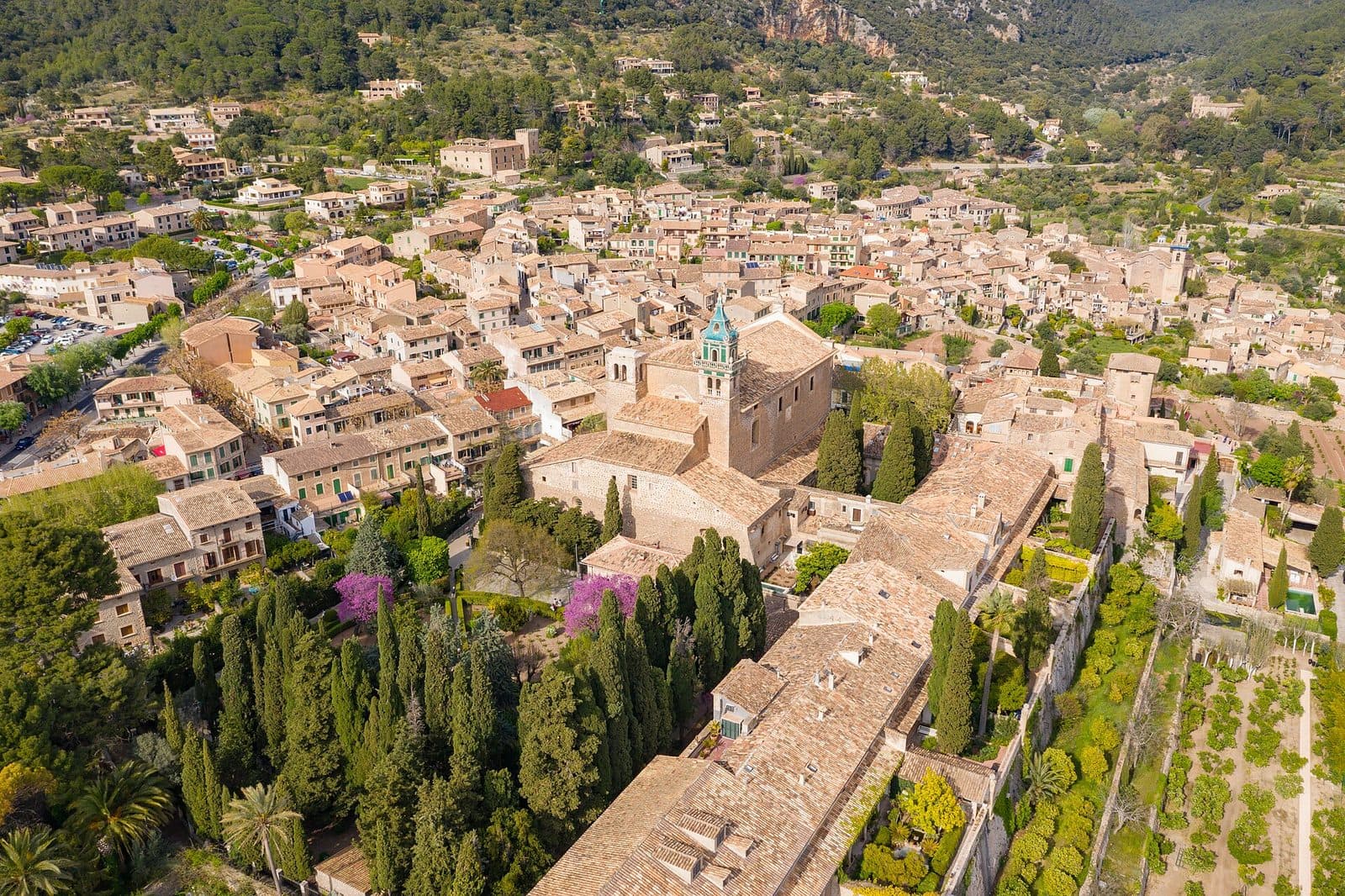
In the heart of the historic center, Cartoixa de Valldemossa opens up a surprisingly broad chapter of Mallorcan history. Behind its walls, a royal palace, Carthusian monastery and museum come together, along with memories of Frédéric Chopin and George Sand. This is not a single building that can be taken in at a glance, but an evolving complex of a church, cloisters, cells, halls, gardens and terraces.
Its appeal lies precisely in these transitions. A grand room is followed by a simple monastic cell, the old pharmacy by an art collection, and a long arcaded corridor by views across the valley of Valldemossa. Anyone interested in history, music, literature or historic interiors will find much more here than the familiar chapter about Chopin's winter in Mallorca.
The charterhouse is also an ideal introduction to Valldemossa. Its rooms explain why the town first became a royal retreat, then a religious center and finally a destination for artists and travelers. The museum is too complex for a fleeting photo stop; its character unfolds when there is time to look closely at the exhibits, architecture and views.
History and significance
The Palace of King Sancho
It began not as a monastery but as a royal residence. King Jaume II of Mallorca chose this location in the Serra de Tramuntana for a palace dating back to 1309. Sancho I. continued to use and shape the complex, which is why it is still known today as the Palace of King Sancho. Its location above the island's lower regions made Valldemossa a favored retreat for Mallorca's rulers.
This courtly past is crucial to understanding the Cartoixa. The Carthusians did not later take over an empty site, but an already important seat of power. That is why the complex still has two faces today: it tells of royal display as well as of an order whose daily life centered on silence, prayer and extensive withdrawal from the outside world.
The royal charterhouse
In 1399, King Martin I. of Aragón founded the Real Cartuja de Jesús de Nazaret de Valldemossa on the foundations of the Alcázar. The palace became a Carthusian monastery. The monks did not live like a closely collaborating community in a single dormitory, but mainly in their own cells. The long corridor with its entrances to the individual areas still makes this way of life spatially understandable today.
The present appearance, however, does not date solely from the Middle Ages. Large parts of the monastic buildings were constructed in the 18th century; the operators distinguish between the old charterhouse with the royal palace and the newer complex shaped from 1717 onward. The Neoclassical church also belongs to this later building phase: its construction extended from 1751 to 1812. In one place, visitors can therefore trace how a medieval residence developed over centuries into an extensive monastic complex.
Secularization and an artists' retreat
Monastic life ended in 1835 with secularization. The Carthusians had to leave the complex, and the nine cells were sold individually and remained in private ownership. Individual cells and rooms of the monastery are now used as museum spaces. This unusual ownership history explains why the Cartoixa now consists of different museum sections and does not feel like a completely preserved, uniformly managed monastery.
Only a few years after the monks left, Frédéric Chopin and George Sand came to Valldemossa. In the winter of 1838/39, they lived in former monastic rooms. Chopin's stay is associated with his Préludes op. 28; George Sand later made their shared Mallorca episode famous in literature through “A Winter in Mallorca.” Their stay became the charterhouse's most celebrated afterlife.
What to see
Church and cloisters
The Neoclassical church is one of the architectural highlights. Its construction from 1751 to 1812 belongs to the monastery's last great era before its dissolution. It therefore represents the imposing form the charterhouse acquired in the 18th and early 19th centuries rather than its medieval beginnings.
The former monastic life becomes especially vivid in the cloisters and the long corridor with white arches. From here, the Carthusians' cells were accessed. The corridor is not merely a picturesque photo backdrop: its regular sequence of arches and doors provides access to the individual cells.
Carthusian cells, library and audience hall
The former cells give the visit its human dimension. They reveal the spatially separate areas in which the monks lived and worked. Monastic artifacts, documents and preserved furnishings help visitors perceive the rooms as more than an empty historical setting.
The complex also includes the library and audience hall. The prior's chair stands in the audience hall. Details like these are easy to overlook, but they often reveal more about the community's daily life than a single magnificent object.
The old monastery pharmacy
Pharmacy vessels from the 17th and 18th centuries make the old pharmacy one of the most immediate rooms on the tour. They point to the monastery's medical knowledge and the practical care of a community that lived largely according to its own rules for a long time.
The pharmacy rewards a slow look. Only the large number of labeled containers and their orderly arrangement convey the character of a historic workspace. The charterhouse also includes the former monastery printing press.
Chopin and George Sand
Cells 2 and 4 display documents and mementos from the stay of Frédéric Chopin and George Sand. Objects associated with Chopin include his death mask and a lock of hair; Sand's “A Winter in Mallorca” is represented by a manuscript. The exhibition combines personal testimonies with the story of the winter that permanently placed Valldemossa in European music and literary history.
Here in particular, it is worth distinguishing between popular legend and the actual place. Chopin and Sand did not arrive at a quietly functioning monastery, but at a complex that had recently been secularized and whose cells had already been sold. The setting was therefore a former monastery in transition. This close timing after the expulsion of the Carthusians makes their stay even more historically interesting.
Joan Miró collection
The Cartoixa does not end with monastic history and Romanticism. A dedicated collection focuses on posters and graphic works by Joan Miró. It introduces a distinct change in visual language: after historic furniture, manuscripts and religious spaces, color, line and printmaking take center stage.
The Miró collection is therefore more than an appended exhibition room. It shows how the Cartoixa now functions as a museum complex in which different eras can be read side by side. Visitors who come solely for Chopin should not skip this section too quickly.
Gardens and terraces
Beyond the interiors, gardens and terraces open toward the valley of Valldemossa. From here, it becomes clear why kings, monks and later artists chose this particular place. The view stretches over the town and into the mountain landscape of the Serra de Tramuntana; at the same time, the complex's tiered structures are easier to understand from outside.
The gardens provide a peaceful counterpoint to the densely furnished museum rooms. Instead of display cases and documents, paths, vegetation and views shape the experience. Anyone who reduces the tour to the famous cells therefore misses an essential part of the visit.
Visiting
Recommended order
The tour becomes more rewarding when followed chronologically: first the royal origins and palace, then the Carthusians' rooms, and finally Chopin, George Sand and modern art. The long arcaded corridor serves as the spatial backbone in particular. From it, paths lead into the cells and exhibition areas before the gardens and terraces direct the view back outside.
Allow at least about an hour for the church, cloisters, pharmacy, cells, art collection and outdoor areas. Anyone who reads the historical documents in detail, looks more closely at the Miró prints or lingers on the terraces will need correspondingly longer. A visit squeezed directly between two tightly scheduled activities hardly does the complex justice.
Music in a historic setting
The visitor program may include a short piano recital featuring works by Chopin. The music provides a different emphasis from display cases and commemorative exhibits: Chopin is presented not only through portraits and personal objects, but can also be heard as a composer. Anyone wishing to attend should check the current schedule before starting the tour, as such program items may be tied to specific dates and the museum's current arrangements.
The Cartoixa also offers an interactive guided tour. It is particularly helpful because the complex combines several historical layers and different collections. Without explanation, it is not always clear at each door whether the room belongs to the royal palace, the later monastery or an exhibition created after secularization.
Best time to visit and crowds
Valldemossa is one of Mallorca's most visited excursion destinations and can become particularly crowded in the high season. Anyone wishing to see the rooms at a quieter pace should arrive when the museum opens, before day-trippers gather in the town center and corridors. On Saturday, the museum day ends earlier than on the other opening days, so a late start leaves less flexibility.
The Cartoixa is open Monday to Friday from 10 to 17 and Saturday from 10 to 16. Admission is charged; since no reliable current price is available, it is advisable to check the museum's latest information before visiting. Any special arrangements on public holidays or during local festivals should also be checked in advance.
Getting there
From Palma and the airport
From Palma Airport, the route initially follows the Ma-20 and then the Ma-1110 to Valldemossa. The town is 25 road kilometers away, and the journey takes around 30 minutes. From central Palma, the route follows the Ma-1110; allow around 35 minutes for the 19 road kilometers.
These details apply to Valldemossa itself, not directly to the museum entrance. The Cartoixa is centrally located on Plaça de la Cartoixa in the historic town center. The final section passes through the densely built village area with its narrow streets and cobbled lanes.
The final stretch on foot
From the town area, the charterhouse, as Valldemossa's most important monument, can easily be included in a walk through the center.
Visitors arriving by bus can get off at either Valldemossa 1 or Valldemossa 2. From there, it is a walk through the town to the centrally located complex. The Ermita de la Trinitat 2 stop is also nearby.
Planning during high season
The Ma-1110 is the key connection between Palma and Valldemossa. Because the mountain village is a highly popular excursion destination, the stated driving times should not be equated with the total time needed to reach the museum entrance. The stated driving times apply as far as Valldemossa. Setting out early not only makes the journey easier but also improves the chances of a quieter tour through the Cartoixa.
Bus lines to Cartoixa de Valldemossa at a glance
| Line | Route | Departures/day | First | Last |
|---|---|---|---|---|
| 203 | Valldemossa / Deià | 152 | 06:47 | 22:34 |
From the official GTFS feeds (TIB/SFM), no real-time data. The figures cover all stops in the town; weekend and holiday services differ — check with the operator before travelling.
Getting there by bus
Valldemossa 1 (63002) · 0.2 km as the crow flies
- 203Valldemossa / Deià · Daily
Valldemossa 2 (63001) · 0.2 km as the crow flies
- 203Valldemossa / Deià · Daily
Ermita de la Trinitat 2 (63011) · 1.9 km as the crow flies
- 203Valldemossa / Deià · Daily
Ermita de la Trinitat 1 (63003) · 2.1 km as the crow flies
- 203Valldemossa / Deià · Daily
Timetable data: official GTFS feeds (TIB/EMT), no real-time — check with the operator before travelling.
Nearby
Valldemossa's historic center
Before or after the museum, it is worth taking a walk through Valldemossa. Cobbled lanes, sand-colored houses and small squares form the immediate setting of the charterhouse. The town is compact enough to explore without a fixed route, although it is also heavily shaped by visitor traffic. Just a few steps away from the central routes, the character of an established Tramuntana village becomes more apparent.
Plaça de la Cartoixa is the natural starting point. The monumental complex and town hall stand close together here, while the Jardins de la Cartoixa also adjoin this central area. The transition between museum, garden and village is seamless. This makes it easier to connect the charterhouse's history with present-day Valldemossa instead of viewing it as an isolated monument.
Jardins de la Cartoixa
The gardens beside the charterhouse are ideal for a quiet break after visiting the interiors. Paths, fountains and vegetation offer some distance from the bustle of the central lanes, while views of the Serra de Tramuntana open up once again. They are a worthwhile complement to the museum terraces without requiring another lengthy activity.
The contrast between the garden and the massive monastery walls also illustrates how strongly the Cartoixa continues to shape the townscape today.
Serra de Tramuntana and other destinations
Valldemossa lies in northwestern Mallorca in the Serra de Tramuntana. A visit can therefore be combined with a drive through the mountain region, for example toward Deià or other places along the west coast. Such combinations are especially practical when the Cartoixa is visited in the morning and enough time remains for the rest of the day.
For a first visit, however, there is no need to overload the itinerary. The charterhouse, gardens and village lanes already create a substantial program of history, art and scenery. Anyone who does not merely check off the Chopin cells in the Cartoixa but also includes the pharmacy, church, Miró collection and terraces can spend a considerable part of the day in Valldemossa.
Local insider tips
Watch for the recital
The visitor program may include a short piano recital featuring works by Chopin. It is best to check the current schedule before starting the tour so that you do not visit the museum rooms at exactly the same time as the performance.
Do not skip Miró
Many visitors come solely for Chopin and George Sand. The collection includes posters and graphic works by Joan Miró and is well worth the deliberate detour.
Continue to the terraces
The tour should not end in the former cells. Gardens and terraces open up views across the valley of Valldemossa and explain the setting that once attracted kings, Carthusians and artists.
Examine the vessels closely
In the old monastery pharmacy, pharmacy vessels from the 17th and 18th centuries tell of the Carthusians' practical daily life. The orderly rows may look unassuming, but they are among the most vivid records of monastic life.
Start when it opens
Valldemossa can become very crowded during the high season. Starting when the museum opens provides more peace in the cells and arcaded corridors and leaves enough time afterward for the gardens, village lanes and a drive through the Tramuntana.