
Palau del Rei Sanç in Valldemossa
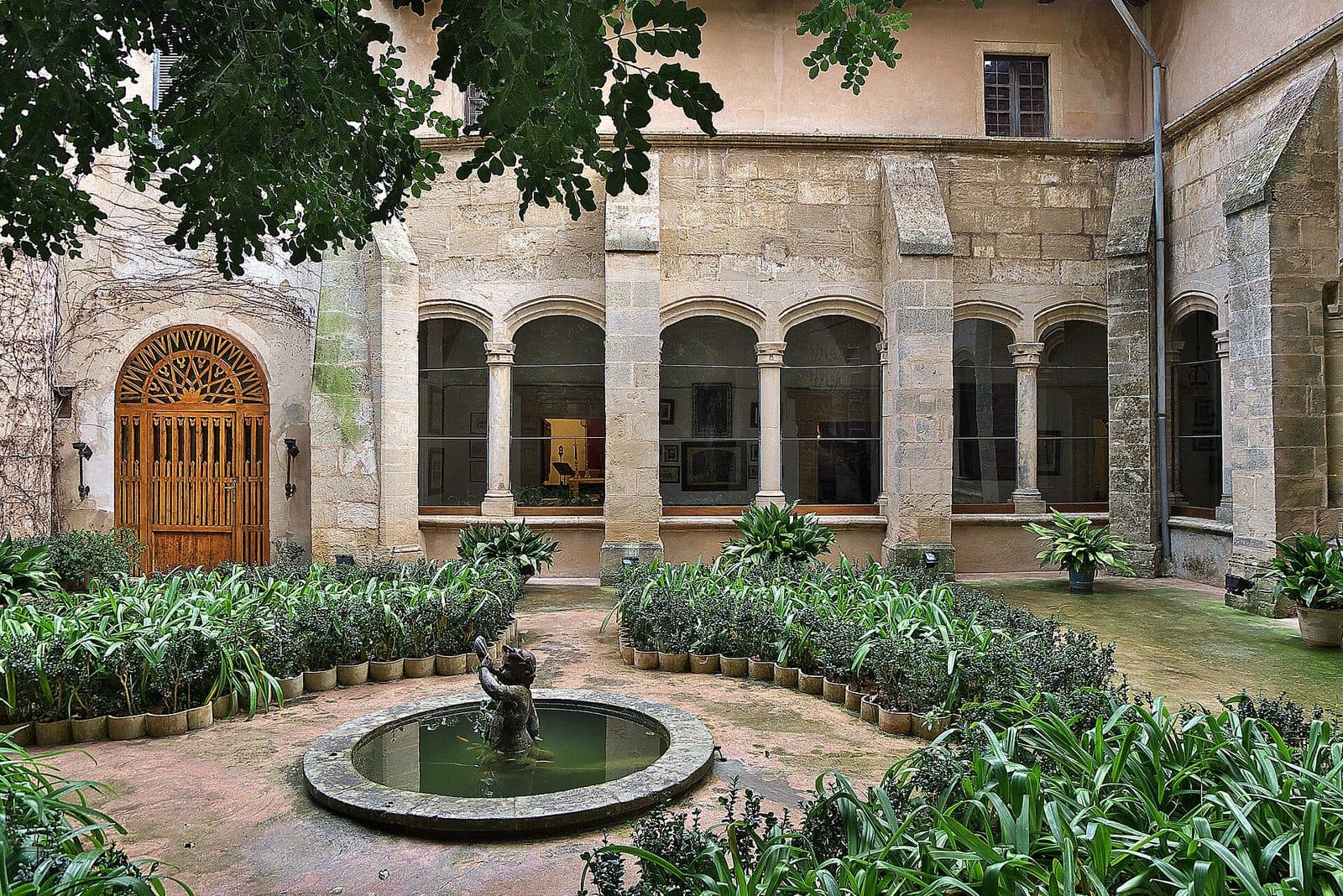

The Palau del Rei Sanç takes you back to the beginning of a story that continues to shape Valldemossa today. Before Carthusian monks lived here, and long before Frédéric Chopin and George Sand made the place famous, a royal residence stood on this site. The palace from the early 14th century forms the historic core of the charterhouse complex that later grew around it.
The building’s appeal comes not from monumental size but from intimacy. A stone façade, a secluded courtyard, and furnished rooms reveal the courtly origins of the site. At the same time, this is not an isolated castle: the Palau is part of an ensemble where royal and monastic history overlap.
A visit is especially rewarding for travelers who want to experience Valldemossa as more than a picturesque mountain village. The palace formed the original core of the later charterhouse and held special significance centuries before Chopin’s stay. Architecture enthusiasts will find traditional Mallorcan forms, while visitors interested in cultural history can trace the transition from residence to monastery.
The building is almost too interesting for a quick photo stop, as its impact comes from the interplay between the courtyard, palace rooms, charterhouse, and Valldemossa’s stone-built townscape. Anyone who examines these connections can read the Palau del Rei Sanç as the opening chapter of a long history of construction and use.
History and significance
It began as a royal retreat. The palace dates to 1309 and was therefore built at the beginning of the 14th century. King Jaume II commissioned the residence for his son Sanç, after whom it is now named. His poor health is cited as the reason: Sanç suffered from breathing difficulties, and the air in Valldemossa’s mountain setting was considered beneficial.
King Jaume II and Sanç
Choosing Valldemossa was about more than selecting a beautiful landscape. A royal residence in the Serra de Tramuntana combined seclusion with the hope of a more favorable climate. It served as a retreat for the royal household, and its modest scale still feels more like a private residence than a fortress.
Sanç, frequently called Sancho in German texts, gave the building its familiar name. Its construction is associated with the stay of an ailing king’s son in the mountain air. This background makes the palace an important testament to medieval court life on the island.
From royal palace to charterhouse
The royal period was not the final chapter. The later charterhouse of Valldemossa developed from the palace; the Palau is considered the original core of its historic and artistic ensemble. The Carthusians used the site until 1835. Over the centuries, a monastic complex with a church, cells, corridors, gardens, and terraces grew around the former residence.
This transition is crucial to understanding the building today. The Palau del Rei Sanç is not an unchanged medieval palace preserved in isolation from its surroundings. Its rooms became part of a monastic organism. Royal and religious uses therefore follow one another chronologically while also remaining directly visible side by side within the ensemble.
Chopin, George Sand, and the proper context
Frédéric Chopin and George Sand’s winter stay in 1838 and 1839 made Valldemossa internationally famous. However, they stayed in the former charterhouse, and this should not be confused with residence in the Palau del Rei Sanç. The famous couple belongs to the history of the complex as a whole, not to the medieval use of the royal palace.
Keeping this distinction in mind helps during the tour. The Palau first tells the story of Jaume II, Sanç, and the site’s courtly origins. The Carthusians represent its long monastic period, while Chopin and Sand belong to its later cultural memory. Together, these layers explain why the complex is far more than the setting of a single famous travel episode.
The Palau today
Today, the former residence is presented as a historic part of the Royal Charterhouse. Visitors encounter furnished interiors and gain insight into Mallorca’s royal past. The palace remains closely connected to the rest of the monumental complex. Its value also lies in its significance as the original core of the charterhouse’s historic ensemble.
What to see
The stone is the first thing you notice. The preserved stone façade displays traditional Mallorcan architecture and blends into Valldemossa’s narrow lanes and natural-stone townscape. Only on closer inspection does it become clear that this is not merely another historic residence, but the oldest core of a royal and later monastic ensemble.
The stone façade
The natural-stone façade provides a good impression of traditional Mallorcan architecture. Together with the paving and surrounding historic walls, it creates an especially harmonious scene. For photographs, it is therefore worth capturing more than a straight-on view of the building and including some of the lane and adjoining complex in the frame. The significance of the Palau emerges above all from its age, its uses, and its position within the charterhouse.
The courtyard
Behind the stone exterior is a small, atmospheric courtyard. It is one of the places where the scale of the palace becomes especially apparent. The architecture feels more private than the expansive courtyards of large residences.
The courtyard is also a good place to notice the transition between exterior and interior spaces. Bright Mallorcan light meets shaded stone surfaces here. Rather than simply crossing it on the way to the rooms, pause briefly, as its intimacy conveys how compactly the original residence was designed.
The furnished palace rooms
Inside, the focus is on historic rooms with furnishings. The interiors help visitors see the building not merely as a stone shell but as a former home. They create a historic atmosphere without turning the Palau into a vast furniture showroom. The building itself remains the most important exhibit.
During a tour, attention should therefore not be limited to individual pieces of furniture. The manageable layout makes it easier to imagine the palace as an inhabited place. This was the starting point of a religious complex that later became considerably larger.
Guided visits are mentioned as an option in travel descriptions. Whether and in what form they are offered on the day of your visit should be checked in advance. A tour can be especially helpful because the historical significance of many rooms cannot be understood from their present furnishings alone.
The transition to the Royal Charterhouse
One of the most important features is not an individual piece of furniture but the connection to the Cartoixa de Valldemossa. The Palau forms its original core, while the later monastic buildings reflect a different use of the same site. On a combined tour, the former royal retreat gradually becomes a monastic complex.
The wider ensemble includes the church and areas characteristic of the Carthusian period, with cells and long connecting corridors. These spaces should not be confused with the palace rooms themselves. However, they clearly show how extensively the site changed and expanded after the royal period.
Gardens, terraces, and valley views
The gardens and terraces of the charterhouse complex open up views from the dense architecture toward the valley of Valldemossa. After the more enclosed palace and monastic rooms, the perspective changes: the Serra de Tramuntana returns to the foreground, and the landscape setting of the former residence becomes easier to understand.
This view belongs to the larger ensemble rather than exclusively to the medieval palace. Nevertheless, it helps explain the palace’s origins. Only when looking across Valldemossa does it become clear why the mountain location was associated with peace, retreat, and healthy air. Anyone visiting the Palau and charterhouse together should therefore not treat the outdoor areas as merely the end of the tour.
Visiting the palace
The Palau del Rei Sanç is best understood as part of a continuous historical tour. Visitors can explore the royal residence with its courtyard and furnished rooms while tracing its development within the charterhouse. Anyone focused exclusively on Chopin can easily overlook the site’s older history, which is fundamental to Valldemossa.
Order and time required
A visit of around one hour is often suggested for the entire monumental complex. This provides a useful framework for a focused tour of the palace, charterhouse, and outdoor areas. Anyone wishing to examine the furnishings more closely, read historical explanations, or spend longer on the terraces should allow additional time. It is difficult to give a reliable separate duration for the palace alone because it is closely connected to the charterhouse both spatially and historically.
A sensible approach is to focus first on Jaume II and Sanç before moving on to the Carthusian period and Chopin’s stay. This keeps the chronology clear. Otherwise, it can easily seem as though all the famous figures used the same rooms at the same time.
The quietest time of day
Valldemossa is one of the most popular destinations in the Serra de Tramuntana. Travel advice recommends arriving early in the morning to avoid the largest crowds in the lanes and around the monumental complex. At that time, it is also easier to appreciate the stone façade in relation to its surroundings without larger groups constantly filling the entrance and small courtyard.
Current admission conditions should be checked before the excursion. Guided tours and access to individual areas may also change. Anyone traveling specifically to see the palace should therefore not rely solely on general information published for the charterhouse.
What to expect from the tour
A visit resembles a search for historical traces: there is a compact palace core, historic rooms, and the connection to the later monastery. This is precisely why it rewards slow observation. The façade, courtyard, and rooms reveal the starting point of the later monastery. Keeping this development in mind also changes the way you experience the charterhouse’s later sections: not as unrelated neighboring buildings, but as the continuation of a story that began in the Palau.
Getting there and parking
The journey first leads to Valldemossa; the stated distances and driving times end in the town, not directly in front of the palace façade. From Palma de Mallorca Airport, the road distance is 25 kilometers. The drive takes around 30 minutes via the Ma-20 and then the Ma-1110. From central Palma, the Ma-1110 leads to Valldemossa over 19 road kilometers; allow around 35 minutes.
The final stretch in Valldemossa
The Palau stands in the historic part of the village beside the Royal Charterhouse. The final stretch is therefore very different from the drive along the approach road. Narrow, partly steep, paved lanes characterize the route through Valldemossa. Allow for a walk during the last few minutes; sturdy, comfortable shoes are more useful than trying to navigate as close to the palace as possible by car.
On busy days, it is sensible to allow extra time for arriving in Valldemossa and walking through the town center instead of scheduling the tour immediately after the calculated driving time.
By bus
Valldemossa can also be reached by public bus. Available stops include Valldemossa 1, Valldemossa 2, and Ermita de la Trinitat 2. From Valldemossa, the route continues through the village to the charterhouse and palace area.
Check the current bus schedule, especially if the visit is linked to timed admission, a guided tour, or another destination in the Serra de Tramuntana. Within Valldemossa, the nature of the final section remains the same: the Palau is reached on foot through the historic streets, with paving and gradients forming part of the visitor experience.
Bus lines to Palau del Rei Sanç at a glance
| Line | Route | Departures/day | First | Last |
|---|---|---|---|---|
| 203 | Valldemossa / Deià | 152 | 06:47 | 22:34 |
From the official GTFS feeds (TIB/SFM), no real-time data. The figures cover all stops in the town; weekend and holiday services differ — check with the operator before travelling.
Getting there by bus
Valldemossa 1 (63002) · 0.2 km as the crow flies
- 203Valldemossa / Deià · Daily
Valldemossa 2 (63001) · 0.3 km as the crow flies
- 203Valldemossa / Deià · Daily
Ermita de la Trinitat 2 (63011) · 1.9 km as the crow flies
- 203Valldemossa / Deià · Daily
Ermita de la Trinitat 1 (63003) · 2.2 km as the crow flies
- 203Valldemossa / Deià · Daily
Timetable data: official GTFS feeds (TIB/EMT), no real-time — check with the operator before travelling.
Nearby attractions
The story does not end at the next door after leaving the palace. The Palau del Rei Sanç stands at the heart of the ensemble from which the Royal Charterhouse of Valldemossa developed. Combining it with the Cartoixa is therefore not an arbitrary addition but the most logical continuation of the visit.
Cartoixa de Valldemossa
The charterhouse presents the long monastic period that followed royal use. The church, former monks’ areas, corridors, gardens, and terraces broaden the view of the site. This is also where visitors encounter the memory of Frédéric Chopin and George Sand, who spent the winter of 1838 and 1839 in Valldemossa. Their story should remain chronologically separate from the medieval palace, but the shared setting gives it added depth.
Even visitors with limited time should regard the Palau and charterhouse as a single historical narrative: first the residence of Jaume II and Sanç, then the life of the Carthusians, and finally the complex’s cultural legacy. This approach is more rewarding than a tour that merely collects famous names or photo opportunities.
Valldemossa town center
Around the complex, the natural stone, paved streets, and closely spaced houses continue. A walk through the town center shows how naturally the palace now belongs to the village. It does not rise in isolation above Valldemossa but is approached through lanes that preserve the scale of the historic center.
The walk does not require an extensive itinerary. Simply moving between the busier main route, quieter side streets, and charterhouse area provides a good impression of the town. Cafés and small shops make it easy to take a break before or after the visit without leaving the historic center.
Serra de Tramuntana and other destinations
Valldemossa lies in northwestern Mallorca in the Serra de Tramuntana. Anyone devoting a full day to the region can combine the palace visit with Deià, a viewpoint on the west coast, or Port de Valldemossa. However, these destinations should not be scheduled too tightly: mountain roads, local traffic, and the walk through the historic center take more time than a glance at the map might suggest.
For a culture-focused excursion, Valldemossa itself is enough. The Palau, charterhouse, and a walk through the town create a coherent sequence without requiring another distant destination. Anyone continuing afterward should visit the palace in the morning and add the landscape to the route only later.
The place it belongs to
Valldemossa in the place guidePractical visitor information
The paving is part of the historic setting but requires attention. Valldemossa’s lanes are steep and uneven in places; comfortable shoes with good grip are advisable for the walk to the palace and the subsequent tour of the town. This is especially true when visiting the charterhouse, gardens, and other streets in the town center in addition to the Palau.
Visiting with children
For children, the Palau works particularly well as a compact introduction to the history of a real royal residence. The courtyard, rooms, and transition to the monastery are more vivid than a purely documentary exhibition. The visit becomes most engaging when the simple story is explained beforehand: a king had a palace built in the mountain air for his sick son, and monks later turned it into the core of their monastery.
Younger children will need more time on Valldemossa’s paved and partly steep paths. Families may therefore benefit from taking a short break between arrival and the indoor visit. A combined tour of the palace and charterhouse is also easier to explain when the different periods are clearly identified.
Clothing and weather
The visit combines interior spaces with outdoor paths. Depending on the route, it may include the courtyard, gardens, or terraces, while the approach through the town already passes along open lanes. The experience does not involve a long stay in open terrain but rather alternates between the village, palace, and charterhouse complex.
The character of the Palau
The Palau del Rei Sanç is a comparatively intimate historic building with stone architecture, a courtyard, and furnished rooms. Its true importance lies in its role as the starting point of the charterhouse. The palace itself should not be equated with the later story of Chopin in the former charterhouse: Chopin and George Sand belong to the later history of the former monastery. Keeping this distinction in mind reveals something in the Palau that is easily overlooked in the better-known Chopin narrative: Valldemossa was a place of royal and religious memory long before the famous winter stay.