
Miranda des Lledoners – Valldemossa Viewpoint over the Valley
.jpg)
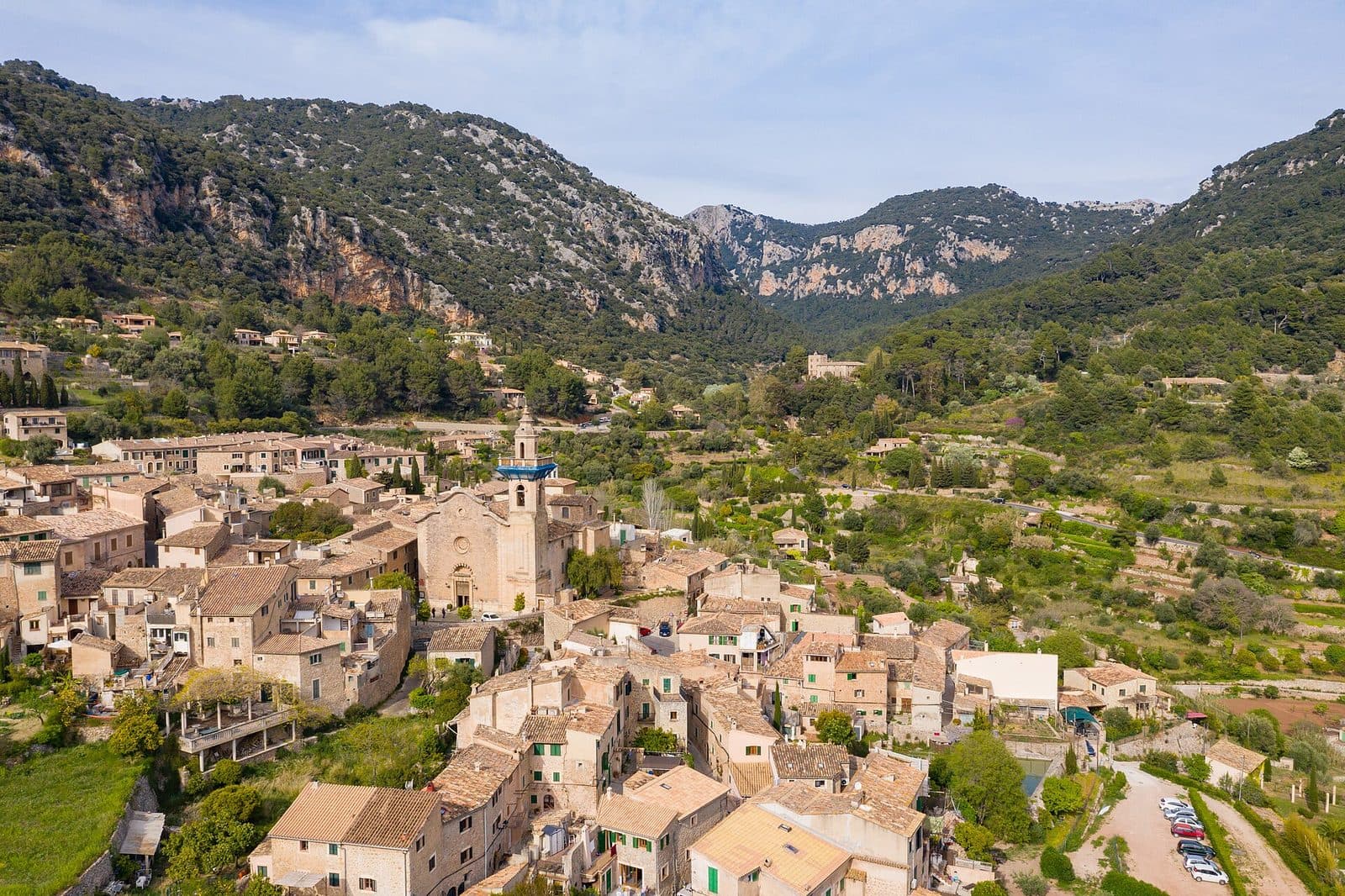
Miranda des Lledoners stands where Valldemossa’s stone lanes suddenly open onto a sweeping view. At the edge of the historic center, the panorama extends across the mountain village’s rooftops, the green valley and the heights of the Serra de Tramuntana. The viewpoint is not a destination for a long tour, but a place to arrive, look and take in the setting. The shift in perspective is particularly appealing: narrow lanes first lead between natural-stone façades, but at the Miranda the closely built old town recedes and the landscape takes over. From here, it is easy to see how Valldemossa nestles between mountain slopes and the valley. The yellowish-brown roofs and walls stand out clearly against the surrounding greenery.
The square is worth visiting for more than the panorama alone. Below and immediately beside the viewpoint, traces recall the former entrance to the monastery precinct, while the houses along the final stretch of the route also belong to the historic setting of the charterhouse. Miranda des Lledoners thus brings together landscape, townscape and monastic history within a compact area. For photographers, families and visitors exploring Valldemossa on foot, the viewpoint is therefore a natural stop. Those who come early in the day or later in the afternoon will usually find it quieter than during typical excursion hours and can spend more time observing the details in the valley.
History and significance
The old entrance to the charterhouse
Historically, Miranda des Lledoners was more than a beautiful square at the edge of the village. The old entrance to Valldemossa’s monastery precinct ran below the viewpoint. Beside the large tower stood a guesthouse for people visiting the Carthusian monks. The view from above therefore extends not only into the landscape but also across a former threshold between the village, the transport route and the monastic world. The old road that led from Palma to Valldemossa can also be traced through the landscape from the Miranda. Its elevated position made the square a natural observation point above the approach road.
Carrer de Jovellanos
Access to the Miranda leads along the narrow Carrer de Jovellanos. Its name commemorates the Spanish statesman Gaspar Melchor de Jovellanos, who was imprisoned in a tower of the charterhouse. The lane is therefore not merely a picturesque passage to the panorama, but part of the historic surroundings of the former monastery.
The houses on both sides were built in the 15th century, when kings occasionally stayed in Valldemossa to hunt. Buildings in this area later passed into the possession of the charterhouse and were used for practical purposes, including as stables and a forge. The walk to the viewpoint therefore passes through an area that once formed part of the monastery complex’s everyday working life.
George Sand and the view of Valldemossa
George Sand added a literary dimension to the location. The French writer came to Mallorca in 1838 with Frédéric Chopin and her children; they spent the winter of 1838–1839 in Valldemossa. Today, one of the island’s literary routes explicitly links Miranda des Lledoners with Sand and her memories of the landscape.
In her autobiography Histoire de ma vie, she described the sky, the valley, the pure mountain air and the sea on the horizon with great admiration. Although her time on Mallorca was overshadowed by Chopin’s illness and her own difficulties, Valldemossa remained one of the most beautiful places she had seen. At the Miranda, it becomes clear why the landscape shaped her memories so strongly: village, valley and mountains do not appear separately here, but as a single, connected scene.
What to see
The panorama over the village and valley
At the edge of the square, a view of approximately 180 degrees opens up. In the foreground are Valldemossa’s densely layered rooftops, with the valley beyond and the wooded or rocky heights of the Serra de Tramuntana behind it. The contrast between the warm colors of the natural-stone houses and the darker green of the mountain landscape is especially striking.
The viewpoint is an excellent place from which to read the townscape. Instead of individual façades, Valldemossa appears as a compact settlement within a dramatically varied landscape. The longer you look, the more paths, walls, rooflines and transitions between the built-up village and the green valley emerge. The Miranda is therefore not only a photo stop, but also a good place to understand the village’s setting.
Stone parapet and paved square
The stone parapet frames the viewpoint like a small balcony. Together with the paving and seating, it preserves the character of the historic center. It does not feel like a large-scale visitor platform, but like an extension of the adjoining lanes. This understated design is an important part of the experience: visitors step out of the narrow street onto the square, walk to the parapet and see Valldemossa from a perspective that mediates between the village and the open landscape.
The monastery area below the Miranda
Below the viewpoint lies the site of the former monastery entrance. The large tower and the surrounding historic buildings provide an architectural frame for the panorama. Those who look only into the distance may easily overlook the fact that the Miranda itself occupies an important junction within the old charterhouse complex.
From here, it is also possible to appreciate the proximity of the Palau del Rei Sanç and the Real Cartuja. Although the Miranda is not part of their interior tours, it helps place the historic buildings within the landscape. The route there passes through the part of Valldemossa where royal history, monastic use and the modern village meet directly.
Light and photography perspectives
The square is often quieter in the early morning, making it possible to view the rooftops without dense crowds. Later in the day, lower light changes the colors of the walls and mountains; warm stone surfaces and shadows become especially pronounced in the late afternoon. For a clear composition, a position directly at the parapet is recommended, while viewpoints from the side include more of the paved square and historic buildings.
Visiting the viewpoint
Through the lanes to the view
The most appealing approach begins in Valldemossa’s historic center. From Plaça de Ramon Llull, the narrow Carrer de Jovellanos leads toward the Miranda. This final stretch is already part of the visit: old stone houses line the lane before the space at the viewpoint suddenly opens toward the valley.
The Miranda itself does not require a fixed route. It makes sense to take in the overall panorama first and then change viewing direction: across the rooftops, down toward the former monastery entrance and out along the old connection toward Palma. Those who stop at the parapet only for a quick photo can easily miss the historic context directly below the square.
A short pause is sufficient for the viewpoint alone. It is worth allowing more time when visiting the Miranda as a stop on a walk through the old town, charterhouse and palace area. It is therefore less an isolated excursion destination than a peaceful highlight within a tour of Valldemossa.
Quiet and busy times of day
Valldemossa attracts many day visitors, and this is also noticeable at its well-known viewpoints. The chance of a quieter moment is especially good in the early morning. Another favorable period begins later in the afternoon, when some excursion visitors have already left the village. At the same time, the light falls more obliquely across the rooftops and slopes.
Around midday, the narrow lanes and the area by the parapet can become livelier. Anyone wishing to take photographs or enjoy the landscape in peace should therefore visit outside the busiest hours. Specific opening hours and admission conditions have not been reliably documented and should be checked for current information before visiting. The Miranda is incorporated into the public walking route through the village, but neighboring historic attractions have their own visitor regulations.
Getting there and parking
From Palma and the airport
From Palma Airport, the drive initially follows the Ma-20 and then the Ma-1110 to Valldemossa. The distance to the village is 25 kilometers by road, and the drive takes around 30 minutes. From central Palma, the route follows the Ma-1110; allow around 35 minutes for the 19 kilometers by road to Valldemossa.
These distances and driving times apply specifically to Valldemossa, not directly to Miranda des Lledoners. The final stretch is on foot through the historic center and along Carrer de Jovellanos. This short walk through the closely built lanes contributes to the viewpoint’s impact, as the panorama opens only at the end of the street.
Parking and bus
Parking in the old town is limited, sometimes subject to time restrictions and in high demand. It is therefore advisable to leave your vehicle in a designated car park at the edge of the center and then explore Valldemossa on foot. Arriving early or late generally improves not only the chances of finding parking, but also the prospect of a quieter visit to the Miranda.
Valldemossa can also be reached by public bus. From the bus stops in the village, the viewpoint is reached on foot through the center. As the Miranda is located in a narrow historic lane, walking is the appropriate final stage in any case, regardless of whether you arrive by car or bus.
Bus lines to Miranda des Lledoners at a glance
| Line | Route | Departures/day | First | Last |
|---|---|---|---|---|
| 203 | Valldemossa / Deià | 152 | 06:47 | 22:34 |
From the official GTFS feeds (TIB/SFM), no real-time data. The figures cover all stops in the town; weekend and holiday services differ — check with the operator before travelling.
Getting there by bus
Valldemossa 1 (63002) · 0.3 km as the crow flies
- 203Valldemossa / Deià · Daily
Valldemossa 2 (63001) · 0.3 km as the crow flies
- 203Valldemossa / Deià · Daily
Ermita de la Trinitat 2 (63011) · 1.9 km as the crow flies
- 203Valldemossa / Deià · Daily
Ermita de la Trinitat 1 (63003) · 2.2 km as the crow flies
- 203Valldemossa / Deià · Daily
Timetable data: official GTFS feeds (TIB/EMT), no real-time — check with the operator before travelling.
Nearby attractions
Real Cartuja and Palau del Rei Sanç
A visit to Miranda des Lledoners combines particularly well with the Real Cartuja and the Palau del Rei Sanç. Both are located in the historic center and explain many of the traces visible from the viewpoint. The charterhouse is closely associated with the stay of Frédéric Chopin and George Sand, while the palace recalls the village’s royal history.
Rather than traveling back and forth between individual sights, it is best to explore them on a continuous walk. The Miranda acts as a scenic counterpart to the interiors, courtyards and collections of the historic buildings. After viewing the valley, the position and extent of the former monastery precinct also become easier to understand.
Valldemossa old town
The characteristic streetscape of Valldemossa continues around the viewpoint: narrow paved lanes, natural-stone façades, colorful shutters and houses often decorated with plants. The village is easy to explore without a fixed route, provided that its slopes and uneven paving are taken into account.
The Jardins Rei Joan Carles and the squares in the center can also be included in the same walk. Cafés offer an opportunity to try Coca de Patata, for which Valldemossa is known. Those with more time for northwestern Mallorca can later combine their village visit with Deià, Miramar or Son Marroig; the Miranda remains the compact viewpoint that reveals Valldemossa itself from above.
Local insider tips
Arrive before the day visitors
In the early morning, the Miranda is usually quieter than during typical excursion hours. You can spend longer viewing the rooftops, and finding parking in Valldemossa is often easier as well.
Do not photograph only straight ahead
Directly at the parapet, you get an unobstructed view across the rooftops and valley. A position from the side also includes the paving, stone parapet and historic buildings, showing more clearly how the viewpoint belongs to the old town.
Look below the parapet
Many visitors focus only on the mountains. However, the old entrance to the charterhouse lay below the Miranda; the large tower and the area of the former guesthouse are also part of the square’s history.
Approach via Jovellanos
The most atmospheric route leads from Plaça de Ramon Llull through Carrer de Jovellanos. The narrow historic lane heightens the impact of the moment when the valley suddenly opens up at the end.
George Sand’s perspective
The island’s literary route links the Miranda with George Sand. Her praise of the sky, valley, mountain air and sea makes the square a fitting place to read before or after visiting the charterhouse.