
Cova de s'ermità Guillem near Valldemossa
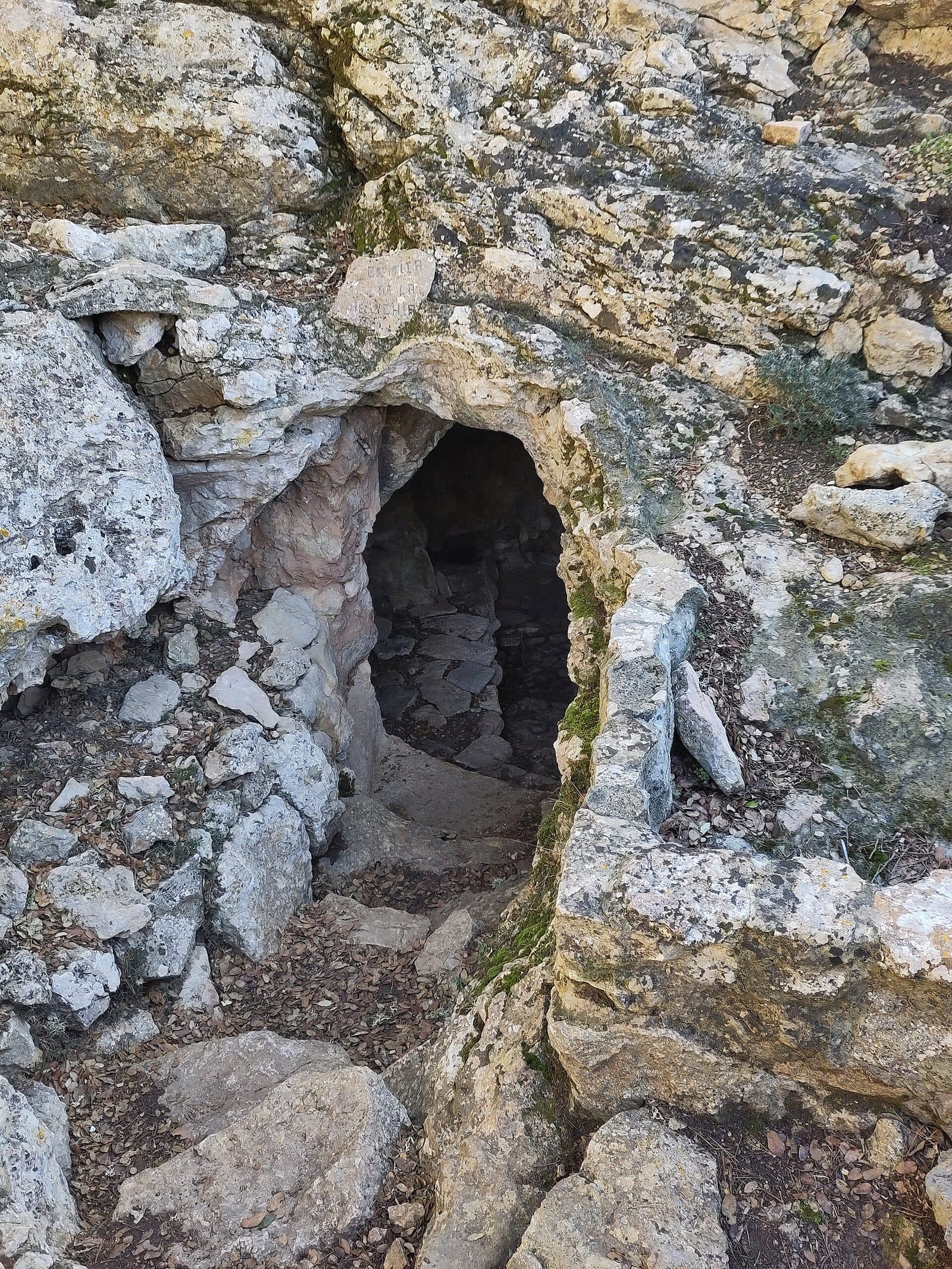

High above Valldemossa lies a place that is discovered rather than simply visited: Cova de s'ermità Guillem is a cave used as a hermitage in the Serra de Tramuntana, reached on foot via mountain trails. This transition from the village into the quiet, rugged landscape is an essential part of the experience.
Inside, the cave is surprising for the traces of human life it contains. Religious and mystical objects show that the rocky chamber served as more than a temporary shelter. The interior continued to be cared for long afterward and conveys the impression of a place where seclusion, prayer and everyday life were closely intertwined. There is no need for a lengthy tour once inside. What matters instead are the few meaningful details: the rocky chamber, the preserved everyday objects and an inscribed stone slab bearing a text by Sri Ramana. Together, they tell of a hermit tradition that does not seem abstract here but becomes tangible in a retreat that was actually used.
The cave is especially worthwhile for hikers seeking a specific cultural and historical destination. It can be incorporated into longer tours across the heights near Valldemossa and is often combined with the Camí de s'Arxiduc. The walk is therefore part of the visit and requires careful route planning.
History and Significance
The Hermits of Son Moragues
Cova de s'ermità Guillem is associated with a centuries-old hermit tradition. In this remote location between Valldemossa and Deià, people deliberately sought distance from everyday society. The natural protection offered by the cave and its distance from the village made the site suitable for an anchoritic way of life: not as a grand sanctuary, but as a quiet place to live and worship.
Reports also refer to the cave as Ermita de Son Moragues. Both names describe the same mountain retreat. For context, it is important not to confuse the cave with the nearby Ermita de la Trinitat or other hermitages in the Serra.
A Retreat Used for Many Years
Its history did not end in a distant era. Until just a few years before a press report published in 2015, people dedicated to a contemplative life were still living here. This comparatively recent use explains why the Cova does not feel like an empty archaeological site: objects from everyday life and religious practice remained in place, and visitors described the site as clean and carefully preserved.
This is precisely what gives it cultural and historical significance. Large monasteries tell the story of communal religious life, while Cova de s'ermità Guillem represents a radically smaller form of spiritual retreat. The rock itself becomes a shelter; just a few objects are enough to unite living, reflection and worship. The cave thus reveals a tradition that endured for centuries in Mallorca's remote mountain landscapes.
From Retreat to Hiking Destination
Today, the Cova is visited mainly as the destination or an intermediate stop on a mountain hike, while also remaining a quiet testament to eremitic life. Even so, it should not be treated like an ordinary hiking shelter. The objects inside are part of the site and are not freely available props.
Its location near well-known high-level trails attracts different kinds of visitors: hikers following the Camí de s'Arxiduc, people interested in Mallorca's religious history and those deliberately seeking less staged places. The Cova brings these perspectives together without losing its simple character.
What to See
The Rocky Chamber
Cova de s'ermità Guillem is a cave transformed into a hermitage through its use. The rock forms its walls, roof and shelter at the same time; the human additions remain subordinate to the existing space. This minimal separation between natural rock formation and living area makes the cave especially vivid.
There is no monumental architecture to distract from its original purpose. Instead, it is immediately apparent why a cave appealed to a hermit: it offered seclusion and an existing, enclosed interior. Those who enter are not standing before a reconstructed historical scene, but at the setting of a way of life maintained over a long period.
The Preserved Interior
Several reports emphasize that the cave remained furnished with everyday objects. Some are associated with religion and mysticism. These items are important visible evidence of the cave's use, give the space a personal dimension and distinguish it from an ordinary rocky hollow beside a trail.
The interior should be viewed with restraint. Its effect comes precisely from the quiet ensemble formed by the objects and the rocky chamber, suggesting everyday life rather than explaining it fully. It is therefore worth looking not only for a single spectacular feature, but also at how the objects are arranged and how modest the living space is.
That the Cova remained clean and preserved together with its utensils is by no means something to take for granted. The respectful behavior of previous visitors helped ensure that the site can still be understood. Nothing should be moved, taken away as a souvenir or supplemented with personal offerings.
The Stone Slab with Sri Ramana's Text
An easily overlooked but particularly meaningful detail is an inscribed stone slab inside. It bears a text by Sri Ramana; a photograph from 2022 documents the slab in the cave.
The Catalan text directs the mind inward and speaks of the innermost foundation of the heart, stillness and the search for one's own self. This call to contemplation fits remarkably well in a place long dedicated to retreat.
When viewing it, taking a little time is more rewarding than photographing it quickly. The slab is not merely a decorative object but a deliberate message within the rocky chamber. It connects the cave's physical seclusion with a spiritual idea of inward reflection.
The Mountain Setting
The trail and surroundings also contribute to the visible character of the Cova. It lies in the heights between Valldemossa and Deià, close to the network of paths around the Camí de s'Arxiduc. Accordingly, it does not appear as an isolated visitor attraction but as part of a landscape shaped by rock, mountain trails and historic routes.
The contrast is crucial: outside, the mountain terrain opens up, while the cave restricts sight and movement to just a few steps. This spatial change helps explain why this particular place was chosen for a contemplative life. The Cova is small in relation to the surrounding Serra, yet its history gives it a distinct significance of its own.
Visiting the Cave
The Journey Is Part of the Destination
From Valldemossa, Cova de s'ermità Guillem is reached via hiking trails. One published description estimates that the walk takes slightly more than an hour. This figure should be treated as guidance, not a guaranteed walking time: the chosen route, fitness level, trail conditions and breaks all affect the actual duration.
Other suggested tours incorporate the cave into substantially longer circular hikes. One documented circuit via Es Caragolí covers 5,6 miles and is estimated at around 3,5 to 4 hours. A route along the Camí de s'Arxiduc between Valldemossa and Deià is 11,5 kilometers long and has a stated walking time of 3:30 hours. The Cova can therefore serve either as the destination of an out-and-back hike or as the cultural and historical highlight of a longer mountain tour.
Time Inside the Cave
Visitors who carefully examine the interior and the stone slab gain more from the experience than those making a hurried photo stop. The actual visit duration results from the combination of the approach, quiet observation and the return journey. Overall planning should therefore account for more than just the time spent inside the Cova.
Even the direct walk from Valldemossa takes several hours there and back. A circular tour adds elevation gain, navigation and further trail sections. In this terrain, allowing extra time for breaks and unexpectedly slow passages is more important than following a tightly scheduled itinerary.
Access and Route Choice
Not every published route to the cave follows the same access rules. One option crossing the grounds of Finca Son Moragues or the Muntanya del Voltor conservation project passes through private land. The number of hikers there is limited to protect nature and the cinereous vultures, and advance permission is required for this route. This rule applies to the access route concerned and should not automatically be assumed to cover every possible approach.
Before setting out, it is therefore advisable not merely to enter the cave's name into a map app. What matters is the complete planned track, including the starting point and property boundaries. Current information from local authorities and the conservation project can help clarify whether the selected route requires permission or whether any trail sections have changed.
Admission and Current Visiting Arrangements
Admission to Cova de s'ermità Guillem is free. No fixed opening hours are recorded, but this does not remove the need to check current local conditions. Conservation or private-property regulations may affect a route even though no ticket is required for the cave itself.
Anyone choosing a longer circuit must also allow sufficient time for the return journey and should not confuse the brief cave visit with the duration of the entire excursion.
Getting There and Parking
From Palma Airport to Valldemossa
From Palma Airport, the drive initially follows the Ma-20 and then the Ma-1110 to Valldemossa. The road distance to the village is 25 kilometers, and the journey takes around 30 minutes. These details expressly apply only as far as Valldemossa, not to Cova de s'ermità Guillem.
Before driving, you should already know which hiking route you intend to use and where it begins. Particularly for routes crossing protected or private land, the starting point cannot simply be changed at will.
From Palma to Valldemossa
From central Palma, the route via the Ma-1110 covers a total of 19 road kilometers to Valldemossa. The journey takes around 35 minutes. Here too, the measured driving time ends in the village. One route description allows slightly more than an hour for the subsequent walk to the cave.
Anyone combining the outward and return drive with a longer mountain tour on the same day should not consider the road journey in isolation. A circuit via the Camí de s'Arxiduc or Es Caragolí can occupy most of the excursion day. The Cova is a stop within the landscape, not the end of a short drive.
Bus and Final Approach
Valldemossa can also be reached by regional bus; route 203 connects the village with Palma, among other places, and continues toward Deià and Port de Sóller. The specific nearby stops are shown separately on this page. Before the tour, current timetables should be checked and coordinated with the expected walking time.
For a point-to-point hike to Deià, the bus can be especially useful because the starting and finishing points do not need to be identical. Returning to Valldemossa makes planning simpler, but sufficient spare time remains important. Missed connections are harder to compensate for from this remote mountain setting than from a destination in the village center.
Bus lines to Cova de s'ermità Guillem at a glance
| Line | Route | Departures/day | First | Last |
|---|---|---|---|---|
| 203 | Valldemossa / Deià | 268 | 06:43 | 22:38 |
From the official GTFS feeds (TIB/SFM), no real-time data. The figures cover all stops in the town; weekend and holiday services differ — check with the operator before travelling.
Getting there by bus
Ca Madò Pilla 2 (63004) · 1.4 km as the crow flies
- 203Valldemossa / Deià · Daily
Ca Madò Pilla 1 (63005) · 1.4 km as the crow flies
- 203Valldemossa / Deià · Daily
Son Gallard 1 (18008) · 1.6 km as the crow flies
- 203Valldemossa / Deià · Daily
Ermita de la Trinitat 1 (63003) · 1.6 km as the crow flies
- 203Valldemossa / Deià · Daily
Ermita de la Trinitat 2 (63011) · 1.6 km as the crow flies
- 203Valldemossa / Deià · Daily
Son Gallard 2 (18007) · 1.6 km as the crow flies
- 203Valldemossa / Deià · Daily
Valldemossa 2 (63001) · 1.7 km as the crow flies
- 203Valldemossa / Deià · Daily
Valldemossa 1 (63002) · 1.7 km as the crow flies
- 203Valldemossa / Deià · Daily
Timetable data: official GTFS feeds (TIB/EMT), no real-time — check with the operator before travelling.
Nearby Places
Valldemossa
Valldemossa is more than merely the transport starting point; it provides a clear contrast to the cave. Streets, historic buildings and places to eat are concentrated in the village, while the much quieter mountain landscape begins above it. This change is especially noticeable after a longer tour.
A clear sequence works well when combining the hike with a village visit: complete the hike first, then spend time in the historic center. Valldemossa has a strong cultural connection with Frédéric Chopin and George Sand. However, an extensive sightseeing schedule should not be planned so tightly that the mountain tour becomes rushed.
One tour report mentions a potato coca with hot chocolate as a simple way to finish the day. After a demanding circuit, this stop suits the character of the excursion better than another hurried attraction.
Camí de s'Arxiduc and Es Caragolí
The Camí de s'Arxiduc is the most obvious scenic connection. Several published tours include the Cova together with this historic high-level trail. Depending on the route, Es Caragolí, Puig des Pou or Puig de Teix may also be included. However, these names do not refer to short detours across level ground, but to sections of substantial mountain hikes.
Parts of the Camí de s'Arxiduc are particularly exposed. One documented route warns of unsecured passages on steep slopes. Anyone combining the cave with the high-level trail should therefore choose the tour based on its most demanding section, not solely on the seemingly small destination of the Cova.
Deià
A point-to-point hike can link Valldemossa and Deià. Cova de s'ermità Guillem then serves as a quiet cultural and historical stop between two well-known places in the Tramuntana. This option avoids returning along the same route but requires coordinated bus planning and a reliable track.
Deià is less suitable as a spontaneous addition after an out-and-back hike than as part of a route planned from the outset. After all, the walking time of 3:30 hours given for one published route between Valldemossa and Deià covers only the hike, not the journey there, breaks or sightseeing.
The place it belongs to
Valldemossa in the place guidePractical Visitor Information
Footwear and Navigation
The Cova is a mountain hiking destination. Shoes with good grip are therefore more important than how the short stay inside is arranged. A saved or offline-accessible track is also useful, as published tours warn that individual junctions can easily be missed.
Not every route found online is equally long or equally demanding. Options range from the direct trail from Valldemossa to lengthy circular tours. Before setting out, the route, elevation profile, return journey and possible access restrictions should all be checked together. Saving only the cave's location is not enough for safe navigation.
Sun, Water and Spare Time
The longer circular routes cross open and sometimes exposed mountain terrain. Water, sun protection and weather protection are therefore essential equipment, even though the cave itself offers shelter beneath the rock. On the documented high-level routes, places to stop for refreshments are mentioned only at the beginning or end in Valldemossa or Deià.
Extra time should be allowed not only for breaks but also for navigation. A long route with substantial elevation differences can take several hours at a normal hiking pace. Those who start late in the day lose precisely the reserve needed after a wrong turn or during a slower descent.
Visiting with Children
The cave can be an exciting destination for older children with mountain experience because the story of hermit life is immediately understandable. However, the chosen route is the decisive factor. One described option along the Camí de s'Arxiduc may not be technically difficult throughout, but it crosses exposed terrain and includes unsecured sections on steep slopes.
For a family outing, the best-known or most scenic circular tour should not automatically be selected. Sure-footedness, stamina and experience in open mountain terrain matter more than age alone. Small children, strollers and a spontaneous walk without precise route knowledge do not suit the nature of this excursion.
Respect Inside the Cave
The preserved objects belong to the history of the Cova. They should neither be touched and rearranged nor used as props for photographs. Candles, personal messages or other supposedly spiritual offerings also alter the site and should not be left behind.
That the cave remained clean and furnished for so long despite being freely accessible is due to visitors' restraint. Quiet behavior is not a formal museum rule here but an appropriate response to a living and devotional space. All waste must be taken away.
What to Expect
Cova de s'ermità Guillem is a historically used rocky chamber whose value comes from its hermit history, preserved interior and setting. Those wishing to combine a mountain hike with a quiet, authentic-looking testament to religious retreat will find an unusually vivid destination here.
Local insider tips
Look for the Stone Slab
Inside is an inscribed stone slab bearing a text by Sri Ramana. It is more than decoration: the inward-looking text directly reflects the theme of eremitic retreat.
Save the Complete Route
Do not mark only the cave's location; save the entire outward and return route offline. Several tours lead to the Cova, and published reports warn that junctions can easily be missed.
Check Access in Advance
One route via Son Moragues passes through the Muntanya del Voltor conservation area and requires advance permission. Access regulations depend on the selected route.
Stop after the Hike
A potato coca with hot chocolate in Valldemossa is a fitting way to finish the mountain tour. One documented tour report recommends exactly this combination after the long circuit.