
Cova de s'Estret des Temps: Bronze Age burial cave by the sea
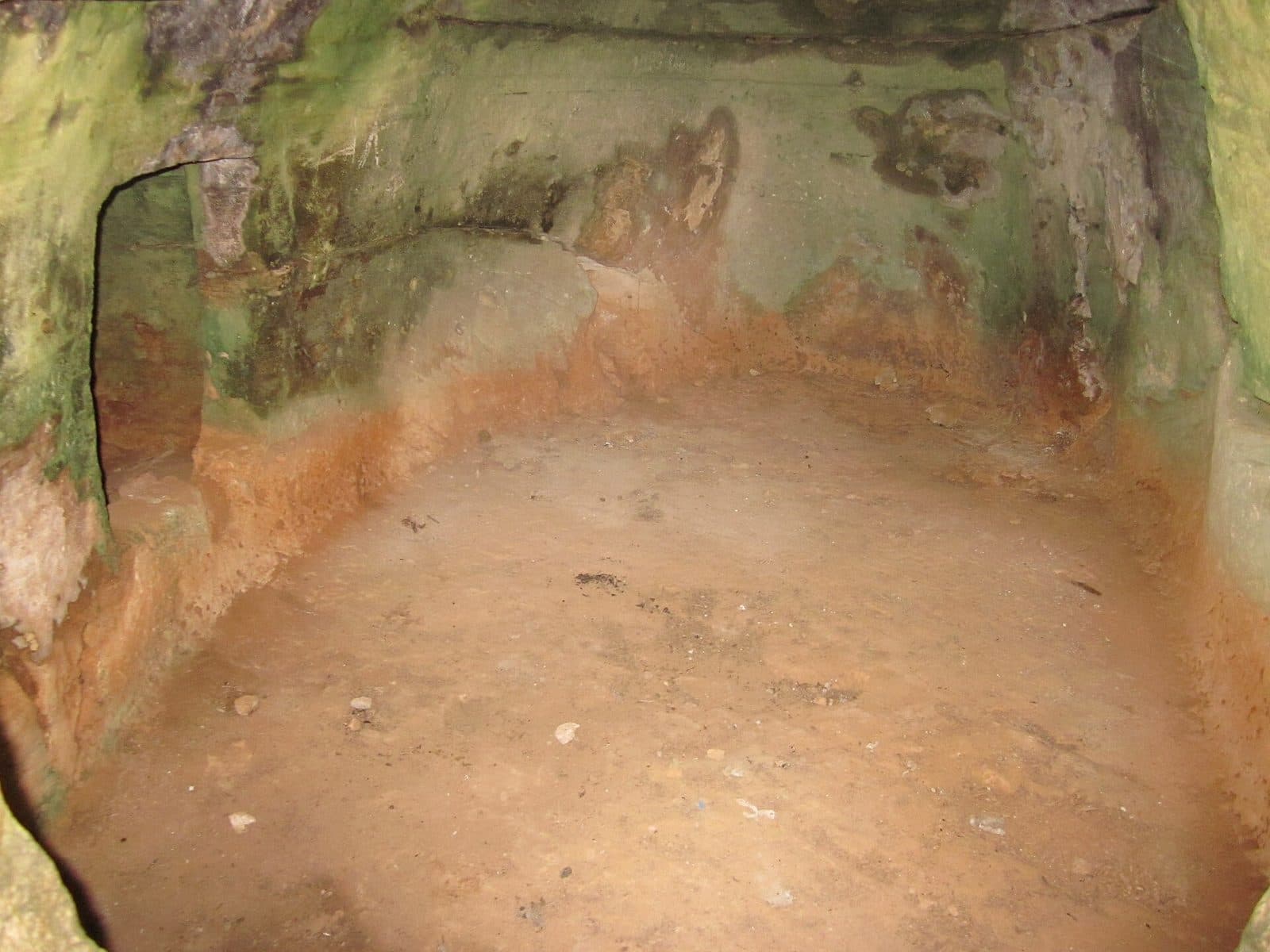

Just a few metres below a road, an unusually small entrance opens in the coastal rock. Beyond it lies Cova de s'Estret des Temps, a man-made cave and archaeological site near Cala Figuera. Anyone passing without paying attention might mistake it for an inconspicuous crack in the rock. In fact, the low entrance leads into a prehistoric burial complex with a corridor, main chamber and side niche.
The appeal of this place lies precisely in the fact that it is neither large nor staged. There is no extensive cavern here, but rather a compact structure whose layout and worked surfaces still reveal how deliberately the rock was shaped. The rectangular entrance, the possible fitting for a sealing slab and the division between passage and chamber turn just a few square metres into a vivid example of prehistoric architecture. Cova de s'Estret des Temps is therefore particularly worthwhile for people who enjoy experiencing archaeological sites in their original landscape. The cave also makes an interesting short cultural and historical stop on an excursion to Cala Figuera or towards the Mondragó Natural Park.
History and significance
The most striking evidence of the past here is not an artefact in a display case, but the worked rock itself. Cova de s'Estret des Temps was created artificially and is an archaeological site dating from Mallorca’s Bronze Age. Its form and the surviving structural details point to its use as a burial cave. It was therefore not a natural shelter that was later repurposed, but a deliberately designed space for dealing with the dead.
A man-made Bronze Age cave
Anyone looking at the low entrance sees the result of carefully planned work. A descending corridor, the main chamber and a small side room were carved into the rock. The flat roof follows the horizontal layers of stone. This approach made excavation easier and shows that the builders responded to the structure of the rock instead of creating an arbitrary cavity.
The cave is dated to the Bronze Age. For Cova de s'Estret des Temps, its function as a burial site is particularly important. The visible structure, however, does not reveal who was buried here, which specific grave goods were deposited or the exact phases of use. At the site, the architecture speaks first: entrance, division and chambers form a sequence that clearly separates the interior from the landscape outside.
The sealable entrance
A particularly revealing detail can be found at the rectangular portal. A recess is visible there that was probably used to fit a sealing slab. The passage was also likely covered with stone slabs. Both features show that the structure was not intended to be an open cavity accessible at all times. Access could be controlled, sealed and separated from the surrounding ground.
A wall with a doorway also stood between the corridor and the main chamber. This inner threshold created another boundary before the burial chamber was reached. Such elements are more important for understanding the site than a spectacular individual find, because they show that the sequence of spaces formed part of the original design.
An archaeological site without elaborate staging
Today, the cave is significant primarily as a preserved archaeological monument. Earth and rubble cover the original floor, while the forms cut into the rock can still be understood. The site therefore does not present a fully reconstructed complex, but instead shows the present condition of a very old burial chamber carved into the coastal landscape.
It is precisely this understated quality that makes the visit memorable. Between the road, rock and sea lies a place that was once deliberately separated from everyday life. Cova de s'Estret des Temps is a reminder that Mallorca’s coast was a culturally shaped landscape long before today’s settlements, harbours and holiday resorts.
What to see
First impressions can be deceptive: the opening is small and the route inside is low. Yet the individual structural elements are clearly related to one another. The cave is therefore best understood not as a single room, but as a short architectural sequence—from the outer entrance through the corridor to the main chamber and its side niche.
The rectangular entrance
The portal is only 0.65 metres high and 0.50 metres wide. These dimensions alone show that Cova de s'Estret des Temps cannot be entered upright like an ordinary room. The small opening slows access and creates a clear transition between outside and inside.
At the edge of the entrance, you can examine the recess that may have held a stone slab. This small detail is easily overlooked, but it is one of the structure’s most revealing features. It turns the entrance into a constructed portal: not only the cavity itself, but also the way it could be closed was carefully considered.
The descending corridor
Behind the portal, a gently descending passage leads to the inner chamber. It is 2.25 metres long, 0.90 metres wide and 1.50 metres high. Although the corridor is roomier than the entrance hatch, it remains low and narrow. The necessary change in posture inevitably shapes the experience of the place: only beyond the tiny portal does the passage open up slightly.
This section was probably originally covered with stone slabs. The corridor would therefore not have been merely an open trench in the ground, but a protected entrance. Today, its gentle slope clearly shows how the route descends from the level of the hillside into the chamber cut into the rock.
The dividing wall
At the transition into the cave there was a wall containing a doorway. The masonry is 0.50 metres thick; the base of the portal stands 5 centimetres above the floor. This small step is a precise structural detail and makes it clear that the passage and chamber did not merge seamlessly.
The dividing wall separated the route into two sections. Anyone entering the complex first passed through the outer entrance and corridor before crossing a second threshold into the burial chamber. For modern visitors, this is a useful reminder not to judge the cave solely by its overall form, because its significance lies in the careful sequence of openings, boundaries and interior spaces.
The main chamber
The central room measures about 4.25 metres long and 1.90 metres wide. The complex is described as having an elongated horseshoe shape. Compared with the narrow entrance, the chamber feels considerably more spacious, although it remains a small, enclosed room. Its proportions suit a structure created for burials rather than large gatherings.
The ceiling is flat and follows the horizontal layers of rock. This reveals a pragmatic technique: the natural bedding of the stone determined the direction in which the room could be carved out more easily. Instead of the irregular vaulting of a natural cave, there is a deliberately created surface. The ceiling makes the artificial character of the Cova particularly clear.
The original floor is now covered by earth and rubble. The chamber should therefore not be understood as a fully excavated or reconstructed interior. What remains visible is primarily the shell cut from the rock—the part of the structure that could neither be carried away nor displayed in a museum.
The side chamber
A small adjoining room opens off the main chamber. It has a kidney-shaped floor plan and measures 1.45 metres and 0.80 metres along its two main axes; its height is 0.95 metres. The niche therefore feels considerably more confined than the main chamber. There is also a small depression at its base.
This side room is easy to overlook if attention is focused only on the entrance or larger chamber. It is, however, essential for understanding the layout. The structure does not simply consist of a passage with a room at the end, but was expanded with an additional, clearly separated area. The visible evidence does not allow the specific function of this niche within the burial ritual to be determined with certainty. Its deliberate construction, however, is beyond doubt.
The coastal rock
The setting is part of the structure. The man-made cave was carved into a rocky coastal slope and faces the sea. It lies only a few metres below road level. This creates an unusual contrast: above is the modern transport route, while below lies a prehistoric space whose entrance closely follows the terrain.
The external setting also helps explain the construction. The corridor uses the difference in elevation on the slope and leads gently downwards. The chambers disappear into the rock, while the entrance lies on the hillside. Only through this connection between landscape and architecture does it become clear why Cova de s'Estret des Temps is a complete archaeological site despite its small size.
Visiting the cave
A visit begins by locating a small portal below the road. The site is compact and can generally be planned as a short archaeological stop. Even so, it is worth doing more than simply looking into the opening. Anyone who examines the entrance, corridor, dividing point and side chamber in sequence will understand the logic of the layout much better.
From the entrance to the chamber
The opening, only 0.65 metres high, creates an obvious physical barrier. Access requires bending very low; in the corridor beyond, the height remains limited to 1.50 metres. The gently descending floor, together with earth and rubble inside, requires slow, controlled movement. The cave is therefore unsuitable for entering casually while simultaneously taking photographs or looking at a phone.
At the entrance, first look for the possible fitting for the sealing slab. In the corridor, follow the gentle slope to the transition into the main chamber. The flat ceiling is an important feature there; the complex as a whole is described as having an elongated horseshoe shape. Only then does the small kidney-shaped side chamber become apparent. This sequence follows the architectural layout and turns the short route into an understandable exploration.
Time needed and nature of the visit
The cave itself does not require a long tour. The duration depends primarily on whether you only look at the entrance or study the structure carefully. Visitors interested in archaeology will spend longer examining the thresholds, wall surfaces and room shapes than those planning the site as a brief stop on a coastal tour.
There is no reason to extend the visit by hastily pushing into confined areas. The essential impression already comes from the interplay between portal, passage and chamber. Because this is a sensitive archaeological site, walls, depressions and possible structural remains should not be stepped on, moved or used as places to set down belongings.
Planning before you set out
Current opening hours and admission conditions should be checked before visiting. Access arrangements and local regulations can change, so signs or barriers at the site take priority. The time of day should also be chosen according to conditions on the coastal slope. Good light, dry ground and enough time to negotiate the low entrance calmly are more important than an events programme or guided-tour schedule. In poor conditions, it is sufficient to view the site from outside rather than forcing entry into a confined or slippery section.
Getting there and parking
Long-distance driving directions lead as far as Cala Figuera. From Palma Airport, the road distance is 52 kilometres; the journey takes around 48 minutes via the Ma-19 and then the Ma-6102. From the centre of Palma, the road distance is 58 kilometres. This route via the Ma-19 and the Ma-6102 takes around 56 minutes.
The final stretch to the cave
The stated distances and driving times end in Cala Figuera, not directly at the cave entrance. The exact location of Cova de s'Estret des Temps should therefore be used for the final stretch. The archaeological site lies in coastal rock only a few metres below the level of a road. From the roadside area, the route to the portal is correspondingly short but descends. Before going down, it is therefore worth examining the slope carefully rather than looking for a large cave entrance or an imposing building.
By bus and on foot
Cala Figuera serves as the stop for arriving by public transport. From there, the onward route to the archaeological site must be planned separately. Because the cave lies below a road, the chosen walking route should take into account not only the shortest connection, but also safe road sections and suitable access points.
Anyone arriving by car should park only in a designated place and must not block the roadside at the archaeological site. For navigation, it is more useful to treat Cala Figuera as the starting point and the cave’s precise location as the second destination. This makes it clear that the stated 52 and 58 road kilometres lead to the town, not directly to the low portal.
Bus lines to Cova de s'Estret des Temps at a glance
| Line | Route | Departures/day | First | Last |
|---|---|---|---|---|
| 521 | Cala d'Or - Cala Mondragó | 22 | 08:45 | 20:40 |
| 516 | Cala Figuera - Campos | 17 | 06:45 | 22:00 |
From the official GTFS feeds (TIB/SFM), no real-time data. The figures cover all stops in the town; weekend and holiday services differ — check with the operator before travelling.
Getting there by bus
Cala Figuera (57029) · 1.3 km as the crow flies
- 516Cala Figuera - Campos · Daily
Cala Mondragó (57024) · 2.0 km as the crow flies
- 521Cala d'Or - Cala Mondragó · Daily
Timetable data: official GTFS feeds (TIB/EMT), no real-time — check with the operator before travelling.
Things to do nearby
After the crouched confines of the burial chamber, the harbour of Cala Figuera offers a deliberate change of perspective. The village lies on a Y-shaped bay whose branches are called Caló d’en Boira and Caló d’en Busques. Fishermen’s houses, boat sheds and small homes line the water, while traditional working boats can be seen in the harbour. A walk there combines well with the archaeological stop without turning both destinations into an overloaded day plan.
Cala Figuera
The bay was mentioned as early as 1306, although it was not permanently settled until towards the end of the 19th century. Today, Cala Figuera is particularly interesting for its long-established harbour scenery. The village has no sandy beach of its own, but it is well suited to a walk by the water and as a starting point for destinations along the southeast coast.
The contrast with Cova de s'Estret des Temps is striking. At the harbour, boats, houses and workplaces shape the scene; at the cave, a low opening leads into a much older world cut into the rock. In different ways, both places tell the story of how people have used the narrow boundary between land and sea.
Mondragó Natural Park
The Mondragó Natural Park lies near the archaeological site and is also mentioned as a landmark for routes through this section of coast. Walks there can be combined with the coves of Cala Mondragó, S’Amarador and Sa Font de n’Alis. A clear order works well for a joint excursion: first visit the archaeological cave as a short, focused stop, then spend longer in the open coastal landscape.
Combining them should not obscure the fact that they are different destinations. The Cova is a man-made Bronze Age burial cave; the natural park provides access to scenery, walking routes and bathing coves. This distinction is precisely what makes a combined excursion varied without reducing the archaeological site to a mere side attraction on a beach trip.
More places on the southeast coast
Torre d’en Beu, Cala Santanyí and Es Pontàs are also mentioned as destinations in the surrounding area. Depending on the route, they can be combined with Cala Figuera. Those focusing on archaeology should give the Cova sufficient attention before the more dramatic coastal views overshadow the experience. The cave is not a viewpoint structure, but a quiet place whose most important details lie in the low portal and worked rock.
The place it belongs to
Cala Figuera in the place guidePractical tips for visiting
The small size of Cova de s'Estret des Temps does not automatically make it easy to access. The portal is lower than an ordinary table, the passage slopes gently downwards and the original floor lies beneath earth and rubble. Good preparation here means above all realistically assessing your ability to move and not treating the archaeological site like a developed show cave.
Footwear and clothing
Sturdy shoes with good grip are advisable for the short descent and uneven interior. Because the entrance is only 0.65 metres high and the corridor 1.50 metres high, clothing should allow freedom of movement when bending down. Large bags or loose items are more of a hindrance than a help during the visit.
A small light source can help you see the shapes and ground directly inside the entrance more clearly. It should be used without dazzling other visitors. The condition of the ground remains the priority: earth, loose stones and small changes in level matter more than capturing the most impressive possible photograph from the chamber.
Visiting with children
Children may find the low opening exciting, but the site is not a play tunnel. The descending corridor, rubble on the floor and archaeological surfaces require close supervision. Children should understand that stones must not be moved, depressions enlarged or walls climbed.
Whether a child should enter the cave depends less on age than on the ability to move safely through confined terrain. A view from outside may already be enough to explain the portal, corridor and setting within the rock. This is particularly the better choice when the ground is damp, visibility is poor or the small opening feels uncomfortable.
Respecting the archaeological site
The Cova is not a natural adventure playground, but a former burial site. Appropriate conduct follows directly from this: take nothing, leave nothing behind and make no carvings. Even apparently loose stones may belong to the archaeological context. The recess at the portal and the remains of the internal divisions should only be observed.
What can be seen is a small burial complex artificially carved from the rock. Its value lies in the preserved proportions, thresholds and proximity to the original landscape—not in tourist facilities.