
Torre d'en Beu near Cala Figuera: Watchtower Above the Sea
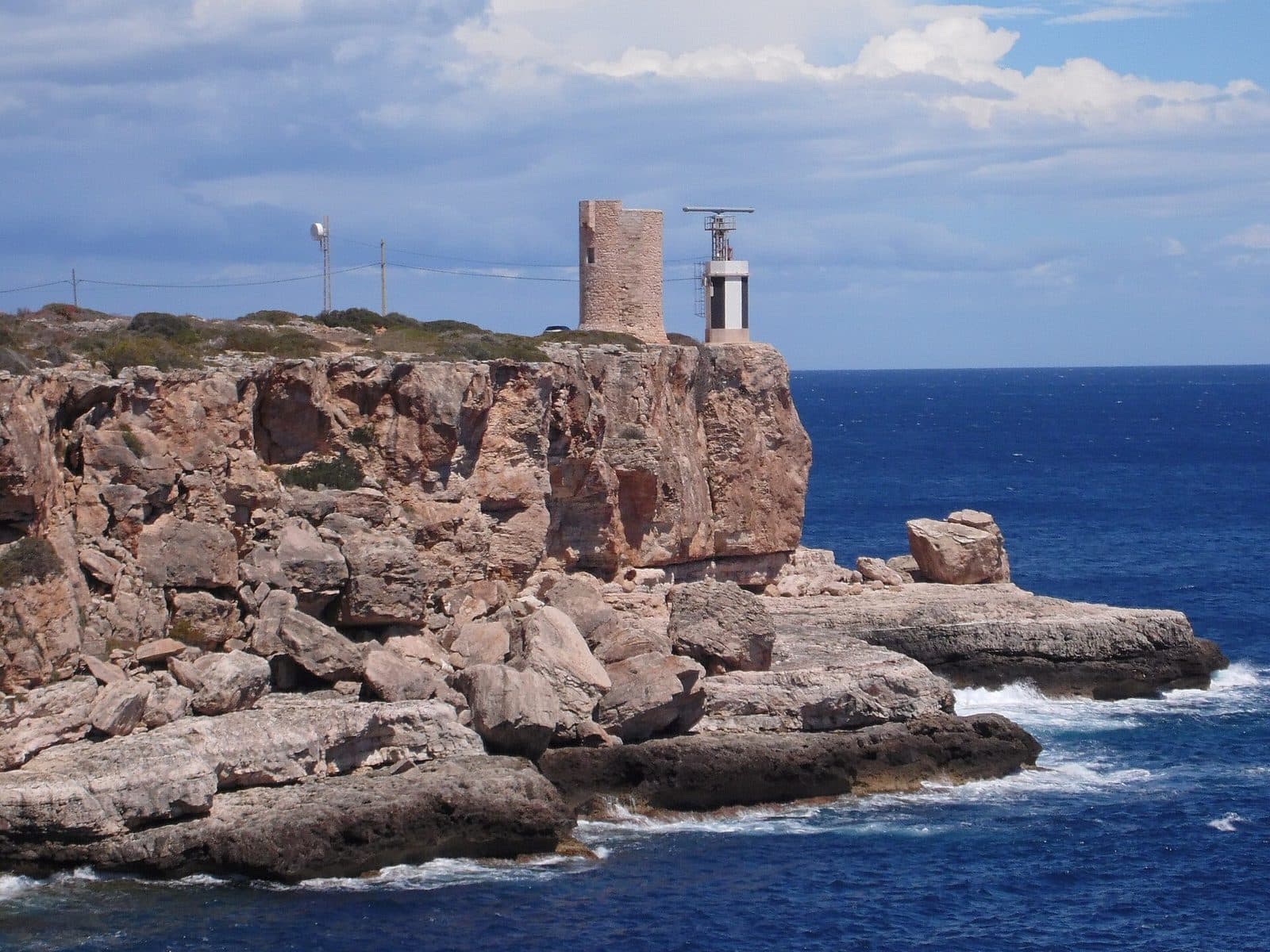

Above the cliffs at the entrance to Cala Figuera, Torre d'en Beu stands like a stone sentinel. This historic coastal watchtower is one of those places on Mallorca whose appeal comes less from an exhibition than from its setting: the open sea in front of the structure, the narrow approach to the natural harbor to one side, and a small lighthouse from a completely different era just a few steps away.
The excursion is especially worthwhile for travelers who want to combine coastal scenery, short walks, and traces of history. Even the route out of Cala Figuera changes your perspective on the village: below are fishing boats and boathouses in the deeply indented harbor inlets, while above, the view opens across rocks and water. In rougher seas, you can hear and see the waves striking the base of the cliffs.
Torre d'en Beu is not a conventional attraction with accessible interiors, a ticket office, or museum displays. The tower can only be viewed from outside. For precisely that reason, a visit should not be treated as a quick photo stop: its history becomes clear through its location, since this elevation provided an early view of the coast and allowed an approaching ship to be spotted long before it reached the bay.
The contrast between the compact historic defensive structure and the neighboring beacon is particularly compelling. Both helped people navigate the same coastline, but under entirely different circumstances: one warned of danger from the sea, while the other helped the fishermen of Cala Figuera return safely to the harbor.
History and Significance
A sail on the horizon could herald a serious threat on 16th-century Mallorca. Coastal communities and rural settlements faced raids by pirates and corsairs; there was often little time between sighting a foreign ship and its landing. Against this background, construction of Torre d'en Beu began in 1569 at the entrance to Cala Figuera. Its elevated position was deliberately chosen: from the cliff, guards could monitor not only the open sea but also the approach to the natural harbor.
The Coastal Watchtower Warning System
The tower did not operate alone but formed part of a Mallorcan network of watchtowers and signal towers positioned so that warnings could be relayed along the coast. A tower guard kept watch for suspicious ships. In the daytime, fresh wood produced clearly visible smoke; at night, dry wood was used to create flames. Neighboring posts picked up the signal and passed it on.
Inland, bells triggered the next stage of the alarm chain. Men capable of fighting were summoned, while other residents sought shelter in fortified buildings. Anyone looking out to sea today can immediately understand this logic: the unobstructed view was not a decorative bonus but the crucial element of the site. Every minute gained through early warning could matter to the people living along the coast.
Destruction and Restoration
Its exposed position made Torre d'en Beu itself a target. After suffering severe damage in a pirate attack, it was restored. Accounts of its construction history refer to additional phases of alteration and rebuilding; what is certain is that the surviving tower is not simply a structure that has remained unchanged since 1569. Instead, its walls tell a story of continued use, damage, and repair.
Torre d'en Beu thus represents a long period when Mallorca's coastline was both a place to live and a vulnerable frontier. Fishermen depended on the sea, yet attackers could arrive by the same route. The watchtower transformed the broad horizon into a monitored space that a guard was expected to observe without interruption.
From Alarm Fire to Beacon
As pirate attacks lost their former significance, the requirements of the site changed. The objective was no longer to warn the population about ships but to show ships the way. The fishermen of Cala Figuera requested a light marker that would make it easier to enter the harbor at night. The mayor of Santanyí formalized this request in a letter in 1953; Rafael Soler designed the lighthouse.
A modern navigational aid was therefore built beside the old watch post. The historical reversal is striking: fire once meant alarm here, while light later signaled a safe return home. The protected historic tower and the lighthouse are therefore not merely coincidental neighbors but two chapters in the same coastal history.
What to See
The first impression comes not from an ornately decorated building but from a clean silhouette. The twelve-meter-high Torre d'en Beu appears massive and functional. Decoration was not a decisive consideration for a coastal watchtower; resilience, height, and an unobstructed view over the sea were what mattered. Up close, its heavy walls and compact construction become more noticeable, while from farther away, it is easier to understand why this particular spot was chosen for the watch post.
Torre d'en Beu
The historic tower stands directly on the coast above a high rock face. It has not been set up as a walk-in museum, and its interior is not accessible to visitors. What can be seen is therefore primarily its exterior. This hardly diminishes the historical impression, provided the setting is taken into account: the tower was not designed to impress but to observe and warn.
Its purpose is clearest on the side facing the sea. From there, the view extends far across the water, while the entrance to Cala Figuera remains visible to the side. This precise combination of long-distance visibility and a clear view of the harbor approach made the location strategically valuable. Visitors today stand within the same sightline that once served as the tower guard's workplace. Torre d'en Beu is not merely a romantic ruin, however: it has retained its enclosed, defensive appearance and is protected as a cultural monument.
The Cliff and Harbor Entrance
The cliff is the tower's true stage. Heights vary slightly between sources, but its distinctly elevated position directly above the rocky coastline is undisputed. From here, the panorama opens in two directions: the open Mediterranean lies before you, while the narrow entrance to Cala Figuera draws the eye inland.
When the sea is rough, the location gains an acoustic dimension. Far below, waves strike the rock, while wind often sweeps across the exposed ground above. The distance from the water should not disguise the danger: the edges are steep, the terrain is rocky, and no photograph justifies stepping into an unsafe area.
Looking back toward Cala Figuera reveals how deeply the natural harbor cuts into the land. From the harbor itself, the coast feels narrow and sheltered; from Torre d'en Beu, by contrast, it becomes clear how abruptly the bay opens into the sea. This perspective is one of the strongest reasons to make the walk.
Far de la Torre d'en Beu
The small lighthouse stands east of the old watchtower. It is a separate structure and should not be confused with Torre d'en Beu. Its exterior was designed in an octagonal shape, while its interior floor plan is circular. Its restrained form and pale surface contrast clearly with the older stone structure.
The lighthouse was built after the village's fishermen requested a nighttime navigational aid for the harbor entrance. Access from the sea was rejected because of the rugged rocky coastline. Instead, the existing local path Sa Torre d'en Beu was used to provide access. This, too, reflects the nature of the terrain: what appears forbidding from the water is comparatively easy to reach from the landward side.
Together, the tower and beacon provide a particularly clear image of how coastal use changed. Several centuries separate them, yet their functions relate to the same horizon. The watchtower searched for enemy ships; the beacon made it easier for local boats to return. Photographers should look for a viewpoint where both structures remain visually distinct rather than blending into each other.
Visiting Torre d'en Beu
A visit usually begins not at the tower itself but with the gradual transition from the village to the open coast. From Cala Figuera, the route climbs toward the tower and lighthouse. The final section is completed on foot. This is not a long museum tour with a fixed sequence, but a flexible coastal walk where the view, architecture, and landscape all deserve time.
From the Path to the Viewpoint
At the destination, it is worth resisting the urge to head straight to the nearest photo spot. The tower's silhouette changes as you approach, and from a short distance its position above the harbor entrance becomes clearer. You can then view the exterior of Torre d'en Beu, the vista across the sea, and the neighboring lighthouse in turn.
How long you stay depends more on the light, weather, and your interests than on any sightseeing schedule. Those who only want to see the buildings from outside will need considerably less time than visitors who include the walk from Cala Figuera, take photographs, and enjoy the views in both directions. Since the interior of the tower is inaccessible, no additional time is needed for rooms or an exhibition.
Light and Visitor Numbers
Late-day light is especially appealing because the lower sun defines the contours of the tower, lighthouse, and rocks more clearly. The so-called golden hour is also reported to be less crowded. However, the view across the open sea does not face directly toward the sunset in every season or from every angle. The attraction therefore lies more in warm side lighting than in a guaranteed sunset over the water.
Those seeking peace and quiet should avoid typical excursion times. On popular days, the access route and nearby viewpoints can become busier, and parking spaces nearby are also in greater demand. In hot weather, an early visit is more comfortable because the terrain is exposed and offers little natural shade. The south-facing rocky areas become very warm during the hotter months.
Outdoor Access Rather Than an Interior Tour
Before setting out, check current information about access. No reliable fixed opening hours or admission price are recorded. In any case, visitors should not expect a conventional tower tour on site: the interior of Torre d'en Beu is inaccessible. The experience focuses on the exterior, the coastal setting, and the historical relationship between the watchtower and lighthouse.
Even during a short stay, it is worth looking beyond the seaward side. The view back toward Cala Figuera explains the location at least as clearly. Only by alternating between the open horizon and the sheltered bay does it become apparent which ships the former guard was expected to observe and why the fishermen later requested a light marker in this exact location.
Getting There and Parking
Long-distance driving directions lead to Cala Figuera, not directly to Torre d'en Beu. From Palma Airport, the route to Cala Figuera covers 52 road kilometers; the drive takes around 48 minutes via the Ma-19 and then the Ma-6102. From central Palma, the distance is 58 road kilometers. Allow around 56 minutes, again using the Ma-19 and the Ma-6102.
From Santanyí to Cala Figuera
The Ma-6102 connects Santanyí with Cala Figuera and is the key access road for travelers coming from Palma. In the coastal village, the onward route branches into the local street network. The tower lies east of the harbor on the headland; the final section to the structure is a footpath. Navigation should therefore not come with the expectation of getting out directly beside the tower.
The historic local path Sa Torre d'en Beu already played a role when access to the lighthouse was established. The land route was chosen because the rugged cliffs prevented practical access from the water. Today, the same principle leads visitors from the built-up area out to the coast.
Parking and the Final Walk
Parking is available along the roadside near the access point or within the adjoining street network. However, visitor reports describe finding a space as more difficult during popular periods. It therefore makes sense not to insist on parking directly at the beginning of the path and to allow for an additional walk. The final section leading to the lighthouse is reserved for pedestrians in any case.
The route is generally straightforward but eventually transitions into rocky and partly uneven coastal terrain. After rain or during strong winds, this section requires more attention than an ordinary urban walk. Starting from the harbor combines the journey with a change of scenery: from the boathouses beside the water up to the open headland.
Arriving by Bus
The relevant bus stop is called Cala Figuera. Torre d'en Beu is not immediately accessible from there; the rest of the route leads on foot through the village and up to the eastern side of the harbor entrance. Traveling by bus is therefore particularly suitable for visitors who already plan to spend time in Cala Figuera and view the tower as the destination of a walk.
Bus lines to Torre d'en Beu at a glance
| Line | Route | Departures/day | First | Last |
|---|---|---|---|---|
| 516 | Cala Figuera - Campos | 17 | 06:45 | 22:00 |
From the official GTFS feeds (TIB/SFM), no real-time data. The figures cover all stops in the town; weekend and holiday services differ — check with the operator before travelling.
Getting there by bus
Cala Figuera (57029) · 0.9 km as the crow flies
- 516Cala Figuera - Campos · Daily
Timetable data: official GTFS feeds (TIB/EMT), no real-time — check with the operator before travelling.
Nearby Attractions
Down in the harbor, the sea seems almost tamed. Boats lie between low boathouses, nets, and moorings; only up at Torre d'en Beu does it become apparent again that Cala Figuera is directly connected to the open Mediterranean. A visit to the tower is therefore best combined with a walk through the village rather than a drive to the headland for a single photograph.
Cala Figuera
Cala Figuera has a Y-shaped natural harbor. Its two arms are called Caló d'en Busques and Caló d'en Boira. Traditional features of the fishing harbor remain along the water: small boathouses, fishermen's work areas, and Mallorcan boats share the bay with more modern recreational vessels. The harbor paths repeatedly offer views across the narrow water toward the houses opposite.
The village is not a conventional bathing cove with a sandy beach. This also changes the visitor experience: Cala Figuera is shaped less by large-scale beach tourism than by its harbor, paths, and confined topography between rock walls and water. Those who first walk along the quay below and then climb to the tower experience the bay from two contrasting perspectives.
Santanyí and the Coast
Santanyí lies inland and is the natural transport hub for reaching Cala Figuera. A stop there can easily be planned before or after the coastal walk. For a longer excursion, other coves and coastal paths in the south and southeast of Mallorca are also suitable, without changing the character of the visit to the tower.
Near the tower, the limestone cliffs also attract climbers. The walls contain numerous routes and bouldering areas, although large rocks make access to the base of the cliffs difficult in places. This is a separate sporting activity, not a casual part of a normal sightseeing visit.
Combining the Harbor and Tower in One Walk
There are two good options for the order of your visit. In the morning, you can begin at the open coast before the sun strongly heats the shade-free terrain, then walk down to the harbor. Later in the day, the reverse is appealing: visit Cala Figuera first, followed by Torre d'en Beu in warmer light.
In both cases, the walk through the village provides context that the tower alone cannot show. The fishermen who later requested a beacon worked in this harbor. The guards in the older tower watched over its entrance. Between the boathouses and cliffs, two separate photo subjects become a continuous story.
The place it belongs to
Cala Figuera in the place guidePractical Visitor Information
A powerful gust of wind, loose stones, and a steep edge demand more attention than the short length of the final path might suggest. Torre d'en Beu is easy to include in an excursion, but the site remains an unsecured coastal landscape rather than a landscaped viewing garden. Sensible preparation makes the difference between a relaxed stay and an unnecessarily risky photo stop.
Footwear and Terrain
Sturdy shoes with grippy soles are advisable for the uneven path and rocky coastal area. Sandals with smooth soles are poorly suited to loose stones. No hiking equipment is required for a normal exterior visit, but the terrain should not be treated like a paved harbor promenade either.
Descending to the climbing walls is not part of the usual visitor route. Large boulders lie there, and some approaches are more challenging than the path to the tower and lighthouse. Those who only want to visit the landmark should remain on the clearly visible upper access route.
Sun, Wind, and Shade
The headland is exposed to the weather. Shade is limited, and the south-facing rocks can become very hot during the warmer months. Sun protection and sufficient water are therefore especially important around midday. At the same time, winds on the cliff may be stronger than down in the sheltered harbor. Hats, light objects, and loose clothing should be secured accordingly.
In stormy weather, keeping a safe distance from the edge is essential. The impressive breaking waves can also be observed from a secure position. Wet rocks may be slippery; after rain, a slower pace is appropriate on the final section.
Visiting with Children
Close supervision is required at all times along the cliff. For families, combining the visit with Cala Figuera's harbor is appealing because fishing boats, boathouses, and the sheltered harbor arms can be viewed up close there.
What Not to Expect
Torre d'en Beu has no accessible interior, exhibition, or tour through historic chambers. The neighboring lighthouse is also not the actual historic watchtower. Keeping the two structures distinct makes their history all the clearer: here is the warning system of the 16th century, and there the later navigational aid for the fishermen.
The value of the site lies in its exterior and landscape. Binoculars can make the view across the sea more interesting but are not necessary. More important is allowing enough time for different viewpoints and looking back toward the bay as well. The strongest view is not necessarily the one where the sea fills the entire background; often, the view of the harbor entrance explains the tower much better.
Local insider tips
Turn Around Toward the Harbor Entrance
Do not photograph only the open sea: the view back toward the narrow entrance to Cala Figuera explains the watchtower's location. From here, the guard could monitor both the horizon and the approach to the sheltered harbor.
Make Use of Warm Side Lighting
Late-day light gives the masonry, rock, and small lighthouse particularly vivid definition. The golden hour is also reported to be less crowded; however, a sunset directly over the sea is not guaranteed because of the viewing direction and season.
Distinguish Between Two Eras
The tower and beacon can be photographed together. The massive stone structure is the historic Torre d'en Beu; the smaller, pale lighthouse was built later at the fishermen's request. A viewpoint from the side keeps both silhouettes clearly recognizable.
Visit the Harbor Before the Watchtower
A walk along the two harbor arms of Cala Figuera provides the best historical context. Afterward, the view from the tower shows how the sheltered fishing harbor connects to the open sea.
Stay on the Upper Visitor Path
Climbing sectors and large boulders lie below the headland. No descent is necessary to visit the tower and lighthouse. The upper access route provides the essential views without taking the more demanding path to the base of the cliffs.