
Coves d'Artà – Mallorca's Cave World Above Canyamel Bay
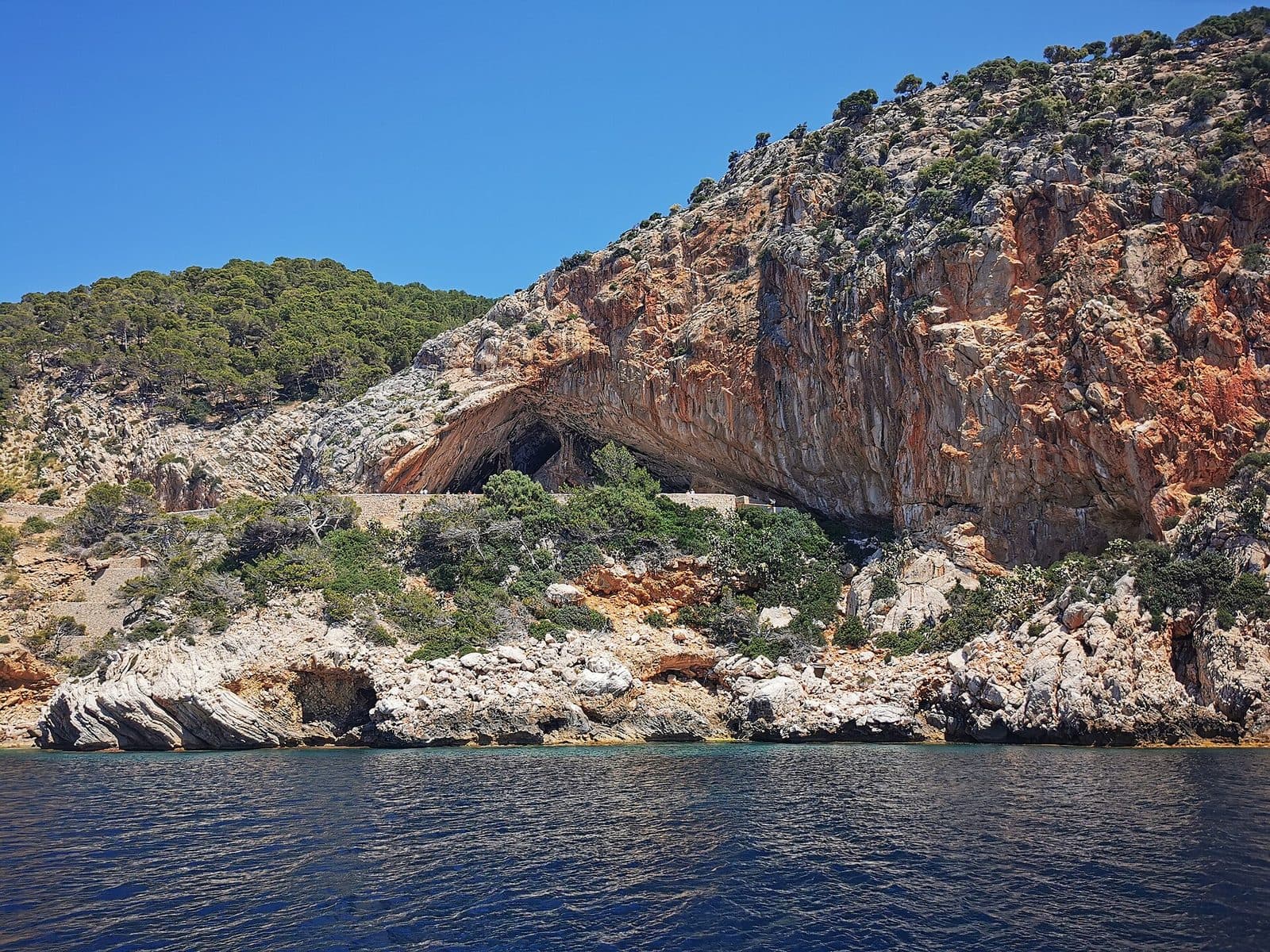

Even the approach to the Coves d'Artà suggests that something special lies hidden in the rock. At Cap Vermell, the coast rises above Canyamel Bay, and the cave's entrance opens in its reddish limestone, visible from afar. Before heading underground, you can take one more look out over the sea, coastal slopes, and beach—then the artificially illuminated world of stalactites takes over.
The cave is not a freely accessible fissure in the rock but a natural attraction explored on guided tours following a fixed sequence of large chambers. The route alternates between high vaults, dense groups of stalactites and stalagmites, and formations whose popular names evoke columns, flags, an organ, or an elephant. It is precisely this variety that makes the visit so vivid: the focus is not on a single stalactite but on an entire underground landscape.
The Coves d'Artà are suitable for travelers who want to discover Mallorca's natural side beyond its beaches, as well as for families and visitors interested in cultural history. The tour is not long enough to take up an entire vacation day, yet the scale of the chambers makes it feel like a complete experience in its own right. Another advantage is the location near Canyamel Platja: the cave, coastal views, and beach can be combined without a major change of location.
It is important to understand the geography. Despite their name, the Coves d'Artà are not located in the town of Artà but on the coast of the municipality of Capdepera near Canyamel. Anyone entering only the town's name into a navigation system may therefore end up at the wrong destination.
History and significance
A wide opening in a mountain is difficult to overlook. The cave was therefore known in prehistoric times, long before maps, guidebooks, or tourist access existed. Consequently, the Coves d'Artà did not have a modern “discovery” by a single explorer. Their history instead consists of early awareness, written records, scientific descriptions, and eventual development as a visitor attraction.
Joan Binimelis and the first mention
The first known written reference comes from Joan Binimelis. The Mallorcan historian and geographer mentioned the cave in 1595 in his history of the Kingdom of Mallorca. This note is important because it marks the transition from local knowledge passed down orally to a documented record. However, an early mention said little about the appearance of the interior; detailed descriptions were only produced later.
During the first half of the 19th century, the caves increasingly attracted the attention of scholars. Isidoro de Antillón published a description in 1815. Joaquín M. Bover followed in 1836 and Antonio Cabrer in 1840. Both Mallorcans explored the underground chambers several times. In this way, an opening visible from afar and surrounded by stories gradually became the subject of systematic observation.
The staircase built for a queen
One of the most charming historical details awaits before the tour itself begins. The grand entrance staircase was built in 1860 for Queen Isabella II.'s visit to Mallorca. In the end, however, the monarch did not visit the cave. The effort was not wasted: the staircase remained and still shapes the ceremonial approach to the rock portal today.
In 1862, Pere d'Alcàntara Peña produced the first detailed map of the cave. It was published several times over the following decades, including in the extensive 1885 album about the caves of Artà and Manacor by Sebastián Gay and Baltasar Champsaur. The mapping transformed the individual descriptions into an understandable spatial representation.
From research destination to famous attraction
In the second half of the 19th century, the reputation of the Coves d'Artà spread far beyond Mallorca. Visitors and authors who reported on them included the German scientists H. A. Pagenstecher and R. W. Bunsen in 1865, Archduke Ludwig Salvator of Austria in 1884, and the French travelers Gaston Vuillier in 1888 and Édouard-Alfred Martel in 1896. King Alfonso XIII. actually saw the cave from the inside in 1904.
From the 1960s onward, the Coves d'Artà became part of Mallorca's rapidly growing tourism industry. Their significance lay not in a building or exhibition but in the presentation of a natural environment that had previously attracted mainly scholars and scientific travelers. To this day, the tour remains focused on the cave system itself.
Legends and historical reality
The large entrance provided ample material for stories. Authors associated the cave with the Muslim population said to have sought refuge after the Christian conquest of Mallorca; other traditions tell of pirates and hidden treasure. Such stories are part of the cultural impact of the Coves d'Artà, but they should not be confused with the well-documented history of the site. What can be reliably established is its early recognition, the mention from 1595, and the intensive exploration conducted in the 19th century.
What to see
The sense of scale changes as soon as you enter the entrance hall. The cave system has a horizontal visitor route extending for more than 700 meters. The accessible chambers reach heights between 15 and 45 meters. As a result, many formations appear not as individual exhibits but as elements of underground architecture: columns seemingly support ceilings, thin limestone curtains hang from walls, and fields of dripstone fill entire sightlines.
This world of shapes formed in limestone. Movements within the mountains created fissures and cavities, while underground water continuously acted upon the rock. Where mineral-rich drops left deposits behind, stalactites grew downward from the ceiling and stalagmites upward from the floor. When the two meet, columns are formed. The result is not a completed historical state but a geological process that continues at an extremely slow pace.
Entrance hall
The natural entrance lies on the slope of Cap Vermell above Canyamel Bay. Its size explains why the cave was known from an early date and appeared in literature and legends. Unlike a narrow shaft, the visit begins with an open, monumental portal. Outside, daylight falls on the rock; farther inside, it gives way to installed lighting.
The entrance hall marks the transition between the coastal landscape and the cave system. Here it is particularly easy to see how strongly the impression is shaped by the natural topography: behind the visitor lies the sea, while ahead opens a vault whose forms were not built from masonry but created by water and limestone deposits.
Hall of Columns and Queen of the Columns
In the Hall of Columns, joined dripstone formations take center stage. The best-known formation is the “Queen of the Columns,” a 17-meter-high stalagmite. The name is imaginative, but its dimensions are entirely real. Because the dripstone grew upward from the floor, it provides an especially clear illustration of the difference between stalagmites and stalactites hanging down from the ceiling.
Its impact does not come from height alone. Surrounded by other limestone formations, the stalagmite appears to form the center of an entire stone ensemble. Anyone who looks only straight ahead during the tour can easily overlook the finer structures around the edges: small points, folded surfaces, and places where upward- and downward-growing formations almost touch.
Hell and Purgatory
With “Hell,” the tour deliberately shifts toward more dramatic imagery. A light and sound presentation is part of the visit in this chamber. Colors and sounds highlight contours that would be less distinct under uniform lighting. This is the most theatrical part of the tour and provides a clear contrast to the calmly explained geological formations in the other chambers.
“Purgatory” follows. Both names come from a tradition of interpreting cave chambers through religious, fantastical, or everyday imagery. They do not refer to a distinct type of rock. What is worth seeing is how lighting, shadows, and changing perspectives create very different impressions of space from the same basic elements—limestone, water, and time.
Theater and Organ
In the “Theater,” tiered formations and the impression of a stage-like space account for the name. The “Organ,” in turn, resembles pipes with its parallel dripstone structures. Such names help visitors find their bearings, but they are not rigid interpretations. The longer your gaze rests on a wall or formation, the more figures of your own you may discover within it.
Here in particular, it is worth looking beyond the large formations. Thin limestone folds and rib-like deposits demonstrate how varied dripstone growth can be. Some sections appear heavy and massive, while others look almost like fabric even though they are made of stone. These contrasts rank among the cave's most striking visual impressions.
Hall of Flags
The Hall of Flags takes its name from broad, hanging limestone formations. Unlike compact columns, these deposits appear thin and folded. Side lighting emphasizes their edges and irregular outlines; depending on where you stand, they resemble flags, curtains, or frozen waves.
The chamber demonstrates why the tour offers more than a sequence of the largest possible stalagmites. The shapes change according to the flow of water, the nature of the underlying surface, and conditions on the ceiling and walls. Each named chamber therefore has a different visual emphasis, even though all belong to the same cave system.
Gloria and the exit
Toward the end, the route passes through the area known as “Gloria.” Along the way, guides also point out popularly named formations such as the “Elephant” and conspicuously sparkling “Diamond Stones.” The names are memory aids, not claims that they are real gemstones or artificial sculptures. Anything resembling an animal, flag, or piece of jewelry is naturally formed limestone.
The finale has its own dramatic structure: after the artificially illuminated chambers, daylight reappears and the coast of Canyamel comes back into view. This transition into the open air is part of the experience. The cave does not end in a neutral indoor space but on a slope above the sea.
Visiting the caves
The Coves d'Artà can only be visited as part of a guided tour. The route takes between 35 and 40 minutes, with a new group starting approximately every half hour. Explanations are provided in German, Spanish, English, and French. This gives the visit a clear structure: after a possible wait, the group enters together and follows the set route through the named chambers.
How the tour works
From the entrance area, the path leads into the entrance hall and continues to the Hall of Columns, Queen of the Columns, Hell, Purgatory, Theater, Hall of Flags, and Gloria. The group stays together throughout. Explanations are provided for individual formations, while the lighting and sequence of chambers reveal the broader context. Wandering freely or exploring at your own pace is not permitted.
Allow 35 to 40 minutes for the tour itself. You should also account for the walk from the parking lot or Canyamel, a possible wait for the next group, and time to enjoy the view at the entrance. The cave is therefore only partly suitable as a quick stop between two other activities; it is more pleasant to set aside a separate block of time without an appointment immediately afterward.
Temperature and cave climate
Conditions inside remain relatively stable throughout the year. Temperatures range between 17 and 22 degrees, and humidity is high. On a hot summer day, the transition into the mountain is clearly noticeable, although the cave should not be compared with a wintry cold environment. An additional light layer may still be comfortable, especially for sensitive visitors.
The high humidity is part of the cave experience. Surfaces may appear damp, and the floor requires more attention than a level museum hall. Secure footwear is therefore more practical than smooth sandals.
Time of day and visitor numbers
Because a group starts approximately every half hour, admission occurs in fixed waves. Anyone arriving shortly after a tour begins may have to wait for the next one. During busy periods, the parking lot at the entrance may also be full. Visiting near the morning opening time is therefore the most reliable choice for anyone who wants to minimize waiting and time spent looking for parking.
From May to October, the caves are open daily from 10:00 to 18:00, and from November to April from 10:00 to 17:00. As operating arrangements may change, checking current information before setting out is recommended. No definitive admission price is deliberately stated here; this should also be checked immediately before the visit.
Getting there and parking
The name can easily be misleading: the destination is not the center of Artà but Canyamel Platja on the coast of the municipality of Capdepera. The cave lies east of the resort at Cap Vermell. When using navigation, choose the Coves d'Artà themselves or the cave road as your destination rather than simply driving toward “Artà.”
From Palma Airport
The road distance from Palma Airport to Canyamel Platja is 77 kilometers. The journey takes around 65 minutes and follows the Ma-15, then the Ma-4030 and Ma-4040. This distance and travel time apply specifically to Canyamel Platja. For the final section, follow the paved cave road along the coastal slope to the entrance.
The route initially follows the fast connection toward the east before continuing along regional roads toward Capdepera and Canyamel. Especially on the final section, it is worth following signs for the cave rather than allowing its name to lead you toward Artà farther inland.
From central Palma
The road distance from central Palma to Canyamel Platja is 79 kilometers. Via Ma-15, Ma-4030, and Ma-4040, the drive takes around 72 minutes. Here too, the distance and travel time refer to Canyamel Platja; the final approach to the cave entrance must be added.
Travel time can be less predictable in city traffic and during busy travel periods. Because visits begin in groups, allowing extra time is advisable: a tight arrival schedule could otherwise mean missing the tour that has just started.
Parking and bus
The operator provides a free parking lot directly at the Coves d'Artà. However, visitor reports indicate that spaces may be occupied at popular times. Arriving early therefore helps not only with admission but also with finding a parking space. From the parking lot, the approach leads to the grand staircase and the rock portal high on the slope.
For visitors arriving by public transport, the “Canyamel - Coves d'Artà” stop is relevant. Its identifier is 14035. Because timetables may change seasonally, check the specific connection for the day of your visit. According to the municipality, the caves can also be reached from the resort of Canyamel within a few minutes on foot; the route leads toward Cap Vermell and ends at the rising approach to the cave.
Bus lines to Coves d'Artà at a glance
| Line | Route | Departures/day | First | Last |
|---|---|---|---|---|
| 424 | Cala Rajada - Portocristo | 42 | 08:18 | 23:10 |
From the official GTFS feeds (TIB/SFM), no real-time data. The figures cover all stops in the town; weekend and holiday services differ — check with the operator before travelling.
Getting there by bus
Canyamel - Coves d'Artà (14035) · 0.7 km as the crow flies
- 424Cala Rajada - Portocristo · Daily
Timetable data: official GTFS feeds (TIB/EMT), no real-time — check with the operator before travelling.
Nearby attractions
After the darkness of the cave, Canyamel Bay appears especially bright. The small resort lies at the end of a broad valley through which the Torrent de Canyamel flows toward the coast. Forested hills and the cliffs of Cap Vermell frame the bay. This makes it easy to combine a cave visit with a break by the sea without turning it into a long day of driving.
Canyamel Platja
Platja de Canyamel is the most convenient second stop. Its pale sandy beach lies within the resort, while the cave opens at the rocky edge of the bay. Restaurants, shops, and other tourist services are concentrated in Canyamel. Visitors attending the first morning tour can head to the beach afterward, while those starting later can combine the cave visit with time in the resort.
Canyamel is more of a quiet coastal resort than a major nightlife center. The Torrent de Canyamel divides the settlement, and the surrounding area is characterized by pines, low Mediterranean vegetation, and coastal cliffs. The place name recalls the former cultivation of sugar cane: “Canya de mel” referred to the sweet cane, or sugar cane.
Cap Vermell
The cave lies within the limestone of Cap Vermell. The red coastal rock is not merely a backdrop but part of the natural environment from which the Coves d'Artà emerged. The area is also important for bird conservation; Cap Vermell is home to a significant cormorant colony. It belongs to a protected area designated as ZEPA and to the European Natura 2000 network.
This creates a particularly clear connection between the landscape and the cave visit: the bay lies below, the entrance is set into the rock above, and inside, water continues its work on the limestone. Anyone who pauses briefly at the exit will appreciate this transition better than someone who immediately returns to the parking lot.
Capdepera and the northeastern coast
With more time, the excursion can continue toward Capdepera or Artà. In Capdepera, the medieval Castell provides a cultural contrast to the natural cave. Other possible destinations include the Torre de Canyamel, the region's Talayotic archaeological sites, and the coastal resorts of Cala Ratjada, Font de sa Cala, and Cala Mesquida. They should be treated as destinations in their own right rather than rushed additions to the guided tour.
For a nature-focused combination, Canyamel and the neighboring coves remain the most practical options. Cala Rotja and Cala Auberdans are listed by the municipality as nearby excursion destinations. Those who prefer to explore history will find a fortified town complex in Capdepera and several examples of Talayotic culture in the wider surrounding area.
The place it belongs to
Canyamel Platja in the place guidePractical information for your visit
Conditions inside the cave differ from those on the beach just a few minutes away. High humidity, changing lighting, and natural ground require some attention. Although the visit is organized and guided, it remains a route through a real cave—not a level exhibition hall with a freely chosen path.
Footwear and clothing
Closed shoes with good grip are the best choice. Damp areas and the transitions between steps, paths, and viewpoints make smooth soles unnecessarily uncomfortable. Beachwear may seem natural in midsummer, but temperatures inside range between 17 and 22 degrees. A light jacket or thin extra layer is easy to bring along.
At the entrance, however, you should expect sunshine. Anyone waiting for the next group or wishing to enjoy the view across the bay for longer should not leave sun protection in the car. The contrast between the bright coastal slope and the darker chambers can also mean that your eyes need a little time to adjust at the beginning.
Visiting with children
For children, the route is manageable: the tour lasts 35 to 40 minutes, and memorable names such as Hell, Organ, Flags, and Elephant provide easy reference points. The light and sound presentation in Hell creates a clear highlight. At the same time, the group is bound to a fixed schedule; spontaneous breaks or moving ahead early are not readily possible.
Parents should therefore consider whether their child will enjoy a guided visit in a humid, partly dark environment. The high chambers do not create the feeling of a narrow shaft, but the subdued lighting and cave sounds may affect young children more strongly than adults. The guide's instructions take priority, especially on stairs and damp sections of the path.
Photography and looking closely
The most striking impressions are not limited to the largest column. Thin limestone curtains, small deposits on the walls, and transitions between illuminated and dark areas are easily overlooked if you view everything only through a camera. Because the tour continues moving, it makes sense to look at the chamber first and take a picture afterward, provided current rules permit it.
The popular names should be understood as invitations to observe. The Elephant is not a sculpture, the Organ is not an instrument, and the Diamond Stones are not a gemstone exhibition. Anyone expecting a boat ride on an underground lake or a freely accessible adventure course is looking for the wrong experience here. The focus is on large cave chambers, dripstone formations, and a guided route with some staged elements.
Planning your time
In addition to the actual tour duration, allow time for arrival, finding parking, a possible wait between groups, and the approach via the grand staircase. The visit should therefore not be calculated at exactly 40 minutes. Anyone planning to spend time on the beach in Canyamel afterward can remain flexible and will not have to postpone a distant follow-up appointment because a tour departure was missed.
One final practical note concerns the name: admission tickets, navigation, and daily planning should all be based on the Coves d'Artà near Canyamel. The town of Artà is a different destination. This small check before departure prevents the most common—and most avoidable—detour.
Local insider tips
Join the first group
Near the morning opening time, your chances of finding a parking space at the entrance are best. Because groups start approximately every half hour, you are also less likely to arrive just after admission and have to wait.
Look up at the Queen
At the 17-meter-high “Queen of the Columns,” it is worth looking beyond the base of the stalagmite. Only by comparing it with the ceiling and neighboring dripstones does its height and the scale of the Hall of Columns become clear.
Do not leave the exit immediately
After the dark chambers, the view opens once again across Canyamel Bay. This transition from artificially illuminated limestone to the bright sea is one of the most memorable moments of the tour.
Combine the cave and beach
Platja de Canyamel lies close to the cave slope. An early tour can therefore be combined with time on the beach or a break in the quiet coastal resort without a long onward journey.
Notice the delicate formations
Alongside massive columns, folded limestone curtains define the Hall of Flags. Their edges appear especially sculptural in side lighting—a detail easily missed when focusing quickly on the largest dripstones.