
Torre de Canyamel: Medieval Watchtower in Northeast Mallorca
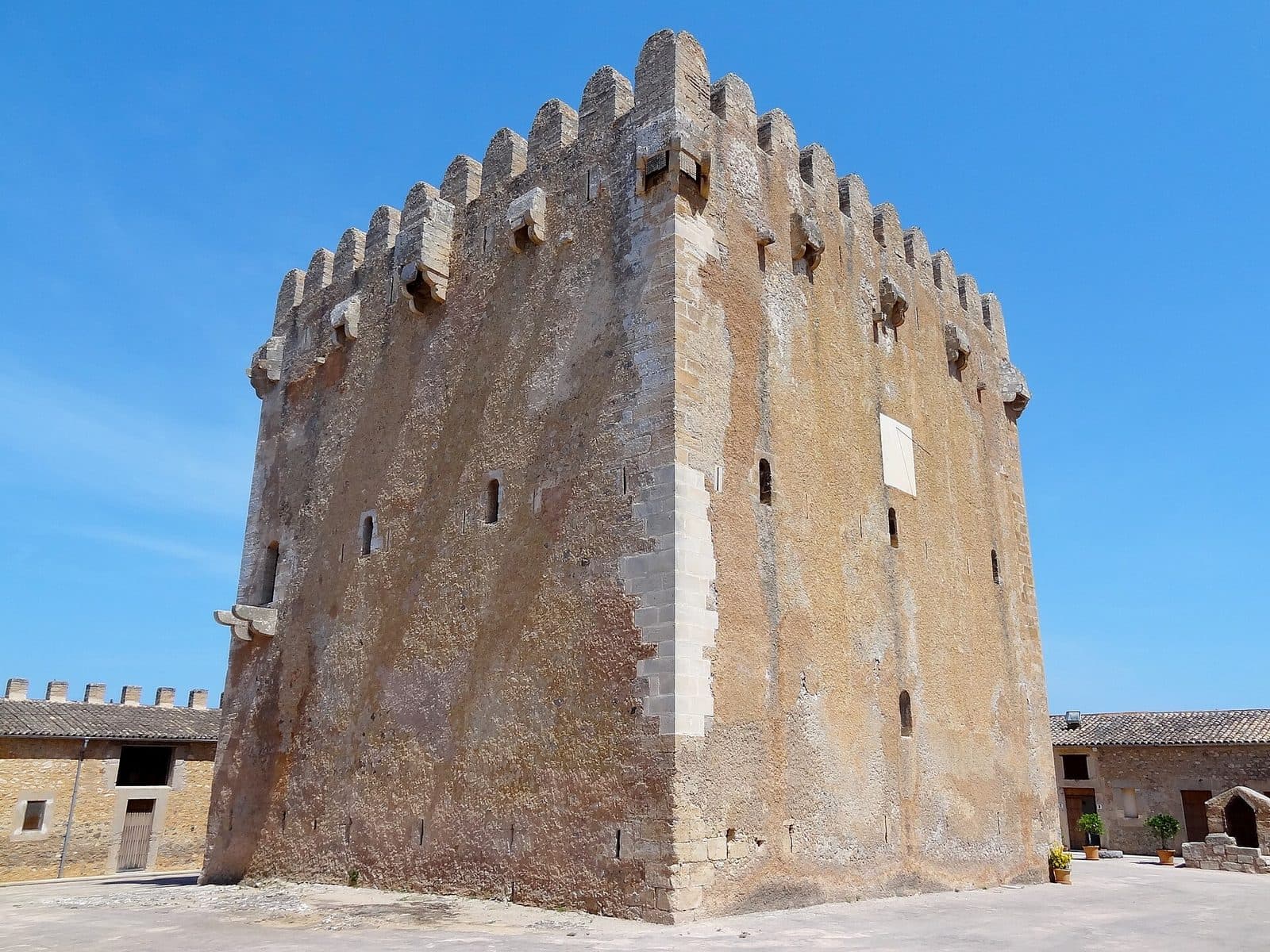

Between Artà and the coast, Torre de Canyamel rises above the fertile valley to which it owes its present name. The imposing square watchtower is one of those buildings that tell the story of medieval Mallorca not through decoration but through sheer mass: thick walls, three levels stacked one above another, and a roof offering views across the landscape to the bay.
A visit is especially rewarding for travelers who enjoy reading history directly from a building. Inside, stairs lead through the floors, while each level changes the perspective on both the structure and the landscape. Instead of an extensive castle complex, visitors encounter a compact, remarkably well-preserved defensive building whose original purpose quickly becomes clear.
At the same time, the tower is not a frozen monument. Today it serves as a museum and as a venue for art, concerts, and other cultural events. Contemporary works meet medieval masonry—a contrast that adds another dimension to the interiors and, depending on the current program, creates an additional reason to visit.
Torre de Canyamel also fits well into an excursion through northeast Mallorca. Canyamel, the Coves d’Artà, Capdepera, and the coastal landscape are close enough to experience the tower not in isolation but as part of a historic cultural landscape. For families, architecture enthusiasts, and visitors who enjoy viewpoints, it is a manageable yet rewarding destination.
History and Significance
When attackers approached the coast, a watchtower had to do more than simply raise the alarm. It needed to overlook the valley, shelter people and possessions, and provide protection until the danger had passed. This context explains the enclosed, massive form of Torre de Canyamel better than any architectural term could.
Medieval Origins
The tower's history reaches back to the Middle Ages. Its origins are associated with the Moorish period, while the development of the present defensive structure is also linked to Jaume I.'s conquest of Mallorca in the 13. century. Its origins are associated with the 13. century; the building is also dated to the middle of the 15. century.
The location was chosen strategically. From here, it was possible not only to observe the agriculturally valuable valley but also to control the direction of the Bay of Canyamel. For a long time, corsairs, pirates, and other attackers posed a genuine threat to the coastal population. The tower therefore served both as a lookout post and as a fortified refuge. Its height provided the necessary overview, while its strong walls and stacked floors made it a place where residents and valuables could be protected temporarily.
From Torre d’en Montsó to Torre de Canyamel
The present name emerged only later. Originally, the building was known as Torre d’en Montsó. Sugarcane cultivation became established in the valley during the second half of the 15. century, and the tower's name changed along with it. The Mallorcan word “canyamel” refers to sugarcane—essentially a cane that produces honey or sweetness.
The name thus preserves the memory of an agricultural era that is no longer immediately visible in today's landscape. Watercourses supplied the valley and created favorable conditions for cultivation. Torre de Canyamel is therefore not only a testament to earlier coastal defense but also a reminder of the area's economic use. Military history and cultural landscape are unusually closely intertwined here.
From Defensive Structure to Cultural Venue
As the threat of attacks from the sea declined, the tower lost its original function. However, it survived as part of an agriculturally shaped estate. Its massive construction and medieval form remain clearly visible today.
Since 2009, Torre de Canyamel has been used as a museum and as a center for art exhibitions and events. The operator organizes concerts, exhibitions, and cultural series here; the program also includes an international piano festival. This use is more than a decorative addition. It opens the historic building to new experiences without obscuring its character as a watchtower. Where visibility and protection were once crucial, encounters, music, and visual art now take center stage.
What to See
The first glance makes it clear that Torre de Canyamel was not designed as a prestigious palace. The structure appears enclosed and austere, while its square plan gives it an almost block-like presence. A crenellated parapet runs around the top. Its effect comes less from façade decoration than from its proportions and visible defensibility.
The Square Watchtower
The tower rises through three floors and reaches a height of 23 meters. Its Gothic-influenced architecture is designed for stability and defense. In the lower section, the walls are up to one meter thick. Torre de Canyamel is a compact refuge and defensive structure intended not only to warn people but also to shelter them.
The square plan remains perceptible inside. The rooms are enclosed by substantial masonry, and the vertical sequence of floors defines the route through the building. Instead of moving through courtyards, residential wings, and extensive fortifications, visitors pass through a single soaring structure. This makes its original logic particularly clear: protection and enclosure below, additional levels above, and finally an overview from the highest accessible area.
The Three Floors
Stairs connect the three floors and lead gradually through the structure. They are described as winding and are among the interior's characteristic features. The perception of the tower changes during the ascent: thick walls and enclosure dominate at first, while the connection to the surrounding landscape becomes increasingly pronounced higher up.
The appeal lies in the preserved building itself, the sequence of levels, and the traces of its defensive function. Passageways, stairs, and wall thicknesses show more clearly than an exterior view alone why the tower could serve as a refuge for the local population. At the same time, visitors can see how consistently the architecture was concentrated within a small footprint.
Museum and Art Exhibitions
Since opening as a museum and cultural center, the interior has been used for changing artistic presentations. The medieval rooms provide a striking backdrop for contemporary works. The program has included exhibitions by Mallorcan and international artists, so the specific presentation may differ from one visit to the next.
This constant change prevents the tower from appearing merely as an empty historic shell. Art draws attention to wall surfaces, room heights, and transitions that visitors might otherwise pass too quickly. At the same time, the architecture remains the most powerful exhibit. An exhibition should therefore not be viewed separately from the building: pictures and objects occupy rooms whose scale and materials already tell a story of their own.
The tower also serves as a stage for cultural events and concerts. These include concert series and an international piano festival. During such events, the visitor experience changes considerably, as the quiet monument becomes an event venue. Anyone coming specifically for an exhibition or concert should check the current cultural program separately; a regular museum visit and an evening event are not the same experience.
The Roof Terrace and Valley Views
The climb is rewarded at the top with an expansive view. Visitors can see the Bay of Canyamel, the east coast, and large parts of the neighboring municipal areas of Capdepera, Artà, and Son Servera. Inland, the panorama opens across the valley; in clear conditions, the view extends far beyond the immediate surroundings.
From above, the choice of location for the watchtower becomes understandable. The bay lies in the direction from which attackers were expected, while the agricultural land around the tower remained visible and controllable. The viewpoint is therefore not merely an attractive conclusion to the tour but an essential part of the building's historical message. Only here do the coast, valley, and tower combine into a comprehensible defensive system.
The origin of the name can also be understood more clearly from above. Today's vegetation should not be equated with medieval sugarcane cultivation, but the fertility and enclosed nature of the valley become evident. The tower does not stand at a random point on the coast: it guarded valuable, productive hinterland and the connection to the nearby bay.
Visiting Torre de Canyamel
The tour essentially follows the tower's vertical architecture. After viewing the massive structure from outside, visitors pass through the lower rooms and climb the stairs. Along the way, they can examine the current exhibition, the thickness of the walls, and the construction of the individual levels. The upper viewpoint forms the natural conclusion, where the previously enclosed experience of the interior opens toward the landscape.
Tour and Time Planning
Anyone who simply climbs the tower and enjoys the view will experience a compact attraction. It is worth allowing more time if an exhibition is on display, architectural details are of interest, or the landscape is to be viewed at leisure from above. The site is therefore suitable both as a cultural destination in its own right and as part of a day trip around Canyamel and Capdepera.
The three floors should be visited without rushing. Climbing the winding stairs is itself part of the experience, not merely the route to the view. It is particularly illuminating to pause and look back on each level: below, the thickness of the masonry shapes the space; higher up, the observation function gains importance. Anyone who rushes straight to the roof can easily miss the building's true quality.
Opening Hours and Admission
Torre de Canyamel is open Tuesday through Saturday in the morning from 10 to 15 and, after a break, again from 17 to 20. On Sundays, visits are possible from 10 to 15; the tower is closed on Mondays. Regular admission costs 3 euros. Before making a longer journey, it is nevertheless advisable to check the latest information, particularly if the visit is intended to coincide with an exhibition or cultural event.
The split opening hours create two different visiting windows. The morning can easily be combined with other destinations in the northeast. The later opening is convenient if the coast or Canyamel is already on the day's itinerary. Concerts and special events, however, may follow a different schedule from regular museum operations.
Exhibition or Event
Visitors to the tower as a museum should not automatically assume that a particular exhibition will be on display. The presentations change, and the operator continuously uses the building for art and culture. The current program therefore helps determine whether the visit focuses more on architecture, visual art, or an event.
Concerts take place on separate dates and may alter access or the atmosphere. Regular museum hours are the right choice for a quiet tour through all floors. Those who would instead like to experience how music sounds within the historic building should deliberately choose an event date and consider its conditions separately from regular admission.
Getting There and Parking
Torre de Canyamel is located on the road between Artà and Canyamel, at kilometer 5 of the Carretera Artà–Canyamel. It stands inland from the coastal resort and should not be confused with a tower directly on the beach. The final section leads through the Canyamel valley to the historic estate.
From Palma Airport
From Palma Airport, the road route initially follows the Ma-15 eastward. It then continues via the Ma-4030 and Ma-4040 into the northeast. Canyamel Coves is 76 road kilometers away, and the journey takes around 71 minutes. These measurements end at Canyamel Coves rather than directly at the tower entrance.
Much of the route follows the island's main eastern connection. Only in the northeast does it become more regional, passing through the surroundings of Artà and Capdepera. Anyone using navigation should explicitly select the attraction or the location on the Artà–Canyamel road as the destination, rather than simply entering the coastal resort of Canyamel.
From Central Palma
From central Palma, the drive to Canyamel Coves covers 79 road kilometers and takes around 78 minutes. Here too, the route follows the Ma-15, then the Ma-4030 and Ma-4040. Again, these details refer to Canyamel Coves; the final section to Torre de Canyamel leads back or farther into the valley toward the road between Artà and Canyamel.
Because of the location in the northeast, the return journey should not be planned too tightly if the tower is visited at the end of a day trip. The afternoon break in particular is important: arriving while the tower is closed cannot be compensated for by a longer exterior walk, as the interior, floors, and view form the core of the visit.
Parking and Bus Travel
Parking near the tower is described as straightforward. On site, visitors should pay attention to the designated areas and the access road to the estate.
Possible bus stops in the surrounding area include Canyamel – Coves d’Artà and Costa dels Pins. Traveling by public transport therefore requires more planning than driving; in particular, the connection between the stop and the tower should be checked in advance using the current timetable and the actual walking route.
Bus lines to Torre de Canyamel at a glance
| Line | Route | Departures/day | First | Last |
|---|---|---|---|---|
| 424 | Cala Rajada - Portocristo | 42 | 08:18 | 23:10 |
| 412 | Costa dels Pins - Manacor | 31 | 05:35 | 23:00 |
From the official GTFS feeds (TIB/SFM), no real-time data. The figures cover all stops in the town; weekend and holiday services differ — check with the operator before travelling.
Getting there by bus
Canyamel - Coves d'Artà (14035) · 1.5 km as the crow flies
- 424Cala Rajada - Portocristo · Daily
Costa dels Pins (62019) · 2.0 km as the crow flies
- 412Costa dels Pins - Manacor · Daily
Timetable data: official GTFS feeds (TIB/EMT), no real-time — check with the operator before travelling.
Things to Do Nearby
The tower roof already reveals why an entire day trip around Canyamel is worthwhile. Very different destinations lie close together between wooded hills, valley, and coast: medieval history, underground natural formations, archaeological traces, and a quiet seaside resort. Torre de Canyamel provides a useful starting point because it makes the landscape historically legible.
Canyamel and the Bay
The coastal resort of Canyamel belongs to the municipality of Capdepera and lies on a bay between wooded hills. The Torrent de Canyamel runs through the resort, and its valley continues inland toward the watchtower. The connection between tower and coast is therefore not merely geographical: the bay was the monitored access point from the sea, while the valley was the hinterland that had to be protected.
After the museum visit, the landscape seen from the roof can be experienced below from another perspective. The beach and the mouth of the torrent provide a peaceful counterpoint to the stone interiors. Those who visit the tower in the morning can spend the rest of the day on the coast; for a later tower visit, the reverse order works well.
Coves d’Artà and Cap Vermell
The Coves d’Artà at Cap Vermell are among the best-known natural attractions in the northeast. The caves combine well with Torre de Canyamel because the two sights reveal different layers of time within the same landscape: the medieval defensive structure here and the geological formation of the coastal mountains there. Enough time should be allowed for each rather than treating them as brief photo stops.
The road toward the caves leads into the coastal landscape that could once be monitored from the tower. This also gives the combination historical meaning. After viewing the bay from the top of Torre de Canyamel, it becomes clear how Cap Vermell defines the coastal area.
Capdepera and Es Claper des Gegant
Capdepera expands the excursion to include the municipality's historic main town. The fortified complex above the town in particular revisits the theme of medieval defense on a larger scale. While Torre de Canyamel functions as a compact refuge and watchtower, Capdepera presents a more extensive fortification. Seeing both destinations in one day highlights the different forms of protection used in northeast Mallorca.
Es Claper des Gegant near Canyamel reaches even farther into the past. The Talayotic site is a reminder that the area was inhabited long before the Middle Ages. A brief comparison is enough to reveal the breadth of history: prehistoric stone architecture in the valley, a medieval watchtower, and later settlements on the coast. For visitors interested in history, this sequence is more rewarding than a loose collection of individual sights.
The place it belongs to
Canyamel Coves in the place guidePractical Visitor Information
Torre de Canyamel is a historic defensive structure with three floors and winding stairs. A visit therefore differs from entering a ground-level exhibition space. Anyone wishing to climb to the viewpoint should choose shoes with a secure grip and allow enough time for an unhurried ascent. The stairs are not a minor detail but an essential part of the medieval construction.
Visiting with Children
For children, the tower can be more vivid than a conventional museum because its defensive function can be experienced directly. Thick walls, stacked levels, and the view toward the bay provide concrete answers to the question of how people once protected themselves from attacks. The route remains manageable in size and can easily be combined with a simple story about guards, refuge, and pirates.
Supervision is important on the stairs and in the upper area. Children should not run ahead alone, especially since the historic routes do not provide the same freedom of movement as a modern museum. It is helpful to divide the ascent into stages and look for a different detail on each level: the thickness of the walls, the connection between floors, or the direction of the sea.
What to Expect
Its value lies precisely in its concentration: a square, three-story defensive structure whose architecture was designed for observation, protection, and retreat. Visitors who arrive with this expectation will notice the wall thicknesses, stairs, and views more consciously.
The museum also does not follow a fixed exhibition format. Contemporary art and cultural programs change, while the tower itself remains the constant. For architecture enthusiasts, the visit is therefore worthwhile regardless of the exhibition theme; anyone traveling for a particular artist or concert should check the current program beforehand.
Why the Viewpoint Matters
The view from the upper area is not merely an extra for attractive photographs. It explains the entire location. It is advisable to look first for the Bay of Canyamel and then let the eye travel across the valley. This connects the tower's historical purpose with today's landscape: monitoring the coastal direction on one side and protecting fertile hinterland on the other.
Anyone who only photographs the façade and drives on therefore misses the most important change in perspective. From outside, the tower appears as a mighty block of stone; from above, it becomes an observation post. Only these two impressions together explain why Torre de Canyamel has remained a defining structure in the valley for centuries.
Local insider tips
Look for the Bay First
At the upper viewpoint, first look toward the Bay of Canyamel. Potential attackers came from that direction. Then look across the valley to understand why the tower served as both a lookout post and a refuge.
Examine the Walls Below
Do not rush straight to the upper floors: in the lower section, the walls are up to one meter thick. The tower's defensive function is particularly clear there before the route opens toward the landscape.
Check the Art Program in Advance
The exhibitions in the tower change, and concerts and cultural series also take place. Checking the current program reveals whether the visit will focus on an exhibition or separate event alongside the medieval architecture.
Compare Two Types of Defensive Architecture
Torre de Canyamel combines well with Capdepera: here, a compact three-story refuge and watchtower; there, a larger fortified complex. A direct comparison makes medieval approaches to protection easier to understand.
Combine the Tower and Caves
The Coves d’Artà at Cap Vermell are a fitting addition. The tower first reveals the historical control of the valley and bay; on the coast, the caves offer a completely different perspective on the same landscape.