
Coves del Drach: Mallorca’s Dragon Caves near Porto Cristo
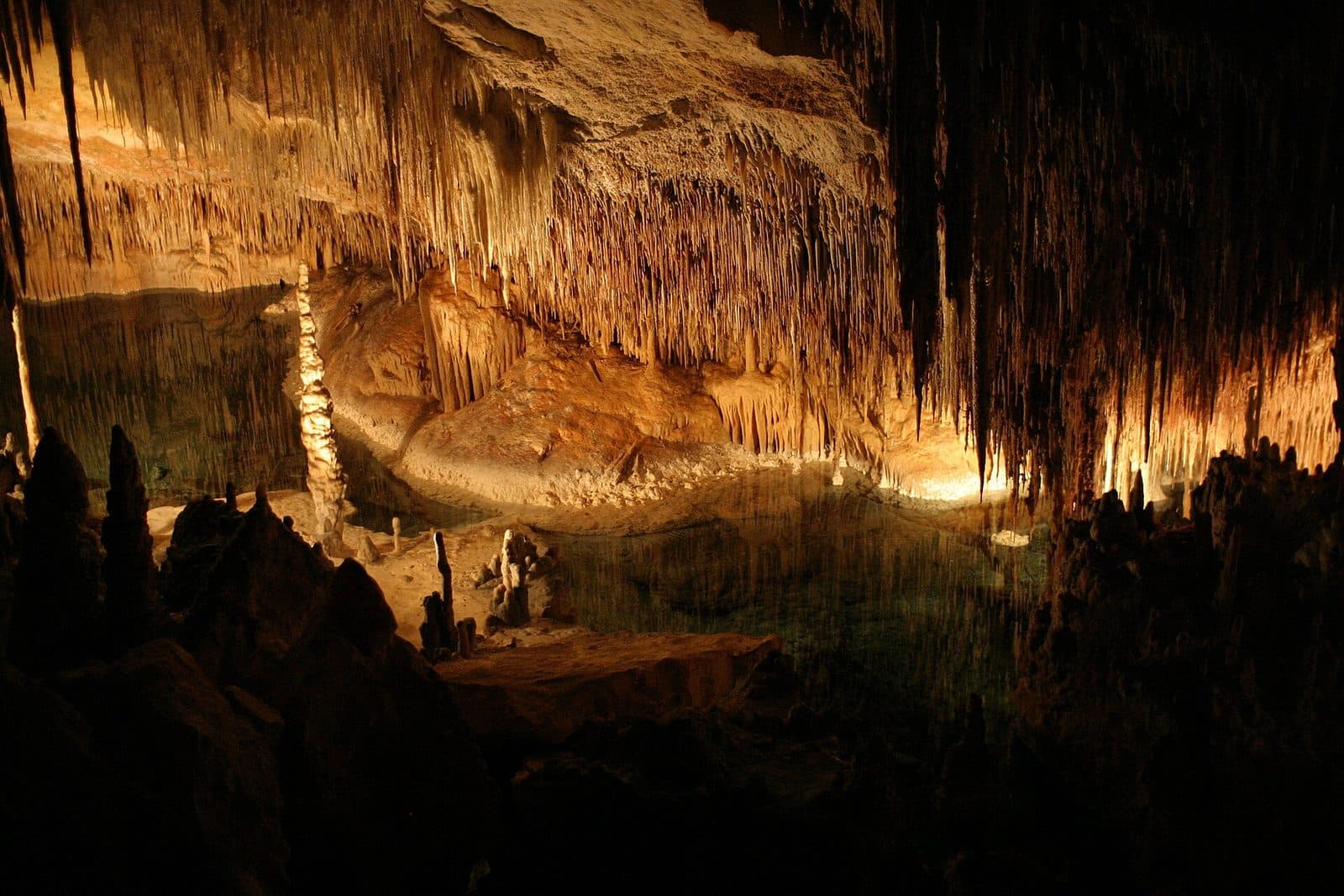

Beneath Mallorca’s east coast lies a world of limestone, water and subdued light. The Coves del Drach near Porto Cristo lead through an extensive system of limestone caves whose chambers reach up to 25 metres below the surface. Stalactites hang from the ceilings, stalagmites rise towards them from the floor, and between them a visitor trail runs through a landscape shaped over a very long time by seeping rainwater.
The most famous moment awaits at Lago Martel. A live concert is performed at this underground lake during every regular visit. Music, darkness and reflections on the water turn the cave tour into a carefully staged visitor experience—less an expedition than underground natural theatre.
The caves are suitable for travellers who want to discover Mallorca’s landscape beyond beaches and viewpoints. Families will also find a clearly organised programme of manageable duration. Anyone expecting a solitary cave tour, independent exploration or an athletic adventure, however, has come to the wrong place: the visit follows an illuminated route in scheduled groups.
The excursion requires more time than the period actually spent underground. A path leads from the car park to the cave entrance, and admission is tied to a booked time slot. Afterwards, Porto Cristo is a good place for a break by the harbour or on the beach.
History and significance
Long before the Coves del Drach became one of Mallorca’s best-known visitor attractions, their entrances and underground chambers were familiar to local people. The operator’s chronology dates the first possible written reference to 1338: the caves are said to have been mentioned in a message from the island’s governor, Roger de Rovenach, to the mayor of Manacor. As the identification is not definitive, this document marks the beginning of the recorded history rather than an actual discovery.
The name Drach
The name, associated with the dragon in Catalan, appears in 1632 in Dameto’s history of the Kingdom of Mallorca. Cartographers, historians and travel writers later included the caves in their descriptions of the island. They included Cardinal Despuig with his map of Mallorca, as well as authors who travelled through the island’s interior when it was still largely undeveloped. The Coves del Drach were therefore already part of Mallorca’s cultural image before systematic surveying began.
The dragon name reflects an older perception of caves as inaccessible, mysterious places. Today’s route, however, has little in common with a dark cave of legend: lighting and paths make the formations clearly visible, while the historic name has been preserved.
Friedrich Will and the first map
In 1880, German officer and entomologist Friedrich Will drew the earliest known map of the Coves del Drach. He had come to Mallorca at the invitation of Archduke Ludwig Salvator. The Archduke studied the Balearic Islands extensively and supported scientific and regional research. For the first time, Will’s map transformed the cave site known through tradition into a charted space and recorded the Cova Blanca and Cova Negra, among other areas.
A few years later, French artist and travel writer Gaston Vuillier helped make the caves known beyond Mallorca. He visited them in 1888 and published a detailed account of his journey through the Balearic Islands the following year. His connection with Édouard-Alfred Martel became important for the caves’ further exploration.
Édouard-Alfred Martel and modern cave research
In September 1896, French cave researcher Édouard-Alfred Martel came to Mallorca. Martel is regarded as one of the founders of modern speleology. Together with Louis Armand, he investigated the Coves del Drach under the patronage and with the support of Archduke Ludwig Salvator. Lago Martel is the large underground lake that now forms the dramatic highlight of the visit.
The Dragon Caves also appeared in literature. Jules Verne mentioned them in his work “Clovis Dardentor”, drawing on accounts already circulating about lakes, limestone formations and fantastically named chambers. Paths and electric lighting were installed in the 20th century; today, the site combines a natural monument with a staged visitor attraction.
What to see
The dimensions alone explain why the Coves del Drach do not feel like a single grotto. The developed complex extends for approximately 1.200 metres horizontally and reaches up to 25 metres below ground at its deepest point. Several cave areas merge into one another. Along the route, the ceiling height, sightlines and density of limestone formations change repeatedly until a broad expanse of water opens up at Lago Martel.
Cova Negra
Cova Negra, the “black cave”, is one of the parts of the system that were mapped early in its history. Today, electric lighting reveals contours that would remain hidden in natural darkness: ledges, ceiling shapes and limestone formations emerge from the shadows, while deeper sections remain dark.
Sections like these show particularly clearly how strongly light changes the effect of a show cave. Some formations are highlighted, while others disappear into the background. The lighting is therefore not merely an aid to orientation but part of the modern presentation.
Cova Blanca
Cova Blanca, the “white cave”, was also recorded in Friedrich Will’s early map. The two classic directions of growth can be clearly distinguished on the ceilings and floors: stalactites hang down, while stalagmites build upwards from below. Where the two meet over a long period, column-like formations develop.
These shapes are the result of water seeping through the limestone-rich ground. It dissolves minerals and deposits them again inside the cave. The underlying carbonate rocks formed in the Upper Miocene and are several million years old. The visible limestone formations, by contrast, continue to grow for as long as mineral-rich water is supplied.
Cova de Lluís Salvador
Cova de Lluís Salvador is one of the named areas of the cave system. Archduke Ludwig Salvator’s study of the Balearic Islands and his support for researchers played an important role in the caves’ scientific exploration.
For visitors, the historic name is usually overshadowed by the immediate visual impression. Shapes resembling curtains, columns or frozen cascades stand close together. Such comparisons help the eye interpret them, but these are not artificial sculptures: all the fundamental forms were created by water and limestone deposits.
Cova dels Francesos
Cova dels Francesos, the “cave of the French”, is another area of the complex. Édouard-Alfred Martel and Louis Armand were associated with the exploration of the cave system.
This part of the system makes it clear why the Coves del Drach are regarded not as isolated chambers but as a connected cave landscape. Passages lead from narrower sections into larger spaces; fields of limestone formations frame the view, and artificial lighting directs attention towards selected structures.
Lago Martel
The scenery changes at Lago Martel. Instead of densely layered rock formations, water now defines the space. The underground lake is approximately 115 metres long and is considered one of the large cave lakes of its kind. Depending on its depth and the lighting, the water appears in different colours; its calm surface reflects the contours of the cave and points of light.
This is where the live concert included in the regular visit takes place. The music is not played as background sound along the route but presented as a separate part of the programme by the lake. Darkness and light on the water focus attention on this moment.
After the concert, Lago Martel can be crossed by boat; alternatively, the visit continues on foot. The boat passage is brief and not a separate cave excursion. Its appeal lies in the change of perspective: for a moment, the surface of the water itself becomes the path through the underground space.
Visiting the caves
The tour follows a fixed sequence. Admission is organised in groups, but the visit itself is not guided. There is therefore no guide who stops at every formation or answers questions. Instead, the group follows the designated route through the illuminated cave chambers to Lago Martel, where the concert begins. Visitors then choose between the short boat passage and the walking route.
Time required and admission
The actual visit takes approximately one hour. You should also allow time for the walk from the car park to the entrance and a reasonable buffer before the booked time. The operator recommends arriving about 15 minutes before the start; the cave entrance is around 200 metres from the car park. Anyone combining the visit with Porto Cristo should therefore allow more than just the hour underground in their day’s schedule.
Admission is organised by time slot. Current opening times and admission prices should be checked before the excursion, as they may be adjusted seasonally. Tickets purchased online are tied to the selected time slot and can be shown on a mobile phone. Advance booking is particularly useful on busy days for securing the preferred visiting time.
Crowds and time of day
The Coves del Drach are among the best-known excursion destinations in eastern Mallorca. Groups can therefore be large during the peak travel season. Anyone wishing to experience the caves with as few crowds as possible should choose the earliest available time of the day if possible. Later time slots, in turn, combine well with a prior visit to the harbour or beach in Porto Cristo.
Even then, you will not be alone on the regular route. The experience is deliberately organised for groups, and visitors gather at Lago Martel for the concert at the latest. The sense of calm there comes less from emptiness than from the shared transition from movement to silence.
Concert and conclusion
All regular visits follow the same basic programme and include the live concert. There is therefore no need to look for a special concert tour. The boat trip across Lago Martel is also part of the experience as an alternative to continuing on foot.
Because the boats cover only a limited section, the trip should not be confused with a longer underground boat tour. The focus remains the walk through the cave system. After the lake, the route leads to the exit and back to the visitor area above ground.
Getting there and parking
The Coves del Drach are located near Porto Cristo on Mallorca’s east coast. The stated road distances and driving times refer to the journey to Porto Cristo, not precisely to the cave entrance. In town, follow the local signs to the site; the final section leads from the urban area to the caves’ visitor car park.
From Palma Airport
The road distance from Palma Airport to Porto Cristo is 67 kilometres. The drive takes around 58 minutes and follows the Ma-15, then the Ma-4020. Traffic around Palma, driving through towns and searching for parking can increase the actual journey time. For admission booked at a fixed time, an additional buffer should therefore be allowed beyond the driving time alone.
From central Palma
From central Palma, the route also follows the Ma-15 and the Ma-4020. The road distance to Porto Cristo is 69 kilometres, and the drive takes around 65 minutes. The short local section to the cave site follows. The route crosses the island largely from west to east and is more direct than driving along the coast.
Parking and public transport
The site has a large free car park for cars, taxis, buses, motorcycles and bicycles. Overnight stays or parking at night are not permitted because the area is closed. Valuables should not be left in the vehicle. The entrance is still around 200 metres from the car park, and this walk should be included in the time planned before admission.
The attraction can also be reached by public transport. A bus stop is located directly on the site, and there is also a taxi rank. This means that no long walk from the centre of Porto Cristo is necessary. The connection should nevertheless be selected to match the booked time slot, as admission is tied to the stated visiting time.
Bus lines to Coves del Drach at a glance
| Line | Route | Departures/day | First | Last |
|---|---|---|---|---|
| 401 | Cala Millor - Palma | 197 | 06:05 | 23:57 |
| 427 | Cala Mendia - Portocristo | 192 | 08:00 | 22:30 |
| A42 | Cala Bona - Aeroport | 166 | 00:02 | 23:02 |
| 424 | Cala Rajada - Portocristo | 129 | 00:05 | 23:56 |
| 425 | Cala Bona - Portocristo | 123 | 08:00 | 22:23 |
| 428 | Cala d'Or - Portocristo | 58 | 08:05 | 21:52 |
From the official GTFS feeds (TIB/SFM), no real-time data. The figures cover all stops in the town; weekend and holiday services differ — check with the operator before travelling.
Getting there by bus
Coves del Drac 2 (33017) · 0.1 km as the crow flies
- 427Cala Mendia - Portocristo · Daily
- 428Cala d'Or - Portocristo · Daily
Coves del Drac 1 (33018) · 0.1 km as the crow flies
- 424Cala Rajada - Portocristo · Daily
- 425Cala Bona - Portocristo · Daily
- 427Cala Mendia - Portocristo · Daily
- 428Cala d'Or - Portocristo · Daily
Platja de Portocristo (33011) · 0.6 km as the crow flies
- 427Cala Mendia - Portocristo · Daily
- 428Cala d'Or - Portocristo · Daily
Mestral 1 (33078) · 1.1 km as the crow flies
- 401Cala Millor - Palma · Daily
- 424Cala Rajada - Portocristo · Daily
- 425Cala Bona - Portocristo · Daily
- A42Cala Bona - Aeroport · Daily
Mestral 2 (33079) · 1.1 km as the crow flies
- 401Cala Millor - Palma · Daily
- 424Cala Rajada - Portocristo · Daily
- 425Cala Bona - Portocristo · Daily
- A42Cala Bona - Aeroport · Daily
Cala Anguila - Cala Magrana 1 (33051) · 1.2 km as the crow flies
- 427Cala Mendia - Portocristo · Daily
Cala Anguila - Cala Magrana 2 (33050) · 1.3 km as the crow flies
- 427Cala Mendia - Portocristo · Daily
Ctra. Son Servera 1 (33053) · 1.3 km as the crow flies
- 401Cala Millor - Palma · Daily
- 424Cala Rajada - Portocristo · Daily
- 425Cala Bona - Portocristo · Daily
- A42Cala Bona - Aeroport · Daily
Ctra. Son Servera 2 (33054) · 1.3 km as the crow flies
- 401Cala Millor - Palma · Daily
- 424Cala Rajada - Portocristo · Daily
- 425Cala Bona - Portocristo · Daily
- A42Cala Bona - Aeroport · Daily
Dinosaurland - Coves Hams (33046) · 1.5 km as the crow flies
- 401Cala Millor - Palma · Daily
Platja de Cala Mendia 2 (33066) · 2.1 km as the crow flies
- 427Cala Mendia - Portocristo · Daily
Platja de Cala Mendia 1 (33039) · 2.2 km as the crow flies
- 427Cala Mendia - Portocristo · Daily
Timetable data: official GTFS feeds (TIB/EMT), no real-time — check with the operator before travelling.
Nearby
After the darkness of the caves, Porto Cristo feels particularly bright and open. The coastal town belongs to the municipality of Manacor and developed around a sheltered bay with a harbour. For a visit to the Coves del Drach, it is more than just an orientation point: the underground attraction, a walk by the water and a break can all be combined here without another long journey.
Porto Cristo harbour
Leisure boats lie alongside smaller, traditionally styled vessels in the harbour. The promenade is ideal for a relaxed continuation of the scheduled cave visit. While paths and lighting determine the experience underground, the view here opens across the bay. Cafés and restaurants make the harbour a practical stop before a later time slot or after the tour.
Porto Cristo is lively with tourism but has retained the scale of a manageable coastal town. Anyone who comes only for the caves and leaves immediately sees little of their connection with the surrounding landscape: the cave system lies directly beside the east coast whose limestone and water contributed to its formation over a long period.
Platja de Porto Cristo
Platja de Porto Cristo lies in the town’s sheltered bay. It is a convenient choice for combining the cave visit with time by the sea without having to drive any farther. With a later time slot, the beach can fill the morning; after an early visit, it is an obvious destination for the rest of the day.
The contrast is appealing: first the constant, subdued atmosphere underground, followed by sand, daylight and harbour water. During the peak season, however, the town beach can also be expected to be busy.
Torre dels Falcons and the coast
Another short addition to the itinerary is Torre dels Falcons, a historic coastal watchtower near Porto Cristo. It represents a very different side of local history from the caves: above, a broad view across the sea; below, the limestone system shaped by water. For a combined excursion, it is enough to plan the tower as a scenic stop; the Coves del Drach remain the scheduled centrepiece of the day.
Anyone wishing to continue along the east coast will find additional beaches and coves near Porto Cristo. It is still sensible not to overload the itinerary. The fixed cave admission time, the journey and a break in town already make for a well-filled half day.
The place it belongs to
Porto Cristo in the place guidePractical information for your visit
Conditions underground differ from those on Mallorca’s coast. According to the operator, the temperature in the caves ranges between 17 and 21 degrees Celsius. On hot days, the difference from the outside air is noticeable, although the Coves del Drach are not wintry cold. A light additional layer may be comfortable for sensitive visitors.
Footwear and clothing
The visit consists of an approximately one-hour walk through a cave system, interrupted by the stop at Lago Martel. Comfortable, secure footwear is more practical for this than beach shoes or dress shoes. High humidity is part of the natural cave climate, so clothing should not be chosen solely for the warmth outside the entrance.
Rain above ground does not generally prevent the visit. This is useful for planning, as the underground tour can also take place on a day that is less suitable for the beach. The path between the car park, entrance and visitor building is outside the cave, however.
Visiting with children
For children, the programme is manageable: chambers filled with limestone formations, an underground lake, music and the possible boat passage at the end provide clear changes of pace. Parents should nevertheless remember that the group remains on a fixed route and that the concert requires a quiet moment. Running around freely or exploring independently is not permitted.
Pushchairs and other bulky objects may not be taken into the cave. Those arriving by car are best advised to leave the pushchair there. Without a vehicle, staff at the entrance will indicate a place where it can be left; luggage storage is limited and cannot normally accommodate pushchairs. For smaller children, a suitable carrier is therefore the more practical solution.
Toilets and luggage
Toilets are located at the entrance and exit, but not inside the cave. Especially when visiting with children, it is advisable to use them before the tour begins, as the visit takes approximately one hour.
Bulky luggage may not be taken inside either. For visitors without a car, limited free storage for larger items such as suitcases or bicycle bags is available at the cave entrance. It is located around 200 metres from the car park. Small valuables, by contrast, should be kept on your person and not left visible inside a parked vehicle.
What not to expect
The Coves del Drach are not a guided research expedition or a natural cave open for unrestricted exploration. The path is illuminated, visits are organised in groups, and Lago Martel is staged as a musical highlight. Anyone expecting detailed geological explanations during the tour should be aware that the groups are not accompanied by a personal guide.
The boat ride is not a long excursion through branching water-filled tunnels either. It forms a brief conclusion at Lago Martel and can be replaced by the walking route. The real richness lies in the sequence of cave chambers, the limestone formations and the transition from rock to water—not in making the ride as long as possible.
Local insider tips
Choose the earliest time slot
The earliest available admission time of the day is usually the best choice for experiencing the caves with fewer crowds. The route will not be completely empty, however, because visits always take place in groups.
Pay attention at Lago Martel
The live concert is included in every regular visit. There is no need to book a special tour. The defining moment is the transition to darkness by the lake, when music and reflections of light take over the cave chamber.
Boat or walking route
After the concert, Lago Martel can be crossed briefly by boat; alternatively, the route continues on foot. The ride is more a change of perspective on the water than a longer boat tour through the cave system.
Leave bulky items in the car
Pushchairs and large pieces of luggage may not be taken into the cave. Storage at the entrance is limited and does not normally accept pushchairs. Anyone arriving by car is best advised to leave bulky items in the vehicle.
Include Porto Cristo
The cave tour can be combined with Porto Cristo’s harbour and town beach without another long journey. An early appointment works well with time by the sea afterwards, while a later one suits a harbour stroll beforehand.