
Cova des Pirata Cave near Cales de Mallorca
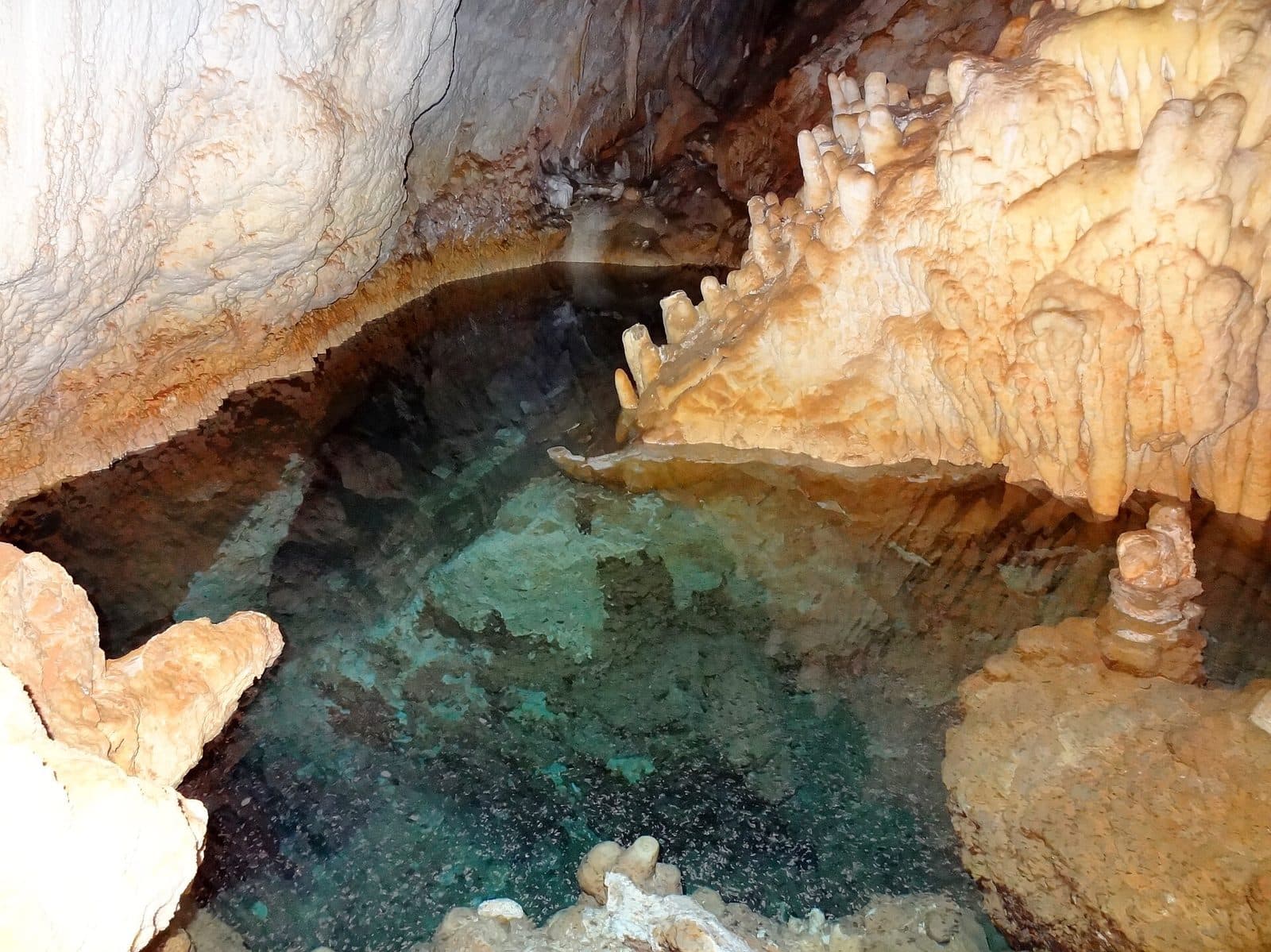

Cova des Pirata reveals a side of Mallorca’s east coast that is barely imaginable from its seaside resorts. Beneath the limestone near Cales de Mallorca lies a natural cave with chambers, stalactite formations, and a flooded section that connects it underwater to the neighboring Cova des Pont. However, anyone expecting an illuminated show cave with a ticket office, scheduled tours, and a staged route has come to the wrong place.
That is precisely what makes Cova des Pirata appealing. Although it was one of Mallorca’s first caves to be developed for tourism, it has no electric lighting and is secured by a gate. A visit therefore depends not only on getting there but, above all, on whether access is currently possible. Bringing your own light source is essential inside; a helmet is strongly recommended.
The cave is especially worthwhile for visitors who want to understand Mallorca’s karst landscape and prefer an unspoiled atmosphere to a large-scale visitor attraction. Individual formations emerge from the darkness in the beam of a lamp, while the rest of the space remains hidden. This changes how the cave is perceived: instead of a fully illuminated setting directing your gaze, each step reveals a new section of the rock.
A practical approach to preparation therefore suits Cova des Pirata better than spontaneous adventurousness. It is a geological site with a historic tradition of tourism, but not a leisure attraction that is accessible at all times. Before traveling, you should confirm whether the entrance is open and under what conditions access is permitted.
History and significance
The best-known story about the cave begins with a wounded figure disappearing into the rock. Its traditional name is explained by the legend of a pirate who is said to have sought refuge here and recovered from his injuries. The story is not a reliable chronicle of a particular pirate, but it shows how strongly the concealed caves of the east coast have long been associated with hideouts and places of retreat.
The pirate legend
The name “Cova des Pirata” means pirate cave. According to the traditional story, an injured pirate fled into the cave system to hide and recover. Nothing beyond this brief account has been established. The legend should therefore not be embellished with later claims about pirate camps, smuggling depots, or specific historical figures.
Nevertheless, the name feels plausible on site: the entrance does not lead into an open chamber visible from afar, but into an enclosed underground world. Without artificial light, side areas and continuations quickly disappear into the darkness. The story thus belongs less to Mallorca’s political history than to the way its coastal caves are perceived—secretive, difficult to survey, and shaped by the sea.
Opening in 1897
The documented history of visits begins in 1897. That year, Cova des Pirata was opened to the public for an agricultural exhibition in Manacor. This is remarkable because the tourist presentation of Mallorca’s caves is now usually associated with large, permanently operated attractions. Cova des Pirata represents an earlier form of development: a constructed path made the interior accessible without completely displacing its natural darkness.
A dedicated description of its most important features had already appeared by 1905. The cave was therefore not merely known locally but was recognized and documented as a visitor destination. Its present character still reflects this intermediate status. It is neither completely undeveloped nor a modern show cave with regulated visitor operations.
A shared cave system
For a long time, Cova des Pirata and Cova des Pont were named and developed for tourism as separate caves. It was only later discovered that the two are connected by an underwater passage. Geologically, they are therefore parts of the same system, even though the traditional names still refer to two distinct entrances and appearances.
This discovery gives Cova des Pirata its true significance. The visible chambers and formations are only the dry, accessible section of a karst body that continues below the waterline. The cave thus tells a story of limestone dissolution, underground waterways, and a coastal landscape whose most important structures remain partly hidden.
What to see
Only the beam of a lamp turns the darkness back into a space. It moves across irregular limestone surfaces, catches on hanging stalactites, and farther below illuminates formations that have grown upward from the ground. Cova des Pirata was shaped not by architecture but by water, dissolved limestone, and extremely long geological processes.
The developed cave path
Inside, visitors follow a constructed path. This historic development distinguishes Cova des Pirata from a completely pathless cave, but it does not turn it into a comfortable museum tour. There is no electric lighting. Uneven ground, damp patches, and changes of direction must therefore be identified using your own reliable lamp.
The path structures movement through the cave: rather than walking arbitrarily between rock formations, visitors follow an existing line through the accessible areas. This also helps prevent unnecessary entry into less easily surveyed sections. A handheld flashlight is generally sufficient as a light source, but lighting that leaves both hands free is more practical. A helmet is also recommended because low or protruding sections of natural rock can easily be overlooked.
Chambers and cave formations
The cave contains several chambers and passages. Stalactites and stalagmites have formed on the ceilings and floors: mineral-rich water penetrates the rock, deposits minerals, and gradually allows formations to grow over a long period. Some hang individually in the open space, while others form irregular clusters along walls and passageways.
Without broad illumination, these formations appear different from those in a large show cave. The beam isolates individual outlines from the background; a few steps later, their shadows change. This makes it possible to examine surfaces and spatial layers closely, though orientation is also more demanding. Anyone wishing to take photographs must expect very little ambient light and must not put personal safety second to framing a shot.
The flooded section
Water is part of the cave system. A fully flooded underground passage connects Cova des Pirata with the nearby Cova des Pont. This section is not part of a normal visitor route and must not be mistaken for a walkable connection between the two entrances. Its exploration should be left to cave divers with the appropriate training and equipment.
However, this invisible connection explains much about the landscape. The two caves, traditionally viewed as separate, are parts of a shared system below the water’s surface. Where the dry path ends, the cave does not end geologically. It continues into an area whose demands go far beyond a visit with a lamp and helmet.
Elevation difference and location in the limestone
Speleological records describe a vertical extent of 33 meters for Cova des Pirata; the entrance is said to lie 22 meters above sea level. These figures help explain that the cave is not a shallow rock recess but a spatially structured system. There are clear differences in elevation between the entrance, chambers, and water-bearing areas.
For visitors, this is apparent less as an abstract figure than through changing spatial proportions and ground conditions. Attention must remain directed not only ahead but also upward and toward the next foothold. Limestone is the unifying element: it forms the rocky coast, supports the resort, and conceals a network of natural cavities beneath its surface.
Visiting the cave
A successful visit to Cova des Pirata begins not at the cave entrance but by checking current access conditions. The cave is secured by a gate and does not have regular, reliably predictable visiting hours. Opening hours and admission details are not permanently documented. Before traveling, you should therefore confirm whether access is possible on the desired day and whether any special conditions apply.
Before entering
A locked gate must never be bypassed. It indicates not only property or access rules but may also protect visitors from current hazards and help protect the cave itself. Anyone arriving without confirmed access must be prepared for the possibility that they will not be able to see the interior. This is the most important difference from the island’s large show caves.
Preparation should include a powerful light source, backup lighting, and suitable footwear. Bringing your own lamp is essential because the cave has no electric lighting. The recommended helmet provides protection against overlooked rock projections but is no substitute for moving carefully.
Inside
If access is permitted, follow the existing cave path and remain within the clearly identifiable, dry visitor areas. The darkness requires a slower pace than an illuminated tour. Each step should be secure before attention lingers on formations or shifts toward side chambers. On damp ground, a seemingly simple path can quickly become a slippery passage.
No fixed standard duration has been documented for Cova des Pirata. The time required depends on the permitted access, individual pace, and how closely the formations are examined. Allowing a generous buffer is sensible so there is no need to rush inside or on the return journey. The cave is not suitable as a brief stop between tightly scheduled appointments.
Time of day and visitor numbers
There is no reliable information about typical peak times. The best time to visit therefore depends first on confirmed access and sufficient daylight for the final section outside the cave. Because visitors must use their own artificial light inside anyway, sunlight does not determine visibility there. For outdoor orientation and the return journey, however, setting out only toward the end of the day is unwise.
Current local notices and closures always take priority.
Getting there and parking
The regional driving directions lead as far as Cales de Mallorca, not directly to the gate of Cova des Pirata. This distinction is important: the resort can be reached by regular roads, while the final section to the cave requires current local knowledge, precise navigation, and compliance with local access rules.
From Palma Airport
The road distance from Palma Airport to Cales de Mallorca is 62 kilometers. The drive takes around 55 minutes and follows the Ma-19, then the Ma-5120 and the Ma-4010. Travel time may vary depending on traffic, especially on the rural roads in the east of the island.
These reliable directions end in Cales de Mallorca. From there, do not continue based solely on the name “pirate cave,” as Mallorca’s coast contains similarly named caves, rock gates, and excursion attractions. The destination must specifically be Cova des Pirata, the cave near Cales de Mallorca.
From central Palma
The road distance from central Palma to Cales de Mallorca is 67 kilometers. The drive takes around 64 minutes. The route follows the Ma-15, the Ma-4015, and the Ma-4014 into the east of the island. The Ma-4014 is also an important point of reference along the coastal section between Porto Cristo and Portocolom.
For this route as well, the distance and driving time apply only as far as Cales de Mallorca. The final section to the cave entrance is not included. Before continuing, it is therefore advisable to check current permitted access instead of spontaneously turning onto unpaved tracks.
Parking and final access
There is no confirmed visitor parking area directly at Cova des Pirata. Vehicles should be left only in areas where parking is expressly permitted; entrances, paths, and private property must be kept clear. On the east coast in particular, apparent shortcuts often cross land where access by foot or vehicle cannot be assumed to be permitted.
Anyone traveling by public transport to Cales de Mallorca or the neighboring coastal towns should plan the onward journey separately. A nearby stop does not mean the cave entrance can be reached without further route-finding. For Cova des Pirata, confirming the final section in advance remains just as important as the main journey itself.
Bus lines to Cova des Pirata at a glance
| Line | Route | Departures/day | First | Last |
|---|---|---|---|---|
| 427 | Cala Mendia - Portocristo | 72 | 08:07 | 22:17 |
From the official GTFS feeds (TIB/SFM), no real-time data. The figures cover all stops in the town; weekend and holiday services differ — check with the operator before travelling.
Getting there by bus
Punta Reina (33041) · 1.8 km as the crow flies
- 427Cala Mendia - Portocristo · Daily
Platja de Cala Mendia 1 (33039) · 2.0 km as the crow flies
- 427Cala Mendia - Portocristo · Daily
Platja de Cala Mendia 2 (33066) · 2.1 km as the crow flies
- 427Cala Mendia - Portocristo · Daily
Timetable data: official GTFS feeds (TIB/EMT), no real-time — check with the operator before travelling.
Nearby attractions
Hotels, restaurants, and holiday apartments stand above the pale limestone surfaces of Cales de Mallorca; below them, the rock continues through cavities and waterways. The resort lies on a particularly cave-rich section of the east coast. Cova des Pirata is therefore not an isolated geological feature but a visible entrance into a landscape that extends underground in many places.
Cales de Mallorca
Cales de Mallorca belongs to the municipality of Manacor and lies between Porto Cristo and Portocolom, near Cala Murada. The resort spreads across a limestone formation threaded with natural cavities. Tourist infrastructure is concentrated in the developed area, while the coast itself is characterized by cliffs and indented bathing coves.
A relaxed stop in the resort is a good option after visiting the cave, especially if clothing or shoes have become damp. Restaurants and shops also make Cales de Mallorca a practical base for preparations. However, specialist cave equipment or confirmed access should not automatically be expected there.
The bathing coves
Cala Domingo Gran, Cala Domingo Petits, and Cala Antena are the resort’s best-known beach coves. They reveal from the outside the same limestone in which caves and fissures have formed farther north and inland. Combining a cave visit with the beach is therefore thematically fitting: first enter the rock, then observe its coastal edge shaped by the sea.
The beach portion of the day should not be scheduled too tightly. There is no reliable standard duration for Cova des Pirata, and access may require additional coordination. It is more sensible to treat the cove as a flexible second activity.
Cova des Pont and Cala Varques
Cova des Pont is especially closely connected to Cova des Pirata in geological terms because the two caves form part of the same system through the underwater passage discovered later. Above ground, Cova des Pont is also known for its striking natural rock bridge. Despite this connection, the visible entrances are separate destinations; the underwater passage is not a visitor route.
Cala Varques is also frequently combined with walks through this section of coast. The routes across rocks and open countryside are largely exposed to the sun. Such an extension therefore requires additional water, sun protection, sturdy footwear, and sufficient time. Cova des Pont must not be confused with Cova des Pirata: one is visible in part as a rock bridge, while the other is the cave described here.
The place it belongs to
Cales de Mallorca in the place guidePractical information for your visit
The most important equipment will not fit into a souvenir bag: light, backup light, shoes with good grip, and a helmet. Without electric lighting, even a constructed cave path remains a dark natural environment.
Lighting and head protection
A headlamp leaves both hands free and directs the beam wherever the head turns. A second, independently functioning lamp should be carried as a backup. The recommended helmet is especially useful around low or protruding rock sections that can easily disappear into side shadows.
Lighting should also be used considerately. Continually dazzling other visitors makes orientation more difficult for them. When taking photographs, make sure no one steps backward onto damp ground or leaves the marked or constructed path for a picture.
Footwear and clothing
Sturdy shoes with good tread are more important than particularly warm clothing. The ground can be damp and slippery, while narrow sections and irregular passages require controlled steps. Sandals, smooth soles, and loose-fitting footwear are unsuitable for these conditions.
Clothing should allow freedom of movement and withstand dirt. Dripping water and contact with the ground cannot be completely avoided in a natural cave. Dry spare clothing in the vehicle may be welcome for the subsequent stay in Cales de Mallorca.
What not to expect
There is no electric staging, no tour program that can regularly be assumed, and no guaranteed spontaneous admission. The connection to Cova des Pont is also not walkable as a passage; it lies underwater and is not part of a normal visit.
These limitations are precisely what preserve the character of the site. Cova des Pirata does not present a perfectly illuminated sequence of named show effects but a section of Mallorca’s karst landscape. Anyone who realistically assesses access, equipment, and personal ability can experience the cave as a quiet geological space rather than an ordinary tourist attraction.
Local insider tips
Two lamps instead of phone light
Cova des Pirata has no electric lighting. A headlamp leaves your hands free; a second, independently functioning light source ensures that a lamp failure does not endanger the safe return journey.
Do not forget a helmet
Although a path has been constructed through the cave, rock projections and low sections remain natural obstacles. A helmet is strongly recommended and is especially helpful where the beam does not illuminate the entire ceiling.
A hidden connection
Cova des Pirata and Cova des Pont appear to be separate destinations above ground, but a later-discovered underwater passage makes them part of the same cave system. This passage is not a visitor route and is reserved for cave divers.
The coast as a geological follow-up
After visiting the cave, the coves of Cales de Mallorca reveal the same limestone from the outside. Cala Domingo Gran, Cala Domingo Petits, or Cala Antena are therefore good flexible follow-up options if access to the cave takes more time.
Confirm access in advance
The cave is secured by a gate and does not have regular visiting hours that can be assumed. Before traveling, check whether access is currently permitted; a closed gate must not be bypassed.