
Coves dels Hams – Stalactite Caves in Eastern Mallorca
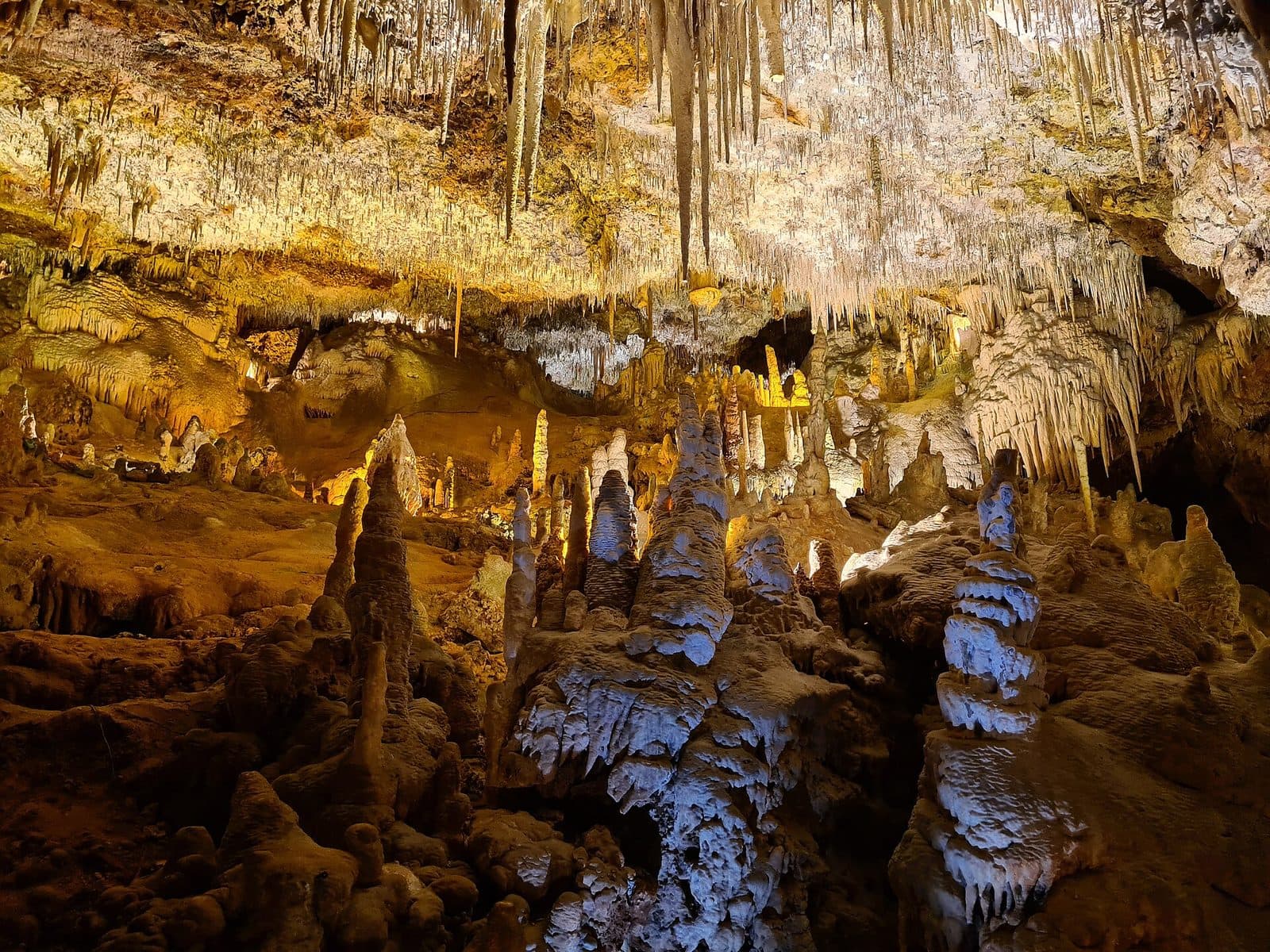

Coves dels Hams leads into a world where water and limestone determine the shapes. Stalactites hang from the ceiling like stone curtains, stalagmites grow up to meet them, and between them appear the distinctive curved formations that gave the caves their name. “Hams” means fishhooks in Mallorcan—a fitting description of the delicate, curved tips inside.
The show cave lies in eastern Mallorca near Porto Cristo and belongs to the Cala Anguila-Cala Mendia area. Its tour combines natural history with deliberately staged imagery: an open garden is followed by the Blue Cave, with a projection about Mallorca’s past, before the route continues through the twelve galleries of the Classic Cave to the underground lake “Mar de Venecia.” There, a music and light show creates a distinctly different atmosphere from the quiet stalactite chambers that precede it.
A visit is particularly worthwhile for travelers who want to experience Mallorca’s landscape beyond the coast. The cave reveals the variety of forms that limestone has taken beneath the island, but it is not a purely geological attraction. Film, colored lighting and music are expressly part of the concept. Anyone expecting a completely natural cave with only dim lighting should be aware of this; those who appreciate vivid staging will find a varied tour.
The site is also interesting for families because several very different stops follow one another. A visit does not take an entire day and can easily be combined with Porto Cristo or one of the coves near Cala Anguila and Cala Mendia. Even so, allow enough time: tours follow fixed time slots, and stairs and damp cave floors mean the route cannot be rushed at will.
History and significance
The discovery resulted not from a systematic cave expedition but from the search for a valuable stone. Pedro Caldentey Santandreu was looking for onyx in the area when he came across Coves dels Hams on 2 March 1905. In the dark chambers, he found not only imposing mineral formations but also the unusually curved shapes resembling fishhooks. This observation gave rise to the name still used today.
Pedro Caldentey and the discovery
Caldentey quickly recognized that the cave could be more than a chance geological find. Before it could be opened for tours, however, a fundamental problem had to be solved: there was no electric light underground. Only a few years after the discovery, he used a watermill, a dynamo and a pond to generate electricity for the lighting himself. This was remarkable because nearby Porto Cristo still had no electricity at the time. While the seaside town had to manage without electric light after dark, the first formations prepared for visitors were already illuminated underground.
This early technical development had a lasting influence on the character of Coves dels Hams. From the beginning, lighting was used to make visits possible. The concept was later developed further; today, the site also uses projections, colors and music. The progression from Caldentey’s self-generated electricity to the modern show cave can therefore be seen as part of its history.
From natural space to visitor cave
The chambers themselves are far older than their tourist use. Flowing water shaped the limestone cave system over a period of around ten million years. Mineral-rich drops deposited limestone layer by layer: on the ceilings as stalactites, on the floor as stalagmites and, where the two joined, as columns. Other deposits formed thin curtains or curved tips.
After the discovery, the system was gradually made accessible to visitors. Today, the experience does not consist of a single cave chamber but of three clearly distinct areas: the Round Cave, the Blue Cave and the Classic Cave. The Blue Cave, which has been part of the site since 2015, demonstrates in particular that the attraction continues to change. It expands the experience beyond simply viewing mineral formations by offering a cinematic approach to the history of Mallorca and its first inhabitants.
The significance of Coves dels Hams therefore lies both in its geological formations and in its long history as a show cave. Technical lighting made the underground natural environment accessible for tours. The experience still follows this fundamental idea today: nature is not merely displayed but made interpretable through light, storytelling and music.
What to see
The changing spaces create the strongest impression. Daylight first enters an open, planted area; shortly afterward, blue light and projections shape the experience. Only then does the Classic Cave unfold with its galleries, mineral columns and the dark water of “Mar de Venecia.” Those who look carefully will notice more than the large formations. The delicate, hook-shaped tips in particular explain why this cave has such an unusual name.
The Round Cave
The Round Cave is an open space that provides a gentle transition from the surface to the underground complex. Unlike the deeper areas, it receives natural light. Today’s garden uses this light to support lush vegetation, and various bird species native to Mallorca also live here freely. After the car park, entrance and bustle of visitors, this green area feels like a small world of its own.
The Round Cave also shows that a cave system does not have to consist entirely of narrow, completely dark passages. Where the ceiling is open, rock, plants and sky meet directly. The light changes throughout the day and highlights different surfaces from those emphasized by the artificial lighting inside. The garden is therefore clearly distinct from the stops that follow.
The Blue Cave
In the Blue Cave, staging takes the lead. The documentary “Discovering the Past” explores the history of Mallorca and the island’s first inhabitants. Projections cast images and colors across the rock surfaces, turning the natural wall itself into a screen. The cave has been part of the visitor experience since 2015.
This section looks beyond the shapes of the mineral formations alone. It places the cave within the island’s longer history while also preparing visitors for the more geologically focused part of the tour. The blue light alters the sense of space: projections stand out sharply, recesses disappear into shadow, and familiar rock shapes seem almost weightless for a moment.
The Blue Cave should not, however, be confused with a natural history museum. Its focus is an audiovisual narrative. Those primarily interested in seeing unaffected rock colors will find them less clearly visible here; visitors who appreciate projections as an introduction receive an accessible overview of the historical and geological context.
The Classic Cave
The Classic Cave forms the heart of the site. It consists of twelve galleries filled with alternating stalactites, stalagmites, columns and thin mineral curtains. Some formations appear massive and seem to support the ceiling, while others are delicate. Among them are the hook-shaped formations that gave the caves their name, with tips that do not simply point straight down but curve in surprising directions.
The tour thrives on changing lines of sight. Another chamber opens behind a column; elsewhere, the mineral formations gather into an almost solid wall. Artificial light traces individual edges and separates the foreground from the depths. This makes the cave appear larger in some places and narrower and more concentrated in others. It is worth looking beyond the largest columns to notice the thin deposits along the ceilings and rock edges.
Mineral formations result from a slow process of deposition. As water passes through limestone, it absorbs minerals and releases some of them when it enters a hollow chamber. Countless deposits gradually create the shapes visible today. The Classic Cave illustrates this process more vividly than any individual display panel: stalactites hang overhead, stalagmites rise beneath them, and joined columns show how the two directions of growth can eventually meet.
Mar de Venecia
At the underground lake “Mar de Venecia,” the Sea of Venice, the atmosphere changes again. The dark surface reflects light and rock while a music show fills the chamber with sound. Lighting and audio are coordinated with the cave setting; reflections on the lake appear to double some contours and blur the boundary between rock and water.
This performance is one of the best-known parts of the visit. It is not a quiet geological observation point but a deliberately theatrical climax. The echo of the music, the illuminated mineral formations and the underground lake create an overall effect distinctly different from the Blue Cave: there, projections tell a story; here, space, water, light and sound take center stage.
This contrast is particularly helpful in understanding Coves dels Hams. The site presents a genuine limestone cave but does not avoid modern show and entertainment elements. Its appeal lies in their coexistence: deposits millions of years old meet staging technology that has changed repeatedly since Pedro Caldentey installed his first electric lamps.
Visiting the caves
The tour cannot begin whenever visitors choose. On opening days, guided tours start every hour on the hour, so a fixed time slot determines the schedule. Booking in advance is advisable, especially when the cave visit forms part of a tightly planned day trip. Anyone arriving shortly after a tour begins may otherwise have to wait for the next one.
Time slots and planning your day
Coves dels Hams is open Wednesday to Sunday from 10 to 17; it remains closed on Monday and Tuesday. Admission is charged, but no reliable price is recorded and the current rate should be checked before visiting. The same applies particularly on public holidays or when seasonal changes may affect the actual availability of individual time slots.
Most visits last about one to two hours. This range reflects the combination of the guided schedule, film sequences, music show and routes between the different areas. It is not an all-day attraction, but a tightly scheduled stop does not do the experience justice either. In addition to the time spent in the caves, allow a buffer for registration, admission and a possible stay in the garden.
Crowds and the best time to visit
Tours in the middle of the morning can be in greater demand and may feel less peaceful. Those who want to view the mineral formations without another group following closely should choose an early slot near opening time or a later available tour where possible. The size of the booked group matters more than any single time of day. Booking early provides more choice.
Punctuality matters more for a tour organized by the hour than for a museum with unrestricted access. It is best not to enter the car park only when the hour begins. Arriving a little earlier allows time to find the entrance without rushing and means stairs or damp passages will not have to be negotiated under time pressure later.
Character of the tour
The visit is not a continuously quiet walk through a cave. In the Round Cave, the garden and daylight take center stage; in the Blue Cave, the focus is a documentary with projections; and in the Classic Cave, attention turns to the natural formations. A music and light show follows at “Mar de Venecia.” This sequence makes the tour varied but also means audiovisual elements have a permanent place in the experience.
Photography is permitted at the site. Consideration for other visitors remains important, however, especially when a group stops in a narrower area or a performance begins. Those taking photographs should also leave time to view the formations without a screen: the delicate hooks, crystal curtains and reflections on the water often become apparent only once the eyes have adjusted to the particular lighting.
Getting there and parking
Shortly before Porto Cristo, the Ma-4020 points the way into the underground world. Coves dels Hams lies along this route between Manacor and the east coast and is signposted locally. The stated distances and driving times initially lead to Cala Anguila-Cala Mendia; for the final section to the cave complex, follow local signs toward Porto Cristo and Coves dels Hams.
By car from Palma and the airport
From Palma Airport, the road distance to Cala Anguila-Cala Mendia is 63 kilometers. The journey takes around 55 minutes and follows the Ma-15, then the Ma-4020. From central Palma, the road distance is 66 kilometers, for which around 61 minutes should be allowed. This route also follows the Ma-15 and Ma-4020.
Both sets of directions explicitly end in Cala Anguila-Cala Mendia rather than directly at the cave entrance. From there, continue through the local road network to the signposted site near Porto Cristo. The Ma-4020 is the key reference point because the access road to Coves dels Hams lies along it. When planning the day, allow a small additional buffer beyond the driving time for the final section and registration before the booked tour.
Parking at Coves dels Hams
A free car park is located directly at the site. From there, access leads to the visitor areas with the ticket office, toilets, bar and restaurant, and souvenir shop. The complex also has a picnic area. These facilities are outside the actual cave tour and are most useful before admission or after returning to the surface.
By bus
The nearest stop is called “Dinosaurland - Coves Hams” and has the identifier 33046. It is located directly by the site and is therefore the most practical choice. Other stops listed in the area are “Mestral 1,” with the identifier 33078, “Mestral 2,” with 33079, and “Coves del Drac 2,” with 33017.
From Palma, TIB route 401 serves the “Dinosaurland - Coves Hams” stop. Alternatively, it is possible to travel by train to Manacor and continue by bus, although this requires a change. Because timetables can vary seasonally and cave admission is tied to time slots, the bus arrival and booked start should be coordinated with enough time between them.
Bus lines to Coves dels Hams at a glance
| Line | Route | Departures/day | First | Last |
|---|---|---|---|---|
| 401 | Cala Millor - Palma | 197 | 06:05 | 23:57 |
| A42 | Cala Bona - Aeroport | 166 | 00:02 | 23:02 |
| 427 | Cala Mendia - Portocristo | 144 | 08:00 | 22:30 |
| 424 | Cala Rajada - Portocristo | 129 | 00:05 | 23:56 |
| 425 | Cala Bona - Portocristo | 123 | 08:00 | 22:23 |
| 428 | Cala d'Or - Portocristo | 58 | 08:05 | 21:52 |
From the official GTFS feeds (TIB/SFM), no real-time data. The figures cover all stops in the town; weekend and holiday services differ — check with the operator before travelling.
Getting there by bus
Dinosaurland - Coves Hams (33046) · 0.4 km as the crow flies
- 401Cala Millor - Palma · Daily
Mestral 1 (33078) · 1.0 km as the crow flies
- 401Cala Millor - Palma · Daily
- 424Cala Rajada - Portocristo · Daily
- 425Cala Bona - Portocristo · Daily
- A42Cala Bona - Aeroport · Daily
Mestral 2 (33079) · 1.0 km as the crow flies
- 401Cala Millor - Palma · Daily
- 424Cala Rajada - Portocristo · Daily
- 425Cala Bona - Portocristo · Daily
- A42Cala Bona - Aeroport · Daily
Coves del Drac 2 (33017) · 1.3 km as the crow flies
- 427Cala Mendia - Portocristo · Daily
- 428Cala d'Or - Portocristo · Daily
Platja de Portocristo (33011) · 1.3 km as the crow flies
- 427Cala Mendia - Portocristo · Daily
- 428Cala d'Or - Portocristo · Daily
Coves del Drac 1 (33018) · 1.4 km as the crow flies
- 424Cala Rajada - Portocristo · Daily
- 425Cala Bona - Portocristo · Daily
- 427Cala Mendia - Portocristo · Daily
- 428Cala d'Or - Portocristo · Daily
Ctra. Son Servera 1 (33053) · 1.6 km as the crow flies
- 401Cala Millor - Palma · Daily
- 424Cala Rajada - Portocristo · Daily
- 425Cala Bona - Portocristo · Daily
- A42Cala Bona - Aeroport · Daily
Ctra. Son Servera 2 (33054) · 1.6 km as the crow flies
- 401Cala Millor - Palma · Daily
- 424Cala Rajada - Portocristo · Daily
- 425Cala Bona - Portocristo · Daily
- A42Cala Bona - Aeroport · Daily
Cala Anguila - Cala Magrana 1 (33051) · 1.8 km as the crow flies
- 427Cala Mendia - Portocristo · Daily
Cala Anguila - Cala Magrana 2 (33050) · 1.9 km as the crow flies
- 427Cala Mendia - Portocristo · Daily
Timetable data: official GTFS feeds (TIB/EMT), no real-time — check with the operator before travelling.
Nearby
After the subdued light of the caves, the blue of the east coast appears particularly clear. Cala Anguila-Cala Mendia is characterized by small coves, low rocky shores and vacation developments, making it a natural place to combine a cave visit with time by the sea. Coves dels Hams itself is closer to Porto Cristo; however, the stated travel details refer to Cala Anguila-Cala Mendia, from where the final section follows the local road network.
Cala Anguila and Cala Mendia
Cala Anguila lies between two rocky headlands and has a fine sandy beach. The sheltered shape of the cove makes it an obvious destination for a swim after the cave tour. Cala Mendia also offers sand and generally calm water; during the high season, it is busier and finding a parking space can be more difficult.
The contrast is the main reason to combine them. Underground, limestone, artificial light and echoes shape the experience; on the coast, the sky and sea open out before you. As a cave visit usually takes about one to two hours, suitable weather leaves enough time for one of the coves. Which comes first depends on the booked time slot: before a fixed cave appointment, beach time should not be scheduled so tightly that finding parking and changing clothes becomes stressful.
Porto Cristo
Porto Cristo is the most important point of reference close to Coves dels Hams. The harbor town is suitable for a waterside walk or a meal before or after the guided tour. From there, the cave complex can be reached quickly via the Ma-4020; a taxi or bus is also an option for the short final section.
Porto Cristo is also home to Coves del Drac. The two cave complexes should not be confused: Coves dels Hams has its own three visitor areas, the twelve galleries of the Classic Cave and the lake “Mar de Venecia.” Anyone wishing to see both on the same day must coordinate the respective admission times carefully. In terms of the experience, it is generally more rewarding to give one cave sufficient attention rather than rushing through two consecutive tours.
Dinosaurland
The name of the nearby bus stop, “Dinosaurland - Coves Hams,” already points to another attraction in the immediate area. For families, combining the two destinations can be practical because no long transfer is required. Combination tickets are offered, but their scope, availability and current price should be checked in advance.
Such a double excursion has a different focus from combining the caves with a cove: the cave presents genuine geological history and mineral formations, while Dinosaurland functions as a family-oriented themed attraction. Anyone also wishing to visit the sea afterward should avoid planning the day too tightly; around one to two hours is realistic for Coves dels Hams alone, including admission and the tour.
The place it belongs to
Cala Anguila-Cala Mendia in the place guidePractical information for your visit
Underground, secure footing matters more than elegant vacation clothing. The tour includes stairs and sections of damp cave floor. Closed shoes with good grip are therefore the most sensible choice. Sandals with smooth soles, loose-fitting shoes or wet water shoes are less suitable for the conditions—especially when the visit is combined directly with a day at the beach.
Clothing and equipment
Large amounts of equipment are unnecessary; keeping your hands free on stairs and securely storing a phone or camera are more important. Photography is permitted, but the lighting conditions vary considerably. Daylight enters the Round Cave, projections dominate the Blue Cave, and focused lighting is used in the Classic Cave. Reflections are added at “Mar de Venecia.” Instead of viewing every room through a bright screen, allow your eyes a moment to adjust to the darkness—only then do delicate mineral formations and the spatial depth become clearer.
Visiting with children
The sequence of garden, film, limestone cave and music show offers more visual variety than a purely geological tour. Projections, unusual hook formations and the underground lake are among the most vivid stops. At the same time, the cave is not an adventure playground where children can roam freely. Younger children should be closely supervised on stairs and damp sections.
A punctual, pre-booked time slot helps families avoid unnecessary waiting. Toilets and food options are available outside the cave before or after the tour. For a longer family day, the visit can be combined with Dinosaurland or one of the coves near Cala Anguila and Cala Mendia; the fixed starting time of the cave tour should determine the day’s schedule.
What to expect—and what not to expect
Coves dels Hams is a staged show cave. Colored lighting, a documentary, projections and music are all part of the program rather than occasional additions. Anyone seeking only unaltered rock colors, silence and a freely chosen route will encounter a different visitor concept here. Yet the combination of natural formations and stage technology has been part of the cave’s identity since the earliest experiments with electric lighting.
Nor is this an all-day expedition or a sporting cave tour. Visitors follow a developed route through named areas. The real highlights lie in careful observation: the curved “fishhooks,” thin mineral curtains, joined columns and reflections on the underground lake. Those who take time to appreciate them will gain more from the experience than anyone simply waiting for the next presentation.
Facilities before and after the tour
The site has public toilets, free Wi-Fi, a bar with a restaurant, a souvenir shop, a picnic area and a botanical garden. Parking is also free. These facilities make a visit easier for those traveling from farther away, but they should not be confused with the actual admission time: the cave tour begins according to its time slot, not as soon as visitors reach the site.
Before the return journey, the open garden can provide a peaceful conclusion. Here, plants, natural light and native bird species meet the rock walls of the Round Cave. After projections, music and artificially highlighted mineral formations, this final impression leads back to the surface—and once again reveals how differently light can make the same limestone appear.
Local insider tips
Look for the hooks
Do not look only at the large columns: the “Hams” that gave the caves their name are delicate, curved formations resembling fishhooks. The ceilings and rock edges are especially worth a second look.
Avoid the middle of the morning
Tours in the middle of the morning can be busier. An early slot near opening time or a later available tour often provides more peace for viewing the mineral formations and reflections.
Do not just walk through the garden
The Round Cave is more than an entrance: daylight, the garden and free-living native bird species create a counterpoint to the artificially illuminated galleries. It is worth pausing here deliberately.
Combine the cave with a cove
After the underground tour, Cala Anguila or Cala Mendia is a natural choice for spending time by the sea. Plan the beach visit around the cave’s fixed time slot, not the other way around.
Choose the direct bus stop
For travel by bus, “Dinosaurland - Coves Hams” is the most practical stop because it is located directly by the site. This leaves only a short walk between the bus arrival and the hourly admission.