
Creu de Can Vicó in Algaida
_-_1.jpg)
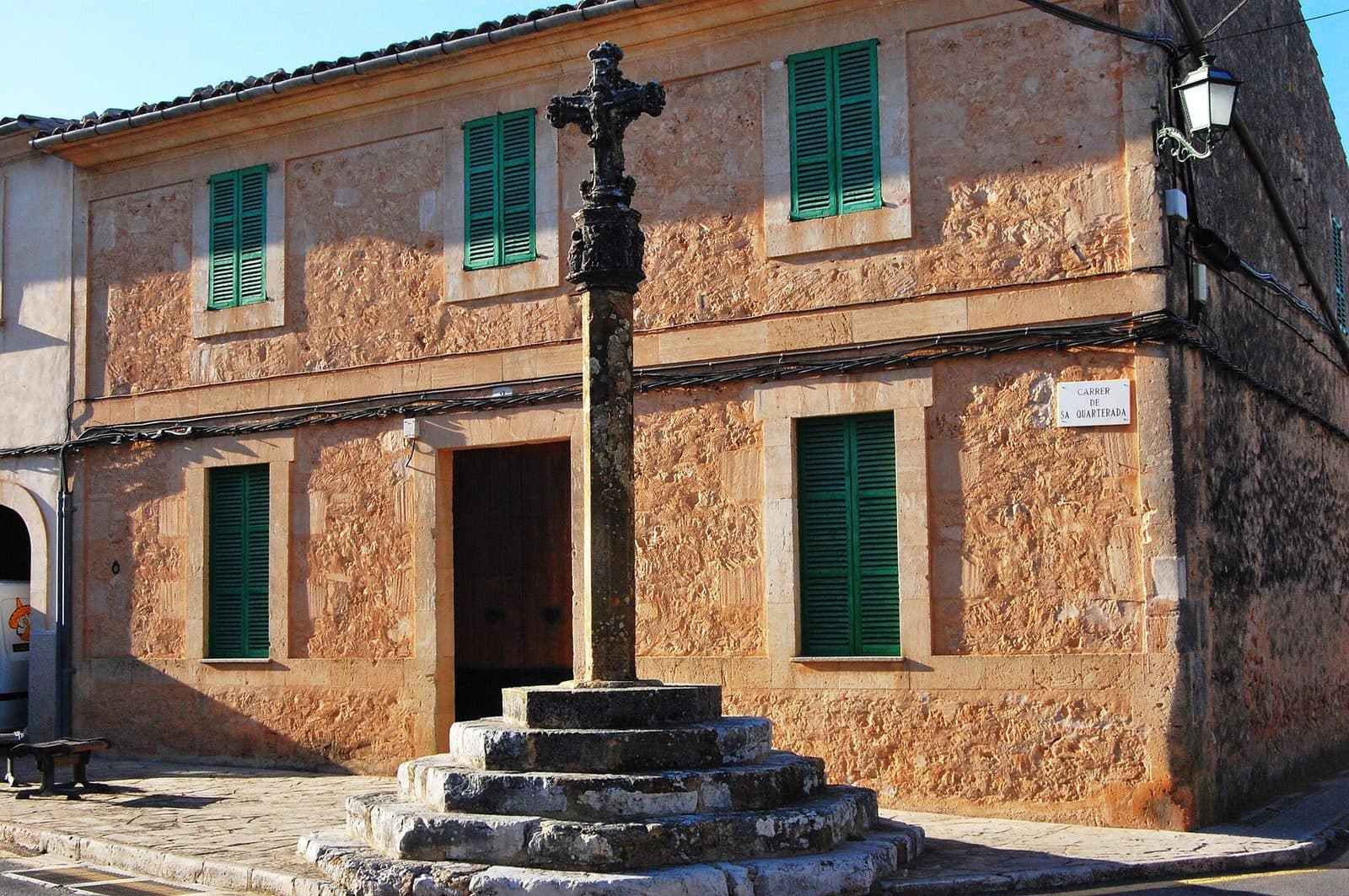
At the junction of Carrer de Palma and Carrer de sa Quarterada stands a piece of Algaida’s local history that is easy to overlook. Creu de Can Vicó is a historic stone cross set within the everyday streetscape. This is precisely where its appeal lies: the monument reveals how closely religious symbols, old routes and the development of a Mallorcan village were once connected.
Travellers heading only for the famous monasteries on Puig de Randa often pass by such traces of the island’s history. Yet Algaida’s village crosses reveal a great deal about the community’s former layout within a small area: they marked entrances, accompanied routes and made Christian symbolism visible even before people entered the more compact village centre. Creu de Can Vicó belongs to a group of historic crosses that remain scattered along different streets in Algaida today.
A visit is especially worthwhile for travellers who want to discover Mallorca through more than monumental churches and castles. The cross is not a sight that requires a long tour; its significance emerges through careful observation and its location. Anyone who then continues walking through Algaida will see that it is not an isolated ornament but part of an evolving cultural landscape of parish church, lanes, village crosses and former windmills.
As a protected cultural asset, Creu de Can Vicó is listed as a Bien de Interés Cultural. This status suits a monument whose value lies less in its size or spectacular decoration than in its historical message: it has endured the changes around it and, at a present-day road junction, preserves the memory of an older concept of village boundaries and routes.
History and Significance
Before Algaida developed into a compact village, people in the Castellitx area lived across numerous rural settlements, farms and smaller communities. Towards the end of the 13th century, the population became increasingly concentrated in Algaida, Pina and Randa. Algaida developed into the most important centre, while other older settlements lost significance and population. The village subsequently became more firmly established, and the ecclesiastical centre also shifted from Castellitx to Algaida.
The tradition of village crosses belongs to this long period of development. As a village grew, its entrances became more clearly perceived and defined. A stone cross beside a route was simultaneously a religious symbol, a visible landmark and a symbolic threshold. It stood where people arrived, left the village or moved between roads and paths. Unlike an altarpiece, such a cross was not confined to the interior of a church but brought a religious symbol into the movement of everyday life.
A Cross at the Village Entrance
Creu de Can Vicó stands where Carrer de sa Quarterada joins Carrer de Palma. The name of the latter street itself points to the connection towards the island’s capital and directly links the monument to Algaida’s road network.
The Village Crosses of Algaida
Creu de Can Vicó belongs to a group of historic village crosses. Five historic village crosses are recorded in Algaida. Alongside Can Vicó, these include Creu d’en Massot on Carrer de la Ribera, Creu des Colomer and Creu de s’Hostal d’en Gi, which is also called Creu des Traginers. Outside the village centre stands Creu de Binicomprat, also known as Creu del Cementeri Vell and Creu dels Apestats.
This distribution turns the crosses into a kind of historical trail through Algaida. Each stands beside a different route or entrance, and together they trace former directions of movement. Creu de Can Vicó therefore derives its significance not only from its own structure but also from its position within this group. Anyone who visits several of the crosses will discover a dispersed ensemble that continues to form part of the village landscape.
Protected Cultural Heritage
Its designation as a Bien de Interés Cultural emphasises that Creu de Can Vicó is more than a religious detail beside the road. It protects a historic artefact where settlement history, religious practice and the course of old routes intersect. Its meaning depends substantially on its location: viewing the cross separately from the road junction would remove part of its significance.
It is precisely this relationship between object and place that makes the monument’s heritage value clear. Creu de Can Vicó does not commemorate a single battle, ruler or spectacular event. Instead, it represents recurring journeys, everyday arrivals and the religious character of public space. This is a quieter form of history, but one that remains understandable at the cross’s present location.
What to See
The first impression is deliberately simple: stone, a raised base and the cross above it. Creu de Can Vicó has to be read within the streetscape. From a few steps away, visitors can first take in its overall form; closer up, its construction, proportions and the transition between the base and cross come into focus.
Creu de Can Vicó
The monumental stone cross itself is the main attraction. Its upright form stands out against the horizontal lines of the neighbouring streets and houses. When examining it, however, it is worth looking beyond the upper part of the cross. Algaida’s village crosses are monumental stone crosses rising above a plinth or stepped base and can belong to different typologies. Stone defines the monument’s appearance.
Plinth and Steps
Mallorcan village crosses of this type rise above a plinth or stepped base. This substructure visibly separates the religious symbol from the ordinary street surface. At the same time, it supports the slender upper section and enhances its effect without requiring a massive architectural volume.
The location offers a good opportunity to observe how important this progression of height is. The eye moves from the lower steps across the supporting structure and upwards. In this way, a single stone symbol becomes a small but clearly articulated monument. The steps should not be confused with a grand staircase leading into a building; they are part of the architectural presentation of the cross itself.
Photographers should avoid cropping out the substructure. Only when seen together with the base does it become clear how the monument is anchored in the streetscape. A close-up of the head of the cross may document the symbol, but it loses the relationship with the ground and therefore an essential part of the monument’s form.
Carrer de Palma and sa Quarterada
The junction is not an incidental backdrop but part of the monument. Creu de Can Vicó stands where Carrer de Palma and Carrer de sa Quarterada meet. From one direction, visitors approach along Carrer de Palma; from the other, they arrive from an area of Algaida where former windmills also form part of the traditional village landscape.
A brief change of position therefore alters the impression considerably. Close up, the stone dominates; from farther away, the course of the routes comes into view. A particularly informative perspective includes both the cross and the branching streets. It then becomes clear that it was not designed like a sculpture on an enclosed square but as a marker at a point of transition.
The Monument as Part of an Ensemble
Creu de Can Vicó is best understood by comparing it mentally with Algaida’s other village crosses. They all follow the same basic idea: a permanent religious symbol is placed at an entrance or waypoint. Differences in location, setting and name nevertheless give each cross its own identity.
At Can Vicó, the position on Carrer de Palma is particularly defining. Creu des Traginers is also called Creu de s’Hostal d’en Gi; Creu des Colomer and Creu d’en Massot mark other parts of the village. Together they preserve a historical topography that is not concentrated in a single square.
For a walking tour, this means that Creu de Can Vicó is both a monument in its own right and a starting point for following a historical trail. A single stop conveys its form and location, while visiting several crosses in succession makes the former network of village entrances easier to understand. Visitors interested in settlement patterns and everyday history will gain more from this comparison than from viewing the cross in isolation.
Visiting Creu de Can Vicó
A visit begins by looking carefully at an ordinary road junction. Creu de Can Vicó is a destination for focused observation. It makes sense to take in the complete form from a short distance first and then move closer to the base, provided the traffic situation allows this safely.
A Short Stop with Historical Context
Anyone wishing to understand the base, the position between the streets and the relationship with the old village boundary should combine the stop with a walk through Algaida. Its true significance only emerges when compared with the buildings and other historic sites in the village. Visitors interested in cultural history can use the cross as the starting point for a longer village walk, while travellers heading to Randa may prefer it as a deliberate stop along the way. The time spent matters less than the willingness to examine the location rather than only the stone object.
Light and Road Traffic
Daylight is best for appreciating the cross’s form. It makes the structure and stepped base easier to see and allows the cross to be photographed together with the junction. No reliable information is available about particularly busy or quiet times.
Taking care around moving traffic is more important than searching for a supposedly perfect time to take photographs. The most interesting viewpoint is not necessarily directly beside the cross. A side view with the streets in the background often explains its historical purpose more effectively and allows visitors to view the monument without stepping dangerously into the road.
Opening Hours and Admission
No confirmed opening hours or admission details are recorded for Creu de Can Vicó. It is therefore advisable to check current local information before visiting. Its appeal lies in the immediate encounter with a historic monument within the village streetscape.
Visitors who want to get more from the stop can make Creu de Can Vicó the first stage of a themed walk. Together, the other village crosses, the parish church and the windmills offer an accessible cross-section of Algaida’s history. A small monument thus becomes the starting point for a route on which the village’s development can be read step by step.
Getting There
Algaida is conveniently located in the centre of the island. The stated distances and driving times lead to the village, not directly to the base of Creu de Can Vicó. For the final section, follow signs or directions within Algaida to Carrer de Palma and its junction with Carrer de sa Quarterada.
From Palma Airport
From Palma Airport, the route to Algaida follows the Ma-5010. The road distance is 28 kilometres, and the journey takes around 31 minutes. This information applies only as far as Algaida. Within the village, continue towards Carrer de Palma; the cross stands where Carrer de sa Quarterada joins it.
From Palma
From central Palma, the route follows the Ma-15. The road distance to Algaida is 31 kilometres, and the journey takes around 38 minutes. Here too, the distance and journey time refer to the village of Algaida. The final streets within the village lead to Carrer de Palma and then to the junction with sa Quarterada.
Travelling from Palma works well for an excursion that does not end at the cross. After visiting it, travellers can continue through Algaida or head towards Randa. Anyone wishing to see several historic village crosses should explore the village centre on foot rather than driving to each individual location.
By Bus
The Ses Escoles and S’Hostal stops are within the Algaida village area. From there, Creu de Can Vicó can be reached on foot through the village streets. Check current services before travelling, as routes and frequencies are unrelated to the monument and may change.
The walk through the village is not merely the final stage of the journey, as it leads through the settlement whose historic entrances were once marked by the village crosses. Visitors arriving from the direction of S’Hostal can also include Creu des Traginers in their route and compare two different points in the old network of roads.
Bus lines to Creu de Can Vicó at a glance
| Line | Route | Departures/day | First | Last |
|---|---|---|---|---|
| 403 | Campos - Algaida - Palma | 92 | 06:45 | 21:50 |
| A42 | Cala Bona - Aeroport | 84 | 00:15 | 23:25 |
| 432 | Sineu - Algaida | 72 | 06:45 | 21:55 |
| 401 | Cala Millor - Palma | 42 | 00:50 | 23:52 |
| 431d | Algaida - Llucmajor | 8 | 09:10 | 17:30 |
From the official GTFS feeds (TIB/SFM), no real-time data. The figures cover all stops in the town; weekend and holiday services differ — check with the operator before travelling.
Getting there by bus
Ses Escoles 2 (4016) · 0.5 km as the crow flies
- 403Campos - Algaida - Palma · Daily
- 431dAlgaida - Llucmajor · Mon-Fri
- 432Sineu - Algaida · Daily
Ses Escoles 1 (4020) · 0.5 km as the crow flies
- 403Campos - Algaida - Palma · Daily
S'Hostal 1 (4015) · 0.9 km as the crow flies
- 401Cala Millor - Palma · Daily
- A42Cala Bona - Aeroport · Daily
S'Hostal 2 (4008) · 0.9 km as the crow flies
- 401Cala Millor - Palma · Daily
- A42Cala Bona - Aeroport · Daily
Sa Talaieta (4004) · 1.1 km as the crow flies
- 403Campos - Algaida - Palma · Daily
Alorda (4011) · 1.3 km as the crow flies
- 403Campos - Algaida - Palma · Daily
Timetable data: official GTFS feeds (TIB/EMT), no real-time — check with the operator before travelling.
Nearby Sights
Algaida is not defined by a single main attraction. Its character comes from a succession of small historical details: a cross at a junction, a windmill above the rooftops and the parish church in the established centre. Creu de Can Vicó is therefore a good starting point for experiencing the village not simply as somewhere to pass through but as a connected historical landscape.
Algaida’s Other Village Crosses
The most direct option is to combine the visit with Algaida’s other historic crosses. Creu d’en Massot stands on Carrer de la Ribera, Creu des Colomer on the street named after it and Creu des Traginers on the route connecting Algaida with Pina. Outside the village stands Creu de Binicomprat, whose other names refer to an old cemetery and victims of the plague.
It is enough to understand these locations as stops within the same historic system. Rather than simply photographing each cross separately, compare their positions beside the roads: which route did each one mark, how has the surrounding development changed, and does the location still feel like the edge of the village? Questions like these make a walk through Algaida unusually informative.
Parish Church of Sant Pere i Sant Pau
Algaida’s parish church forms the ecclesiastical counterpart to the crosses beside the roads. While Creu de Can Vicó brings religious symbolism into the public streetscape, the church represents the established spiritual centre of the village. Its architectural history extends across several periods, and Gothic and Baroque works are preserved inside.
This connection is particularly useful for understanding Creu de Can Vicó. The route from the village cross to the church symbolically follows the movement from the entrance towards the centre. Even without a fully reconstructed historic procession route, it becomes clear how religious symbols shaped the entire village rather than being concentrated only within the church building.
Windmills and sa Quarterada
Algaida preserves a remarkable group of former windmills. Several stand on or near Carrer de sa Quarterada, including Molí des Sant and Molí d’en Mostatxet. As Creu de Can Vicó stands directly where this street joins Carrer de Palma, visitors can move from a religious monument to rural economic history without a major thematic leap.
The windmills are privately owned and should therefore be viewed from public areas. They recall an economic landscape in which agriculture, storage and domestic life were closely connected. Together with the village cross, they reveal two different sides of the same village: the symbolic ordering of its routes and the practical work that shaped Algaida over a long period.
Randa and Puig de Randa
South of Algaida rises Puig de Randa with its religious sites. An excursion there can easily be combined with a stop in the village without reducing Creu de Can Vicó to a mere stopover. On the contrary, the small village cross and the sanctuaries on the mountain illustrate two very different scales of religious culture in Mallorca.
In Algaida, it appears directly at a road junction; on Puig de Randa, it shapes an entire mountain. Visiting both in succession gives a broader impression of how faith, routes and landscape were historically connected on the island. For Creu de Can Vicó itself, however, the village setting remains essential: its place is not on a summit with panoramic views but in the middle of a road network used for centuries.
Local insider tips
Include the Junction in Your Photo
Do not photograph only the head of the cross: a side view that includes Carrer de Palma and sa Quarterada explains its historic purpose as a marker at an entrance much more effectively.
Follow the Crosses Through Algaida
Can Vicó belongs to a group of historic village crosses. A walk to Creu d’en Massot, Creu des Colomer and Creu des Traginers reveals the village’s former network of routes.
Continue Along Sa Quarterada
Historic windmills also stand along Carrer de sa Quarterada, including Molí des Sant and Molí d’en Mostatxet. This makes it easy to combine local history with the village’s former world of work.
From the Village Edge to the Church
The route from Creu de Can Vicó to the parish church of Sant Pere i Sant Pau clearly illustrates the layout of the historic village: from the stone marker at the entrance to the ecclesiastical centre.
Stop in Algaida Before Randa
Anyone travelling to Puig de Randa should not simply pass through the village. Creu de Can Vicó reveals everyday religious culture within the streetscape and provides an informative contrast with the sanctuaries on the mountain.